Want more images or videos?
Request additional images or videos from the seller
1 of 9

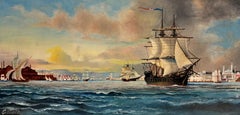
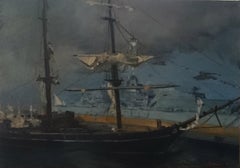
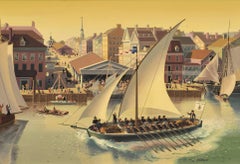
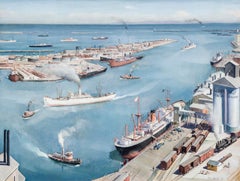
Robert Salmon
Whitehaven Quay

Dated 1826

Price:$22,000
$27,500List Price

You May Also Like

46: Folkstone Harbour

46: Folkstone Harbour

Located in Columbia, MO

Edward William Cooke was born in Pentonville. His father, George Cooke, and uncle William Bernard Cooke were also well-known line engravers. Growing up in an environment of artists,...

Category

1820s Naturalistic Landscape Prints

Materials

Etching

"Fantasy harbour view"

"Fantasy harbour view"

Located in Edinburgh, GB

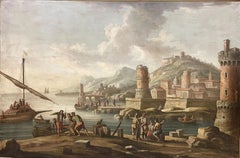
Orasio Giovanni Grevenbroeck (Active 17th-18th Century) – "Fantasy Harbour View" Medium: Oil on canvas Dimensions (Framed): 154 x 238 cm Dimensions (Flat): 153 x 234 cm Frame: Elegant period-style frame Description: This grand-scale maritime painting by Orasio Giovanni Grevenbroeck, an artist active in Italy and France between the 17th and 18th centuries, presents an idealized harbor scene, skillfully blending architectural fantasy and daily coastal life. The painting is not signed. The composition unfolds with bustling activity at the water’s edge, where merchants, sailors, and laborers engage in trade, unloading barrels, and negotiating transactions. The fortified port city, crowned with cylindrical towers, elegant bridges, and hillside settlements, suggests an imaginary Mediterranean or Adriatic setting, characteristic of Grevenbroeck’s capriccio-style harbor views. His atmospheric perspective and luminous palette capture the soft morning light, casting delicate shadows across the calm waters and rugged shoreline. The detailed rendering of maritime vessels, animated figures, and classical architecture reflects the Baroque and Rococo fascination with seascapes and exoticized urban vistas. A highly decorative and historically significant piece, "Fantasy Harbour View" is an exceptional example of 17th-18th century European maritime painting, ideal for collectors of Old Master seascapes...

Category

18th Century Realist Figurative Paintings

Materials

Canvas, Oil

Harbor Scene

William Moore DavisHarbor Scene

$16,000

H 24.5 in W 32.25 in D 2.5 in

Harbor Scene

Located in Milford, NH

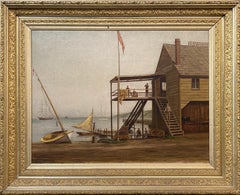
A nicely detailed view of a harbor by American artist William Moore Davis (1829-1920). Davis was born in Setauket, New York, and spent most of his life painting and living in the area he loved best, Port Jefferson, Long Island. There he befriended renowned genre painter William Sidney Mount...

Category

19th Century Landscape Paintings

Materials

Canvas, Oil

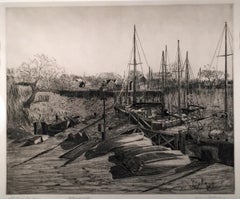
In the Harbor

Earl HorterIn the Harbor

$650

H 7.5 in W 12 in D 1 in

In the Harbor

By Earl Horter

Located in Wiscasset, ME

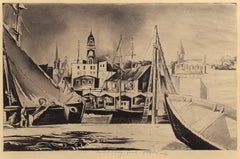
Born in Germantown, Pennsylvania, Earl Horter was a self-taught artist who began his career working in New York City as a draftsman at an advertising agenc...

Category

1920s Modern Landscape Prints

Materials

Aquatint

20th Century Oil - Harbour Scene

20th Century Oil - Harbour Scene

Located in Corsham, GB

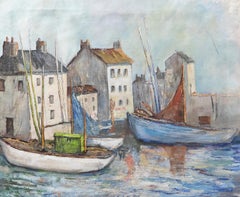
An impressionistic harbour scene in oil, complete with fine black outlining to the sea-side houses and fishing boats. A second artwork can be seen to the reverse of the oil,- A Still...

Category

20th Century Figurative Paintings

Materials

Oil

Huge British Marine Oil Painting Shipping off Busy Trading City Port Harbour

Huge British Marine Oil Painting Shipping off Busy Trading City Port Harbour

Located in Cirencester, Gloucestershire

Off the Coastline by G. Selby (British, second half 20th century) signed oil on canvas, unframed canvas: 20 x 40 inches Provenance: private collection, England Condition: very good c...

Category

Mid-20th Century English School Landscape Paintings

Materials

Oil

Brest - Frégate de Grasse

Jacques ROHAUTBrest - Frégate de Grasse

$9,360

H 31.89 in W 39.37 in D 2 in

Brest - Frégate de Grasse

By Jacques ROHAUT

Located in Atlanta, GA

Official Painter of the Navy appointed in 2010. Official Painter of the Armies appointed in 2000. Official Painter of Air and Space appointed in 1996. It was friendship and then the discovery of the art of painting that prompted Jacques Rohaut to visit Philippe Lejeune's studio in Etampes in the 1970s during his law studies. He also worked for a restorer of paintings. Emulation within what has become the "Etampes School" allowed him to continue the necessary learning before making many personal exhibitions: the first in 1984, at the Taylor Foundation (Paris), then at the Orangerie de Villeroy, at the VIP lounge for ministerial air links in Villacoublay, in Düsseldorf, at the Saint-Roch gallery (Paris), at the Musée de l'Ordre des Avocats (Hôtel de la Porte in Paris), at the Hôtel du Conseil Général d'Eure et Loire (Chartres), in the Jehan de Beauce tower of Chartres cathedral, at the Etampes Museum, at the Inès Bonlieu gallery, Guest of honor at several Salons in the provinces, he also regularly participates in major Parisian Salons: French Artists, Autumn, Comparisons. His profession as a lawyer practiced in Paris for thirty years, within the firm Ader Jolibois, inspired him many paintings of which the judicial life and the courthouses were the pretext; his country of birth, Morocco, allowed him to rediscover the lights that usually make up his paintings; the air and the sea are another source of inspiration. Among the main distinctions he has received: Bronze medal at the Salon de la Marine, Gold medal at the Salon des Artistes Français, Prix de la Fondation André et Berthe Noufflard...

Category

21st Century and Contemporary Modern Landscape Paintings

Materials

Oil

Harbor Scene

Simon GrecoHarbor Scene

$4,500

H 12.5 in W 16 in

Harbor Scene

By Simon Greco

Located in Fort Washington, PA

Medium: Gouache on Board Dimensions: 12.50" x 16.00" Signature: Signed Lower Right

Category

20th Century Landscape Paintings

Materials

Gouache, Board

San Pedro Harbor

Paul SampleSan Pedro Harbor, 1937

$275,000

H 30 in W 40 in

San Pedro Harbor

By Paul Sample

Located in New York, NY

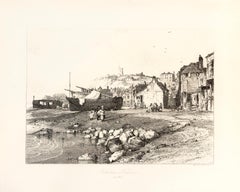
It is infrequent, to say the least, that a diagnosis of tuberculosis proves fortuitous, but that was the event, in 1921, that set Paul Starrett Sample on the road to becoming a professional artist. (The best source for an overview of Sample’s life and oeuvre remains Paul Sample: Painter of the American Scene, exhib. cat., [Hanover, New Hampshire: Hood Museum of Art, 1988] with a detailed and definitive chronology by Sample scholar, Paula F. Glick, and an essay by Robert L. McGrath. It is the source for this essay unless otherwise indicated.) Sample, born in Louisville, Kentucky, in 1896 to a construction engineer and his wife, spent his childhood moving with his family to the various locations that his father’s work took them. By 1911, the family had landed in Glencoe, Illinois, settling long enough for Paul to graduate from New Trier High School in 1916. Sample enrolled at Dartmouth College, in Hanover, New Hampshire, where his interests were anything but academic. His enthusiasms included the football and basketball teams, boxing, pledging at a fraternity, and learning to play the saxophone. After the United States entered World War I, Sample, to his family’s dismay, signed on for the Naval Reserve, leading directly to a hiatus from Dartmouth. In 1918 and 1919, Sample served in the U.S. Merchant Marine where he earned a third mate’s license and seriously contemplated life as a sailor. Acceding to parental pressure, he returned to Dartmouth, graduating in 1921. Sample’s undergraduate life revolved around sports and a jazz band he formed with his brother, Donald, two years younger and also a Dartmouth student. In November 1933, Sample summarized his life in a letter he wrote introducing himself to Frederick Newlin Price, founder of Ferargil Galleries, who would become his New York art dealer. The artist characterized his undergraduate years as spent “wasting my time intensively.” He told Price that that “I took an art appreciation course and slept thru it every day” (Ferargil Galleries Records, circa 1900–63, Archives of American Art, Smithsonian Institution, available on line). In 1920, Donald Sample contracted tuberculosis. He went for treatment to the world-famous Trudeau Sanitorium at Saranac Lake, in New York State’s Adirondack Mountains for the prescribed regimen of rest, healthful food, and fresh air. Visiting his brother in 1921, Paul also contracted the disease. Tuberculosis is highly contagious, and had no certain cure before the development of streptomycin in 1946. Even for patients who appeared to have recovered, there was a significant rate of recurrence. Thus, in his letter to Price, Sample avoided the stigma conjured by naming the disease, but wrote “I had a relapse with a bad lung and spent the next four years hospitalized in Saranac Lake.” The stringent physical restrictions imposed by adherence to “the cure” required Sample to cultivate an alternate set of interests. He read voraciously and, at the suggestion of his physician, contacted the husband of a fellow patient for instruction in art. That artist, then living in Saranac, was Jonas Lie (1880–1940), a prominent Norwegian-American painter and an associate academician at the National Academy of Design. Lie had gained renown for his dramatic 1913 series of paintings documenting the construction of the Panama Canal (The Metropolitan Museum of Art, New York; United States Military Academy, West Point, New York). Primarily a landscape artist, Lie had a particular affinity for scenes with water. His paintings, impressionistic, atmospheric, and brushy, never strayed from a realistic rendering of his subject. Sample regarded Lie as a mentor and retained a lifelong reverence for his teacher. Sample’s early paintings very much reflect Lie’s influence. ` In 1925, “cured,” Sample left Saranac Lake for what proved to be a brief stay in New York City, where his veteran’s benefits financed a commercial art course. The family, however, had moved to California, in the futile hope that the climate would benefit Donald. Sample joined them and after Donald’s death, remained in California, taking classes at the Otis Art Institute in Los Angeles. In Sample’s account to Price, “I couldn’t stomach the practice of painting a lot of High Sierras and desert flowers which seemed to be the only kind of pictures that were sold here so I got a job teaching drawing and painting at the art school of the University of Southern California.” Initially hired as a part-time instructor, Sample progressed to full-time status and ultimately, by the mid-1930s, to the post of Chairman of the Fine Art Department. Sample, however, did not want to wind up as a professor. “Teaching is all right in small doses,” he wrote, “but I have a horror of drifting into being a college professor and nothing more.” At the same time as he taught, Sample began to exhibit his work in a variety of venues at first locally, then nationally. Though he confessed himself “a terrible salesman,” and though occupied with continued learning and teaching, Sample was nonetheless, ambitious. In 1927, he wrote in his diary, “I am eventually going to be a painter and a damned good one. And what is more, I am going to make money at it” (as quoted by Glick, p. 15). In 1928, Sample felt sufficiently solvent to marry his long-time love, Sylvia Howland, who had also been a patient at Saranac Lake. The Howland family were rooted New Englanders and in summertime the Samples regularly traveled East for family reunion vacations. While the 1930s brought serious hardship to many artists, for Paul Sample it was a decade of success. Buttressed by the financial safety net of his teacher’s salary, he painted realist depictions of the American scene. While his work addressed depression-era conditions with a sympathetic eye, Sample avoided the anger and tinge of bitterness that characterized much contemporary realist art. Beginning in 1930, Sample began to exhibit regularly in juried exhibitions at important national venues, garnering prizes along the way. In 1930, Inner Harbor won an honorable mention in the Annual Exhibition of the Art Institute of Chicago. That same year Sample was also represented in a show at the Albright-Knox Gallery in Buffalo and at the Biennial Exhibition of the Corcoran Gallery of Art, Washington, D.C. In 1931, Dairy Ranch won the second Hallgarten Prize at the Annual Exhibition of the National Academy of Design, in New York. Sample also made his first appearances at the Carnegie Institute, Pittsburgh, and The Pennsylvania Academy of the Fine Arts, Philadelphia. In 1936, Miner’s Resting won the Temple Gold Medal at the Pennsylvania Academy’s Annual Exhibition. Always interested in watercolor, in 1936, Sample began to send works on paper to exhibitions at the Whitney Museum, New York. While participating in juried exhibitions, Sample also cultivated commercial possibilities. His first New York art dealer was the prestigious Macbeth Gallery in New York, which included his work in a November 1931 exhibition. In 1934, Sample joined the Ferargil Galleries in New York, after Fred Price arranged the sale of Sample’s Church Supper to the Michele and Donald D’Amour Museum of Fine Arts in Springfield, Massachusetts. In 1937, The Metropolitan Museum of Art purchased Sample’s Janitor’s Holiday from the annual exhibition of the National Academy of Design, a notable honor. As prestigious as this exhibition schedule may have been, by far Sample’s most visible presence in the 1930s and 1940s was the result of his relationship with Henry Luce’s burgeoning publishing empire, Time, Inc. Sample’s first contribution to a Luce publication appears to have been another San Pedro...

Category

20th Century American Modern Landscape Paintings
Materials

Canvas, Oil

STERLING HARBOUR

Joan JohnsSTERLING HARBOUR

$675

H 24 in W 28 in

STERLING HARBOUR

Located in Portland, ME

Johns, Joan. STERLING HARBOUR. Etching, not dated, but probably 1950s-60s. titled, inscribed "Artist's Proof," and signed in pencil. Printed on heavy wove paper. 19 1/4 x 23 5/8 inch...

Category

1950s Landscape Prints

Materials

Etching

More From This Seller

View All
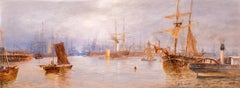
Harbor Scene

Harbor Scene

Located in Costa Mesa, CA

This highly detailed harbor scene features many ships of various types, something British Royal Naval officer and artist Commander Charles Lodder would have seen in his everyday life...

Category

1870s Other Art Style Paintings

Materials

Paper, Watercolor

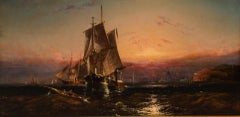
New York Harbor Near Castle Garden

New York Harbor Near Castle Garden

By Elisha Taylor Baker

Located in Costa Mesa, CA

In this atmospheric and luminous work by E.T. Baker, the busy port of New York hosts a huge number of ships coming and going near the Battery and the famous landmark of Castle Garden...

Category

1860s Other Art Style Landscape Paintings

Materials

Canvas, Oil

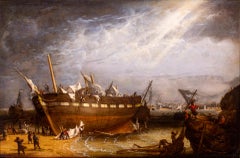
Aftermath of a Tyne River Storm

Aftermath of a Tyne River Storm

By Robert Salmon

Located in Costa Mesa, CA

Painted with unsurpassed detail, Robert Salmon's works are desirable to collectors the world over, due to the impressive amount of historic subject matter presented through artistic compositions of the highest order. As an artist Salmon was one of the most important to come out of England and immigrate to America in this period, influencing the art of Fitz Henry Lane...

Category

1840s Realist Paintings

Materials

Oil, Panel

Follow the Leader

Follow the Leader

By Joseph Witham

Located in Costa Mesa, CA

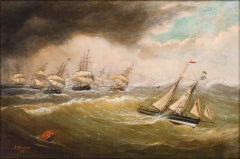
The most important maritime center in the 19th century, Liverpool, had many advantages. Located on the England-facing west coast of the Irish Sea, the Mersey approach was wide, deep and actively associated with all aspects of shipping. It also faced northwest, as the distressed fleet in Witham's work has discovered on a stormy February 8, 1881. To the rescue of the 12 ships, the Pilot Schooner No.2, LEADER, signals the fleet to follow, using the pre-1900 commercial code signals "l w c". She has waited for the rising tide and keeps the line tight to the red starboard buoy, Q1, which marks the beginning of the Queen's Channel. Within a span of hours, all twelve ships were led successfully to their docks. Witham painted the scene in conjunction with the great acclaim the Pilots received in 1881, and it became so popular that he painted additional works marking the event over time. His local contemporary, Samuel Walters...

Category

1890s Other Art Style Paintings

Materials

Canvas, Oil

Ship LUCY G. DOW

Ship LUCY G. DOW

Located in Costa Mesa, CA

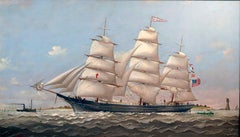
The strength of a great ship portrait lies with its overall striking composition blended with an attention to detail. Charles Sidney Raleigh was extremely skilled with both elements, and this is one of his finest works. An American full-rigged ship of large proportions, LUCY G. DOW is one of many ships owned by Maine interests, where the ship would be locally built and consortium owned. More Maine captains owned part of their ships than any other East Coast region, it appears through an informal survey of lists. Note the fine details of the captain and crew hard at work onboard off the coast. The numerous buildings are clustered on the peninsular stretch with a pier coming out near the lighthouse’s walkway. At the distance, ship masts...

Category

1880s Other Art Style Landscape Paintings

Materials

Canvas, Oil

Regatta in Sydney Harbour

Regatta in Sydney Harbour

Located in Costa Mesa, CA

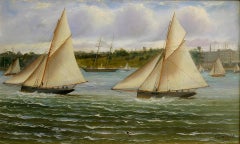
Period yacht racing is a rare and desirable subject for marine paintings, and a 19th century work from Australia of this prime subject is among the rarest finds we may offer. The artist, Charles F. Gerrard, shows up in 1882 on the Sydney professional trade list as a painter, then as a marine artist and finally as simply 'artist'. He exhibits his first works with the Royal Art Society in Sydney in 1884, consisting of coastal scenes. He is extremely well received by his contemporaries according to newspaper reports. The recognizable features of "The Rocks", along the western shore of Sydney cove near the harbor bridge, stands forth as a superb background for the racing yachts. This historic location is the foundation of the British Australian empire, and today is the oldest preserved colonial district in the country, described as "Sydney's outdoor museum". Fine-lined cutter yachts compete over a sailing course, with two shown in great close detail while five more hold their positions in the regatta, as the rhythmic small swells are evidence the wind favors the leaders running on close reaches with the crossing tide. The crew and yachts are very much in the British formal yachting manner, with full uniforms and the plum-bow hulls. Note that there is one crew attired in red, possibly a naval marine team, and the sail steam ship anchored in the center flies the Australian Colonial...

Category

1880s Other Art Style Landscape Paintings

Materials

Oil, Board