Georges Braque (Argenteuil-sur-Seine, 1882 - Paris, 1963)
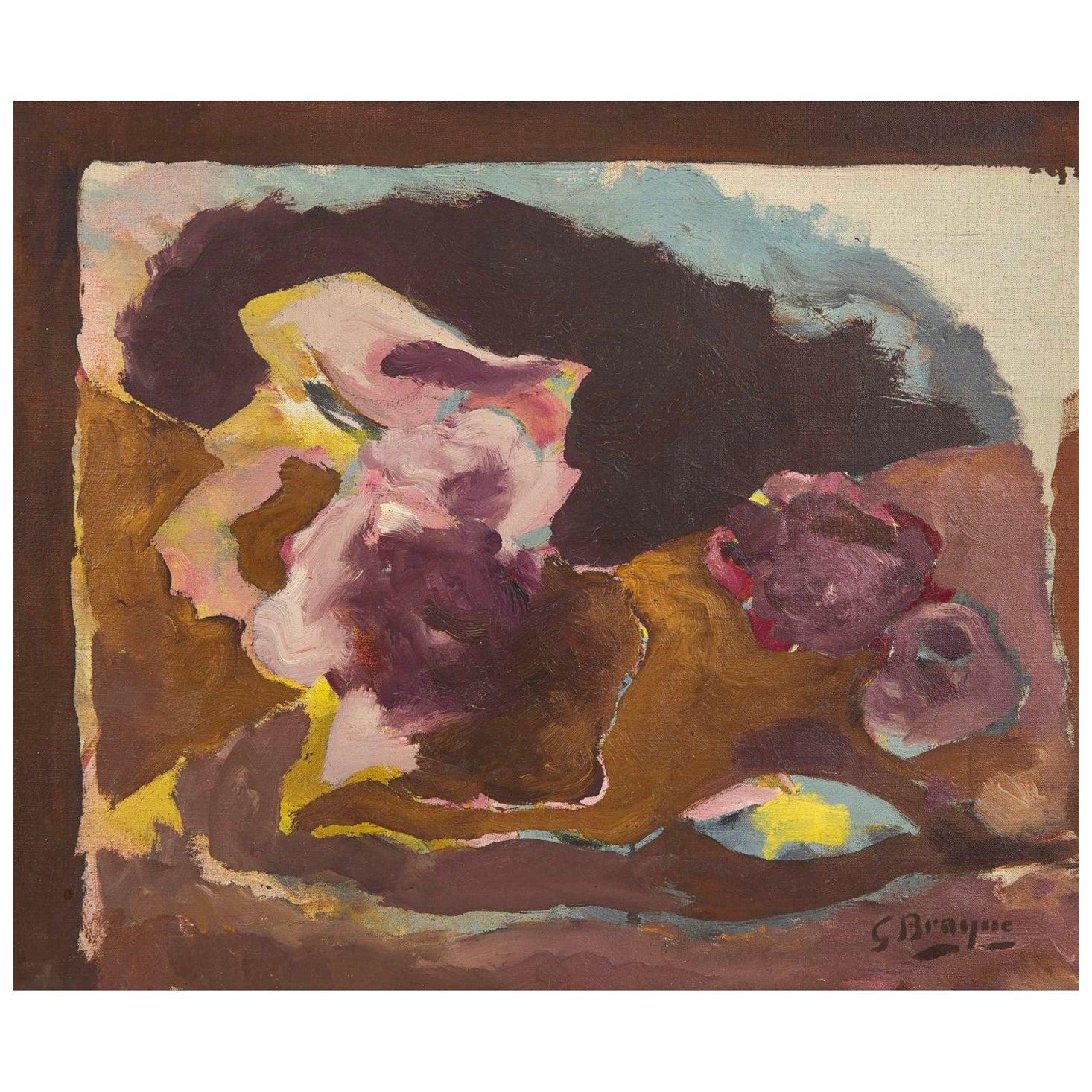
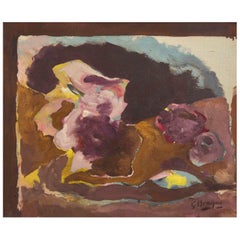
"Valse"
1919.
Oil on canvas.
33 x 45,8 cm (67 x 82 cm)
Signed "G Braque" on the back.
Provenance:
- Private collection, Mr. & Mrs. John Warrington, Cincinnati, USA.
- Theo Gallery, Barcelona.
- Private collection, Europe.
Publications:
- ISARLOV, George. "Georges Braque." Collection Orbes, José Corti. Paris, 1932. Reference on p. 22, with no. 252 (“Grappe de raisin à gauche et, à droite, verre”).
- CENDRARS, Blaise. "Georges Braque", in “Cahiers d'Art”. Paris, 1933. Reproduced on p. 39.
- "Catalogue of Georges Braque's works. Paintings 1916-1923". Maeght Éditeur. Paris, 1962. Illustrated on p. 65.
Bibliography:
- COGNIAT, R. “Georges Braque”. Harry N. Abrams, Inc., 1980.
- LEAL, B. “Georges Braque. 1882-1963”. La Fábrica and Guggenheim Bilbao, 2014.
- LEMAYRIE, J. “Braque”. Skira, 1961.
Description:
Braque created this work in 1919, a pivotal year both historically and personally. Having just ended the First World War, it was the year of his definitive public recognition, thanks to the successful exhibition dedicated to him that year at the L’Effort Moderne gallery in Paris. By then, Braque was an artist exploring his practice in isolation: in 1914, his collaborative work with Picasso on the development of Synthetic Cubism had been interrupted by the war, and by 1918, Cubism as a collective movement had come to an end. From that date onward, each of its members would follow their own individual path, taking advantage of an autonomy, in a way, restored by the war.
Having recovered from the serious wound he suffered at the front in 1915, Braque resumed painting in 1917 and, after several months of experimentation, regained mastery of his artistic language by the end of the following year, now guided solely by individual criteria and instincts. By 1918, the problems posed by Cubism remained unresolved: the Cubist experience still needed to be fully realized, and Braque dedicated himself to this task, accepting the presence of emotion as a corrective, or perfecting, element of the Cubist “rule.” In the expression of his intimate artistic emotion, and in the consequent acceptance of his own sensibility as a guide, Braque finally achieved the full resolution of the process begun with Picasso more than a decade earlier. Thus, new, more powerful and profound colors appeared in his work, while still maintaining perfect Cubist harmony. Unlike Picasso, who opted for a very intense palette during these years, Braque remained aloof from pure color, delicately balancing discipline and emotion.
In the words of art historian Jean Lemayrie, “once the technical problems [in the Cubist period] were resolved and the syntax constructed, it was vision itself that was unleashed in all its hallucinatory power.” Between 1918 and 1919, Braque managed to reconcile the rigorous discipline of Synthetic Cubism with the freshness of objects that were evoked by plastic forms, and not the other way around. Braque painted without a model, without a pre-established composition; as a painter, he saw colors and forms, not objects, and only later did he transform the patches of color suggested by his vision into concrete motifs.
From this point on, Braque's work no longer followed the previous methodical progression. He began to work on several paintings simultaneously, experimenting with diverse solutions and approaches, and therefore a strictly chronological analysis of his work lost relevance in favor of a thematic one. A fundamental group within his painting from these years are the still lifes; The still lifes from around 1918-1921 are works that symbolically derive from Cézanne's emblematic Cubist motif, the fruit bowl, and that extend Synthetic Cubism while simultaneously combining it with new values. Thus, the compositions remain eminently Cubist, with planes of color relating to vertical elements, and are often still rigorously contained within oval or rhomboidal canvases. However, a richness in the pictorial matter is evident, which, despite being entirely new, is harmoniously balanced with color and form. The resurgence of poetic and sensory values is thus reflected in less rigid forms, undulating lines, and a more dynamic technique, with an increasingly thick brushstroke that gradually gains in expressiveness until it finally abandons the rigidity of the Cubist line. The result is a pictorial surface that now evokes a kind of tactile, sensual vibration, far removed from Cubist coldness. This irruption of the sensory and the expressive transforms these still lifes into a kind of experimental game that unfolds on a solid foundation, so it is no surprise that they have often been compared to musical variations, a coherent simile given that Braque was a great lover of music, as well as a performer himself, and that he recurrently introduced musical allusions into his painting, through the representation of instruments, musical scores, or, as here, the word "waltz," which evokes a very specific rhythm and is repeated in other works by Braque.