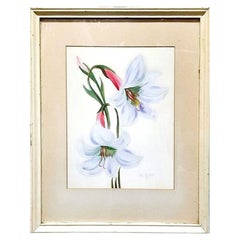
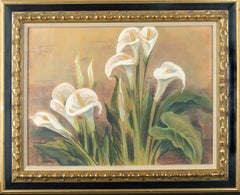
Want more images or videos?
Request additional images or videos from the seller
1 of 11

Jane Peterson
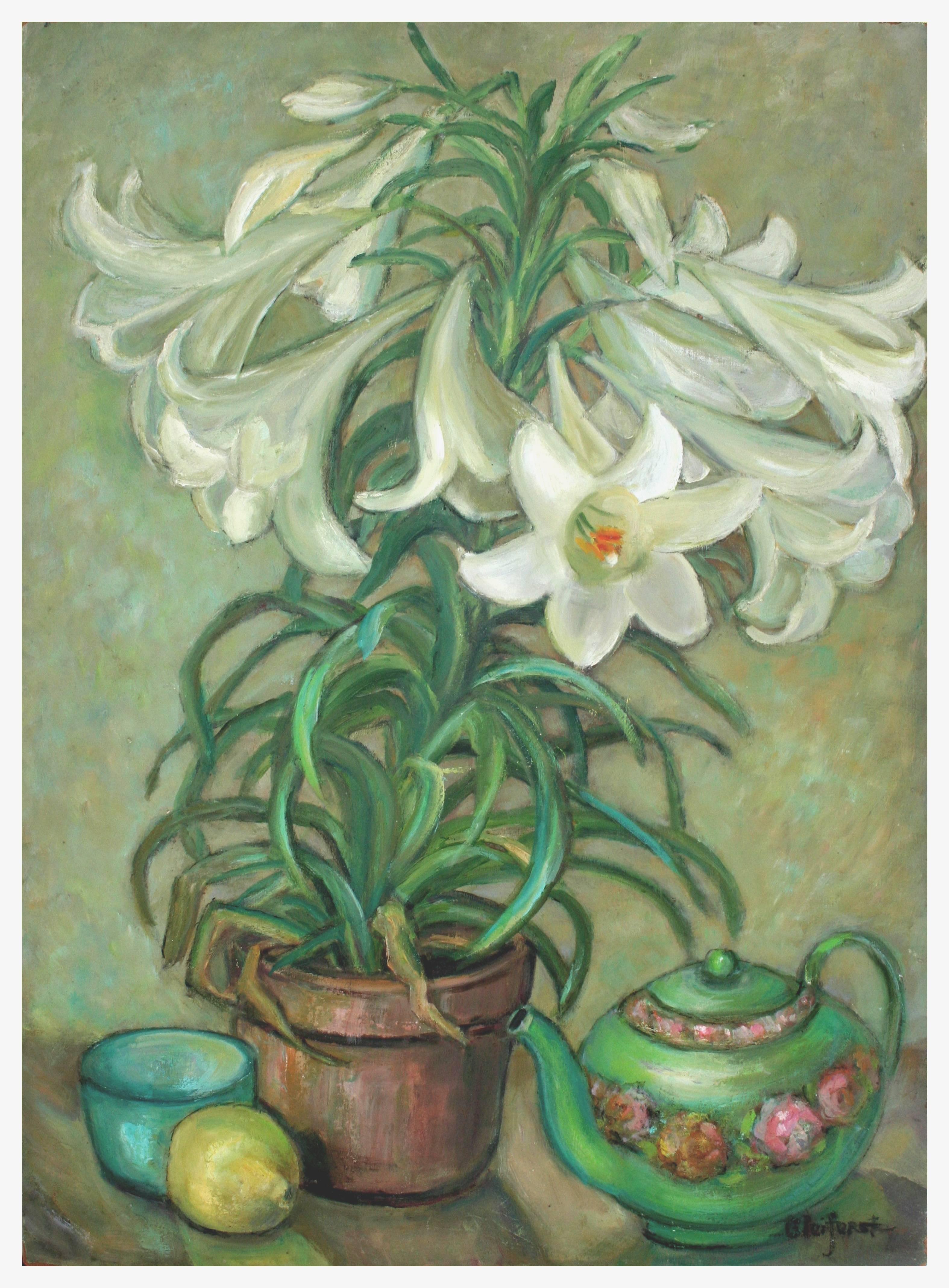
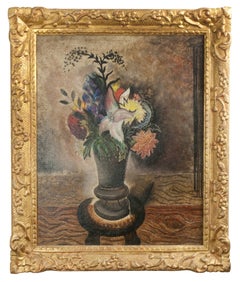
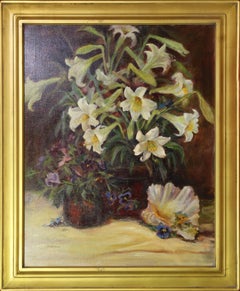
Lilies Oil Painting, American Impressionist, Signed, 1952-1953, Framed

$24,000
£18,086.44
€21,134.42
CA$34,057.80
A$34,161.33
CHF 19,815.51
MX$417,004.56
NOK 229,519.58
SEK 234,897.84
DKK 157,979.23

About the Item

Jane Peterson (1876-1965) Lilies Oil on canvas, 1952-1953 Signed by the artist lower right: JANE PETERSON (see photo) Painting size: 29 x 23 inches Frame size: 38 x 32-1/2 x 1-1/2 inches Exhibited: The Pennsylvania Academy of the Fine Arts: One Hundred and Forty Eighth Exhibition of American Painting and Sculptures, January 25-March 1, 1953 (Photo of original label). Original tacks on stretcher where label was afixed. Label stolen while on exhibition. Exhibited: Childs Gallery, Boston, 2019- 2023 Jane Peterson was an artist who achieved significant critical attention and adulation over the course of her career. Following her first American solo exhibition in 1909, a critic observed, “There is not a dull canvas in the entire collection and everything is interesting”.1 Thirty-five years later, Historical Records published her biography in the almanac Prominent Women of New York.2 Regardless of her success, Peterson remained pragmatic as she always sought to challenge herself with new ideas and techniques. She spent a lifetime immersed in the practice of painting; as a student, teacher, and gifted artist. Peterson was a painter with little interest in self-promotion or the conventional achievements of an artist, as a result there has only been a moderate body of scholarship written about her posthumously. Peterson’s legacy is her brilliant oeuvre of impressionistic paintings, held by collections such as the Metropolitan Museum of Art, the Philadelphia Museum of Art, and the Brooklyn Museum of Art. "Jennie Christine Peterson was born in Elgin, Illinois in 1876. From an early age Peterson, who was known throughout her life as Jane, showed a natural talent for drawing. As a teenager, having received no formal art training, Peterson sat the art aptitude test conducted by the Pratt Institute. The results were promising and, in 1895, Peterson moved to New York to study at the Pratt Institute in Brooklyn. Peterson thrived at Pratt as a conscientious student, although it was not an easy time for her financially. When her money ran low Peterson gave art lessons to other students, and also earned some income through the sale of her paintings in student exhibitions. When Peterson graduated in 1901, she began working as Drawing Supervisor of Public Schools in Brooklyn. She also continued her art education taking classes at the Art Students League. Between 1904 and 1906 Peterson worked as an art teacher in New York, Massachusetts, and Maryland. In 1907, Peterson sailed to Europe where she visited artists and museums in France, Holland, and Italy. She found Europe to be more socially progressive for women artists and decided to stay and continue her art education. While in Europe, Peterson studied under Frank Brangwyn at the London School of Art, before relocating to Paris where she received instruction from Jacque-Emile Blanche, Charles Cottet, and Claudio Castelucho. Throughout 1908, Peterson was extremely productive, creating many works in her spare time while also taking on portrait commissions to augment her income. She lived in rooms in Montparnasse located around the corner from Gertrude Stein’s salon, where on Saturday evening artists and art enthusiasts would gather to view and discuss Stein’s seminal collection of Modern art. Attending these events Peterson surrounded herself with powerful art luminaries such as Pablo Picasso, Henri Matisse, Georges Braque, André Derain, and Henri Rousseau. Peterson’s style from this period is neither entirely academic nor avant garde. Rather she blends the technical skills of her academic training with the loose brushwork and bold color palette of her contemporaries to produce paintings that are beautiful impressions of life. Peterson’s early oil paintings from Europe often show flat generalized areas of color contrasted with skilled detailing – brickwork, window frames, clothes, etc. – that perfectly conjure a scene. While in Paris, Peterson exhibited her work at the Société des Artistes Français. Then, in 1909, she had her first American exhibition at the Botolph Club, Boston. Favorable reviews ensured this exhibition marked a decisive point in her career, as she shifted from diligent student into the role of a mature artist. However, despite her success Peterson’s single-minded passion for painting kept her open to experimentation new techniques, as she considered perpetual learning and re-learning to be essential practices for an artist. Following two more successful solo exhibitions in 1909, Peterson returned to Europe where she commenced studying with the acclaimed Spanish artist Joaquín Sorolla y Bastida in Madrid. Of all her teachers, Sorolla had the most influence upon Peterson’s style. Sunlight-drenched Spanish scenes characterize Sorolla’s works. After 1909, Peterson’s canvases become more daring with color, as layers of loose brushstrokes combine to represent the shimmer of Summer’s light in southern Europe. In 1910, Peterson travelled alone to Egypt and Algiers – an extremely brave move for a woman in the early 20th century – where she did a series of paintings in her new bold style. These works were exhibited later that year in a solo exhibition at the Art Institute of Chicago. In 1911, Louis Comfort Tiffany invited Peterson to his estate, Laurelton Hall, in Oyster Bay, Long Island. Peterson remained at Laurelton for many months, painting the estate’s magnificent gardens. Her love for nature, particularly flowers, would become a subject matter that would increasingly occupy her work. She stated later in life, “I adore gardens! They are the most elusive art of a nation.”3 After 1912, Peterson worked increasingly with gouache as the medium allowed her more freedom for painting en plein air and experimenting with quick strokes of color. She often combined charcoal with gouache, as drawing details with charcoal allowed Peterson to be even more free and light with her paint. Between 1913 and 1919 Peterson worked as a watercolor instructor at the Art Students League. During the 1910s and 1920s Peterson continued to travel extensively overseas, taking solo painting trips to France and Turkey. Closer to home, she visited Canada, Alaska, California, Florida, and the states of New England. As a result of her adventures around the globe, many of Peterson’s subjects are quite internationally debonair and socially minded in an era when many women favored painting domestic scenes of women and children. For example, during World War One, Peterson joined the war effort painting military portraits and patriotic scenes of women rolling bandages and folding blankets at the Red Cross Center. Spending six months in Turkey in 1924, she painted streets scenes in the Islamic cities of Constantinople and Broosa. In 1925, Peterson married Moritz Bernard Philipp, a successful corporate lawyer. The couple moved to five-story home on Fifth Avenue in New York City, directly opposite the Metropolitan Museum of Art. A sixth story was added to their home to be Peterson’s studio. After her marriage Peterson focused on flower painting, a subject that would occupy her practice for the rest of her life. She explains: [Flowers] scintillate the prismatic hues of the rainbow; they harmonize the pastel shades of the night; they are all that is delicate; all that is lurid, brilliant, bizarre. They are living things with personality and refinement, with delicacy of form and structure, with variety of size and shape, with rhythm and charm of arrangement, with grace and dignity of bearing.4 Peterson approached flower subjects with the same intense single-minded passion that drove her to travel solo around the world. She analyzed flowers as mysterious objects of beauty that required diligent attention and sensitive expression. Flowers were by no means an undemanding subject for Peterson. After Philipp died in 1929, Peterson continued to travel frequently. Throughout the 1930s and 1940s she often spent Summer in Europe, Fall and Spring in New York, and Winter in Palm Beach, Florida. In 1938, she studied with the Modernist André Lhote in Paris. During this time Peterson continued to paint her ‘flower portraits’, and she had numerous exhibitions in New York and Florida. By the mid-1950s arthritis had affected Peterson’s hands so badly that she could only paint occasionally. Peterson spent the last five years of her life living with her niece in Kansas. She died in 1965. Since Peterson’s death, her works continue to be highly coveted by collectors. This is due partially to her artistic oeuvre not fitting neatly into a single movement of art history. Peterson’s love for painting floral arrangements is not consistent with her contemporaries’ ideas of the avant-garde. However, while Peterson painted gardens, town squares, and beach scenes in an impressionistic representational style, she was also – like her Modernist peers – pushing the boundaries of an accepted norm. Peterson’s biography is a testament to her passionate, and very determined quest to depict beauty. She persevered against the conventions of her modest upbringing to establish a career as an artist, and she preserved against the conventions of her gender to establish herself as an independent and internationally experienced artist. As a result, Peterson’s flower portraits and international landscapes are a tribute to her adventuresome spirit and resolve to capture elusive beauty on canvas." Courtesy Questroyal Fine Art
  • Creator:
    Jane Peterson (1876-1965, American)
  • Dimensions:
    Height: 29 in (73.66 cm)Width: 23 in (58.42 cm)
  • Medium:
  • Movement & Style:
  • Period:
  • Condition:
  • Gallery Location:
    Fairlawn, OH
  • Reference Number:
    Seller: FA68031stDibs: LU14015959672

More From This Seller

View All
Full Bloom

Full Bloom

By Robert Hallowell

Located in Fairlawn, OH

Full Bloom Oil on canvass, 28 x 21 1/2 inches Signed lower right: Robert Hallowell Provenance: Estate of the artist Marbella Gallery, New York Illustrated in Ma...

Category

1930s American Impressionist Still-life Paintings

Materials

Oil

American Modenrist, Cleveland School, Henry Keller, Hollyhocks and Tiger Lilies

American Modenrist, Cleveland School, Henry Keller, Hollyhocks and Tiger Lilies

By Henry Keller

Located in Fairlawn, OH

Henry G. Keller (1869-1949) Hollyhocks and Tiger Lillies Gouache on paper, c. 1913 Signed with the artist's signature: "H G Keller," and monogramed lower left corner (see photo) Sign...

Category

1910s American Modern Landscape Drawings and Watercolors

Materials

Gouache

Still Life with Vase of Flowers, American Modern, Circa 1929

Still Life with Vase of Flowers, American Modern, Circa 1929

By Konrad Cramer

Located in Fairlawn, OH

Still Life with Vase of Flowers Oil on board with incised scraffito, c. 1929-1930 Unsigned by the artist Signed and inscribed verso: "Painting by my father, Aileen B. Cramer" verso, ...

Category

1920s American Modern Paintings

Materials

Oil

Persephone Oil on Canvas, American Modern, Signed, 1952, 20x16 in

Persephone Oil on Canvas, American Modern, Signed, 1952, 20x16 in

By Virginia Dehn

Located in Fairlawn, OH

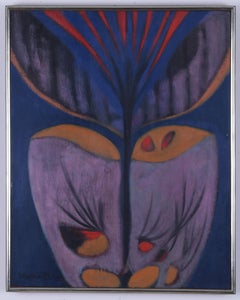
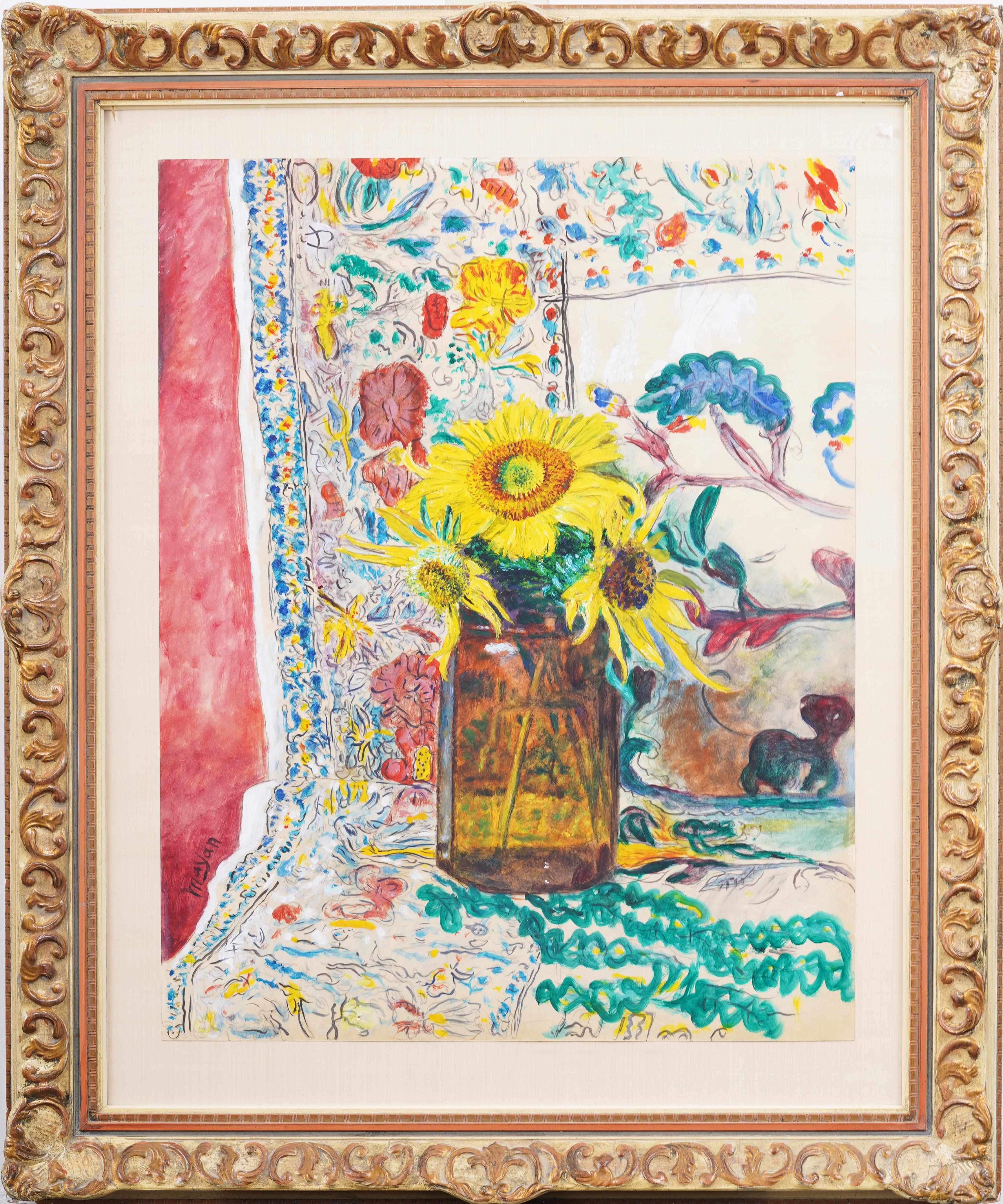
Persephone Oil on canvas, 1952 Signed lower left (see photo) Titled reverse "Persephone" Signed "V. 52" Exhibited: Columbus Gallery of the Arts label "71/30 Bt. 2", see label Condition: two very small flakes of missing paint Canvas size: 20 1/8 x 16" Frame size: 20 7/8 x 16 3/4" Provenance: Estate of the artist Dehn Heirs An important painting by the artist. Virginia Dehn From Wikipedia, the free encyclopedia Virginia Dehn (1922-2005) Virginia Dehn was an American painter and printmaker whose lyrical abstractions drew inspiration from nature, archaeology, ancient civilizations, and the spiritual dimensions of landscape. Born Virginia Engleman in Nevada, Missouri, on October 26, 1922, she studied at Stephens College, the Traphagen School of Design, and the Art Students League in New York. In the 1940s she met the distinguished lithographer and watercolorist Adolf Dehn, whom she married in 1947. Although initially known in connection with her husband's artistic circle, she developed an independent career that spanned more than five decades. Her mature work transformed natural forms, gardens, pottery, geological formations, and symbols from ancient cultures into richly textured, semi-abstract compositions characterized by luminous color and contemplative imagery. Her major series included Gardens and Galaxies, Ancient Landscapes, Earth Memory, The Egyptian Series, The Oriental Series, and The Gold Series. Dehn exhibited widely throughout the United States and was represented during her career by galleries including the Susan Teller Gallery in New York, Harmon-Meek Gallery in Naples, Florida, Cline LewAllen Contemporary Gallery in Santa Fe, New Mexico, and Thomas French Fine Art in Ohio. Her work was featured in numerous solo and group exhibitions and earned recognition for its synthesis of modern abstraction with enduring themes drawn from history and the natural world. Works by Virginia Dehn are held in a number of public collections, including the New Mexico Museum of Art, the Butler Institute of American Art, the Portland Art Museum, the Museum of Fine Arts, Springfield (Massachusetts), the University of California, Berkeley, the Minnesota Historical Society, and the New York State Library. These institutional holdings reflect the broad geographic reach of her career and the continuing appreciation of her contribution to twentieth-century American art. Virginia Dehn died in Santa Fe, New Mexico, on July 28, 2005. Today her paintings, drawings, and prints are represented in museum collections and private collections throughout the United States, and her work remains associated with a distinctive vision that united abstraction, memory, and the enduring forms of the natural world. Virginia and Adolf Dehn The Dehns lived in a Chelsea brownstone on West 21st Street where they worked side by side. They often hosted gatherings of other influential artists and intellectuals of the 20th century. Among their closest friends were sculptor Federico Castellón and his wife Hilda; writer Sidney Alexander and his wife Frances; artists Sally and Milton Avery; Ferol and Bill Smith, also an artist; and Lily and Georges Schreiber, an artist and writer. Bob Steed and his wife Gittel, an anthropologist, were also good friends of the Dehns. According to friend Gretchen Marple Pracht, "Virginia was a glamorous and sophisticated hostess who welcomed visitors to their home and always invited a diverse crowd of guests..." Despite their active social life, the two were disciplined artists, working at their easels nearly daily and taking Saturdays to visit galleries and view new work. The Dehns made annual trips to France to work on lithographs at the Atelier Desjobert in Paris. Virginia used a bamboo pen to draw directly on the stone for her lithographs, which often depicted trees or still lifes. The Dehns' other travels included visits to Key West, Colorado, Mexico, and countries such as Greece, Haiti, Afghanistan, and India. Dehn's style of art differend greatly from that of her husband, though the two sometimes exhibited together. A friend of the couple remarked, "Adolf paints landscapes; Virginia paints inscapes." Virginia Dehn generally painted an interior vision based on her feelings for a subject, rather than a literal rendition of it.] Many of her paintings consist of several layers, with earlier layers showing through. She found inspiration in the Abstract Expressionism movement that dominated the New York and Paris art scenes in the 1950s. Some of her favorite artists included Adolf Gottileb, Rothko, William Baziotes, Pomodoro, and Antonio Tapies. Dehn most often worked with bold, vibrant colors in large formats. Her subjects were not literal, but intuitive. She learned new techniques of lithography from her husband Adolf, and did her own prints. Texture was very important to her in her work. Her art was influenced by a variety of sources. In the late 1960s she came across a book that included photographs of organic patterns of life as revealed under a microscope. These images inspired her to change the direction of some of her paintings. Other influences on Dehn's art came from ancient and traditional arts of various cultures throughout the world, including Persian miniatures, illuminated manuscripts, Dutch still life painting, Asian art, ancient Egyptian artifacts...

Category

1950s American Modern Abstract Paintings
Materials

Acrylic

Studio Flowers

Studio Flowers

By Robert Kipniss

Located in Fairlawn, OH

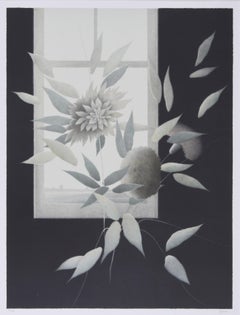
Studio Flowers Lithograph, 1982 Signed lower right (see photo) Numbered lower left Edition: 120 (42/120) (see photo) Condition: Mint condition Two bits of hinge residue verso Image s...

Category

1980s American Realist Still-life Prints

Materials

Lithograph

Maine artist, Mt. Desert area, Boston School trained, Iris

Maine artist, Mt. Desert area, Boston School trained, Iris

By Greta Allen

Located in Fairlawn, OH

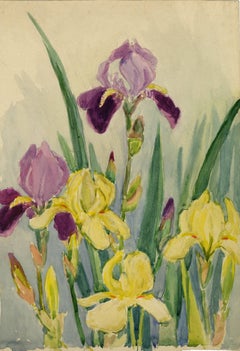
Iris Watercolor on paper, c. 1920 Unsigned Provenance: Estate of the Artist Condition: Excellent, slight surface dirt Image/Sheet size: 15 x 10 1/4 inches Allen was trained in Boston...

Category

20th Century American Impressionist Still-life Drawings and Watercolors

Materials

Watercolor

You May Also Like

Lilies with Seashells, 30x24" oil, framed

Lilies with Seashells, 30x24" oil, framed

By Lu Haskew

Located in Loveland, CO

Lilies and Seashell by Lu Haskew Oil 30x24" image size 36x30" framed, gold leaf on wood, as pictured​ Floral Still life ABOUT THE ARTIST: Lu Haskew 1921-2009 "Life is good to me. B...

Category

1990s American Impressionist Interior Paintings

Materials

Canvas, Oil

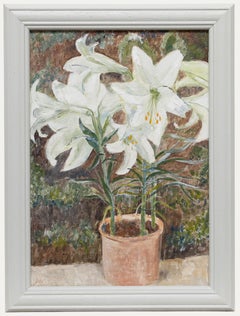
Olga Awty (1928-2014) - 20th Century Oil, Lilies

Olga Awty (1928-2014) - 20th Century Oil, Lilies

Located in Corsham, GB

A sensitive still life study by the artist Olga Awty (1928-2014) depicting brilliant white lilies in a terracotta pot. Signed with initials to the lower left. Smartly presented in a ...

Category

20th Century Still-life Paintings

Materials

Oil

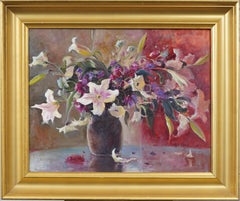
Vintage American School Signed Impressionist Flower Still Life Rare Oil Painting

Vintage American School Signed Impressionist Flower Still Life Rare Oil Painting

Located in Buffalo, NY

Vintage American impressionist flower still life oil painting. Oil on canvas. Signed. Framed. Provenance from a Sag Harbor, NY collection. Measuring: 32 by 38 inches overall. Handso...

Category

Early 2000s Impressionist Still-life Paintings

Materials

Oil, Canvas

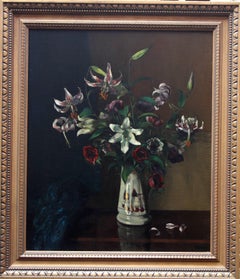
Floral Arrangement - British art 1920's oil painting still life lilies flowers

Floral Arrangement - British art 1920's oil painting still life lilies flowers

By Margaret Evangeline Wilson

Located in Hagley, England

A large oil on canvas of a stunning floral arrangement by female artist Margaret Evangeline Wilson. Wilson exhibited at the Paris Salon and won the Medaille d'Or at the Paris Salon i...

Category

20th Century Realist Still-life Paintings

Materials

Oil

Calla Lilies - Vintage Pastel Drawing, Signed 1965

Calla Lilies - Vintage Pastel Drawing, Signed 1965

Located in Soquel, CA

Calla Lilies - Vintage Pastel Drawing, Signed 1965 Beautiful soft pastel drawing of calla lilies by Thousand Oaks, California artist Pauline J Bisaccio (American 20th Cent.) This pi...

Category

1960s Abstract Impressionist Still-life Drawings and Watercolors

Materials

Paper, Pastel