Henry Rox (1899–1967)
(born Heinz Rosenberg)
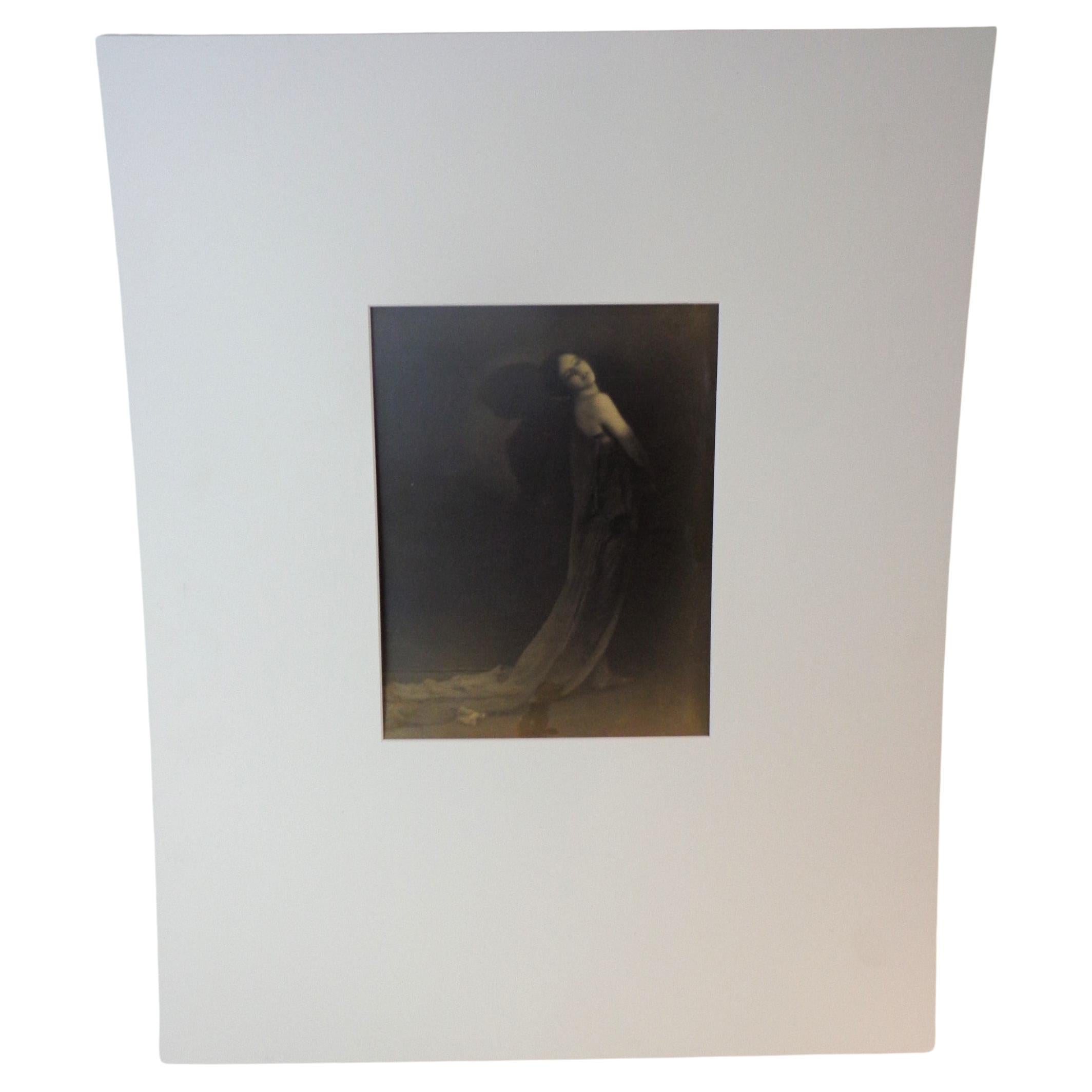
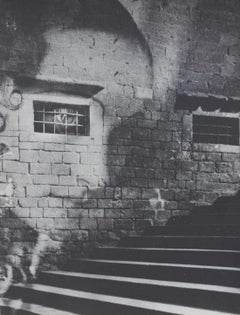
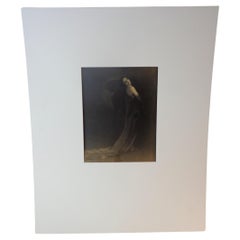
“Down the Stairs Came A Pale, Imposing Figure in A Flowing Gown” 1935
From Tommy Apple and Peggy Pear
by James Laver
Jonathan Cape, London, 1936
Opposite p. 54
Negative 1936 (print c. 1940)
Vintage silver gelatin print
Image: 9.25 x 6.875 inches
London copyright stamp; estate stamp verso
No known negatives extant
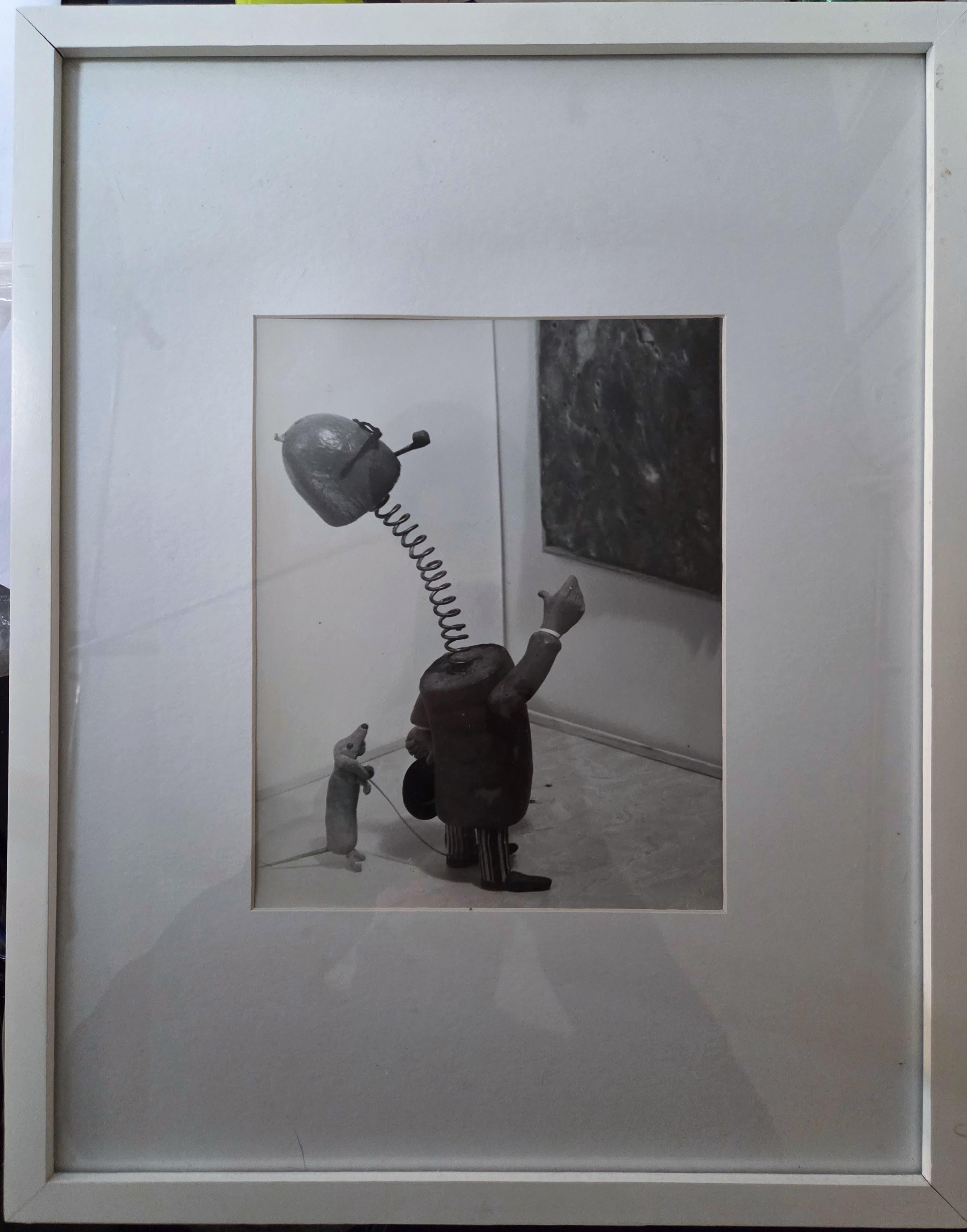
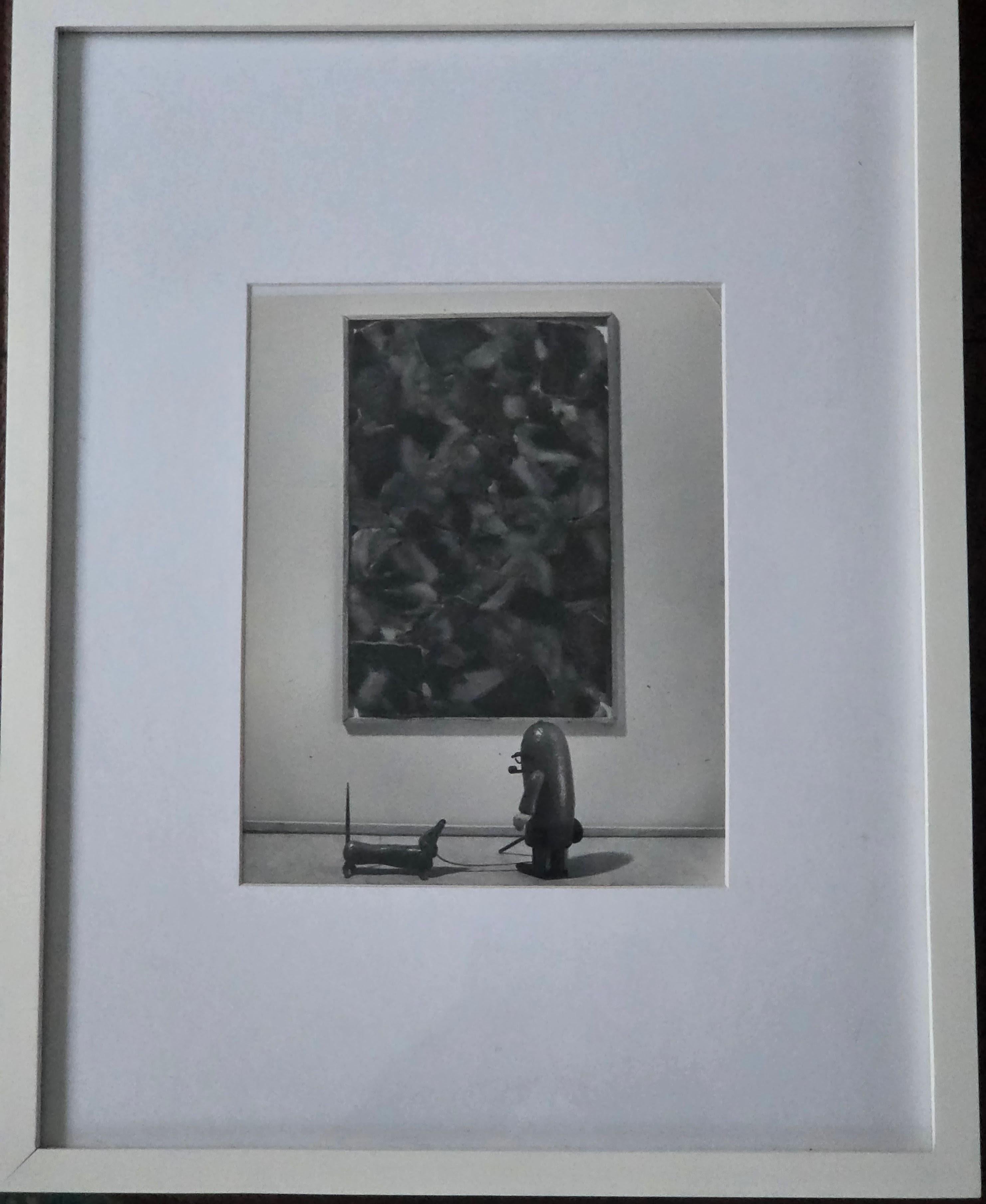
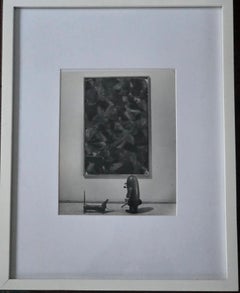
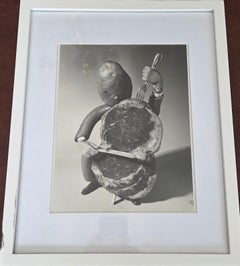
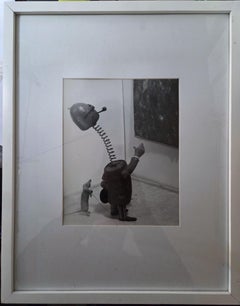
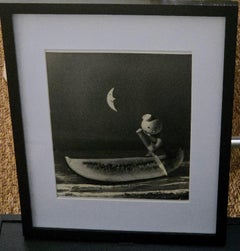
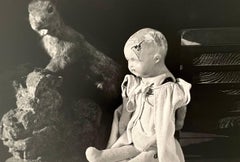
This vintage silver gelatin print is one of the twenty-two original photographic “photo-sculptures” created by Henry Rox for Tommy Apple and Peggy Pear, written by James Laver and published by Jonathan Cape, London, in 1936. The composition appears opposite page 54 and stages a dramatic encounter within a simplified architectural setting.
A small coachman figure stands below as a tall, descending female presence commands the stair. The scale contrast establishes immediate narrative tension. Rox constructs his characters entirely from organic material. The coachman’s head is formed from an onion, its rounded bulb lending quiet vulnerability. The imposing female figure — often referred to as the “Lentil Lady” — is constructed from lentil elements: a lentil inverted to form the head, cascading lentil leaves arranged to suggest drapery, and wiry lentil roots rising in a structured coiffure. Botanical morphology becomes costume, anatomy, and psychological presence.
The architectural staging is spare but deliberate: planar stair, controlled railing geometry, and spherical finial elements anchor the composition. Rox’s Berlin training in sculpture is evident in the measured spacing, proportional control, and tonal orchestration. Light falls evenly across surfaces, reinforcing sculptural volume while maintaining theatrical clarity. The result is neither simple illustration nor novelty photography, but a staged sculptural tableau resolved through the camera.
By 1936 Rox’s London “photo-sculptural” method was fully consolidated. The figures inhabit constructed space with narrative continuity rather than functioning as isolated visual transformations. Fabrication, staging, lighting, and photographic resolution operate as a unified system.
During his London period (1934–1938), Rox collaborated with James Laver (1899–1975), author, critic, and later Keeper of Prints, Drawings, and Paintings at the Victoria and Albert Museum (appointed 1938). In the mid-1930s Laver was already active within British cultural and publishing circles, writing on art, design, and material culture.
Their collaboration resulted in two published volumes issued by Jonathan Cape, London:
Tommy Apple and His Adventures in Banana-Land (1935)
Tommy Apple and Peggy Pear (1936)
These works positioned Rox’s constructed photographic method within mainstream British publishing at a moment when he was rebuilding his career after leaving Germany in 1934. The images were conceived as fully staged sculptural environments created specifically for photographic resolution. The photograph — not the physical model — was the finished artistic object.
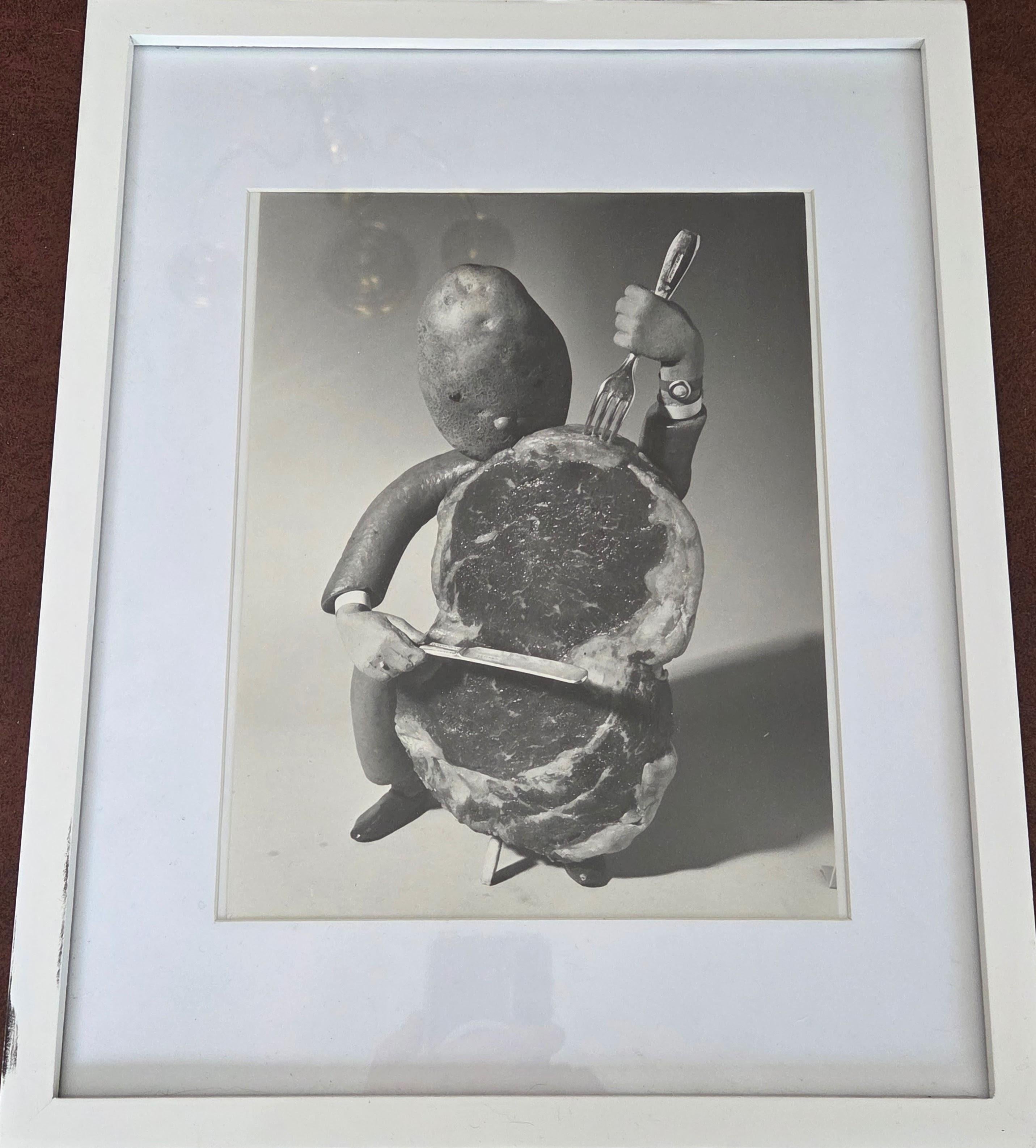
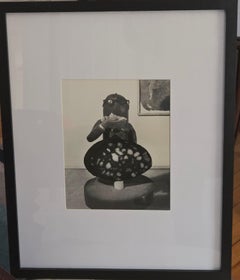
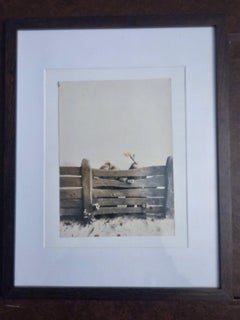
Rox referred to these works as “photo-sculptures.” Rather than photographing existing subjects, he constructed miniature sculptural environments from fruit, vegetables, and everyday materials, carefully arranging lighting and perspective before photographing the finished tableau. The resulting images combine sculpture, stagecraft, and photography into a single resolved composition.
Rox’s photo-sculptures circulated widely within the illustrated magazine culture of the mid-twentieth century. His constructed images appeared in American publications including Life, Coronet, Collier’s, The New York Times Magazine, and later Family Circle, participating in the expanding visual journalism environment shaped by publisher Henry Luce and the broader editorial world associated with Condé Nast and art director Alexander Liberman.
British editorial connections established during Rox’s London years in the mid-1930s also continued to surface in later publications. Illustrated magazines such as Picture Post and other European design journals, including the Swiss publication Graphis, reproduced Rox’s photo-sculptures during the 1940s and 1950s, demonstrating the ongoing circulation of his work within both British and continental publishing networks.
Alongside his photographic constructions, Rox maintained an active career as a modern sculptor. During the 1940s and 1950s his work appeared in a number of important museum exhibitions, including presentations at the Whitney Museum of American Art, the Yale University Art Gallery, the Philadelphia Museum of Art, and the Metropolitan Museum of Art. These exhibitions placed Rox within the broader international development of modern sculpture in the decades surrounding the Second World War.
During his London period (1934–1938), Rox collaborated with writer and art historian James Laver on illustrated books published by Jonathan Cape. These works—Tommy Apple and His Adventures in Banana-Land (1935) and Tommy Apple and Peggy Pear (1936)—introduced Rox’s sculptural photographic tableaux to a wide audience through narrative illustration.
Rox’s career bridges European avant-garde sculpture, émigré reinvention, British publishing culture, American commercial modernism, and postwar academic practice. His photo-sculptures stand as hybrid works—simultaneously sculptural, performative, and photographic—reflecting a life shaped by displacement, adaptation, and sustained intellectual rigor.
Research on Henry Rox has developed through a combination of archival investigation and direct examination of surviving works. Early inquiries in the 1990s—including correspondence with the Mount Holyoke College Archives, the Solomon R. Guggenheim Museum, and the Whitney Museum of American Art—helped establish documentation of Rox’s American teaching career and exhibition history.
More recently, curator and collector Wolfgang Vollmer assembled the most comprehensive documentation of Rox’s career to date through extensive archival research and visits to both European and American institutions. His work culminated in the 2021 Fotohof publication and a series of exhibitions in Salzburg, Vienna, Berlin, and Paris featuring Rox’s photography, significantly expanding the modern understanding of Rox’s work and helping reintroduce the artist to contemporary European audiences.
The present understanding of Rox’s work also benefits from the examination of a large surviving body of vintage prints, including several hundred photo-sculpture images as well as photographs documenting Rox’s sculptural works and self-portraits.
As with all Rox photo-sculptures, the photograph is not documentation but the resolved artistic object — sculpture conceived for photographic realization and completed through the lens. The construction existed for the camera; the print constitutes the finished work. No known negatives survive. This example bears the estate stamp verso and forms part of the approximately 300–500 lifetime prints preserved following Rox’s death. The majority of Rox’s images survive in only one to three prints.
Henry Rox
(born Heinz Rosenberg, Berlin, 1899 – South Hadley, Massachusetts, 1967)
Henry Rox was born Heinz Rosenberg in Berlin in 1899 into a prosperous Jewish family whose department store operated in one of the city’s principal upscale commercial districts. This background afforded him the financial stability to pursue advanced academic and artistic training in Germany and France.
Education
University of Berlin
Art History
1919–1923
Charlottenburger Kunstgewerbeschule, Berlin
Wood Culture Specialization
1921–1925
Académie Julian, Paris
Sculpture
1925–1927
Académie Colarossi, Paris
Drawing and Sketching (Multiple Courses)
1925–1928
Berliner Fotoschule, Berlin
Advanced Photographic Training
1933
He maintained a studio at 14 Rue Bréa, Montparnasse, Paris, before returning to Berlin, where he established a modern studio above his parents’ shop and later on Nürnberger Strasse.
Formally trained as a sculptor, Rox exhibited widely during the late Weimar period and was an established figure within the European avant-garde.
Exhibition History (Selected Early Exhibitions)
Salon d’Automne
Paris
Juryfreie Kunstschau
Berlin, 1926
Freie Kunstschau
Berlin, 1929
Preussische Akademie der Künste
Berlin, 1930
Berliner Secession
1929–1932
Paul Cassirer Gallery
Berlin
Alfred Flechtheim Gallery
Berlin
Royal Academy of Arts
London
Royal Institute
Glasgow
A documented 1930 photograph of Rox’s Berlin studio confirms the scale and seriousness of his sculptural practice: a substantial modernist workspace with installed lighting, drafting tables, and works in progress. Rox was not an experimental amateur; he was an established European sculptor operating within the late Weimar avant-garde.
Working within Berlin’s experimental climate, Rox absorbed Dadaist strategies of constructed object juxtaposition and formal irony. His attendance at the Berliner Fotoschule in 1933 strengthened his technical command of photography, though his primary identity at that time remained sculptural.
With the rise of National Socialism, Rox and his wife Lotte fled Germany in 1934, abandoning his studio, sculptures, and professional infrastructure. His parents and other family members remained and were later murdered in concentration camps. When Rox left Berlin, the only professional instrument he carried beyond personal effects was his camera. That instrument became the foundation of his reinvention.
Rebuilding his career in London beginning in 1934, Rox formally developed what he termed “photo-sculpture” — sculptural constructions created specifically for photographic realization rather than pedestal display. In this new method, the photograph was conceived as the final artistic object. Financial necessity redirected Rox from independent sculpture toward the development of photo-sculptures for both creative and commercial application.
He introduced his constructed photographic language into British publishing culture, leading to commissions from Harrods; De Bilenkork (Holland); Vitrolite; Guinness; Churchill Tobacco; Shell Oil; Helene of London; and, later in the United States, CBS Radio; Container Corporation of America; Macy’s; Dole; Hawaiian Coffee; among others. Through these commissions, Rox translated sculptural intelligence into sophisticated advertising imagery.
During this London period, Rox collaborated with James Laver — author, critic, and art historian, and later Keeper of Prints, Drawings, and Paintings at the Victoria and Albert Museum (1938–1959). Together they produced Tommy Apple and His Adventures in Banana-Land (Jonathan Cape, 1935) and Tommy Apple and Peggy Pear (Jonathan Cape, 1936). These works were not casual children’s novelties but structurally rigorous photographic constructions created in dialogue with one of Britain’s leading museum intellectuals. The collaboration firmly positioned Rox within British cultural and institutional circles.
Henry and Lotte Rox departed London for New York in May 1938. In 1939 he joined Mount Holyoke College in South Hadley, Massachusetts as Lecturer in Sculpture, commuting from New York during his first year before relocating permanently in 1940. This transitional period coincided with intense experimentation across media.
In 1940 Rox created an animated short incorporated into MGM’s Strike Up the Band, demonstrating continued engagement with narrative construction and material animation. He also co-authored his third and final children’s book, Banana Circus, with Margaret Fisher, a fellow German émigré who had likewise relocated to London in 1934.
Rox’s photo-sculptures gained broader visibility through American publishing networks under Henry Luce and Condé Nast, appearing in major magazines including Life, Vogue, Mademoiselle, Seventeen, Harper’s Bazaar, Collier’s, and McCall’s. Although his financial status never returned to its Berlin-era level, his American period allowed him to continue serious sculptural production alongside his photographic work.
His first Guggenheim Fellowship application in 1941, proposing further development of animation and film, was unsuccessful. A second application in 1949, again focused on sculpture, was also rejected. In 1954 he was awarded a Guggenheim Fellowship for sculpture and later became Mary Lyon Professor of Art at Mount Holyoke College.
Following Rox’s death in July 1967 and Lotte Rox’s death in April 1971, a substantial portion — approximately 300–500 lifetime prints — was salvaged and preserved. No known negatives are extant. These prints therefore constitute the primary surviving material record of his photo-sculptural practice.
Rox’s work has undergone renewed European institutional reassessment in recent years due in significant part to the research of Wolfgang Vollmer of Cologne, Germany. This reassessment includes a 2021 exhibition at Fotohof, Salzburg; the inclusion of material from the Banana Circus series at the Bonartes Photo Institute in Vienna (December 2025 – February 2026); and participation in Berlin’s European Month of Photography