Henry Rox (1899–1967)
Art Critic (Standing Before Monumental Framed Post War Abstraction)
c. 1948
Vintage silver gelatin print
8 × 10 inches
Printed c. 1948
Estate stamp verso
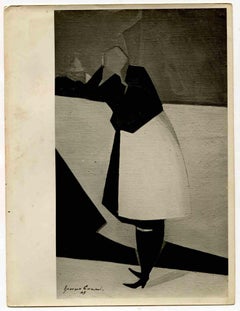
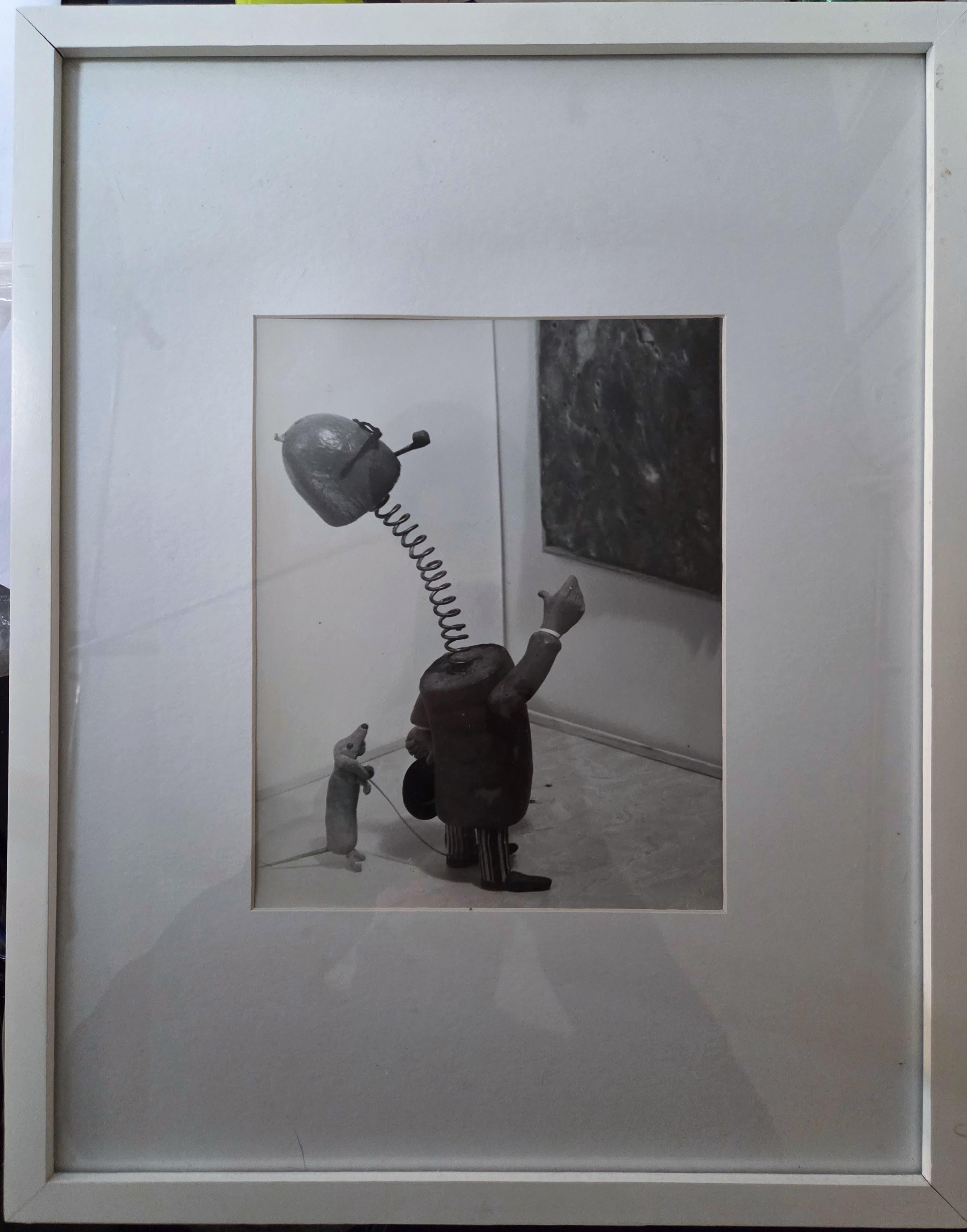
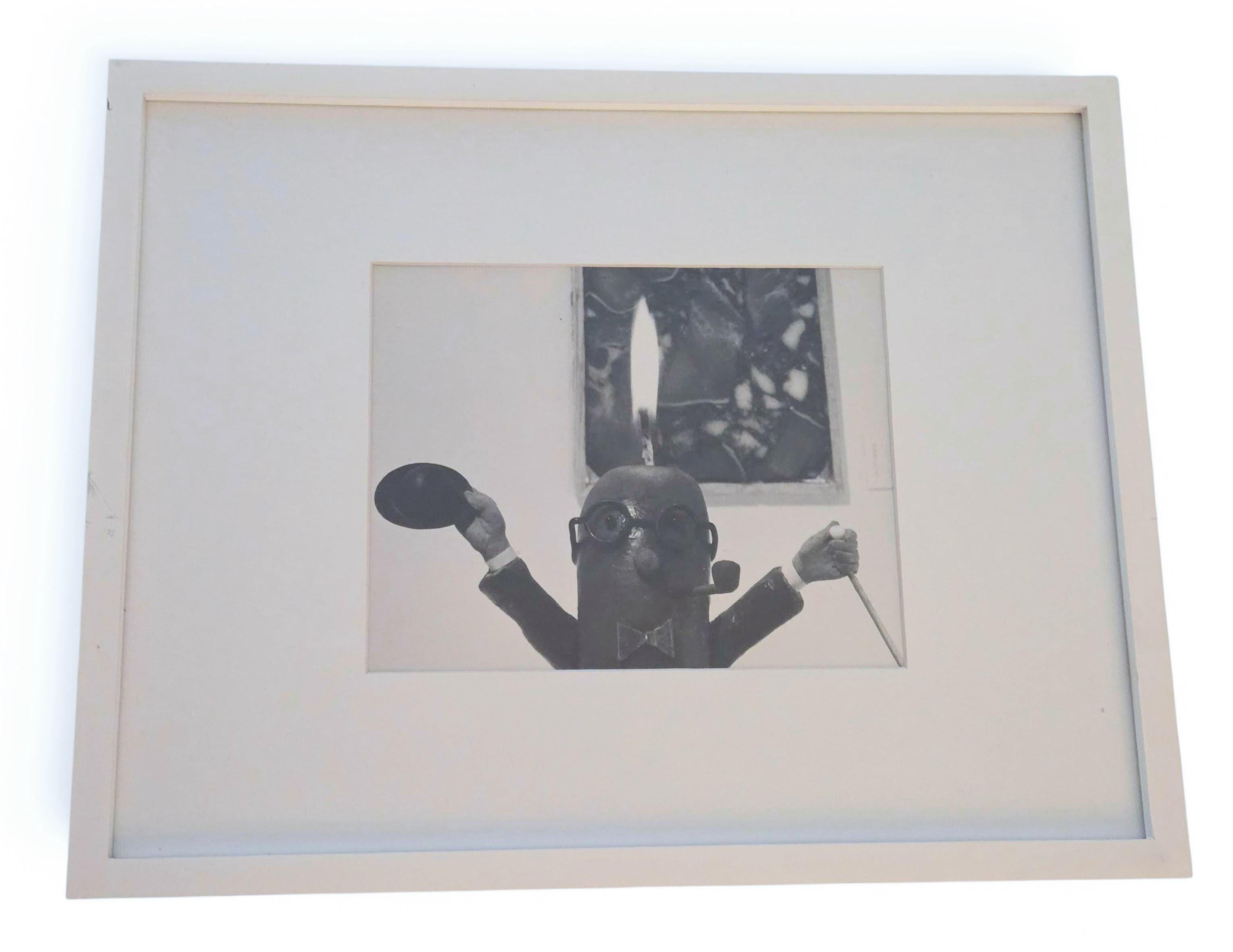
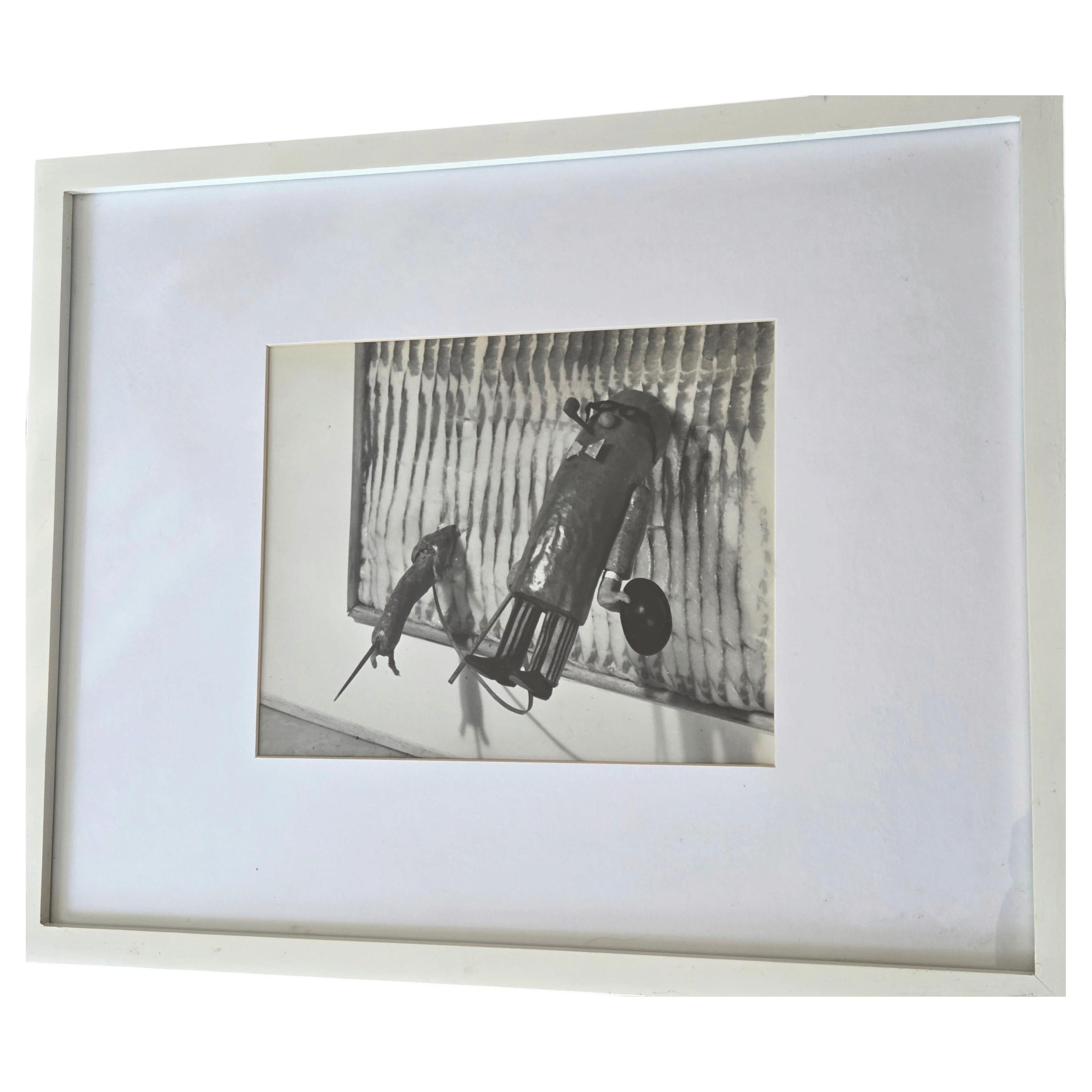
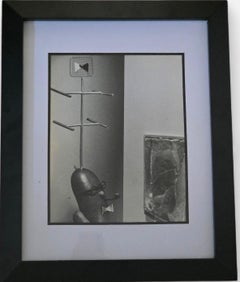
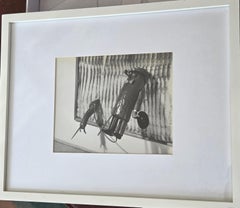
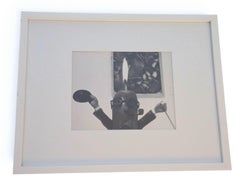
This 8 × 10 inch vintage silver gelatin print presents one of Henry Rox’s most architecturally composed “Art Critic” constructions: a solitary figure positioned before a monumental framed painting within a staged interior. The critic, rendered with precise sculptural articulation, stands in measured relation to the oversized work, establishing a dynamic between human scale and pictorial authority.
The painting—constructed from unconventional materials yet convincingly resolved as an abstract pictorial field—dominates the composition. Rox carefully calibrates proportion, framing, and placement to emphasize the tension between viewer and object. The critic functions as both anchor and counterpoint, directing attention toward the act of interpretation itself.
The composition centers on the critic, built from a tubular sausage form and articulated with small round spectacles, bow tie, pipe, and cane. His posture is slightly inclined, the head subtly lowered as if in reflective withdrawal—an inward turn following close scrutiny of the work before him. The cane rests to the floor rather than supporting him, reinforcing a moment of pause rather than movement. At his side, a dachshund extends the scene horizontally, its low, elongated body grounding the figure.
The scene is tightly arranged. The large rectangular “painting” fills the upper portion of the image, while the critic and dog occupy the lower edge. The bottom of the frame sits almost directly above the critic’s head—visually pressing downward—so that the painting appears to rest on or align with the critic’s topmost contour. This compression is deliberate: the painting dominates, and the critic is drawn into its presence rather than positioned at a distance.
Rox’s control of linear relationships is particularly refined here. The horizontal formed by the dachshund, leash, and the critic’s stance establishes a stabilizing base across the lower register of the image. This line is not strictly parallel to the picture plane but is subtly turned, creating a tension between alignment and deviation. The dachshund’s tail aligns closely with the edge of the framed painting, establishing a visual correspondence between the lower horizontal elements and the vertical boundary of the picture above. Together, these elements act as a counterweight to the mass of the painting, producing a sense of equilibrium—as if the lower structure visually supports or prevents the upper field from tipping forward.
Rox constructs every element in the scene—the figure, the dog, and the “painting”—from everyday materials, then stages and lights them with precision before photographing the result. The photograph is the final work, not a document of a prior object. What initially reads as a conventional gallery setting gradually shifts on closer inspection. The materials remain legible, and that tension is central to the work. The image holds simultaneously as a convincing presentation of modern abstraction and a measured inquiry into the conditions that confer its authority.
Lighting is controlled and frontal, allowing the surface of the “painting” to register as a coherent pictorial plane while maintaining the material ambiguity central to Rox’s method. The composition is both theatrical and analytical, positioning the gallery as a constructed space in which perception itself is staged.
Within the Art Critic series, this work extends Rox’s inquiry into questions of scale, authority, and the institutional framing of art. As with all of his photo-sculptures, the photograph is not documentation but the final artistic object.
Rox’s photo-sculptures circulated widely within mid-twentieth-century illustrated magazine culture. His constructed images appeared in publications including Life, Vogue, Town & Country, Harper’s Bazaar, Mademoiselle, Seventeen, Coronet, Collier’s, and The New York Times Magazine, participating in the editorial environment associated with Time Inc. and Condé Nast.
Context and Development
Rox’s constructed photographs emerge from the late Weimar photographic environment in which experimental approaches to lighting, object study, and staged imagery were actively developing. His photographic training in 1933 at the Berliner Fotoschule placed him within this context shortly before leaving Germany. Following his arrival in London in May 1934, he translated his sculptural training into what he termed “photo-sculpture”: carefully constructed three-dimensional tableaux created specifically for photographic realization.
A documented 1930 photograph of Rox’s Berlin studio confirms the scale and sophistication of his sculptural practice prior to exile. His subsequent photographic training in 1933 took place within this same advanced design and photographic milieu.
In London, Rox’s work entered publication through his collaboration with James Laver, resulting in Tommy Apple and His Adventures in Banana-Land (1935) and Tommy Apple and Peggy Pear (1936).
General Overview
Henry Rox (born Heinz Rosenberg, Berlin, 1899) was trained as a sculptor in Berlin and Paris before exile in 1934 necessitated a transformation in his working method. Operating first in London and later in the United States, he developed a hybrid practice in which sculptural construction, theatrical staging, and photography were fully integrated. His images appeared widely in mid-20th century publications associated with Condé Nast and Time Inc., while his sculpture continued to be exhibited in American museum contexts, including the Whitney Annual exhibitions.
Beginning in 1992, Rox’s photographs were reintroduced through a series of Modernism exhibitions in the United States, where they were engaged primarily as objects within a broader decorative and material context.
In recent years, Rox’s work has undergone renewed European institutional reassessment through the research of Wolfgang Vollmer (Cologne). This includes exhibition at Fotohof, Salzburg (2021); participation in the European Month of Photography; presentations in Paris; and inclusion in the exhibition at Bonartes Photo Institute, Vienna (December 2025 – February 2026).
Rox’s career bridges European avant-garde sculpture, émigré reinvention, British publishing culture, American commercial modernism, and postwar academic practice. His photo-sculptures stand as hybrid works—simultaneously sculptural, performative, and photographic—reflecting a practice shaped by displacement, adaptation, and sustained formal inquiry.
Rox illustrated three books: Tommy Apple and His Adventures in Banana-Land (1935), Tommy Apple and Peggy Pear (1936), and Banana Circus (1940).
No known negatives survive, and Rox’s photographs do not appear to have been produced in formal editions. Individual images exist in varying and often limited numbers.
Provenance and Survival
This group of photographs originates from Henry Rox’s final residence in South Hadley, Massachusetts, where a substantial body of material remained following the deaths of the artist and his wife. No known negatives are extant, and these prints constitute a primary material record of the artist’s photographic practice.
Condition
Very good vintage condition. Minor handling marks consistent with age. Verso with handwritten elements and later collection stamp.Henry Rox (1899–1967)
Art Critic (Standing Before Monumental Framed Post War Abstraction)
c. 1948
Vintage silver gelatin print
8 × 10 inches
Printed c. 1948
Estate stamp verso
This 8 × 10 inch vintage silver gelatin print presents one of Henry Rox’s most architecturally composed “Art Critic” constructions: a solitary figure positioned before a monumental framed painting within a staged interior. The critic, rendered with precise sculptural articulation, stands in measured relation to the oversized work, establishing a dynamic between human scale and pictorial authority.
The painting—constructed from unconventional materials yet convincingly resolved as an abstract pictorial field—dominates the composition. Rox carefully calibrates proportion, framing, and placement to emphasize the tension between viewer and object. The critic functions as both anchor and counterpoint, directing attention toward the act of interpretation itself.
The composition centers on the critic, built from a tubular sausage form and articulated with small round spectacles, bow tie, pipe, and cane. His posture is slightly inclined, the head subtly lowered as if in reflective withdrawal—an inward turn following close scrutiny of the work before him. The cane rests to the floor rather than supporting him, reinforcing a moment of pause rather than movement. At his side, a dachshund extends the scene horizontally, its low, elongated body grounding the figure.
The scene is tightly arranged. The large rectangular “painting” fills the upper portion of the image, while the critic and dog occupy the lower edge. The bottom of the frame sits almost directly above the critic’s head—visually pressing downward—so that the painting appears to rest on or align with the critic’s topmost contour. This compression is deliberate: the painting dominates, and the critic is drawn into its presence rather than positioned at a distance.
Rox’s control of linear relationships is particularly refined here. The horizontal formed by the dachshund, leash, and the critic’s stance establishes a stabilizing base across the lower register of the image. This line is not strictly parallel to the picture plane but is subtly turned, creating a tension between alignment and deviation. The dachshund’s tail aligns closely with the edge of the framed painting, establishing a visual correspondence between the lower horizontal elements and the vertical boundary of the picture above. Together, these elements act as a counterweight to the mass of the painting, producing a sense of equilibrium—as if the lower structure visually supports or prevents the upper field from tipping forward.
Rox constructs every element in the scene—the figure, the dog, and the “painting”—from everyday materials, then stages and lights them with precision before photographing the result. The photograph is the final work, not a document of a prior object. What initially reads as a conventional gallery setting gradually shifts on closer inspection. The materials remain legible, and that tension is central to the work. The image holds simultaneously as a convincing presentation of modern abstraction and a measured inquiry into the conditions that confer its authority.
Lighting is controlled and frontal, allowing the surface of the “painting” to register as a coherent pictorial plane while maintaining the material ambiguity central to Rox’s method. The composition is both theatrical and analytical, positioning the gallery as a constructed space in which perception itself is staged.
Within the Art Critic series, this work extends Rox’s inquiry into questions of scale, authority, and the institutional framing of art. As with all of his photo-sculptures, the photograph is not documentation but the final artistic object.
Rox’s photo-sculptures circulated widely within mid-twentieth-century illustrated magazine culture. His constructed images appeared in publications including Life, Vogue, Town & Country, Harper’s Bazaar, Mademoiselle, Seventeen, Coronet, Collier’s, and The New York Times Magazine, participating in the editorial environment associated with Time Inc. and Condé Nast.
Context and Development
Rox’s constructed photographs emerge from the late Weimar photographic environment in which experimental approaches to lighting, object study, and staged imagery were actively developing. His photographic training in 1933 at the Berliner Fotoschule placed him within this context shortly before leaving Germany. Following his arrival in London in May 1934, he translated his sculptural training into what he termed “photo-sculpture”: carefully constructed three-dimensional tableaux created specifically for photographic realization.
A documented 1930 photograph of Rox’s Berlin studio confirms the scale and sophistication of his sculptural practice prior to exile. His subsequent photographic training in 1933 took place within this same advanced design and photographic milieu.
In London, Rox’s work entered publication through his collaboration with James Laver, resulting in Tommy Apple and His Adventures in Banana-Land (1935) and Tommy Apple and Peggy Pear (1936).
General Overview
Henry Rox (born Heinz Rosenberg, Berlin, 1899) was trained as a sculptor in Berlin and Paris before exile in 1934 necessitated a transformation in his working method. Operating first in London and later in the United States, he developed a hybrid practice in which sculptural construction, theatrical staging, and photography were fully integrated. His images appeared widely in mid-20th century publications associated with Condé Nast and Time Inc., while his sculpture continued to be exhibited in American museum contexts, including the Whitney Annual exhibitions.
Beginning in 1992, Rox’s photographs were reintroduced through a series of Modernism exhibitions in the United States, where they were engaged primarily as objects within a broader decorative and material context.
In recent years, Rox’s work has undergone renewed European institutional reassessment through the research of Wolfgang Vollmer (Cologne). This includes exhibition at Fotohof, Salzburg (2021); participation in the European Month of Photography; presentations in Paris; and inclusion in the exhibition at Bonartes Photo Institute, Vienna (December 2025 – February 2026).
Rox’s career bridges European avant-garde sculpture, émigré reinvention, British publishing culture, American commercial modernism, and postwar academic practice. His photo-sculptures stand as hybrid works—simultaneously sculptural, performative, and photographic—reflecting a practice shaped by displacement, adaptation, and sustained formal inquiry.
Rox illustrated three books: Tommy Apple and His Adventures in Banana-Land (1935), Tommy Apple and Peggy Pear (1936), and Banana Circus (1940).
No known negatives survive, and Rox’s photographs do not appear to have been produced in formal editions. Individual images exist in varying and often limited numbers.
Provenance and Survival
This group of photographs originates from Henry Rox’s final residence in South Hadley, Massachusetts, where a substantial body of material remained following the deaths of the artist and his wife. No known negatives are extant, and these prints constitute a primary material record of the artist’s photographic practice.
Condition
Very good vintage condition. Minor handling marks consistent with age. Verso with handwritten elements and later collection stamp.
![Untitled [Science]](https://a.1stdibscdn.com/a_9323/1584647427635/Mills_Untitled_Varnished_Photo_1200_2_master.jpg?width=240)