1910s Abstract Prints

to
35
7
1
1
Overall Width
to
Overall Height
to
26
7
4
4
24
2
2
1
1
12
88
12,333
6,555
3
40
65
247
511
1,772
4,699
2,031
1,175
5
23
17
3
3
2
2
1
1
1
1
30
5
5
4
4
23
27
35
10
Period: 1910s
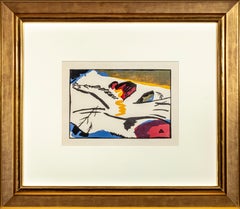
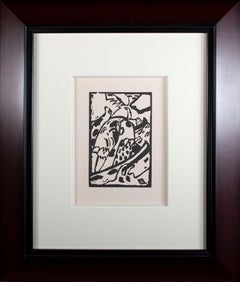
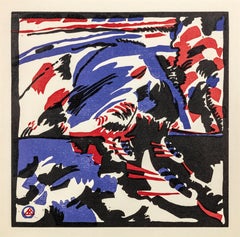
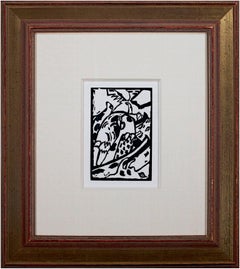
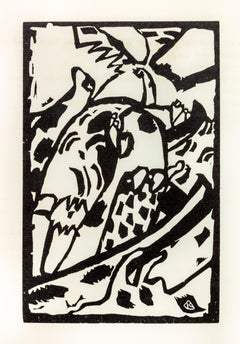
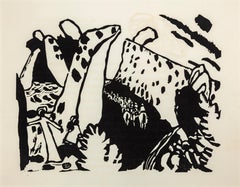
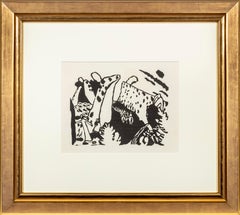
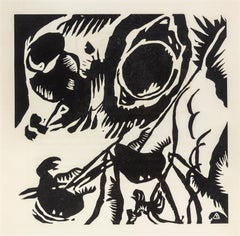
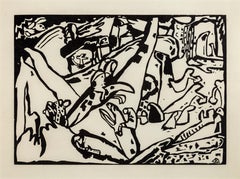
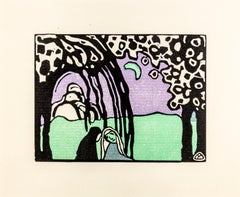
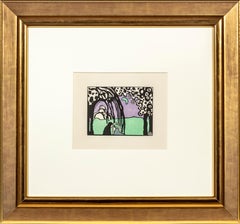
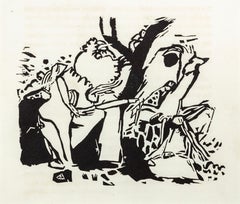
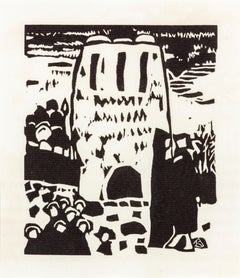
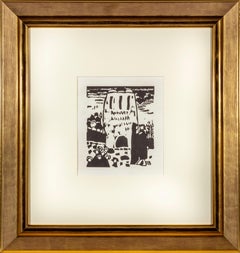
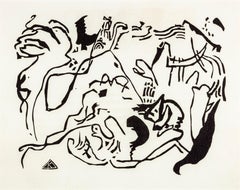
'Improvisation 7' second ed. woodcut from 'Klänge' by Wassily Kandinsky

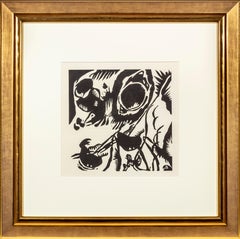
'Improvisation 7' second ed. woodcut from 'Klänge' by Wassily Kandinsky

By Wassily Kandinsky

Located in Milwaukee, WI

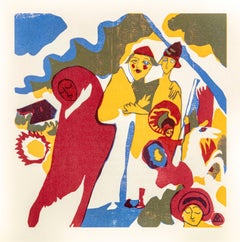
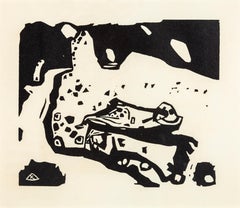
'Improvisation 7' second ed. woodcut from 'Klänge' is a woodcut print created by Wassily Kandinsky. The present woodcut print comes from the second edition of 'Klänge (Sounds),' a book of original graphics and poetry by Wassily Kandinsky. The title of the album and of this print, 'Improvisation,' demonstrated Kandinsky's interest in music and how abstract musical forms could be translated into images on a two-dimensional surface. This particular composition is difficult to read, but through the abstraction, one can make out various figures and a landscape beyond. Originally carved and printed in 1911, this second edition print was done ca. 1938. It is a woodcut in black ink on woven paper. Signed with encircled 'K' in the block, lower right (from the book, signed in ink, ed. 117/300) Image Size: 7 1/2" x 5 inches Frame Size: 22 1/4" x 18 3/4" Ref. Roethel 124 Artist Bio: The Museum of Modern Art described 'Klänge (Sounds)' as follows: Vasily Kandinsky's self-described "musical album," Klänge (Sounds), consists of thirty-eight prose-poems he wrote between 1909 and 1911 and fifty-six woodcuts he began in 1907. In the woodcuts Kandinsky veiled his subject matter, creating increasingly indecipherable images (though the horse and rider, his symbol for overcoming objective representation, runs through as a leitmotif). This process proved crucial for the development of abstraction in his art. Kandinsky said his choice of media sprang from an "inner necessity" for expression: the woodcuts were not merely illustrative, nor were the poems purely verbal descriptions. Kandinsky sought a synthesis of the arts, in which meaning was created through the interaction of, and space between, text and image, sound and meaning, mark and blank space. The experimental typography shows his interest in the physical aspects of the book. Klänge is one of three major publications by Kandinsky that appeared shortly before World War I, alongside Über die Geistige in der Kunst (Concerning the Spiritual in Art) and the Blaue Reiter almanac...

Category

Blue Rider 1910s Abstract Prints

Materials

Woodcut, Laid Paper

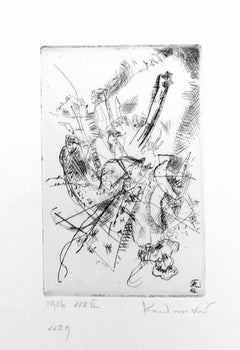
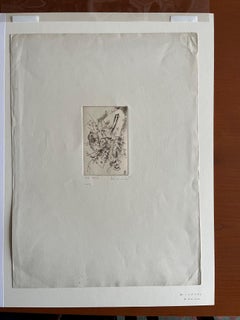
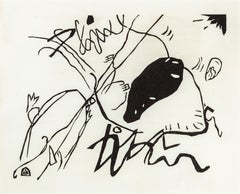
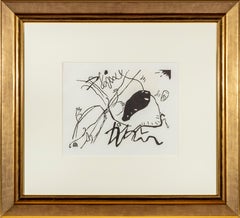
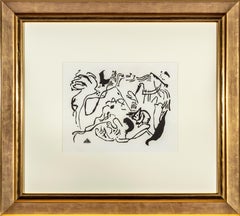
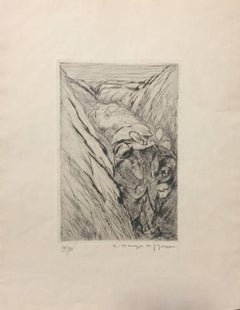
Etching 1916 Number II

Etching 1916 Number II

By Wassily Kandinsky

Located in New York, NY

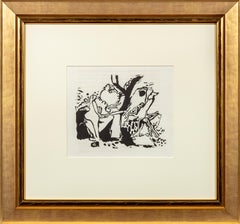
Wassily Kandinsky (1866-1944), Etching 1916 Number II, drypoint, signed in pencil lower right, titled, numbered (No. 9) and dated lower left [also with initials and date in the plate lower right]. Reference: Roethel 154, only state, edition of 10. In excellent condition (the barest handling fold at sheet edge), printed on a heavy ivory wove paper, the full sheet with full margins, 4 7/8 x 3 1/4, the sheet 17 1/2 x 13 inches, archival mount with window mat. A fine fresh impression of this great rarity, printed in a dark brown ink. Kandinsky created this drypoint (erroneously named Etching 1916) in early 1916 while staying with Gabriel Munter in Stockholm during the winter of 1915-16. This is from the second series of drypoints he made; the first was in the year 1913-14. Provenance: Kornfeld Auction, Bern, June 2007. The tiny size of this edition (10) makes this print a great rarity within the Kandinsky’s printed...

Category

Abstract 1910s Abstract Prints

Materials

Drypoint

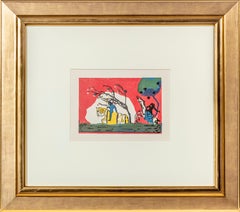
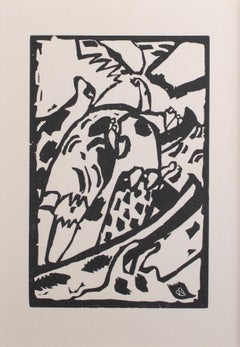
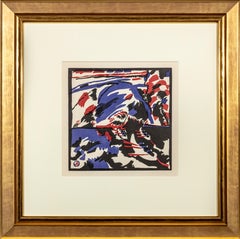
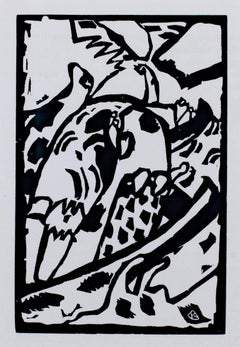
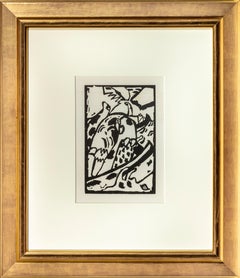
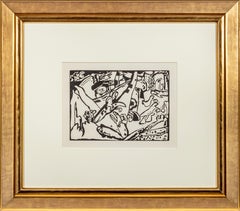
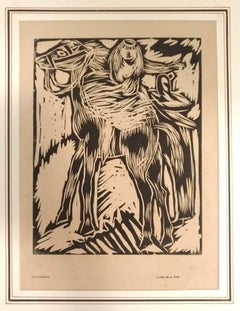
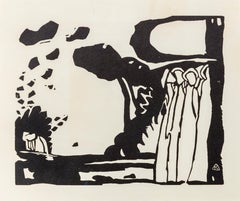
'Improvisation 7' original first ed. woodcut  from 'Klänge' by Wassily Kandinsky

'Improvisation 7' original first ed. woodcut from 'Klänge' by Wassily Kandinsky

By Wassily Kandinsky

Located in Milwaukee, WI

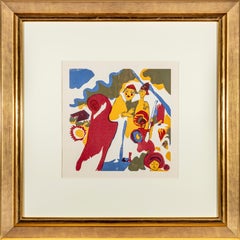
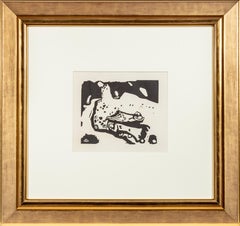
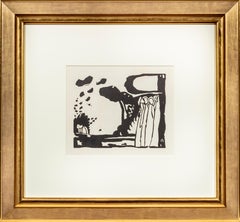
The present woodcut print comes from 'Klänge (Sounds),' a book of original graphics and poetry by Wassily Kandinsky. This first edition was released in an edition of 300, each book signed and numbered by the artist. The title of the album and this particular print, 'Improvisation,' demonstrated Kandinsky's interest in music and how abstract musical forms could be translated into images on a two-dimensional surface. This particular composition is difficult to read, but through the abstraction, one can make out various figures and a landscape beyond. 7.5 x 5 inches, image 22 x 19.5 inches, frame Woodcut in black ink on laid paper (watermark Van Gelder Zonen) Signed with encircled 'K' in the block, lower right Framed to conservation standards using 100 percent acid free archival materials including silk-lined matting with 1/4 inch bevel, museum glass, and a gold-gilded moulding Ref. Roethel 124 The Museum of Modern Art described 'Klänge (Sounds)' as follows: Vasily Kandinsky's self-described "musical album," Klänge (Sounds), consists of thirty-eight prose-poems he wrote between 1909 and 1911 and fifty-six woodcuts he began in 1907. In the woodcuts Kandinsky veiled his subject matter, creating increasingly indecipherable images (though the horse and rider, his symbol for overcoming objective representation, runs through as a leitmotif). This process proved crucial for the development of abstraction in his art. Kandinsky said his choice of media sprang from an "inner necessity" for expression: the woodcuts were not merely illustrative, nor were the poems purely verbal descriptions. Kandinsky sought a synthesis of the arts, in which meaning was created through the interaction of, and space between, text and image, sound and meaning, mark and blank space. The experimental typography shows his interest in the physical aspects of the book. Klänge is one of three major publications by Kandinsky that appeared shortly before World War I, alongside Über die Geistige in der Kunst (Concerning the Spiritual in Art) and the Blaue Reiter almanac...

Category

Blue Rider 1910s Abstract Prints

Materials

Woodcut

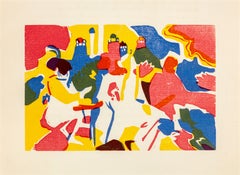
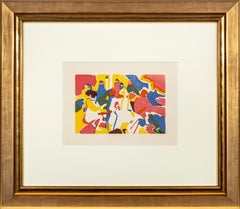
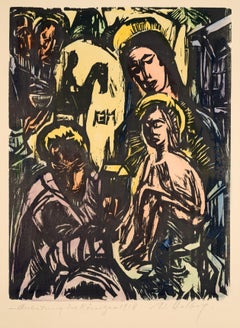
Adoration of the Magi / - The Rider of the Sun -

Adoration of the Magi / - The Rider of the Sun -

Located in Berlin, DE

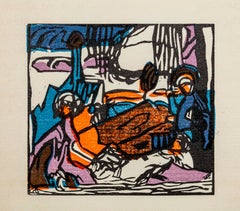
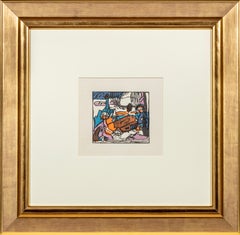
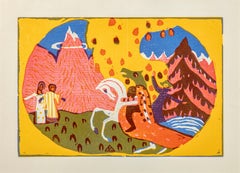
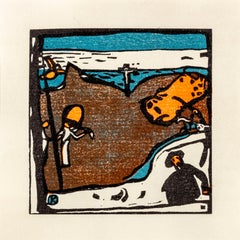
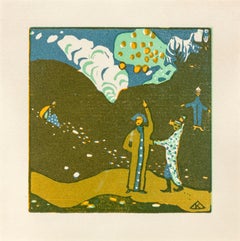
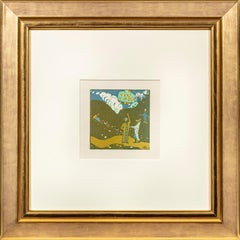
Walter Helbig (1878 Falkenstein - 1968 Ascona), Adoration of the Magi, 1918. Hand-colored linocut, 30 cm x 22.5 cm (depiction), 50 cm x 35 cm (sheet size), signed “W.[alter] Helbig” in pencil lower right, inscribed “Adoration of the Magi” lower left and dated “1918”. Below this a handwritten dedication “with heartfelt Christmas greetings”. - Paper somewhat darkened and with slight creases, thumbtack holes in the corners - The Rider of the Sun - The 'apocalypse' of World War I brought about a return to sacred art. Walter Helbig belonged to the circle of the 'Brücke' and the 'Blauer Reiter'. With his reinterpretation of religious themes in an expressionist formal language, Helbig shaped an avant-garde neo-sacred art. This is symbolically expressed in the silhouette of the rider against the sun-like yellow background. It refers to the awakening initiated by the Blue Riding, which is now linked back to the sacred. The rider and horse "look" at Mary and the Christ Child, who occupy the entire field. Opposite them are the three kings, the eldest of whom kneels before Christ and offers him a gold-filled casket. The expressionist lines give rise to a tower that rises into the "sun", so that the gift has become a Gothic church, expressing the hope that the fallen world will be resurrected in the name of Christ. This dimension of meaning is emphasized by the magical effect of the color scheme. About the artist In 1895, Walter Helbig began studying at the Dresden Academy of Art, where he became friends with the future Brücke artist Otto Müller, with whom he lived in Dresden from 1903 to 1905. While studying in Italy from 1897 to 1899, he met Arnold Böcklin and Adolf von Hildebrand. After completing his studies, he first worked for Otto Gussmann, painting churches. From 1905 to 1909 he worked as a freelance painter in Hamburg. In 1909, through the mediation of Otto Müller, Helbig made the acquaintance of artists from the 'Brücke'. In 1910 he exhibited at the founding exhibition of the Berlin 'Neue Sezession'. In the same year, he moved to Switzerland, where, together with Hans Arp and Oscar Lüthy, he founded the 'Moderne Bund' in Weggis, to which Cuno Amiet and Giovanni Giacometti also belonged. At the second exhibition of the 'Moderne Bund' in Zurich in 1911, Henri Matisse and Robert Delaunay were represented alongside artists from the 'Blauer Reiter'. In 1913, Helbig traveled to Paris with Arp and Lüthy. After the dissolution of the 'Moderne Bund', Helbig was represented at the first Dada exhibition in Zurich in 1914. In 1919, he joined the Berlin 'Novembergruppe'. After the devastation of World War I, Helbig turned increasingly to religious themes in his work. In 1924, like many other artists of his time, he moved to Ascona for financial reasons, where he became a naturalized citizen in 1938. There he founded the artists' association "The Great Bear", to which Marianne von Werefkin...

Category

Expressionist 1910s Abstract Prints
Materials

Paper

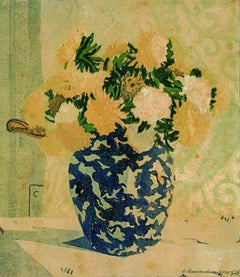
Blumen in Vase

Blumen in Vase

Located in New York, NY

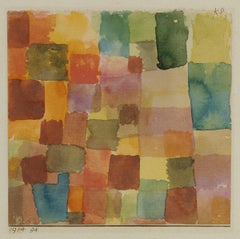
Color woodcut on Japan paper. Signed, numbered 1/30 and inscribed by the artist.

Category

Impressionist 1910s Abstract Prints

Materials

Color, Woodcut

Invocation

Invocation

By Max Weber

Located in New York, NY

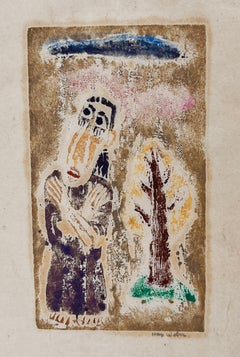
M a x W e b e r – – 1 8 8 1 – 1 9 6 1 Invocation- – 1919-20, Color Woodcut. Rubenstein 27. Proofs only. Signed in pencil. Image size 3 3/4 x 2 1/8 inches (124 x 54 mm); sheet size ...

Category

Cubist 1910s Abstract Prints

Materials

Woodcut

The Broad Curtain
The Broad Curtain

The Broad Curtain

By Childe Hassam

Located in New York, NY

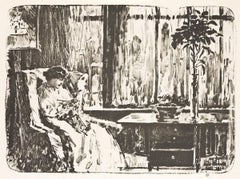
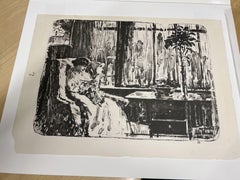
A superb, richly-inked impression of this very scarce lithotint on Japan paper. Edition of approximately 55. Signed with the artist's cypher in pencil, lower right.

Category

American Impressionist 1910s Abstract Prints

Materials

Lithograph

La Fumée du Bateau

La Fumée du Bateau

By Jean Francois Raffaëlli

Located in New York, NY

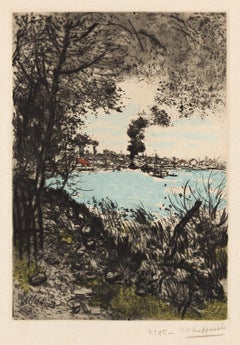
A very good impression of this color drypoint and aquatint. Third state (of 3). Edition of 150. Signed and inscribed "No. 25" in pencil, lower right.

Category

Impressionist 1910s Abstract Prints

Materials

Color, Drypoint, Aquatint

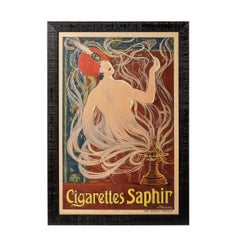
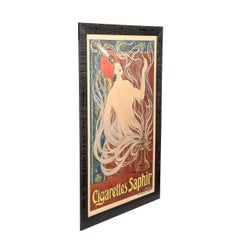
Art Nouveau Cigarettes Saphir Advertisement Poster

Art Nouveau Cigarettes Saphir Advertisement Poster

Located in New York, NY

This Art Nouveau advertisement poster for Cigarettes Saphir, France, circa 1910, is an exquisite example of the flowing elegance and evocative romanticism characteristic of the Art N...

Category

Art Nouveau 1910s Abstract Prints

Materials

Lithograph

Mosque / - The Expression of Architecture -

Mosque / - The Expression of Architecture -

Located in Berlin, DE

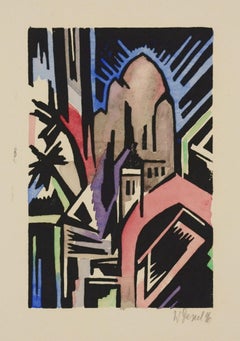
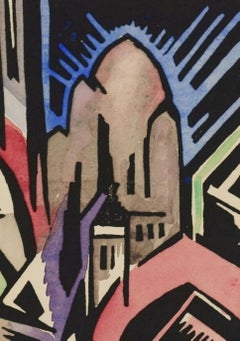
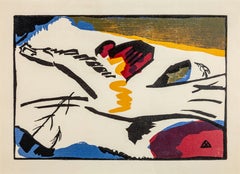
Walter Dexel (1890 Munich – 1973 Braunschweig), Mosque, 1916. Watercolor woodcut on handmade paper, 15.5 cm x 10 cm (image), 29 cm x 22.3 cm (sheet size), signed “WDexel 16” in penci...

Category

Expressionist 1910s Abstract Prints
Materials

Paper

Russian Ballet.
Russian Ballet.

Russian Ballet.

By David Bomberg

Located in New York, NY

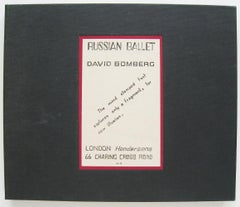
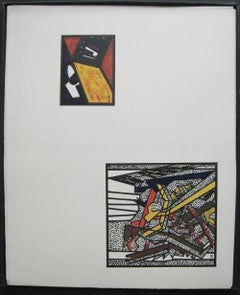
BOMBERG, David. Russian Ballet. With 6 original color lithographs by David Bomberg. London; Hendersons. [The Bomb Shop] 1919. 8 3/8 x 10 1⁄2 Inches, 8 ...

Category

Abstract 1910s Abstract Prints

Materials

Lithograph

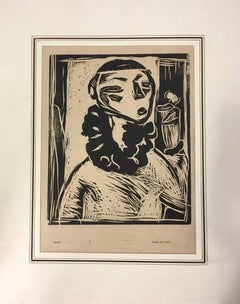
Portrait of Woman Woodcut Print, Modern Style, Circa 1910-1919, Signed

Portrait of Woman Woodcut Print, Modern Style, Circa 1910-1919, Signed

By Arturo Martini

Located in Roma, IT

This very rare xylograph is in excellent conditions. Title and signature printed on the lower margin. The artist used the name of his mother "Martini de la Valle". Passepartout included : 55 x 45 cm Image Dimensions : 30 x 24.5 cm Arturo Martini (1889-1947) was an Italian sculptor. He studied ceramics in Faenza and sculpture in Treviso. His copious artistic production is characterized by immediate plasticity, halcyon inventiveness, and thorough mastery of all technical processes: stone, bronze, terracotta...

Category

Modern 1910s Abstract Prints

Materials

Woodcut

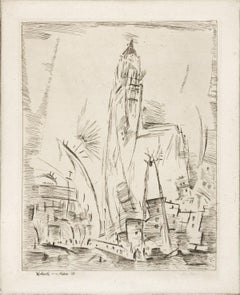
Woolworth Building, No. 2

Woolworth Building, No. 2

By John Marin

Located in New York, NY

A superb, richly-inked impression of this extremely scarce etching and drypoint. Second state (of 2). Edition of approximately only 10. Signed in pencil by Marin in lower right margi...

Category

Modern 1910s Abstract Prints

Materials

Drypoint, Etching

The Small Mechanical Workshop

The Small Mechanical Workshop

Located in London, GB

JACQUES VILLON 1875-1963 (Gaston Duchamp) Damville 1875-1963 Paris (French) Title: The Small Mechanical Workshop Le petit atelier de mécanique, 1914 ...

Category

Cubist 1910s Abstract Prints

Materials

Etching

Le Petit Équilibriste

Le Petit Équilibriste

By Jacques Villon

Located in London, GB

JACQUES VILLON 1875-1963 (Gaston Duchamp) Damville 1875-1963 Paris (French) Title: Le Petit Équilibriste, 1914 Technique: Original Hand Signed and Numbered Etching with full m...

Category

Cubist 1910s Abstract Prints

Bílé rytmy na černém II, Abstract Woodcut on Rice Paper by Frantisek Kupka

Bílé rytmy na černém II, Abstract Woodcut on Rice Paper by Frantisek Kupka

By Frantisek Kupka

Located in Long Island City, NY

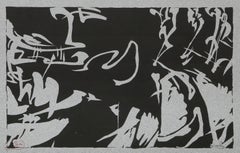
Bílé rytmy na černém II Frantisek Kupka, Czech (1871–1957) Date: 1912 Woodcut on handmade rice paper, signed in the plate and stamp signed Image Size: 10 x 16 inches Size: 15 x 22.75...

Category

Abstract Expressionist 1910s Abstract Prints
Materials

Rice Paper, Woodcut

Scene for a Fairy Tale

Scene for a Fairy Tale

By Edward Wadsworth

Located in New York, NY

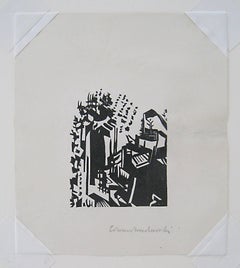
WADSWORTH, Edward. Scene for a Fairy Tale, ca 1918. Woodcut printed in black on cream wove paper, Signed in pencil (which is rare for a Wadsworth rarely signed his woodcuts). Ref: Colnaghi 126. [Exhibited as Untitled Abstract] Edward Wadsworth was an English artist, most famous for his close association with Vorticism. He painted, often in tempera, coastal views, abstracts, portraits and still-life. He was also an engraver on wood and copper. In the First World War he was involved in transferring dazzle camouflage...

Category

Abstract 1910s Abstract Prints
Materials
Woodcut