Medium Prints and Multiples

to
2,674
38,713
17,179
11,880
8,654
Overall Width
to
Overall Height
to
6,101
3,835
2,732
1,966
1,347
418
249
218
153
152
135
105
71
21
549
318
270
221
201
202
410
16,560
5,833
76
146
133
149
420
671
1,755
6,005
3,250
1,486
156
13,066
8,133
1,708
7,766
4,199
2,804
2,384
2,341
2,322
1,504
1,069
1,018
892
878
817
742
694
681
645
580
567
565
553
9,559
4,051
3,657
3,531
1,263
3,381
9,181
11,629
10,247
Size: Medium
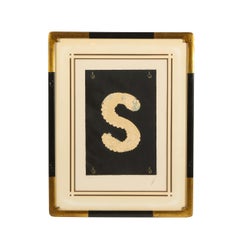
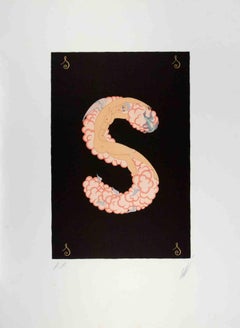
Letter "S" from Alphabet Suite (Signed Erté)

Letter "S" from Alphabet Suite (Signed Erté)

By Erté

Located in New York, NY

From the celebrated Alphabet Suite, this stunning Art Deco lithograph/serigraph was designed by the Russian-born French artist and designer known by the pseudonym Erté, and produced ...

Category

1970s Art Deco Figurative Prints

Materials

Lithograph

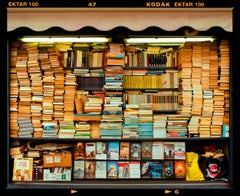
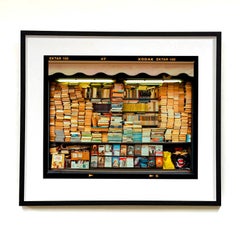
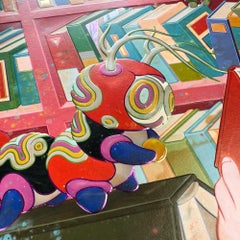
Karma, Milan - Italian bookshop street photography framed print

Karma, Milan - Italian bookshop street photography framed print

By Richard Heeps

Located in Cambridge, GB

Karma, street photography from Richard Heeps series, A Short History of Milan. 'A Short History of Milan' began in November 2018 for a special project featured at the Affordable Art...

Category

2010s Contemporary Color Photography

Materials

Photographic Paper, C Print, Color, Silver Gelatin

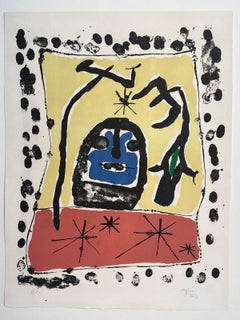
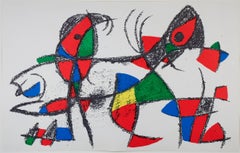
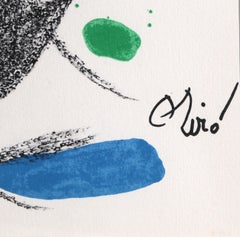
Exhibition at the Matarasso Gallery, Nice, 1957

Exhibition at the Matarasso Gallery, Nice, 1957

By Joan Miró

Located in Paris, FR

Lithograph, 1957 Edition : 125, of which 100 are numbered Publisher : Galerie Matarasso Catalog : [Maeght 247, page 103] 62.00 cm. x 48.00 cm. 24.41 in. x 18.9 in. (paper) 55.00 cm. x 44.00 cm. 21.65 in. x 17.32 in. (image) Handsigned by the artist in pencil Annotated "HC" Lithograph in colors, before letters This lithograph was used to create the poster for one of the artist's exhibitions in Nice in 1957. It is characterized by a rectangular composition bordered by black dots, and an almost primitive, spontaneous combination of primary colors. The work is characteristic of the late 1950s and early 1960s. The flat tints of color, the small dots, the stars and the graphic intensity of the image are striking. By taking up the portrait format, Miró plays with so-called classical iconography while breaking aesthetic codes. Instead of a face, we might see an Aboriginal mask...

Category

1950s Abstract Abstract Prints

Materials

Lithograph

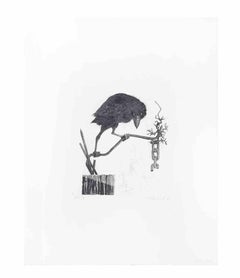
Crow on the Branch - Etching by Leo Guida - 1972

Crow on the Branch - Etching by Leo Guida - 1972

By Leo Guida

Located in Roma, IT

Crow on the Branch is an artwork realized in 1972 by the Italian Contemporary artist Leo Guida (1992 - 2017). Etching on cardboard. Hand Signed and dated on the lower right marg...

Category

1970s Contemporary Figurative Prints

Materials

Etching

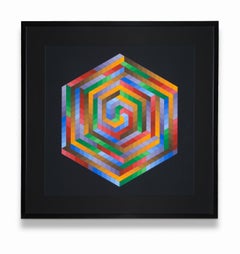
Victor Vasarely Screen Print Abstract, Geometric Squares Cubes Hexagon

Victor Vasarely Screen Print Abstract, Geometric Squares Cubes Hexagon

By Victor Vasarely

Located in Detroit, MI

Victor Vasarely born in 1906 was a Hungarian-French artist, who is widely accepted as a "grandfather" and leader of the Op Art movement. Op Art is a form of abstract art that gives the illusion of movement by the precise use of pattern and color, or in which conflicting patterns emerge and overlap. Victor Vasarely and Brigit Riley are its most famous exponents. In its visual balancing act of color and movement from a flat plane to developed continuous flow “Untitled” is a complex arrangement of squares and colors that visually expand and contract. It is one of Vasarely’s most successful Op Art abstract works. The piece is signed on the lower right and number 20/150 on the lower left. The print is behind glass and matted. Vasarely was born in Pecs and grew up in Slovakia and Budapest, where in 1925, he took up medical studies. Abandoning medicine he turned to traditional academic painting at the private Podolini-Volkmann Academy. In 1928/1929, he enrolled at Sandor Bortnyik’s private art school widely recognized as Budapest's centre of Bauhaus studies. His studies concentrated on applied graphic art and typographical design. In 1929, he painted his Blue Study and Green Study. In 1930, he married his fellow student Claire Spinner (1908–1990). Together they had two sons, Andre and Jean-Pierre. Vasarely became a graphic designer and a poster artist during the 1930s combining patterns and organic images with each other. Vasarely utilized geometric shapes and colorful graphics, the artist created compelling illusions of spatial depth, as seen in his work Vega-Nor (1969). Vasarely’s method of painting borrowed from a range of influences, including Bauhaus design principles, Wassily Kandinsky, and Constructivism. In the late 1920s, Vasarely enrolled at the Muhely Academy in Budapest, where the syllabus was largely based on Walter Gropius’s Bauhaus school in Germany. After settling in Paris in 1930, Vasarely worked in advertising agencies to support himself as a graphic artist while creating many works including Zebra (1937), which is considered by some to be one of the earliest examples of Op Art. The artist experimented in a style based in Surrealism and Abstract Expressionism during the 1940s, before arriving at his hallmark checkerboard...

Category

Mid-20th Century Op Art Abstract Prints

Materials

Paper, Screen

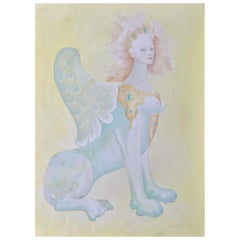
Leonor Fini, Sphinx Ariene, rare handsigned print

Leonor Fini, Sphinx Ariene, rare handsigned print

By Leonor Fini

Located in Saint-Didier, Provence-Alpes-Côte d'Azur

Rare print handsigned and numered by surrealist artist Leonor Fini, now rediscovered and inscreasingly esteemed with the movement of rediscovering art by women. It depicts a mytholog...

Category

20th Century Surrealist Figurative Prints

Materials

Paper

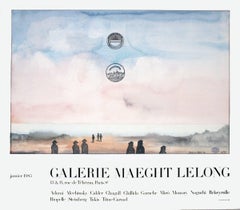
1985 After Saul Steinberg 'Galerie Maeght Lelong'

1985 After Saul Steinberg 'Galerie Maeght Lelong'

By Saul Steinberg

Located in Brooklyn, NY

Paper Size: 26.5 x 30.25 inches ( 67.31 x 76.835 cm ) Image Size: 18 x 27.5 inches ( 45.72 x 69.85 cm ) Framed: No Condition: A: Mint Additional Details: First edition exhibiti...

Category

1980s Contemporary Prints and Multiples

Materials

Offset

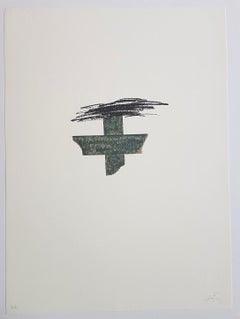
Llambrec-1
Llambrec-1

Llambrec-1

By Antoni Tàpies

Located in Kansas City, MO

Antoni Tapies Llambrec-1 Catalogue raisonné: Galfetti 539 Lithograph Year: 1975 Signed by hand and inscribed Edition: H.C. Size: 7.4 × 9.8 on 29.6 × 21.5 inches Over the course of h...

Category

1970s Modern Prints and Multiples

Materials

Lithograph

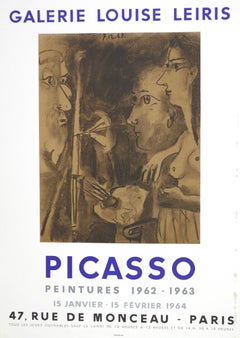
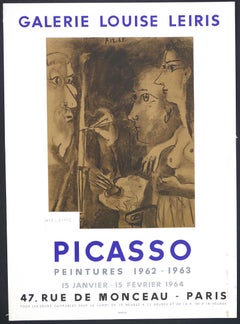
Picasso Vintage Exhibition Poster in Paris - 1964

Picasso Vintage Exhibition Poster in Paris - 1964

By Pablo Picasso

Located in Roma, IT

Picasso Exhibition Poster in Paris - 1964 is a rare and precious print of Pablo Picasso's exhibition held at Galerie Louise Leiris, Paris, 1964. Offset and photolithographed poster ...

Category

1960s Cubist Figurative Prints

Materials

Lithograph, Offset

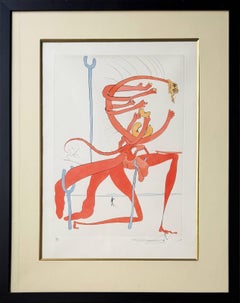
Hommage a Albrecht Durer Triomphe de Venus

Hommage a Albrecht Durer Triomphe de Venus

By Salvador Dalí­

Located in Hollywood, FL

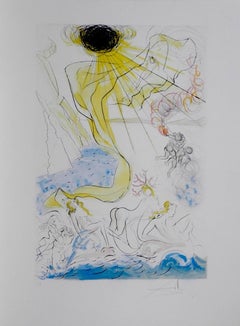
ARTIST: Salvador Dali TITLE: Hommage a Albrecht Durer Triomphe de Venus MEDIUM: Etching SIGNED: Hand Signed PUBLISHER: Vision Nouvelle EDITION NUMBER: EA MEASUREMENTS: 23" x ...

Category

1970s Surrealist More Prints

Materials

Etching

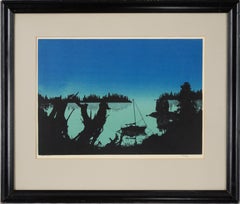
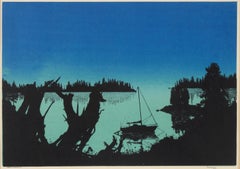
Lone Boat At Dusk - Serigraph Print

Lone Boat At Dusk - Serigraph Print

Located in Soquel, CA

Lone Boat At Dusk - Serigraph Print Original serigraph depicting a landscape scene with contrasts of black, blue and green. Hues of blue make up the ...

Category

1970s Contemporary Landscape Prints

Materials

Paper, Ink

Personalities (Limited Edition Print)

Personalities (Limited Edition Print)

By Mauro Oliveira

Located in LOS ANGELES, CA

Limited edition of 30 museum quality giclee prints on PAPER, signed and numbered by the artist. Print lead time 1 week. A "Certificate of Authenticity" issued by the artist is incl...

Category

21st Century and Contemporary Abstract More Prints

Materials

Giclée

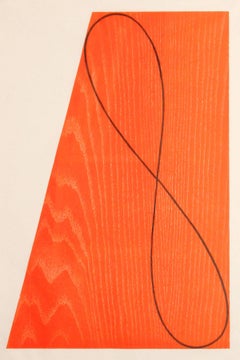
Untitled
Untitled

Untitled

By Robert Mangold

Located in New York, NY

Associated with the Minimalist art movement of the 1960s, Mangold developed a reductive vocabulary based on geometric forms, monochromatic color, and an emphasis on the flatness of t...

Category

1990s Abstract Abstract Prints

Materials

Woodcut

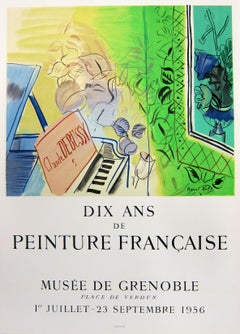
Homage to Claude Debussy - Institut Français D'Écosse (after) Raoul Dufy, 1966

Homage to Claude Debussy - Institut Français D'Écosse (after) Raoul Dufy, 1966

By Raoul Dufy

Located in New York, NY

This lithographic poster was designed in 1966 after the late artist Raoul Dufy, for an exhibition of works by Chagall, Dufy, Braque, Matisse and other French artists at the French Institute of Scotland in Edinburg. This beautiful image features a lithographic rendition of Dufy's 1952 oil painting, "Homage to Claude Debussy...

Category

1960s Modern More Prints

Materials

Lithograph

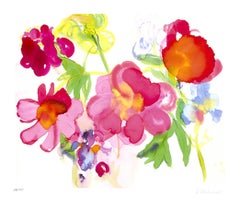
Daniela Flörsheim - "Chinese Peonies" - Color Offset Lithograph

Daniela Flörsheim - "Chinese Peonies" - Color Offset Lithograph

Located in Winterswijk, NL

Colour-intensive offset lithograph, hand signed, numbered (edition of 100) and dated (2005). Lithograph after watercolour painting: A sensitive choice of colours and an expressive br...

Category

Early 2000s Abstract Paintings

Materials

Lithograph

Fiesta, Signed Op Art Screenprint by Roy Ahlgren

Fiesta, Signed Op Art Screenprint by Roy Ahlgren

By Roy Ahlgren

Located in Long Island City, NY

Artist: Roy Ahlgren, American (1927 - 2011) Title: Fiesta Year: circa 1970 Medium: Screenprint, signed and numbered in pencil Edition: 130 Image Size: 18 x 26 inches Size: 22 x 30 in...

Category

1970s Op Art Abstract Prints

Materials

Screen

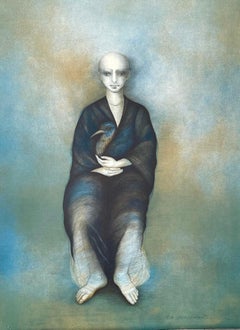
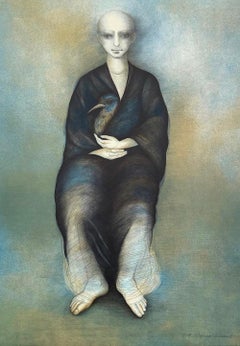
SELVAGGIA Signed Lithograph, Robed Figure, Bird, Surrealism, Latin American

SELVAGGIA Signed Lithograph, Robed Figure, Bird, Surrealism, Latin American

By Norma Bessouet

Located in Union City, NJ

SELVAGGIA is an original hand drawn limited edition lithograph by the Argentine woman artist Norma Bessouet printed using hand lithography techniques on Arches paper, 10% acid free. SELVAGGIA is unframed, in mint condition, full bleed image, hand torn edges, signed in pencil by Ms. Bessouet. Print size - 28.5 x 20.5 inches, unframed, excellent condition, pencil signed by Norma Bessouet Edition size - 150, plus proofs Year printed - 1986 Printer - J K Fine Art Editions Co. NYC Bessouet, born in Argentina, schooled in Argentina, London and in Italy, where she was able to look to the works of the Old Masters for inspiration. She refers to the artists of the Italian quattrocento along with Velazquez and El Greco as her muses, and traces of these historic artists shine through in her paintings. Her work is in numerous private and public collections throughout the world. Bessouet's art focused primarily around portraits, domesticity and the female nude. In the original print, SELVAGGIA, Norma Bessouet merges certain Latin American strands of literary magic realism with Surrealism and presents a portrait of an androgynous seated figure, with bald head, serene facial expression, wearing a full length ombre shaded robe, cradling a large, long-beak bird. Ms. Bessouet's sensitive, masterly drawing expresses a fantasy doll...

Category

1980s Surrealist Portrait Prints

Materials

Lithograph

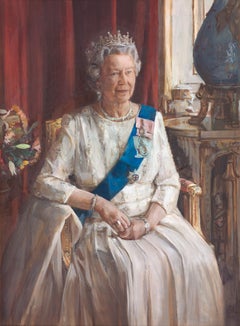
HM Queen Elizabeth II

HM Queen Elizabeth II

By Christian Furr

Located in London, GB

Christian Furr HM Queen Elizabeth II, 2022 Inkjet on 310gsm Hahnemuhle paper Paper size 70.5 x 54.2 cms Image Size 54.5 x 40.2cms Edition of 70 + 5 AP hand-signed and numbered by the...

Category

2010s Contemporary Portrait Prints

Materials

Inkjet

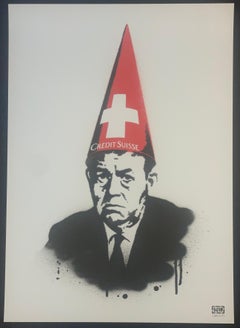
Game Over - Insert Coins - Credit Suisse Contemporary Street Urban Art

Game Over - Insert Coins - Credit Suisse Contemporary Street Urban Art

Located in Draper, UT

Game Over - Insert Coins - Credit Suisse Contemporary Street Art, 2023 Described as an ”ENRAGED ARTIST”, the work of Goin is simply like no other. In GAME OVER, INSERT COINS.” We ar...

Category

2010s Street Art Portrait Prints

Materials

Screen

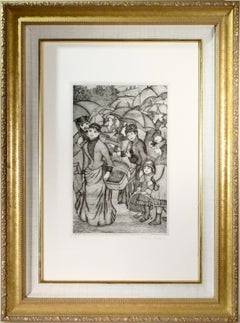
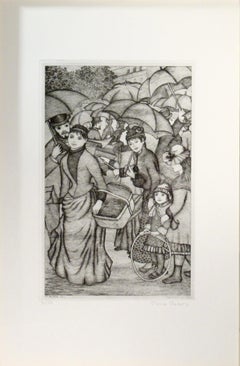
Under the Rain
Under the Rain

Under the Rain

Located in San Francisco, CA

This artwork "Under the Rain" 1992 is an original etching by French/Canadian artist Pierre Roland Renoir b.1958 (Grand son of the famous impressionist artist Pierre Auguste Renoir) I...

Category

Late 20th Century Impressionist Figurative Prints

Materials

Etching

Quevedos Visioner, Planche VI

Quevedos Visioner, Planche VI

By Salvador Dalí­

Located in OPOLE, PL

Salvador Dali (1904-1989) - Quevedos Visioner, Planche VI Etching from 1975. The edition of 295/300. Dimensions of work: 66 x 50 cm. Hand signed. Publisher: Galerie Börjeson, Ma...

Category

1970s Surrealist More Prints

Materials

Etching

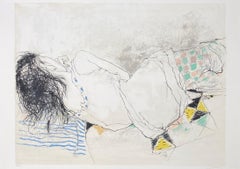
Stéphanie au collant à damier, 1989, original lithograph by Jean Jansem, signed

Stéphanie au collant à damier, 1989, original lithograph by Jean Jansem, signed

By Jean Jansem

Located in Les Acacias GE, GE

Jean Jansem (1920-2013) Stéphanie au collant à damier, 1989 Lithographie sur papier Arches Signée en bas à droite et justifiée en bas à gauche 50 x 65 cm / 54 x 76 cm Bibliographi...

Category

Late 20th Century Expressionist Figurative Prints

Materials

Lithograph

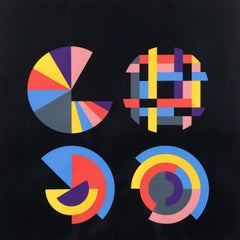
Free Arrangements of Equal Parts Geometric Abstract Screenprint by Herbert Bayer

Free Arrangements of Equal Parts Geometric Abstract Screenprint by Herbert Bayer

By Herbert Bayer

Located in Long Island City, NY

Free Arrangements of Equal Parts by Herbert Bayer, Austrian (1900–1985) Date: circa 1968 Screenprint, signed and numbered in pencil Edition of 12/75 Size: 29.75 x 29.5 in. (75.57 x 7...

Category

1960s Abstract Geometric Abstract Prints

Materials

Screen

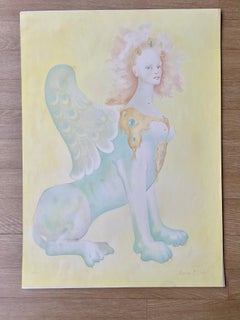
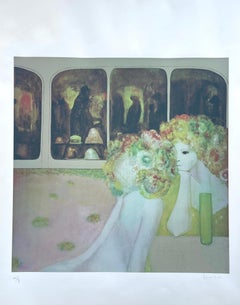
Leonor Fini, rare original serigraph on Rives paper, circa 1970

Leonor Fini, rare original serigraph on Rives paper, circa 1970

By Leonor Fini

Located in Saint-Didier, Provence-Alpes-Côte d'Azur

Rare print handsigned by surrealist artist Leonor Fini, inscreasingly esteemed with the movement of rediscovering art by women. This silkscreen is in perfect condition and from a ver...

Category

Mid-20th Century Surrealist Figurative Prints

Materials

Paper

Asunder 1

Asunder 1

By David Collins

Located in Dallas, TX

David Collins was raised in Dallas, received a BFA from the Rhode Island School of Design, and currently lives and works in New York City. Collins has had numerous solo exhibitions i...

Category

21st Century and Contemporary Contemporary Abstract Prints

Julian Stanczak Blue Op Art Screen Print

Julian Stanczak Blue Op Art Screen Print

By Julian Stanczak

Located in Lake Worth Beach, FL

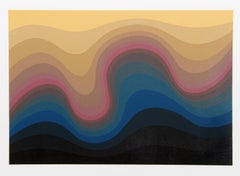
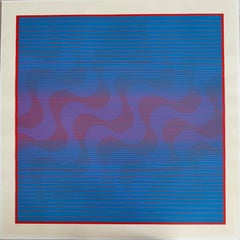
Julian Stanczak Blue Op Art Screen Print screenprint Pencil signed (lower right) edition numbered 20/165, measures 28" x 28". Black frame under Plexiglas. Julian Stanczak American/Polish, 1928-2017. Julian Stanczak explores the visual, psychological, and emotional resonance of color in his Op art paintings, through which he aims to induce a “color meltdown,” as he describes: “I want to fuse many colorants and their gradations into a single color experience.” Influenced by Josef Albers and Russian Suprematism...

Category

1970s Op Art Abstract Prints

Materials

Screen

Don Juan: The Banquet (Le Banquet)

Don Juan: The Banquet (Le Banquet)

By Salvador Dalí­

Located in Santa Monica, CA

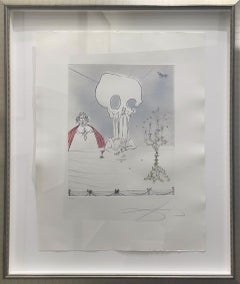
Salvador Dali Don Juan: The Banquet (Le Banquet), Published 1970 Medium: Hand-Colored Drypoint Etching on Arches Paper Edition: 38/250 Artwork Size: 25 x 20 in Framed Size: 33 ...

Category

1970s Surrealist Figurative Prints

Materials

Etching

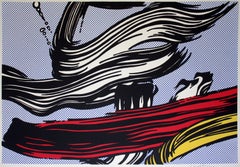
Brushstrokes (C.45)
Brushstrokes (C.45)

Brushstrokes (C.45)

By Roy Lichtenstein

Located in New York, NY

Screenprint on off-white wove paper Signed and numbered in pencil: 44 from 300 plus an unknown number of AP (inscribed A/P).

Category

20th Century Pop Art Prints and Multiples

Materials

Screen

Untitled (A)
Untitled (A)

Untitled (A)

By Thomas Nozkowski

Located in New York, NY

Thomas Nozkowski (b. 1944, Teaneck, New Jersey; d. 2019, New York) was recognized for his richly colored and intimately scaled abstract paintings, drawings, and prints that push the...

Category

Early 2000s Abstract Abstract Prints

Materials

Color, Aquatint

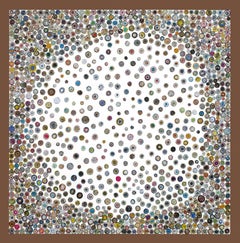
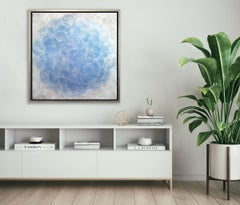
"Dichondra, " Framed Limited Edition Giclee Print, 24" x 24"

"Dichondra, " Framed Limited Edition Giclee Print, 24" x 24"

By Roger Mudre

Located in Westport, CT

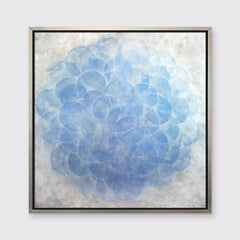
This Limited Edition giclee print by Roger Mudre features nearly transparent light blue circles, arranged in an overlapping pattern to create a larger circle shape. The outer layer o...

Category

2010s Contemporary Abstract Prints

Materials

Digital, Giclée

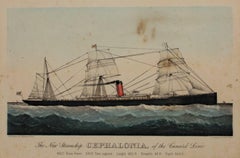
19th century color lithograph seascape boat ship waves maritime landscape

19th century color lithograph seascape boat ship waves maritime landscape

By Currier & Ives

Located in Milwaukee, WI

"The New Steamship Cephalonia, of the Cunard Line" is an original hand-colored lithograph by Currier & Ives. It depicts a large sailing steamship. There is a significant stain in the artwork in the upper center. 12" x 16 3/4" art 21" x 26" frame Nathaniel Currier was a tall introspective man with a melancholy nature. He could captivate people with his piercing stare or charm them with his sparkling blue eyes. Nathaniel was born in Roxbury, Massachusetts on March 27th, 1813, the second of four children. His parents, Nathaniel and Hannah Currier, were distant cousins who lived a humble yet spartan life. When Nathaniel was eight years old, tragedy struck. Nathaniel’s father unexpectedly passed away leaving Nathaniel and his eleven-year-old brother Lorenzo to provide for the family. In addition to their mother, Nathaniel and Lorenzo had to care for six-year-old sister Elizabeth and two-year-old brother Charles. Nathaniel worked a series of odd jobs to support the family, and at fifteen, he started what would become a life-long career when he apprenticed in the Boston lithography shop of William and John Pendleton. A Bavarian gentleman named Alois Senefelder invented lithography just 30 years prior to young Nat Currier’s apprenticeship. While under the employ of the brothers Pendleton, Nat was taught the art of lithography by the firm’s chief printer, a French national named Dubois, who brought the lithography trade to America. Lithography involves grinding a piece of limestone flat and smooth then drawing in mirror image on the stone with a special grease pencil. After the image is completed, the stone is etched with a solution of aqua fortis leaving the greased areas in slight relief. Water is then used to wet the stone and greased-ink is rolled onto the raised areas. Since grease and water do not mix, the greased-ink is repelled by the moisture on the stone and clings to the original grease pencil lines. The stone is then placed in a press and used as a printing block to impart black on white images to paper. In 1833, now twenty-years old and an accomplished lithographer, Nat Currier left Boston and moved to Philadelphia to do contract work for M.E.D. Brown, a noted engraver and printer. With the promise of good money, Currier hired on to help Brown prepare lithographic stones of scientific images for the American Journal of Sciences and Arts. When Nat completed the contract work in 1834, he traveled to New York City to work once again for his mentor John Pendleton, who was now operating his own shop located at 137 Broadway. Soon after the reunion, Pendleton expressed an interest in returning to Boston and offered to sell his print shop to Currier. Young Nat did not have the financial resources to buy the shop, but being the resourceful type he found another local printer by the name of Stodart. Together they bought Pendleton’s business. The firm ‘Currier & Stodart’ specialized in "job" printing. They produced many different types of printed items, most notably music manuscripts for local publishers. By 1835, Stodart was frustrated that the business was not making enough money and he ended the partnership, taking his investment with him. With little more than some lithographic stones, and a talent for his trade, twenty-two year old Nat Currier set up shop in a temporary office at 1 Wall Street in New York City. He named his new enterprise ‘N. Currier, Lithographer’ Nathaniel continued as a job printer and duplicated everything from music sheets to architectural plans. He experimented with portraits, disaster scenes and memorial prints, and any thing that he could sell to the public from tables in front of his shop. During 1835 he produced a disaster print Ruins of the Planter's Hotel, New Orleans, which fell at two O’clock on the Morning of the 15th of May 1835, burying 50 persons, 40 of whom Escaped with their Lives. The public had a thirst for newsworthy events, and newspapers of the day did not include pictures. By producing this print, Nat gave the public a new way to “see” the news. The print sold reasonably well, an important fact that was not lost on Currier. Nat met and married Eliza Farnsworth in 1840. He also produced a print that same year titled Awful Conflagration of the Steamboat Lexington in Long Island Sound on Monday Evening, January 18, 1840, by which melancholy occurrence over One Hundred Persons Perished. This print sold out very quickly, and Currier was approached by an enterprising publication who contracted him to print a single sheet addition of their paper, the New York Sun. This single page paper is presumed to be the first illustrated newspaper ever published. The success of the Lexington print launched his career nationally and put him in a position to finally lift his family up. In 1841, Nat and Eliza had their first child, a son they named Edward West Currier. That same year Nat hired his twenty-one year old brother Charles and taught him the lithography trade, he also hired his artistically inclined brother Lorenzo to travel out west and make sketches of the new frontier as material for future prints. Charles worked for the firm on and off over the years, and invented a new type of lithographic crayon which he patented and named the Crayola. Lorenzo continued selling sketches to Nat for the next few years. In 1843, Nat and Eliza had a daughter, Eliza West Currier, but tragedy struck in early 1847 when their young daughter died from a prolonged illness. Nat and Eliza were grief stricken, and Eliza, driven by despair, gave up on life and passed away just four months after her daughter’s death. The subject of Nat Currier’s artwork changed following the death of his wife and daughter, and he produced many memorial prints and sentimental prints during the late 1840s. The memorial prints generally depicted grief stricken families posed by gravestones (the stones were left blank so the purchasers could fill in the names of the dearly departed). The sentimental prints usually depicted idealized portraits of women and children, titled with popular Christian names of the day. Late in 1847, Nat Currier married Lura Ormsbee, a friend of the family. Lura was a self-sufficient woman, and she immediately set out to help Nat raise six-year-old Edward and get their house in order. In 1849, Lura delivered a son, Walter Black Currier, but fate dealt them a blow when young Walter died one year later. While Nat and Lura were grieving the loss of their new son, word came from San Francisco that Nat’s brother Lorenzo had also passed away from a brief illness. Nat sank deeper into his natural quiet melancholy. Friends stopped by to console the couple, and Lura began to set an extra place at their table for these unexpected guests. She continued this tradition throughout their lives. In 1852, Charles introduced a friend, James Merritt Ives, to Nat and suggested he hire him as a bookkeeper. Jim Ives was a native New Yorker born in 1824 and raised on the grounds of Bellevue Hospital where his father was employed as superintendent. Jim was a self-trained artist and professional bookkeeper. He was also a plump and jovial man, presenting the exact opposite image of his new boss. Jim Ives met Charles Currier through Caroline Clark, the object of Jim’s affection. Caroline’s sister Elizabeth was married to Charles, and Caroline was a close friend of the Currier family. Jim eventually proposed marriage to Caroline and solicited an introduction to Nat Currier, through Charles, in hopes of securing a more stable income to support his future wife. Ives quickly set out to improve and modernize his new employer’s bookkeeping methods. He reorganized the firm’s sizable inventory, and used his artistic skills to streamline the firm’s production methods. By 1857, Nathaniel had become so dependent on Jims’ skills and initiative that he offered him a full partnership in the firm and appointed him general manager. The two men chose the name ‘Currier & Ives’ for the new partnership, and became close friends. Currier & Ives produced their prints in a building at 33 Spruce Street where they occupied the third, fourth and fifth floors. The third floor was devoted to the hand operated printing presses that were built by Nat's cousin, Cyrus Currier, at his shop Cyrus Currier & Sons in Newark, NJ. The fourth floor found the artists, lithographers and the stone grinders at work. The fifth floor housed the coloring department, and was one of the earliest production lines in the country. The colorists were generally immigrant girls, mostly German, who came to America with some formal artistic training. Each colorist was responsible for adding a single color to a print. As a colorist finished applying their color, the print was passed down the line to the next colorist to add their color. The colorists worked from a master print displayed above their table, which showed where the proper colors were to be placed. At the end of the table was a touch up artist who checked the prints for quality, touching-in areas that may have been missed as it passed down the line. During the Civil War, demand for prints became so great that coloring stencils were developed to speed up production. Although most Currier & Ives prints were colored in house, some were sent out to contract artists. The rate Currier & Ives paid these artists for coloring work was one dollar per one hundred small folios (a penny a print) and one dollar per one dozen large folios. Currier & Ives also offered uncolored prints to dealers, with instructions (included on the price list) on how to 'prepare the prints for coloring.' In addition, schools could order uncolored prints from the firm’s catalogue to use in their painting classes. Nathaniel Currier and James Merritt Ives attracted a wide circle of friends during their years in business. Some of their more famous acquaintances included Horace Greeley, Phineas T. Barnum, and the outspoken abolitionists Rev. Henry Ward, and John Greenleaf Whittier (the latter being a cousin of Mr. Currier). Nat Currier and Jim Ives described their business as "Publishers of Cheap and Popular Pictures" and produced many categories of prints. These included Disaster Scenes, Sentimental Images, Sports, Humor, Hunting Scenes, Politics, Religion, City and Rural Scenes, Trains, Ships, Fire Fighters, Famous Race Horses, Historical Portraits, and just about any other topic that satisfied the general public's taste. In all, the firm produced in excess of 7500 different titles, totaling over one million prints produced from 1835 to 1907. Nat Currier retired in 1880, and signed over his share of the firm to his son Edward. Nat died eight years later at his summer home 'Lion’s Gate' in Amesbury, Massachusetts. Jim Ives remained active in the firm until his death in 1895, when his share of the firm passed to his eldest son, Chauncey. In 1902, faced will failing health from the ravages of Tuberculosis, Edward Currier sold his share of the firm to Chauncey Ives...

Category

1870s Other Art Style Prints and Multiples

Materials
Lithograph

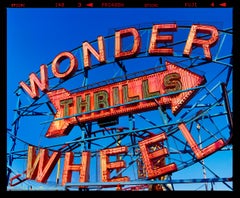
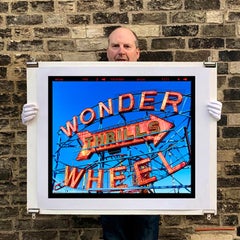
Thrills, Coney Island, New Your - American Color Typography Photography

Thrills, Coney Island, New Your - American Color Typography Photography

By Richard Heeps
Located in Cambridge, GB

Thrills, the iconic Coney Island Wonder Wheel photograph by Richard Heeps. The bold typography of the architectural structure fills the Fuji Film frame combining Richard's signature ...

Category

2010s Contemporary Color Photography

Materials

Photographic Paper, C Print, Color, Silver Gelatin