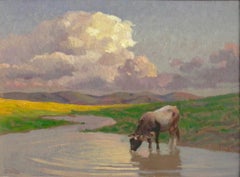
Alberto Zardo Art

Italian, 1876-1959

Alberto Zardo was an Italian painter and artist. He went to Florence where he was a pupil of Raffaello Sorbi. He also attended sculpture courses and had artist Augusto Rivalta as his teacher. Convinced realist, he also produced paintings with a lively complexion departing from the Tuscan School. In 1901, the artist won the Alinari Competition prize for the illustration of the Divina Commedia; in 1918, he was appointed resident member of the Florentine Academy.

to
1
Overall Width
to
Overall Height
to
1
1
1
1
1
1
1
1
11,049
2,853
2,494
1,431
1
1
Artist: Alberto Zardo
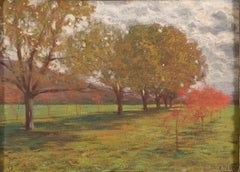
Landscape with Trees - Oil on Cardboard by Alberto Zardo

Landscape with Trees - Oil on Cardboard by Alberto Zardo

By Alberto Zardo

Located in Roma, IT

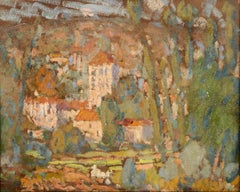
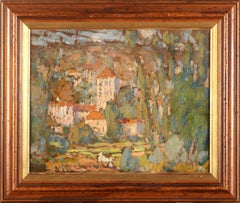
Landscape with Trees is an original modern artwork realized by the Italian painter Alberto Zardo in the first decades of the XX Century. Original oil on cardboard. Hand-signed by ...

Category

Early 20th Century Modern Alberto Zardo Art

Materials

Oil, Cardboard

Related Items
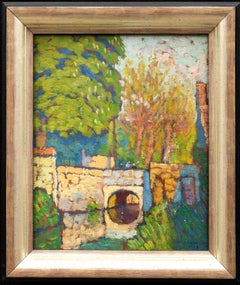
The Bridge Over the Sauceron at Nesles la Vallée (Val d'Oise) Maurice de Lambert

The Bridge Over the Sauceron at Nesles la Vallée (Val d'Oise) Maurice de Lambert

Located in SANTA FE, NM

"The Bridge upon the Sauceron at Nesles la Vallée (Val d'Oise), 1918" Maurice Walter Edmond de Lambert (French, 1873-1952) Oil on cardboard Signed and dated lower right 10 3/4 x 8 3/...

Category

1910s Post-Impressionist Alberto Zardo Art

Materials

Oil, Cardboard

Autumn Landscape in Sunlight - Indian Summer -

Autumn Landscape in Sunlight - Indian Summer -

Located in Berlin, DE

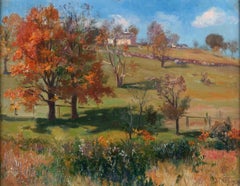
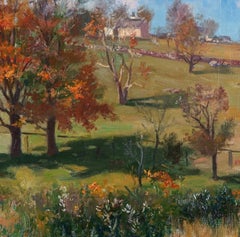
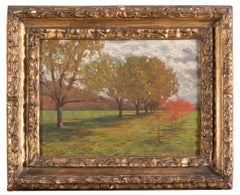
Frederick Vezin (1859 Torresdale Philadelphia - 1933 Düsseldorf), Autumn Landscape in the Sunlight, oil on canvas, mounted on cardboard, 32 x 41 cm (inside measurement), 44 x 51 cm (frame), signed and dates lower right "F. Vezin. [19]05". - Cardboard slightly curved, small inconspicuous retouch at the centre of the upper edge of the picture. About the artwork Although the painting appears to be a sketch, Frederick Vezin considered it to be a finished work of art, as evidenced by his signature on the lower right. And it is precisely this sketchy quality that leads to an understanding of the painting, which was certainly created in the landscape itself: the natural phenomena were to be depicted artistically at the moment of their observation. This is not done by meticulously sketching nature, but - and here Vezin follows the teaching of French Impressionism - by illustrating nature in its visual fullness. The artist's eye is, as it were, immersed in the visuality of nature, which is made visible by his hand. The painting is therefore not a reflection of the landscape, but its artistic intensification. This intensification also includes the fact that the foreground of the painting - corresponding to the field of vision - eludes a detail-oriented close-up view. Instead, the spatula-like application of paint, the vertical structure of which corresponds to the structure of the floral growth, has the effect of making nature tangible in its colourful substance. At the same time, the foreground, which remains indeterminate in its concrete objectivity, creates an atmospheric space that connects with the actual protagonist of the picture, the group of trees, which flares up in shades of red and brown. Here, too, the leaves are more speckled than clearly outlined. It is precisely this 'sketchiness' that opens up a visual experience that makes the landscape accessible in its visual fullness, thus revealing its essence. In addition to this abundance, the landscape is presented as a structure of order in that the composition of the picture makes the composition of the landscape visible. For example, the group of trees forms a distinct dark green shadow, which is repeated in the shadows cast by the trees behind it. A patterned diagonal axis is created in the picture, which is composed in this way by the landscape itself. Strictly speaking, this is a cultivated landscape: a fence at the bottom and a low stone wall at the top, running from left to right, are two elements that also have a strong compositional effect. And on the top of the hill, a stone house is embedded in the landscape as the brightest surface in the picture. Nature and culture here form a harmonious synthesis, giving the painting an Arcadian touch. In order to give the landscape as much space as possible, the horizon line is raised, but the design of the sky is also crucial. The clouds, combined with the shapes of the trees, create a bright blue sky. To the European eye, such a sky is reminiscent of a summer landscape. Accordingly, within the seasonal cycle, the blue sky is reserved for summer, and French Impressionism is also primarily an ode to summer. In Vezin's painting, however, the brilliant blue sky stands above an autumnal landscape, some of the trees even defoliated. It can therefore be assumed that the painting was made not in Europe but in the United States, and that it illustrates the proverbial Indian summer, making Frederick Vezin a pioneer of American landscape painting. About the artist Frederick Vezin was the son of a French immigrant to the United States and a German-born mother. This predestined him to promote artistic exchange between the old and new worlds. Having spent part of his schooling in Germany, in 1876, at the age of 20, he enrolled at the Düsseldorf Academy of Art, where he studied with Peter Janssen the Elder, Eduard von Gebhardt and Wilhelm Sohn, among others. He graduated in 1883, settled in Munich and returned to Düsseldorf in 1895, where he lived until his death in 1933. A native of the United States, he travelled to the country frequently and became a popular portrait and society painter. His artistic talent, however, was most evident in his landscape paintings. Trained in French Impressionism, he developed a virtuoso use of colour and a free brushwork that remained tied to the landscape motif, opening up the landscape itself in a new way. Frederick Vezin turned his attention primarily to the landscape of his homeland, becoming a pioneer of modern American landscape...

Category

Early 1900s Impressionist Alberto Zardo Art
Materials

Oil, Cardboard

Ottone Zorlini (Italian master) - 20th century mountain lake plein air view

Ottone Zorlini (Italian master) - 20th century mountain lake plein air view

Located in Varmo, IT

Ottone Zorlini (Treviso 1891 - San Paolo 1967) - Landscape with Lake and Mountains. 23.5 x 30.5 cm unframed, 38.5 x 45 cm with frame. Oil on cardboard, in a wooden frame. - Signed...

Category

Mid-20th Century Realist Alberto Zardo Art

Materials

Oil, Cardboard

Ottone Zorlini (Italian master) - 20th century plein air landscape, arches

Ottone Zorlini (Italian master) - 20th century plein air landscape, arches

Located in Varmo, IT

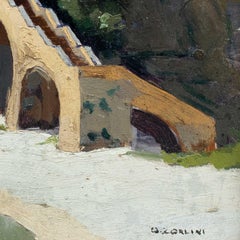
Ottone Zorlini (Treviso 1891 - São Paulo 1967) - Landscape with stairway. 25.5 x 33.5 cm (without frame) - 35 x 43 cm (with frame). Oil on cardboard, in wooden frame. Signed lower...

Category

Mid-20th Century Realist Alberto Zardo Art

Materials

Oil, Cardboard

"Along Peconic Bay, Long Island" Irving Ramsey Wiles, Impressionist Work

"Along Peconic Bay, Long Island" Irving Ramsey Wiles, Impressionist Work

By Irving Ramsey Wiles

Located in New York, NY

Irving Ramsey Wiles Along Peconic Bay, Long Island Signed lower left Oil on canvas laid on cardboard 8 x 10 inches In his heyday—the first quarter of the twentieth century—Irving W...

Category

1910s American Impressionist Alberto Zardo Art
Materials

Canvas, Oil, Cardboard

"Days End" - Volcano, California 1970's Horizontal Landscape

"Days End" - Volcano, California 1970's Horizontal Landscape

By Frederick Colbus

Located in Soquel, CA

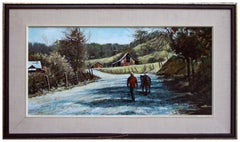
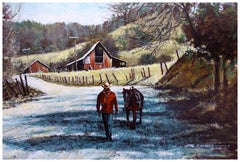
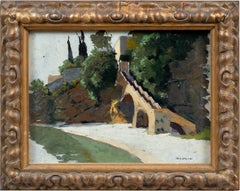
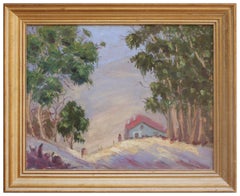
A charming scene of a man leading his horse down a country lane near a red barn in Volcano, CA by listed artist Frederick Colbus (American, 1917-1986). Signed and dated "F. Colbus, 1978" lower right. On verso titled "Days End" (Volcano, CA), signed F. Colbus, and dated July 30, 1978. Presented in a wood frame with linen liner. Image size: 12"H x 24"L Frederick Colbus was born in Daly City...

Category

1970s American Impressionist Alberto Zardo Art
Materials

Canvas, Oil, Cardboard

View of Caillac in Lot department

View of Caillac in Lot department

Located in BELEYMAS, FR

Joseph LÉPINE (Rochefort 1867 – Paris 1943) The Church of Caillac - Lot Oil on cardboard H. 33 cm; W. 41 cm Signed lower left Joseph Lépine quickly moved to Bordeaux, where he studied under Louis-Alexandre Cabié, a well-known landscape painter in the region and teacher of many early 20th-century artists. Despite the master's warnings, he sought to confront the Parisian modernity of the late 19th century and discover Impressionist and even early Post-Impressionist styles. There, he became a student of the neoclassical painters Courtois and Girardot, both former students of the great Jean-Léon Gérôme. In 1897, he exhibited at the Salon, where he sent landscapes of Provence. He became a member of the Société des Artistes Indépendants in 1905, the same year that the Fauves Matisse, Derain, and Vlaminck participated in and became known at the Salon d'Automne. A purchase by the French government of the 1908 Salon des Indépendants, "Vieille boutique," now housed at the Menton Museum, officially launched his career. He exhibited that year in London at the Royal Albert Hall, at the invitation of the Allied Artists' Association, demonstrating the painter's distinguished status within the international art scene. In Paris, the artist met several well-known painters of the time in the Montmartre and Montparnasse neighborhoods, including Matisse and Signac. His painting is based in particular on his approach to material, light, and color, whose juxtapositions present a play of saturation and composition based on apparent reserves. After the First World War, Lépine returned more to his home region, where he painted landscapes around Bordeaux and up the Dordogne River to the charming landscapes of the lower Corrèze. He painted Beaulieu-sur-Dordogne, Argentat, and also the Lot region, with the built-up escarpments of Saint Circq Lapopie. The city of Bordeaux and the French government acquired two of his works, representing a landscape near Verdelais and a view of the Saint-Michel Church in Bordeaux, in 1939 and 1941. Considered today a very important figure in Bordeaux painting...

Category

1920s French School Alberto Zardo Art

Materials

Oil, Cardboard

Chinese Contemporary Art by Su Yu - Qiang Lang

Chinese Contemporary Art by Su Yu - Qiang Lang

By Su Yu

Located in Paris, IDF

Oil on canvas Su Yu is a Chinese artist born in 1987 who lives and works in Beijing. He was an old student of prestigious art teachers as Shi Liang & Chen Danqing at Oil Paintin...

Category

2010s Realist Alberto Zardo Art

Materials

Oil, Cardboard

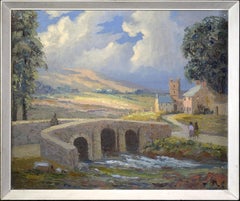
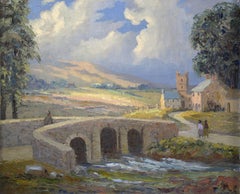
Vintage 1956 British Impressionist Landscape Oil Painting Stone Bridge River

Vintage 1956 British Impressionist Landscape Oil Painting Stone Bridge River

Located in Stockholm, SE

This vivid mid-20th-century landscape by professional British artist John Edwards (1914–2009) captures a stunning Cornish view with a rushing river beneath an old stone bridge. Paint...

Category

1950s Post-Impressionist Alberto Zardo Art
Materials

Wood, Oil, Cardboard

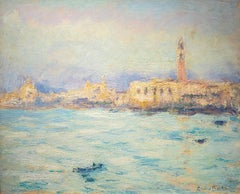
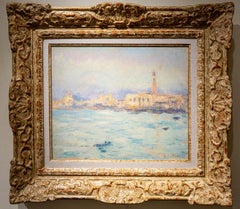
Venise
Venise

André Georges BarbierVenise

$9,342

H 14.97 in W 18.12 in

Venise

By André Georges Barbier

Located in LE HAVRE, FR

André BARBIER (1883-1970) Venise Oil on cardboard mounted on canvas Dimensions of the painting: 38 x 46 cm Signed lower right Painting in perfect condition. Very beautiful carved a...

Category

Mid-20th Century Post-Impressionist Alberto Zardo Art
Materials

Canvas, Oil, Cardboard

In Solitude by the Sea, Expressionist Oil Painting on Canvas, 2010-

In Solitude by the Sea, Expressionist Oil Painting on Canvas, 2010-

By Elena Lukina

Located in Zofingen, AG

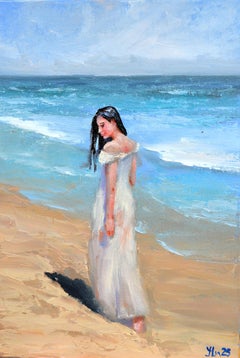
"In solitude by the sea" is an original oil painting on canvas that captures a quiet moment on the beach. Soft brushstrokes and a delicate expression evoke solitude and introspection...

Category

2010s Expressionist Alberto Zardo Art
Materials

Canvas, Oil, Cardboard

Previously Available Items

Alberto Zardo art for sale on 1stDibs.

Find a wide variety of authentic Alberto Zardo art available for sale on 1stDibs. If you’re browsing the collection of art to introduce a pop of color in a neutral corner of your living room or bedroom, you can find work that includes elements of yellow and other colors. You can also browse by medium to find art by Alberto Zardo in oil paint, paint, board and more. Much of the original work by this artist or collective was created during the 20th century and is mostly associated with the modern style. Not every interior allows for large Alberto Zardo art, so small editions measuring 15 inches across are available. Customers who are interested in this artist might also find the work of Luigi Cagliani, Francisco Calabuig, and Leonid VAICHILIA. Alberto Zardo art prices can differ depending upon medium, time period and other attributes. On 1stDibs, the price for these items starts at $1,337 and tops out at $2,750, while the average work can sell for $2,043.

Artists Similar to Alberto Zardo