Anne Dykmans Interior Prints

Belgian, b. 1952
Anne Dykmans is an established artist. Anne Dykmans was born in 1952. Artists born in the same year and of the same generation are Raúl Blisniuk, Peter Andersson, José Macaparana, Ricardo Cejudo Nogales, and Abolfazl Beytoei. Further Biographical Context for Anne Dykmans Born in 1952, Anne Dykmans was primarily influenced by the 1970s. The 1970s were a period of consolidation and development in the arts, most often characterised as a response to the central strains of the previous decade. Conceptual art developed as a key movement, and was in part an evolution of and response to minimalism. Land Art took the works of art into the extensive outdoors, taking creative production away from commodities and engaging with the earliest ideas of environmentalism. Process art combined elements of conceptualism with other formal reflections, creating esoteric and experimental bodies of work. Expressive figurative painting began to regain importance for the first time since the decline of Abstract Expressionism twenty years prior, especially in Germany where Gerhard Richter, Anselm Kiefer, Georg Baselitz became highly respected figures worldwide. A number of the artists who gained fame and successful in the 1960s remained dominant figures. For example, Andy Warhol branched out into film and magazine publishing, the first kind of cross cultural activity for a visual artist. This secured his reputation as a globally renowned celebrity in his own right. Towards the end of the decade, the emerging practices of graffiti and street art were beginning to gain attention in the fine art community. Artists like Keith Haring and Jean-Michel Basquiat were working in downtown Manhattan and guaranteeing that spray paint and tagging gained some acceptability as a fine art practice, a trend which would fully develop and dominate during the next decade.
to
1
2
Overall Width
to
Overall Height
to
1
7
121
89
74
73
2
2
1
1
1
1
1
1
1
1
2
2
2
Artist: Anne Dykmans
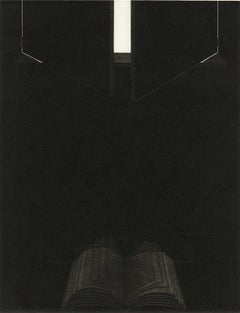
1970s Livre Mezzotint Print: An Opening to the Book of Knowledge

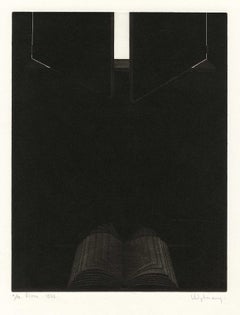
1970s Livre Mezzotint Print: An Opening to the Book of Knowledge

By Anne Dykmans

Located in New Orleans, LA

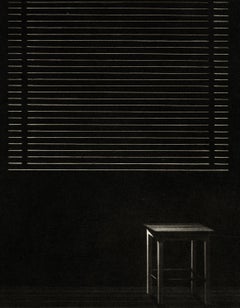
This image seems to capture the opening of knowledge through books. At the top of the image doors are opening revealing a sliver of light providing entree to the massive book at the...

Category

1970s Anne Dykmans Interior Prints

Materials

Mezzotint

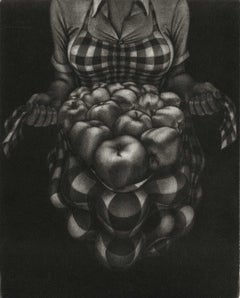
Fructidore (Fruit being carried is hard to distinguish from the woman's body)

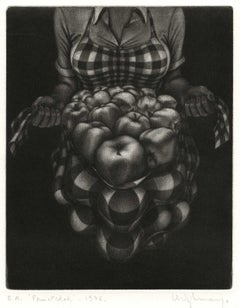
Fructidore (Fruit being carried is hard to distinguish from the woman's body)

By Anne Dykmans

Located in New Orleans, LA

In Anne Dykmans' "Fructidore", a well endowed woman uses her plaid apron to carry a bunch of fruit. Parts of her body clothed in plaid seem to suggest the same fruit she is carrying...

Category

1970s Modern Anne Dykmans Interior Prints

Materials

Mezzotint

Related Items
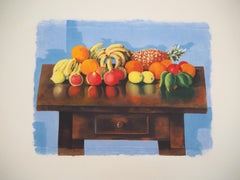
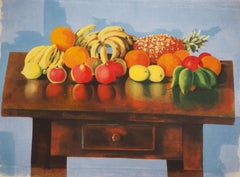
Table of Summer Fruits - Original Lithograph

Table of Summer Fruits - Original Lithograph

Located in Paris, IDF

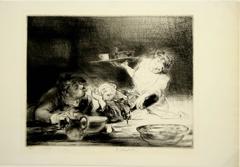
Moise KISLING Table of Summer Fruits Original Lithograph On Arches vellum 28 x 38 cm (c. 11 x 15 inches) Very good condition

Category

1950s Modern Anne Dykmans Interior Prints

Materials

Lithograph

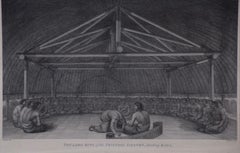
"King of the Friendly Islands" (Tonga); Engraving from Captain Cook's 3rd Voyage

"King of the Friendly Islands" (Tonga); Engraving from Captain Cook's 3rd Voyage

By John Webber

Located in Alamo, CA

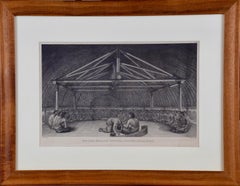
"Poulaho, King of the Friendly Islands, Drinking Kava" is an engraving created by William Sharp (1749-1824), from a drawing by John Webber (1752-1793), who was the artist on Captain James Cook's 3rd and final voyage of discovery. It was published in the atlas of "A Voyage to the Pacific Ocean Undertaken by the Command of His Majesty, for Making Discoveries in the Northern Hemisphere", the official British Admirality sanctioned journal published upon completion of the voyage in London in 1784 by Strahan & Cadell. Captain Cook visited Tonga on his 3rd voyage, which he named The Friendly Islands because of the warm welcome he and his crew received, unlike some of the other more hostile Pacific islands. The engraving depicts Cook and his men observed a kava ceremony at the village of Mu’a on Tongatapu. King Paulaho sits in the centre foreground, his back to the spectator with a man kneeling before him. The ceremonial mat depicted behind Paulaho indicates that nobody was allowed to sit behind him. The figure in the centre holds a single cup, referring to the Tongan custom of offering the cup to the king first. Kava is native to the islands of the South Pacific and was first described for English readers in 1768 by Captain James Cook. The kava root has been used for centuries as a central feature of ceremonies and celebrations because it was able to bring about a calming and pleasant social atmosphere. The root was crushed and processed into coconut milk to become the focal ceremonial beverage, simply referred to as kava. This engraving is presented in a Koa wood frame and a white mat. Koa wood is legendary in Hawaii. There are occasional faint spots, but the print is otherwise in very good condition. This amazing Koa wood is native to Hawaii and it is known for the deep rich colors and varied grain pattern. Koa has an honored heritage in Hawaii and is highly revered and sacred. The word “koa” means “warrior” in Hawaiian. The warriors of King Kamehameha the Great, created canoes and weapons from a wood plentiful on the Big Island of Hawaii. This wood became synonymous with the warriors themselves, and it became known as koa. There are three other engravings listed from the official journal of Captain Cook's 3rd voyage available that are presented in identical Koa wood frames and mats (LU117324682422, LU117324684052, LU117324684032). They would make a wonderful grouping for a display of 2, 3 or 4 prints. A discount is available for a grouping depending on the number of items included. Captain Cook is remembered as one of the greatest explorers and navigators in history. His explorations included Australia, New Zealand and islands of the South Pacific and the northwest coast of North America. Hawaii was discovered by Captain Cook during this voyage. Hawaii was originally called The Sandwich Islands in honor of The Earl of Sandwich...

Category

1780s Realist Anne Dykmans Interior Prints

Materials

Engraving

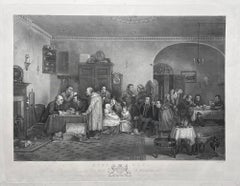
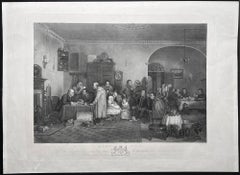
Rent Day, English antique engraving after Sir David Wilkie

Rent Day, English antique engraving after Sir David Wilkie

By Sir David Wilkie

Located in Melbourne, Victoria

'Rent Day' Engraving by Abraham Raimbach (1776-1843) after Sir David Wilkie RA (1785-1841). Circa 1820. 'Second Plate' printed under engraver's name. Wilkie was an important Scot...

Category

Mid-19th Century Naturalistic Anne Dykmans Interior Prints

Materials

Engraving

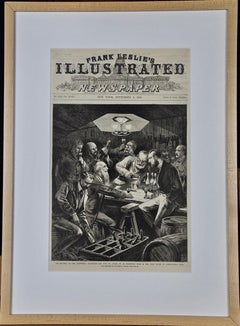
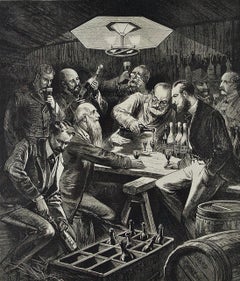
"Inspection Tour in the Wine Vaults", 1876 Philadelphia Centennial Exposition

"Inspection Tour in the Wine Vaults", 1876 Philadelphia Centennial Exposition

Located in Alamo, CA

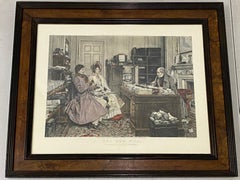
This engraving is entitled "Philadelphia, PA- The Centennial Exposition - the Jury of Award on an Inspection Tour in the Wine Vaults of Agricultural Hall", ...

Category

Late 19th Century Naturalistic Anne Dykmans Interior Prints

Materials

Engraving

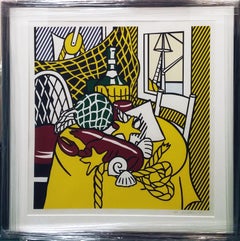
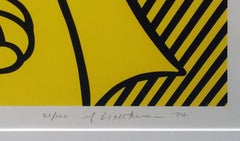
Still Life with Lobster, Lithograph and Screen Print on Paper, Signed, 1974

Still Life with Lobster, Lithograph and Screen Print on Paper, Signed, 1974

By Roy Lichtenstein

Located in Aventura, FL

Hand signed, dated and numbered by the artist. From the Six Still Lifes Series. Lithograph and screenprint on rives BFK paper. Co-published by Multiples, Inc. and Castelli Graphics, ...

Category

1970s Pop Art Anne Dykmans Interior Prints

Materials

Paper, Lithograph, Screen

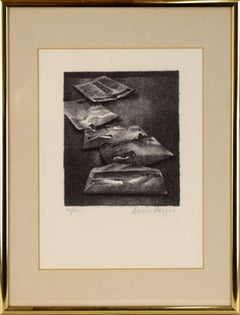
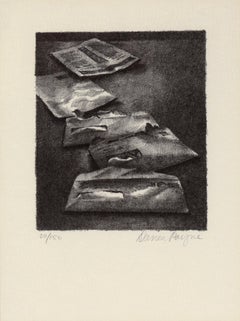
Newspapers on the Table - Still Life Etching on Heavy Paper

Newspapers on the Table - Still Life Etching on Heavy Paper

Located in Soquel, CA

Newspapers on the Table - Still Life Etching on Heavy Paper, #20/150 Black and white etching by Darien Payne (American, b. 1951). This piece is a meticulously detailed depiction of ...

Category

1990s Photorealist Anne Dykmans Interior Prints

Materials

Archival Paper, Drypoint, Etching

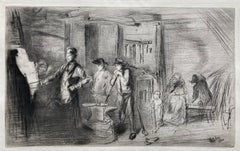
THE FORGE - Rich Drypoint

THE FORGE - Rich Drypoint

By James Abbott McNeill Whistler

Located in Santa Monica, CA

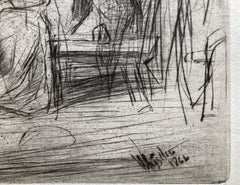
JAMES ABBOTT MCNEIL WHISTLER (1834 – 1903) THE FORGE 1866 (Kennedy. 68 iv/vi: Glascow 86 vi/vi) Etching and drypoint. Signed and dated in the plate 1866. VERY GOOD IMPRESSION WITH...

Category

Late 19th Century Impressionist Anne Dykmans Interior Prints

Materials

Drypoint

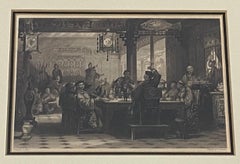
G. Paterson "Dinner Party at a Mandarin's House" Engraving After T. Allom c.1840

G. Paterson "Dinner Party at a Mandarin's House" Engraving After T. Allom c.1840

Located in San Francisco, CA

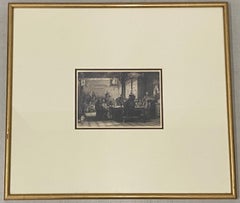
G. Paterson "Dinner Party at a Mandarin's House" Original Engraving After T. Allom C.1840 Original engraving Dimensions 8" wide x 5" high The frame measures 20.5" wide x 18.5" hig...

Category

Mid-19th Century Realist Anne Dykmans Interior Prints

Materials

Engraving

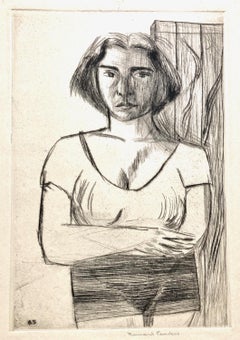
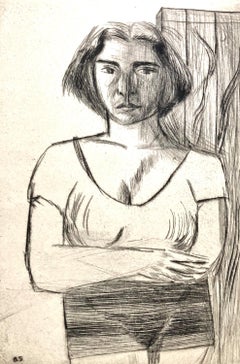
Bernard Sanders, Young Girl (With Arms Crossed), about 1930

Bernard Sanders, Young Girl (With Arms Crossed), about 1930

By Bernard Sanders

Located in New York, NY

Young Girl by Bernard Sanders (1906-1967) is a classic example of his masterful portraiture. This is a drypoint. It is signed in pencil, titled in the lower left margin, and initial...

Category

1930s American Modern Anne Dykmans Interior Prints

Materials

Drypoint

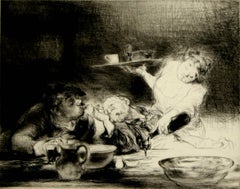
Vin Rouge (Red Wine)

Edmund BlampiedVin Rouge (Red Wine), 1932

$1,750Sale Price|30% Off

H 9.25 in W 11.63 in

Vin Rouge (Red Wine)

By Edmund Blampied

Located in Plano, TX

1932. Drypoint. Appleby 167. 9 1/4 x 11 5/8 (sheet 11 3/8 x 17 15/16). Edition 100 #48. Mat line, well outside the image; otherwise excellent condition. A rich impression with drypo...

Category

1930s Modern Anne Dykmans Interior Prints

Materials

Drypoint

Interiors VII: The Train from Munich

Interiors VII: The Train from Munich

By Peter Milton

Located in Middletown, NY

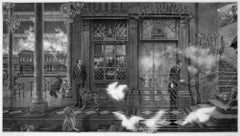
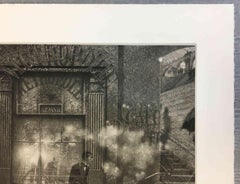
Interiors VII: The Train from Munich Robert E. Townsend, 1991. Resist ground etching and engraving with hand refinement in charcoal, pencil, stabilo, and eraser on BFK Rives white wove paper, 20 x 36 inches (507 x 914 mm), full margins. Signed, titled, dated and numbered 51/175 by the artist in pencil, lower margin. A brilliant, inky impression with luminous light and gradient tones. In excellent condition with one extremely minor and superficial spot of light tan adhesive residue on the verso, unobtrusive and not visible on the recto, with no other visible defects. With the blind stamp of the printer, Robert E. Townsend in the lower left margin. An especially fine impression in superb condition. [Milton 113]. When asked about this work in particular, Milton expressed that his favorite images were his darkest images, in theme, mood, and in ink. Milton, who has said that his work is infused with a postmodern awareness of the past, has focused here in a deeply personal way on a segment of history that continues to haunt us all. The work, published in 1991, evokes one of the darkest periods of European history, the eroding and erasing of European culture under fascism, and the eventual total loss of humanity. The Train from Munich is an especially relevant and emotional work for Milton, who created the piece for his wife, Edith, who escaped Munich in 1939 as a child on the fabled Kinderstransport. The Kinderstransport was a desperate rescue effort on the part of the British government to save as many Jewish children as possible by railway before borders closed on the precipice of the Second World War. Children left their parents behind, and boarded the trains alone, leaving the impending doom of Nazi Germany, they arrived in Great Britain as refugees. More than 10,000 children escaped the holocaust via the Kinderstransport. In Train from Munich, the image itself holds an almost immeasurable amount of symbolism; each inch of the matrix is a successful effort to confront this history in a way that is poignant through a series of motifs. We see the Café disappearing into a ghostlike memory of the past, an allegory to the disintegration of culture, while through the windows we can see a rampant, snarling dog; a portrait of Hitler's shepherd, Blondi. Blondi isn't the only notable figure in the composition. Milton has pointed out that the fading figure of the doorman at the Hotel Metropole is modeled after the artist and intellectual Marcel Duchamp, and the face of the young girl peering...

Category

1990s American Modern Anne Dykmans Interior Prints

Materials

Charcoal, ABS, Engraving, Etching
Previously Available Items
Carbonrel
Carbonrel

Anne DykmansCarbonrel

Sold

H 10.75 in W 8.25 in

Carbonrel

By Anne Dykmans

Located in New Orleans, LA

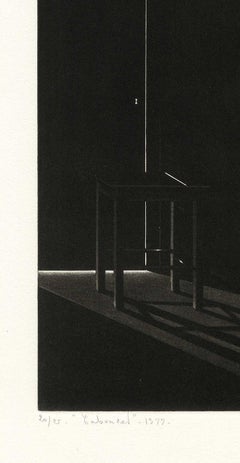
This impression was created in 1977 and is #20 out of edition of25 Anne Dykmans employs her superb command of engraving techniques, especially mezzotint, to create a special light w...

Category

1970s Contemporary Anne Dykmans Interior Prints

Materials

Mezzotint

Store I
Store I

Anne DykmansStore I, 1976

Sold

H 10.38 in W 8 in

Store I

By Anne Dykmans

Located in New Orleans, LA

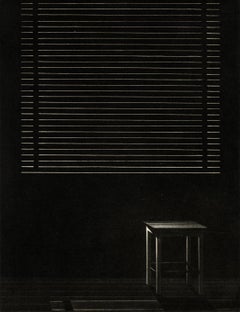
In "Store I", Anne Dykmans depicts the stark outline of a very modest store interior. Anne Dykmans employs her superb command of engraving techniques, especially mezzotint, to creat...

Category

1970s Modern Anne Dykmans Interior Prints

Materials

Mezzotint

Rue du Printemps (Shadows in house on Spring Street in Brussels)

Rue du Printemps (Shadows in house on Spring Street in Brussels)

By Anne Dykmans

Located in New Orleans, LA

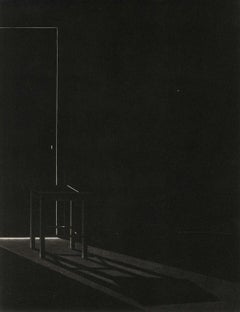
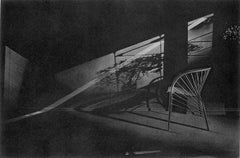
Light pours through a sparsely furnished room in a space on Spring Street in Brussels creating stark shadows as it streaks through the bushes, blinds and the outline of a modern chai...

Category

1990s Contemporary Anne Dykmans Interior Prints

Materials

Mezzotint, Aquatint

Anne Dykmans interior prints for sale on 1stDibs.

Find a wide variety of authentic Anne Dykmans interior prints available for sale on 1stDibs. You can also browse by medium to find art by Anne Dykmans in engraving, mezzotint, aquatint and more. Much of the original work by this artist or collective was created during the 20th century and is mostly associated with the modern style. Not every interior allows for large Anne Dykmans interior prints, so small editions measuring 5 inches across are available. Customers who are interested in this artist might also find the work of Jukka Vanttinen, Yuji Hiratsuka, and Piero Cesaroni. Anne Dykmans interior prints prices can differ depending upon medium, time period and other attributes. On 1stDibs, the price for these items starts at $125 and tops out at $600, while the average work can sell for $315.