Charles Coleman Art

to
1
1
5
Overall Width
to
Overall Height
to
3
1
2
2
3
5
6
5
2
1
1
1
1
1
1
1
1
1
5
1
1
1
6
11,063
2,853
2,494
1,431
6
Artist: Charles Coleman
Related Items
Street Scene with Women and a Beggar

Street Scene with Women and a Beggar

By Chester Dixon Snowden 1

Located in Houston, TX

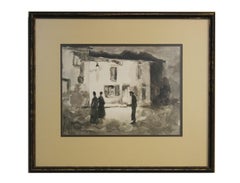
Watercolor painting of a street scene with two females and a man that appears to be a beggar. The work is signed by the artist. It is framed in a black frame with a yellow matte. Dim...

Category

1950s Naturalistic Charles Coleman Art

Materials

Watercolor

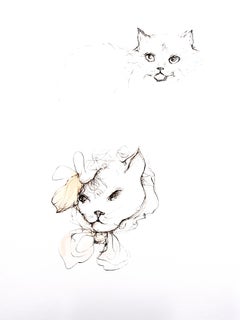
Leonor Fini - Cats - Original Etching

Leonor FiniLeonor Fini - Cats - Original Etching, 1985

$1,398

H 17.33 in W 11.03 in D 0.04 in

Leonor Fini - Cats - Original Etching

By Leonor Fini

Located in Collonge Bellerive, Geneve, CH

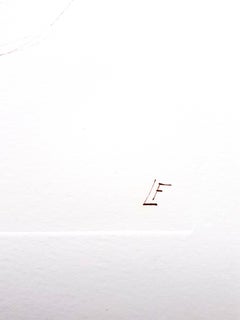
Leonor Fini - Cats - Original Engraving Mme.Helvetius' Cats Original etching created in 1985, Printed Signature (LF). Conditions: excellent Edition: 100 Support: Arches paper. Dimensions: Paper dimensions: 44 x 28 cm Editions: Moret, Paris. Leonor Fini is considered one of the most important women artists of the mid-twentieth century, along with Leonora Carrington, Frida Kahlo, Meret Oppenheim, Remedios Varo, and Dorothea Tanning – most of whom Fini knew well. Her career, which spanned some six decades, included painting, graphic design, book illustration, product design (the renowned torso-shaped perfume bottle for Schiaparelli’s Shocking), and set and costume design for theatre, ballet, opera, and film. In this compellingly readable, exhaustively researched account, author Peter Webb brings Fini’s provocative art and unconventional personal life, as well as the vibrant avant-garde world in which she revolved, vividly in life. Born in Buenos Aires in 1907 (August 30 – January 18, 1996, Paris) to Italian and Argentine parents, Leonor grew up in Trieste, Italy, raised by her strong-willed, independent mother, Malvina. She was a virtually self-taught artist, learing anatomy directly from studying cadavers in the local morgue and absorbing composition and technique from the Old Masters through books and visits to museums. Fini’s fledging attempts at painting in Trieste let her to Milan, where she participated in her first group exhibition in 1929, and then to Paris in 1931. Her vivacious personality and flamboyant attire instantly garnered her a spotlight in the Parisian art world and she soon developed close relationships with the leading surrealist writers and painters, including Paul Eluard, Salvador Dali, Man Ray, and Max Ernst, who became her lover for a time. The only surrealist she could not abide because of his misogyny was André Breton. Although she repeatedly exhibited with them, she never considered herself a surrealist. The American dealer Julien Levy, very much impressed by Fini’s painting and smitten by her eccentric charms, invited her to New York in 1936, where she took part in a joint gallery exhibition with Max Ernst and met many American surrealists, including Joseph Cornell and Pavel Tchelitchew. Her work was included in MoMA’s pivotal Fantastic Art, Dada and Surrealism exhibition, along with De Chirico, Dali, Ernst, and Yves Tanguy. In 1939 in Paris she curated an exhibition of surrealist furniture for her childhood friend Leo Castelli for the opening of his first gallery. Introductions to her exhibition catalogues were written by De Chirico, Ernst, and Jean Cocteau. A predominant theme of Fini’s art is the complex relationship between the sexes, primarily the interplay between the dominant female and the passive, androgynous male. In many of her most powerful works, the female takes the form of a sphinx, often with the face of the artist. Fini was also an accomplished portraitist; among her subjects were Stanislao Lepri...

Category

1980s Modern Charles Coleman Art

Materials

Etching

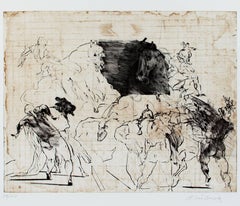
20th century drypoint etching figurative animal print horses sketch signed

20th century drypoint etching figurative animal print horses sketch signed

By Claude Weisbuch

Located in Milwaukee, WI

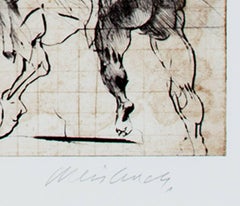
"Combat Equestre" is an original lithograph by Claude Weisbuch. The artist signed the piece lower right and wrote the edition number (24/100) in the lower left. This piece depicts mu...

Category

1970s Modern Charles Coleman Art

Materials

Drypoint, Etching

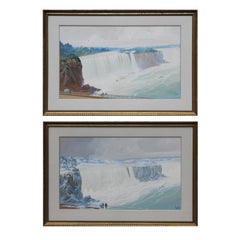
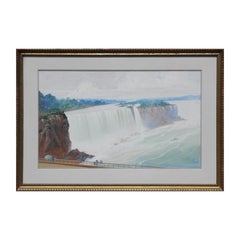
Niagra Falls Spring and Winter Watercolor Landscapes

Niagra Falls Spring and Winter Watercolor Landscapes

By Maude Leach

Located in Houston, TX

Original watercolor landscape painting of Niagra falls in the winter and in the spring. The pair of paintings are signed by the artist in the bottom corne...

Category

20th Century Naturalistic Charles Coleman Art

Materials

Watercolor

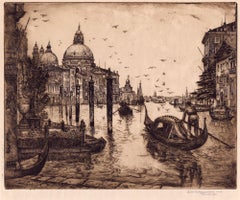
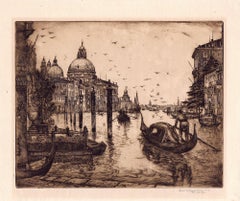
The Grand Canal, Venice

The Grand Canal, Venice

By Elias S. Mandel Grossman

Located in Middletown, NY

1926. Etching in sepia ink on Japon paper, 9 5/8 x 11 1/2 inches (245 x 292 mm), full margins with the lower margin slightly notched. Signed, titled and dated in pencil in the lower ...

Category

Early 20th Century American Modern Charles Coleman Art

Materials

Handmade Paper, Etching

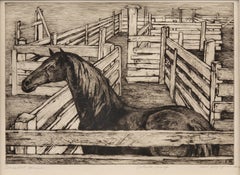
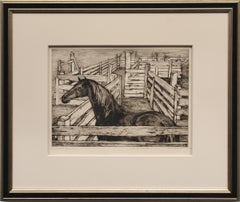
Ethel Magafan “Corralled Horse” 1940s WPA-Era Modernist Etching, Artist’s Proof

Ethel Magafan “Corralled Horse” 1940s WPA-Era Modernist Etching, Artist’s Proof

By Ethel Magafan

Located in Denver, CO

Corralled Horse is a rare WPA-era modernist etching by acclaimed American artist Ethel Magafan, created in the 1940s. This artist’s proof depicts a lone dark horse within a wooden co...

Category

1940s American Modern Charles Coleman Art

Materials

Etching

Norwegian Pine Grove - The inner glow of the trees -

Norwegian Pine Grove - The inner glow of the trees -

Located in Berlin, DE

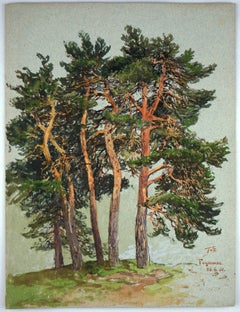
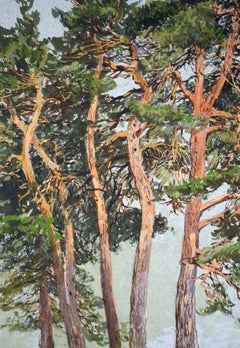
Themistokles von Eckenbrecher (1842 Athens - 1921 Goslar), Norwegian pine grove, 1901. Watercolor on blue-green paper, 30 x 22 cm. Signed, dated and inscribed in his own hand "TvE. Fagermes [i.e. Fagermes]. 26.6.[19]01." - Slight crease throughout at left margin, otherwise in good condition. About the artwork Themistokles von Eckenbrecher often traveled to Norway to study the nature that fascinated him there. On June 26, 1901, near the southern Norwegian town of Fagernes, in the summer evening sun, he saw a small pine grove, which he immediately captured in a watercolor. He exposed the trees growing on a small hill in front of the background, so that the pines completely define the picture and combine to form a tense motif. The tension comes from the contrast of form and color. The trunks, growing upward, form a vertical structure that is horizontally penetrated by the spreading branches and the pine needles, which are rendered as a plane. This structural tension is further intensified by the color contrast between the brown-reddish iridescent trunks and branches and the green-toned needlework. Themistokles von Eckenbrecher, however, does not use the observed natural scene as an inspiring model for a dance of color and form that detaches itself from the motif and thus treads the path of abstracting modernism. Its inner vitality is to be brought to light and made aesthetically accessible through the work of art. It is precisely in order to depict the inner vitality of nature that von Eckenbrecher chooses the technique of watercolor, in which the individual details, such as the needles, are not meticulously worked out, but rather a flowing movement is created that unites the contrasts. The trees seem to have formed the twisted trunks out of their own inner strength as they grew, creatingthose tense lineations that the artist has put into the picture. The inner strength continues in the branches and twigs, culminating in the upward growth of the needles. At the same time, the trunks, illuminated by the setting sun, seem to glow from within, adding an almost dramatic dimension to the growing movement. Through the artwork, nature itself is revealed as art. In order to make nature visible as art in the work, von Eckenbrecher exposes the group of trees so that they are bounded from the outside by an all-encompassing contour line and merge into an areal unity that enters into a figure-ground relationship with the blue-greenish watercolor paper. The figure-ground relationship emphasizes the ornamental quality of the natural work of art, which further enforces the artwork character of the group of trees. With the presentation of Themistokles von Eckenbrecher's artistic idea and its realization, it has become clear that the present watercolor is not a study of nature in the sense of a visual note by the artist, which might then be integrated into a larger work context, but a completely independent work of art. This is why von Eckenbrecher signed the watercolor. In addition, it is marked with a place and a date, which confirms that this work of nature presented itself to him in exactly this way at this place at this time. At the same time, the date and place make it clear that the natural work of art has been transferred into the sphere of art and thus removed from the time of the place of nature. About the artist Themistocles' parents instilled a life of travel in their son, who is said to have spoken eleven languages. His father, who was interested in ancient and oriental culture, was a doctor and had married Francesca Magdalena Danelon, an Italian, daughter of the British consul in Trieste. During a stay in Athens - Gustav von Eckenbrecher was a friend of Heinrich von Schliemann and is said to have given him crucial clues as to the location of Troy - Themistokles saw the light of day in 1842. After an interlude in Berlin, where Themistokles was educated at the English-American School, the journey began again. From 1850 to 1857 the family lived in Constantinople, after which the father opened a practice in Potsdam, where Themistokles, who wanted to become a painter, was taught by the court painter Carl Gustav Wegener. In 1861 the von Eckenbrechers left Potsdam and settled in Düsseldorf. There Themistokles received two years of private tuition from Oswald Aschenbach, who greatly admired the talented young artist. After his artistic training, he undertook extensive travels, often accompanied by Prince Peter zu Sayn-Wittgenstein, which took him to northern and eastern Europe, but above all to the Middle East and even to South America. The paintings that resulted from these journeys established his artistic reputation and led to his participation in large panoramas such as the 118 x 15 metre Entry of the Mecca Caravan into Cairo, painted for the City of Hamburg in 1882. 1882 was also the start of a total of 21 study trips to Scandinavia, most of them to Norway, and the unique Norwegian landscape with its rugged fjords became a central motif in his work. Along with Anders Askevold and Adelsteen Normann...

Category

Early 1900s Naturalistic Charles Coleman Art
Materials

Watercolor

Low Country (South Carolina)

Low Country (South Carolina)

By Elizabeth Verner

Located in Middletown, NY

An enchanting Southern landscape by the mother of the Charleston Renaissance. A native of Charleston, South Carolina, and educated under the tutelage of Thomas Anshutz at The Pennsylvania Academy of Fine Arts, O'Neill Verner was a teacher, a mother, an artist, an ardent preservationist, and a skilled autodidact. Having previously focused on painting, in the early 1920s she found herself deeply moved by printmaking as a media, and especially so by the simple, peaceful themes and tableaus she discovered in Japanese art. She embarked on a effort to teach herself Japanese printmaking techniques, and in the process, produced the charming images of every day life in Charleston and its environs that earned her recognition as a cultural icon in her day, and in more modern times, as the mother of the Charleston Renaissance, which flourished well into the 1930s. In 1923 she opened a studio in Charleston where she focused on documenting the local color and the architecture and landscape that distinguishes Charleston as one of the South's most beautiful cities, all the while applying the gentle and poetic thematic sensibilities of Japanese printmaking. O'Neill Verner soon found herself in high demand when municipalities and institutions throughout the country sought commissions from her to document the beauty of their grounds and historic buildings. She worked as far north as the campuses of Harvard and Princeton, and extensively across the South, including in Savannah, Georgia, where through sweeping commissions she was able to marry her love of southern preservation and art. O'Neill Verner was a lifelong learner, and continued a path of edification that led her to study etching at the Central School of Art in London, to travel extensively through Europe, and to visit Japan in 1937, where she studied sumi (brush and ink) painting. She was a founding member of the Charleston Etchers Club, and the Southern States Art League. Her works are represented in the permanent collections of leading museums across the American south, and in major national institutions including the Metropolitan Museum of Art, Boston's Museum of Fine Art, and the Smithsonian American Art Museum. O'Neil Verner...

Category

Early 20th Century American Modern Charles Coleman Art
Materials

Archival Paper, Drypoint, Etching

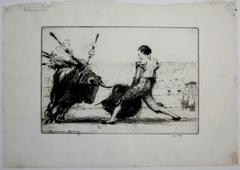
A Fierce Bull
A Fierce Bull

James McBeyA Fierce Bull, 1911

$1,500Sale Price|40% Off

H 16 in W 20 in D 0.5 in

A Fierce Bull

By James McBey

Located in Plano, TX

A Fierce Bull. 1911. Drypoint. Hardie 108. 5 3/8 x 8 (sheet 8 5/16 x 11 7/8). Edition 8. An exceptional impression with rich drypoint burr printed on antique laid paper. A proof of t...

Category

1910s Modern Charles Coleman Art
Materials

Drypoint, Etching

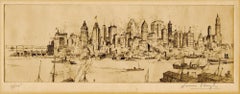
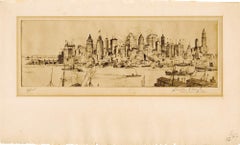
New York Skyline
New York Skyline

Louis H. RuylNew York Skyline, 1920

$450

H 9.18 in W 12.72 in

New York Skyline

By Louis H. Ruyl

Located in Middletown, NY

Etching with drypoint on cream wove paper with deckle edges, 4 3/8 x 12 3/4 inches (233 x 323 mm); sheet 9 1/2 x 15 3/4 inches (240 x 338 mm), full margins. Signed and numbered 4/75 ...

Category

Early 20th Century American Modern Charles Coleman Art
Materials

Handmade Paper, Etching, Drypoint

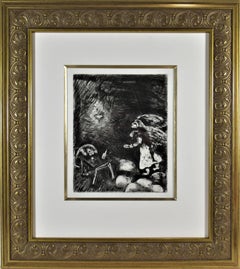
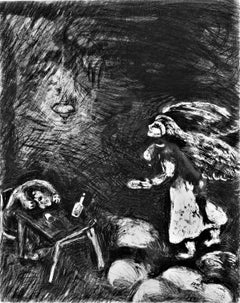
l' Ivrogne et sa Femme

Marc Chagalll' Ivrogne et sa Femme, 1927

$1,488

H 26.5 in W 23.5 in D 1.5 in

l' Ivrogne et sa Femme

By Marc Chagall

Located in San Francisco, CA

Artist: Marc Chagall (Russian, 1887-1985) Title: l'Ivrogne et sa Femme Year: 1927 Medium: Original etching Edition: fom the unumbered edition of 200 Paper: Montval Laid paper Image ...

Category

Early 20th Century Modern Charles Coleman Art
Materials

Etching

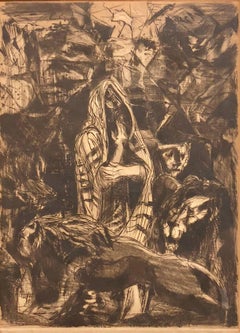
Modernist Daniel in Lions Den Biblical Judaica Etching Israeli Artist

Modernist Daniel in Lions Den Biblical Judaica Etching Israeli Artist

Located in Surfside, FL

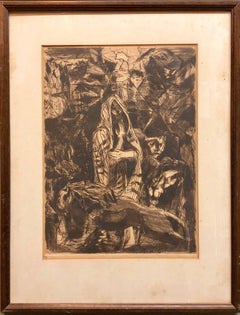
Daniel In Lions Den. Artist proof etching. it depicts a rabbi wrapped in a tallit surrounded by lions. A very well executed work of a famous miracle from the bible. it appears to bee...

Category

20th Century Modern Charles Coleman Art
Materials

Etching

Charles Coleman art for sale on 1stDibs.

Find a wide variety of authentic Charles Coleman art available for sale on 1stDibs. You can also browse by medium to find art by Charles Coleman in etching, ink, paint and more. Much of the original work by this artist or collective was created during the 18th century and is mostly associated with the modern style. Not every interior allows for large Charles Coleman art, so small editions measuring 6 inches across are available. Customers who are interested in this artist might also find the work of Patrick Procktor, Pierre Quentin Chedel, and Rowland Hilder. Charles Coleman art prices can differ depending upon medium, time period and other attributes. On 1stDibs, the price for these items starts at $163 and tops out at $921, while the average work can sell for $163.

Artists Similar to Charles Coleman