Fritz Eichenberg. Art

American, German, 1901-1990
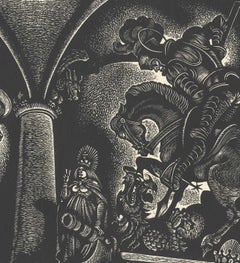
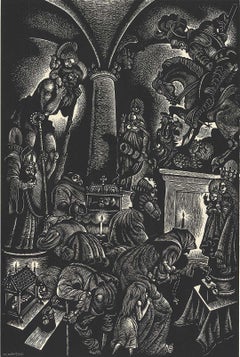
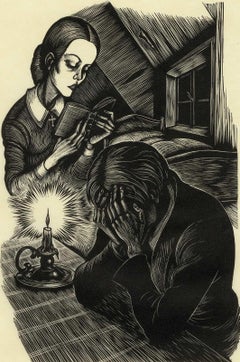
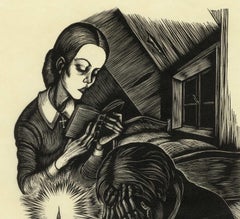
Fritz Eichenberg was one of the world's most sought-after illustrators of literary classics, including The Brothers Karamazov and Crime and Punishment, as well as works by Edgar Allan Poe, Dylan Thomas, the Brontë sisters, and others. Born in Cologne, Germany in 1901, he learned lithography, wood-engraving, and etching and by his early twenties had produced masterful illustrations for Gulliver's Travels and Till Eulenspiegel. He came to the United States in 1933 and over the next five decades produced an astonishing range of individual images and book illustrations. Throughout his life, he was preoccupied with the tragedy of war. He became a close friend and great supporter of Dorothy Day and The Catholic Worker and used his art to express his hope for more justice in the world.
to
3
Overall Width
to
Overall Height
to
3
1
1
1
2
3
2
2
1
1
1
1
1
2
1
3
11,123
2,854
2,494
1,436
3
Artist: Fritz Eichenberg.
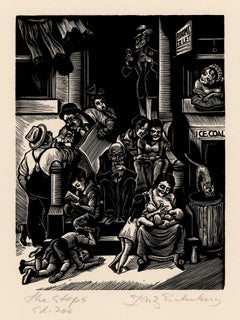
'The Steps' — WPA Era Graphic Modernism

'The Steps' — WPA Era Graphic Modernism

By Fritz Eichenberg

Located in Myrtle Beach, SC

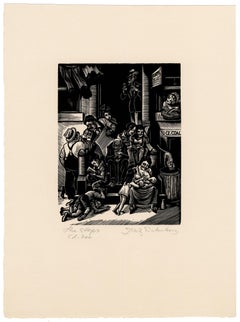
Fritz Eichenberg, 'The Steps', wood engraving, 1933, edition 200. Signed, titled, and annotated 'Ed. 200' in pencil. Initialed in the block, lower right. A superb, richly-inked impr...

Category

1930s American Modern Fritz Eichenberg. Art

Materials

Woodcut

'The Pimp' — Graphic Modernism

'The Pimp' — Graphic Modernism

By Fritz Eichenberg

Located in Myrtle Beach, SC

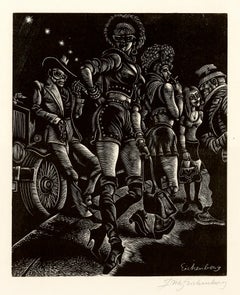
Fritz Eichenberg, 'The Pimp', wood engraving, 1980, artist's proof before the edition. Signed in pencil. Signed in the block, lower right. A fine, richly-inked impression, on cream wove paper, with full margins (2 3/16 to 3 1/2 inches), in excellent condition. Archivally sleeved, unmatted. Image size 12 x 9 3/4 inches (305 x 248 mm); sheet size 18 x 14 inches (457 x 356 mm). ABOUT THE ARTIST Fritz Eichenberg (1901–1990) was a German-American illustrator and arts educator who worked primarily in wood engraving. His best-known works were concerned with religion, social justice, and nonviolence. Eichenberg was born to a Jewish family in Cologne, Germany, where the destruction of World War I helped to shape his anti-war sentiments. He worked as a printer's apprentice and studied at the Municipal School of Applied Arts in Cologne and the Academy of Graphic Arts in Leipzig, where he studied under Hugo Steiner-Prag. In 1923 he moved to Berlin to begin his career as an artist, producing illustrations for books and newspapers. In his newspaper and magazine work, Eichenberg was politically outspoken and sometimes wrote and illustrated his reporting. In 1933, the rise of Adolf Hitler drove Eichenberg, who was a public critic of the Nazis, to emigrate with his wife and children to the United States. He settled in New York City, where he lived most of his life. He worked in the WPA Federal Arts Project and was a member of the Society of American Graphic Artists. In his prolific career as a book illustrator, Eichenberg portrayed many forms of literature but specialized in works with elements of extreme spiritual and emotional conflict, fantasy, or social satire. Over his long career, Eichenberg was commissioned to illustrate more than 100 classics by publishers in the United States and abroad, including works by renowned authors Dostoyevsky, Tolstoy, Charlotte and Emily Brontë, Poe, Swift, and Grimmelshausen. He also wrote and illustrated books of folklore and children's stories. Eichenberg was a long-time contributor to the progressive magazine The Nation, his illustrations appearing between 1930 and 1980. Eichenberg’s work has been featured by such esteemed publishers as The Heritage Club, Random House, Book of the Month Club, The Limited Editions Club, Kingsport Press, Aquarius Press, and Doubleday. Raised in a non-religious family, Eichenberg had been attracted to Taoism as a child. Following his wife's unexpected death in 1937, he turned briefly to Zen Buddhist meditation, then joined the Religious Society of Friends in 1940. Though he remained a Quaker until his death, Eichenberg was also associated with Catholic charity work through his friendship with Dorothy Day...

Category

1980s American Modern Fritz Eichenberg. Art

Materials

Woodcut

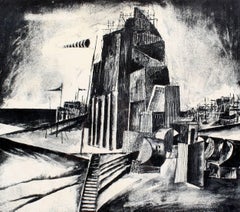
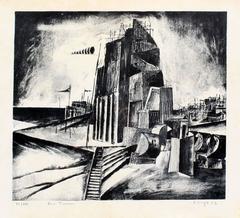
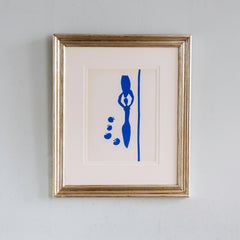
original lithograph

original lithograph

By Fritz Eichenberg

Located in Henderson, NV

Medium: original lithograph. This lithograph was printed in 1953 for the "Improvisations" portfolio, published by the Artists Equity Association of New York on the occasion of the 19...

Category

1950s Fritz Eichenberg. Art

Materials

Lithograph

Related Items
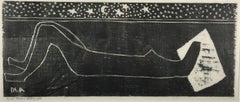
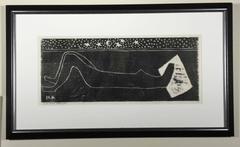
NIGHT NUDE
NIGHT NUDE

Milton AveryNIGHT NUDE, 1953

$16,000

H 16 in W 30 in D 2 in

NIGHT NUDE

By Milton Avery

Located in Portland, ME

Avery, Milton. NIGHT NUDE. Woodcut, 1953. Edition of 25 in black and white (there were a further 25 printed in black and blue). Signed, dated and numbered "6/25" in pencil, and also ...

Category

1950s American Modern Fritz Eichenberg. Art

Materials

Woodcut

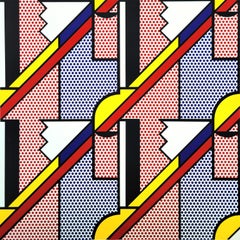
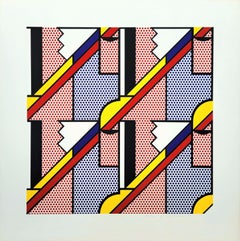
Modern Print /// Roy Lichtenstein Pop Art Abstract Geometric MoMA Gemini G.E.L.

Modern Print /// Roy Lichtenstein Pop Art Abstract Geometric MoMA Gemini G.E.L.

By Roy Lichtenstein

Located in Saint Augustine, FL

Artist: Roy Lichtenstein (American, 1923-1997) Title: "Modern Print" *Numbered, signed, and dated by Lichtenstein in pencil lower right Year: 1971 Medium: Original Lithograph and Scr...

Category

1970s Pop Art Fritz Eichenberg. Art

Materials

Lithograph, Screen

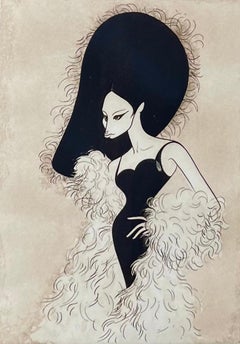
Barbra Stresiand "Belle of 14th Street" 1973 CBS TV Special 20th Century Litho

Barbra Stresiand "Belle of 14th Street" 1973 CBS TV Special 20th Century Litho

By Albert Al Hirschfeld

Located in New York, NY

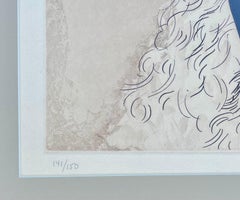
Barbra Stresiand "Belle of 14th Street" 1973 CBS TV Special 20th Century Litho Signed and numbered 10/150 in pencil, lower margin. Etching, 13.5” x 9.75”. Framed 21.25” x 17.25”. Pulled in 1975. Belle of 14th Street After two successful television shows on CBS, Barbra's manager, Marty Erlichman told the press, “We don't intend to go to the well once too often. The next special will have other performers. However, Barbra will never become just another hostess for just another musical variety show. Whatever we decide to do in the future shows, she will dominate in a unique fashion.” Barbra’s third television special for CBS and her sponsor, Monsanto, was titled The Belle of 14th Street . In February 1966, shortly after finishing up Color Me Barbra , Streisand and husband Elliott Gould took a second honeymoon in Paris. The trip was financed by her television corporate sponsor, Chemstrand. Barbra told the press, “I’m here to purchase the wardrobe for my next TV special. Cost is no object because my sponsor is picking up the tab.” At that point the theme of her third TV show would be fashion, and Paris offered many couture choices. Barbra was seen at a Dior fashion show wearing not the designer’s clothes, but a jaguar suit and hat she had designed herself. In all, it is said Barbra chose nine Dior outfits at a cost of $150,000. However, Barbra Streisand's third television special for CBS was postponed. In March 1966, Barbra flew to London to appear at the Prince of Wales Theatre in Funny Girl . Shortly after beginning her run in London, Barbra announced her pregnancy. Not only did that cause her concert tour to be abbreviated, but Barbra’s television special was postponed as well. Barbra told the BBC in July 1966: “I also can’t do my third television show, which I was supposed to do here [London].” Returning to the States, Barbra performed four concert dates, and then retired to enjoy the rest of her pregnancy and give birth to her son, Jason, in December 1966. CBS and Chemstrand wanted a new special by the end of 1967, therefore production on the show picked up momentum in March 1967. (Barbra was due in Hollywood in May to begin shooting the Funny Girl film.) The format and theme of the television show had changed, too. Instead of centering on fashion, Barbra’s next special would be situated in a 1900’s Vaudeville theater. “We were all determined that the show not be just a variety format,” director Joe Layton said. “We wanted something different. So we hit upon the idea of restaging a vaudeville performance. All the acts, songs, skits and specialties had to be derivative of the period between 1895-1912.” Barbra’s creative collaborators did meticulous research on Vaudeville — “We even called George Burns in Hollywood and Jack Pearl,” said Barbra’s manager, Marty Erlichman. Entitled The Belle of 14th Street , the new special would allow Barbra to play several different characters but not have to shoulder the burden of carrying another one-woman show—this time Streisand would be accompanied by guest stars: Broadway actor Jason Robards; Vaudeville veteran John Bubbles; and Lee Allen...

Category

1970s Performance Fritz Eichenberg. Art

Materials

Lithograph

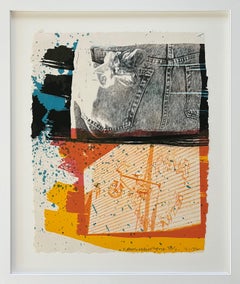
Fest
Fest

Robert RauschenbergFest, 1991

$6,500

H 26 in W 19 in

Fest

By Robert Rauschenberg

Located in Indianapolis, IN

Robert Rauschenberg (1925-2008) Fest (1991) Four color lithograph Size: 26 x 21 in (66 x 53.3 cm) Frame size: 33.5 x 28.25 (85 x 71.7 cm) Edition of 51, this is 38/51 Hand signed an...

Category

1990s Abstract Expressionist Fritz Eichenberg. Art

Materials

Lithograph

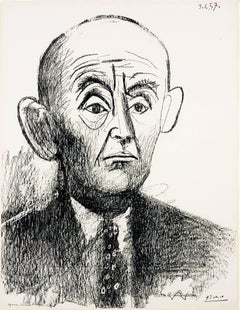
Portrait de D. H. Kahnweiler I Lithograph, French School, 1957, Signed

Portrait de D. H. Kahnweiler I Lithograph, French School, 1957, Signed

By Pablo Picasso

Located in Fairlawn, OH

Portrait de D. H. Kahnweiler I Lithograph, 1957 Estate Signature Stamp lower right Provenance: Picasso Estate Marina Picasso, her stamp on reverse Annotated in ...

Category

1950s French School Fritz Eichenberg. Art

Materials

Lithograph

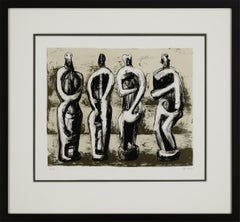
Henry Moore "Four Standing Figures" Signed Color Lithograph, 1978, Ed. 50

Henry Moore "Four Standing Figures" Signed Color Lithograph, 1978, Ed. 50

By Henry Moore

Located in Miami, FL

HENRY MOORE (1898–1986) – "FOUR STANDING FIGURES" Color Lithograph on Wove Paper ⚜ Hand Signed and Numbered ⚜ Custom Conservation Frame A SCULPTOR’S MEDITATION ON THE STANDING FIGU...

Category

1970s Modern Fritz Eichenberg. Art

Materials

Lithograph

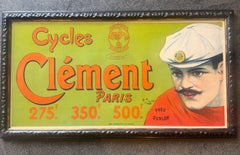
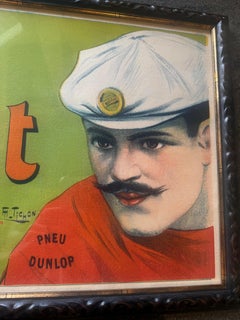
1895 Cycles Clément Paris lithographic poster

1895 Cycles Clément Paris lithographic poster

By Charles Tichon

Located in Santa Monica, CA

Rare and beautifully framed authentic 1895 Cycles Clément Paris lithographic poster featuring a stylized cyclist portrait and bold Art Nouveau typography, complete with certificate o...

Category

1880s Art Nouveau Fritz Eichenberg. Art

Materials

Lithograph

Modern American Industrial Landscape

Modern American Industrial Landscape

Located in Buffalo, NY

An original woodblock print dated 1965, titled "Our Town" but signed illegibly.

Category

1960s American Modern Fritz Eichenberg. Art

Materials

Paper, Woodcut

Rare Trial Proof Nude Lithograph by Ashcan School Artist

Rare Trial Proof Nude Lithograph by Ashcan School Artist

By George Wesley Bellows

Located in Fairlawn, OH

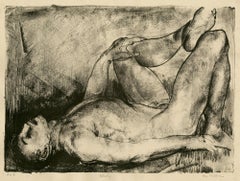
Man on His Back, Nude Lithograph, c. 1916 Signed by the artist lower right: Geo Bellows (see photo) Annotated bottom left: No. 3 by the artist (see photo) An unredorded trial proof b...

Category

1910s Ashcan School Fritz Eichenberg. Art

Materials

Lithograph

Set of Four Hand-Colored Lithograph Ornithological Prints from "The Ibis" Birds

Set of Four Hand-Colored Lithograph Ornithological Prints from "The Ibis" Birds

By Philip Lutley Sclater

Located in Saint Augustine, FL

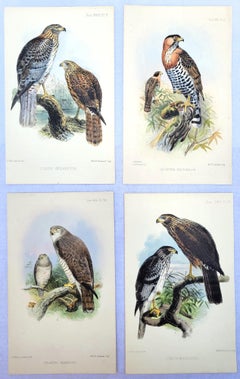
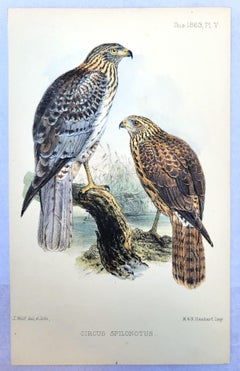
Artist: Philip Lutley Sclater (English, 1829-1913) Titles: "Circus Spilonotus (Eastern Marsh Harrier)", "Accipiter Pectoralis (Gray-Bellied Hawk)", "Circaetus Beaudouini (Beaudouin's...

Category

1860s Victorian Fritz Eichenberg. Art

Materials

Watercolor, Lithograph

FELIPE PANTONE - CHROMADYNA MICAP #2 Op Art Abstract Street Art Black Modern

FELIPE PANTONE - CHROMADYNA MICAP #2 Op Art Abstract Street Art Black Modern

By Felipe Pantone

Located in Madrid, Madrid

Felipe Pantone - CHROMADYNA MICAP #2 Date of creation: 2020 Medium: Lithograph on paper Edition: 30 Size: 75.5 x 55.5 cm Condition: New, in mint condition and never framed Lithograph...

Category

2010s Op Art Fritz Eichenberg. Art

Materials

Paper, Lithograph

Previously Available Items
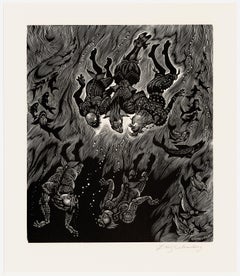
'The Aquarium' — WPA Era Graphic Modernism

'The Aquarium' — WPA Era Graphic Modernism

By Fritz Eichenberg

Located in Myrtle Beach, SC

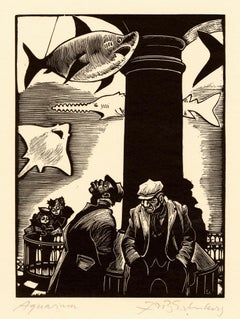
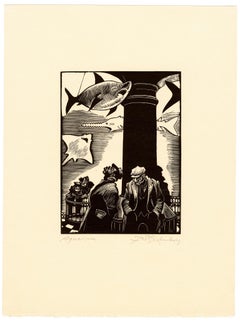
Fritz Eichenberg, 'The Aquarium', wood engraving, 1933, edition 200. Signed and titled in pencil. Initialed in the block, lower right. A superb, richly-inked impression, on pale yel...

Category

1930s American Modern Fritz Eichenberg. Art

Materials

Woodcut

'The Wolf and the Little Kids' — Graphic Modernism

'The Wolf and the Little Kids' — Graphic Modernism

By Fritz Eichenberg

Located in Myrtle Beach, SC

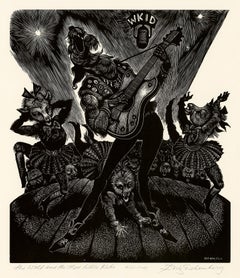
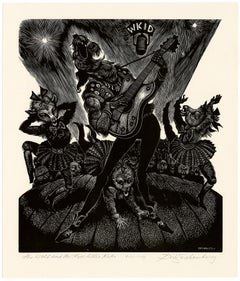
Fritz Eichenberg, 'The Wolf and the Little Kids' from the suite 'Fables with a Twist', wood engraving, 1975-76, artist's proof apart from the edition of c. 50. Signed, titled, and annotated 'Artist’s Proof' in pencil. Signed in the block, lower right. A fine, richly-inked impression, on cream wove paper, with full margins (7/8 to 1 1/2 inches), in excellent condition. Complete with vellum folder with descriptive text in red and black linotype. Printed by master printer Harold McGrath at The Gehenna Press, Northampton, MA. Image size 13 15/16 x 12 1/8 inches (354 x 308 mm); sheet size 16 1/2 x 14 inches (419 x 356 mm). Archivally sleeved, unmatted. Collection: Harvard Museums. ABOUT THE ARTIST Fritz Eichenberg (1901–1990) was a German-American illustrator and arts educator who worked primarily in wood engraving. His best-known works were concerned with religion, social justice, and nonviolence. Eichenberg was born to a Jewish family in Cologne, Germany, where the destruction of World War I helped to shape his anti-war sentiments. He worked as a printer's apprentice and studied at the Municipal School of Applied Arts in Cologne and the Academy of Graphic Arts in Leipzig, where he studied under Hugo Steiner-Prag. In 1923 he moved to Berlin to begin his career as an artist, producing illustrations for books and newspapers. In his newspaper and magazine work, Eichenberg was politically outspoken and sometimes wrote and illustrated his reporting. In 1933, the rise of Adolf Hitler drove Eichenberg, who was a public critic of the Nazis, to emigrate with his wife and children to the United States. He settled in New York City, where he lived most of his life. He worked in the WPA Federal Arts Project and was a member of the Society of American Graphic Artists. In his prolific career as a book illustrator, Eichenberg portrayed many forms of literature but specialized in works with elements of extreme spiritual and emotional conflict, fantasy, or social satire. Over his long career, Eichenberg was commissioned to illustrate more than 100 classics by publishers in the United States and abroad, including works by renowned authors Dostoyevsky, Tolstoy, Charlotte and Emily Brontë, Poe, Swift, and Grimmelshausen. He also wrote and illustrated books of folklore and children's stories. Eichenberg was a long-time contributor to the progressive magazine The Nation, his illustrations appearing between 1930 and 1980. Eichenberg’s work has been featured by such esteemed publishers as The Heritage Club, Random House, Book of the Month Club, The Limited Editions Club, Kingsport Press, Aquarius Press, and Doubleday. Raised in a non-religious family, Eichenberg had been attracted to Taoism as a child. Following his wife's unexpected death in 1937, he turned briefly to Zen Buddhist meditation, then joined the Religious Society of Friends in 1940. Though he remained a Quaker until his death, Eichenberg was also associated with Catholic charity work through his friendship with Dorothy Day...

Category

1970s American Modern Fritz Eichenberg. Art
Materials

Woodcut

'Simplicius' Farewell to the World' — Graphic Modernism

'Simplicius' Farewell to the World' — Graphic Modernism

By Fritz Eichenberg

Located in Myrtle Beach, SC

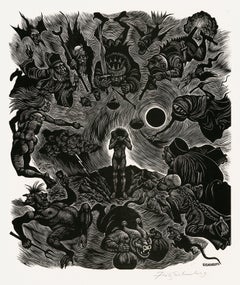
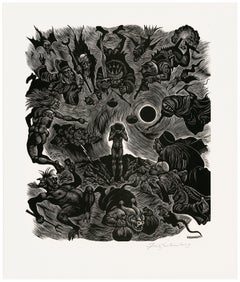
Fritz Eichenberg, 'Simplicius’ Farewell To The World' from the suite 'The Adventurous Simplicissimus', wood engraving, 1977, artist's proof apart from the edition of 50. Signed in pencil. Signed in the block, lower right. A fine, richly-inked impression, on cream wove paper, with full margins (1 1/2 to 2 inches), in excellent condition. Image size 14 x 12 inches (356 x 305 mm); sheet size 17 1/2 x 15 inches (445 x 381 mm). Archivally sleeved, unmatted. ABOUT THIS WORK 'Simplicius Simplicissimus' (German: Der abenteuerliche Simplicissimus Teutsch) is a picaresque novel of the lower Baroque style, written in five books by Hans Jakob Christoffel von Grimmelshausen published in 1668, with the sequel Continuatio appearing in 1669. The novel is told from the perspective of its protagonist Simplicius, a rogue or picaro typical of the picaresque novel, as he traverses the tumultuous world of the Holy Roman Empire during the Thirty Years' War. Raised by a peasant family, he is separated from his home by foraging dragoons. He is adopted by a hermit living in the forest, who teaches him to read and introduces him to religion. The hermit also gives Simplicius his name because he is so simple that he does not know his own name. After the death of the hermit, Simplicius must fend for himself. He is conscripted at a young age into service and, from there, embarks on years of foraging, military triumph, wealth, prostitution, disease, bourgeois domestic life, and travels to Russia, France, and an alternate world inhabited by mermen. The novel ends with Simplicius turning to a life of hermitage, denouncing the world as corrupt. ABOUT THE ARTIST Fritz Eichenberg (1901–1990) was a German-American illustrator and arts educator who worked primarily in wood engraving. His best-known works were concerned with religion, social justice, and nonviolence. Eichenberg was born to a Jewish family in Cologne, Germany, where the destruction of World War I helped to shape his anti-war sentiments. He worked as a printer's apprentice and studied at the Municipal School of Applied Arts in Cologne and the Academy of Graphic Arts in Leipzig, where he studied under Hugo Steiner-Prag. In 1923 he moved to Berlin to begin his career as an artist, producing illustrations for books and newspapers. In his newspaper and magazine work, Eichenberg was politically outspoken and sometimes wrote and illustrated his reporting. In 1933, the rise of Adolf Hitler drove Eichenberg, who was a public critic of the Nazis, to emigrate with his wife and children to the United States. He settled in New York City, where he lived most of his life. He worked in the WPA Federal Arts Project and was a member of the Society of American Graphic Artists. In his prolific career as a book illustrator, Eichenberg portrayed many forms of literature but specialized in works with elements of extreme spiritual and emotional conflict, fantasy, or social satire. Over his long career, Eichenberg was commissioned to illustrate more than 100 classics by publishers in the United States and abroad, including works by renowned authors Dostoyevsky, Tolstoy, Charlotte and Emily Brontë, Poe, Swift, and Grimmelshausen. He also wrote and illustrated books of folklore and children's stories. Eichenberg was a long-time contributor to the progressive magazine The Nation, his illustrations appearing between 1930 and 1980. Eichenberg’s work has been featured by such esteemed publishers as The Heritage Club, Random House, Book of the Month Club, The Limited Editions Club, Kingsport Press, Aquarius Press, and Doubleday. Raised in a non-religious family, Eichenberg had been attracted to Taoism as a child. Following his wife's unexpected death in 1937, he turned briefly to Zen Buddhist meditation, then joined the Religious Society of Friends in 1940. Though he remained a Quaker until his death, Eichenberg was also associated with Catholic charity work through his friendship with Dorothy Day...

Category

1970s American Modern Fritz Eichenberg. Art
Materials

Woodcut

'A Visit to the King of the Waters' — Graphic Modernism

'A Visit to the King of the Waters' — Graphic Modernism

By Fritz Eichenberg

Located in Myrtle Beach, SC

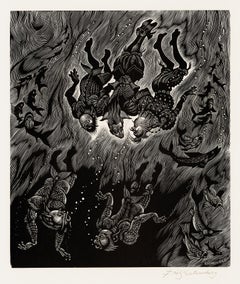
Fritz Eichenberg, 'A Visit to the King of the Waters' from the suite 'The Adventurous Simplicissimus', wood engraving, 1977, artist's proof apart from the edition of 50. Signed in pencil. Signed in the block, lower right. A fine, richly-inked impression, on cream wove paper, with full margins (1 1/2 to 2 inches), in excellent condition. Image size 14 x 12 inches (356 x 305 mm); sheet size 17 1/2 x 15 inches (445 x 381 mm). Archivally sleeved, unmatted. ABOUT THIS WORK 'Simplicius Simplicissimus' (German: Der abenteuerliche Simplicissimus Teutsch) is a picaresque novel of the lower Baroque style, written in five books by Hans Jakob Christoffel von Grimmelshausen published in 1668, with the sequel Continuatio appearing in 1669. The novel is told from the perspective of its protagonist Simplicius, a rogue or picaro typical of the picaresque novel, as he traverses the tumultuous world of the Holy Roman Empire during the Thirty Years' War. Raised by a peasant family, he is separated from his home by foraging dragoons. He is adopted by a hermit living in the forest, who teaches him to read and introduces him to religion. The hermit also gives Simplicius his name because he is so simple that he does not know his own name. After the death of the hermit, Simplicius must fend for himself. He is conscripted at a young age into service and, from there, embarks on years of foraging, military triumph, wealth, prostitution, disease, bourgeois domestic life, and travels to Russia, France, and an alternate world inhabited by mermen. The novel ends with Simplicius turning to a life of hermitage, denouncing the world as corrupt. ABOUT THE ARTIST Fritz Eichenberg (1901–1990) was a German-American illustrator and arts educator who worked primarily in wood engraving. His best-known works were concerned with religion, social justice, and nonviolence. Eichenberg was born to a Jewish family in Cologne, Germany, where the destruction of World War I helped to shape his anti-war sentiments. He worked as a printer's apprentice and studied at the Municipal School of Applied Arts in Cologne and the Academy of Graphic Arts in Leipzig, where he studied under Hugo Steiner-Prag. In 1923 he moved to Berlin to begin his career as an artist, producing illustrations for books and newspapers. In his newspaper and magazine work, Eichenberg was politically outspoken and sometimes wrote and illustrated his reporting. In 1933, the rise of Adolf Hitler drove Eichenberg, who was a public critic of the Nazis, to emigrate with his wife and children to the United States. He settled in New York City, where he lived most of his life. He worked in the WPA Federal Arts Project and was a member of the Society of American Graphic Artists. In his prolific career as a book illustrator, Eichenberg portrayed many forms of literature but specialized in works with elements of extreme spiritual and emotional conflict, fantasy, or social satire. Over his long career, Eichenberg was commissioned to illustrate more than 100 classics by publishers in the United States and abroad, including works by renowned authors Dostoyevsky, Tolstoy, Charlotte and Emily Brontë, Poe, Swift, and Grimmelshausen. He also wrote and illustrated books of folklore and children's stories. Eichenberg was a long-time contributor to the progressive magazine The Nation, his illustrations appearing between 1930 and 1980. Eichenberg’s work has been featured by such esteemed publishers as The Heritage Club, Random House, Book of the Month Club, The Limited Editions Club, Kingsport Press, Aquarius Press, and Doubleday. Raised in a non-religious family, Eichenberg had been attracted to Taoism as a child. Following his wife's unexpected death in 1937, he turned briefly to Zen Buddhist meditation, then joined the Religious Society of Friends in 1940. Though he remained a Quaker until his death, Eichenberg was also associated with Catholic charity work through his friendship with Dorothy Day...

Category

1970s American Modern Fritz Eichenberg. Art
Materials

Woodcut

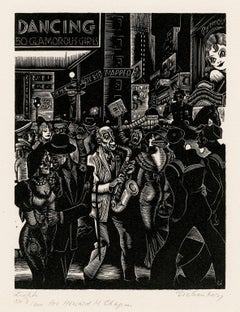
'City Lights' — Vintage Wood Engraving, New York City, 1934

'City Lights' — Vintage Wood Engraving, New York City, 1934

By Fritz Eichenberg

Located in Myrtle Beach, SC

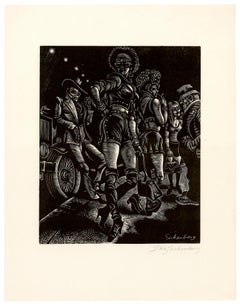
Fritz Eichenberg, 'City LIghts', wood engraving, 1934, edition 200. Signed, titled 'Lights', and annotated 'No 2/200 for Howard M. Chapin' in pencil. Initialed in the block, lower right. A fine, richly-inked black impression, on cream wove paper, with full margins (1 1/4 to 1 7/8 inches); a small loss (5/8 inch) in the top right sheet corner, well away from the image, otherwise in excellent condition. Printed by master printer Ernest Roth...

Category

1930s American Modern Fritz Eichenberg. Art
Materials

Woodcut

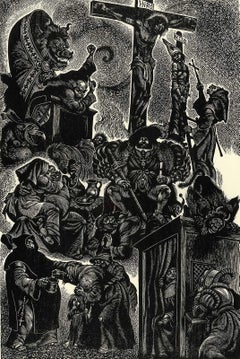
Follies of the Monks  -- Erasmus

Follies of the Monks -- Erasmus

By Fritz Eichenberg

Located in New Orleans, LA

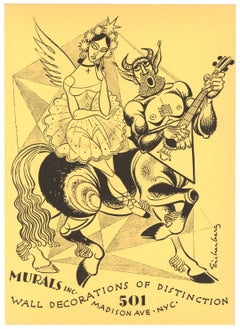
Trouble is not new to the church. Eichenberg illustrated In Praise Of Folly created this image called Folly of the Monks and Erasmus was writing in the 16th century. Erasmus was an...

Category

1970s American Modern Fritz Eichenberg. Art
Materials

Wood, Engraving

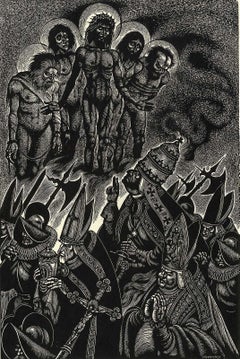
Follies of the Popes (1500 to 2019 - Erasmus

Follies of the Popes (1500 to 2019 - Erasmus

By Fritz Eichenberg

Located in New Orleans, LA

Trouble is not new to religion. Eichenberg illustrated In Praise Of Folly and created this image called Folly of the Popes and Erasmus was writing in the 16...

Category

1970s American Modern Fritz Eichenberg. Art
Materials

Wood, Engraving

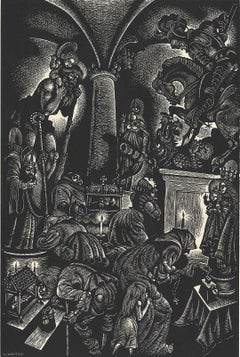
Folly of Worshipping Idols

Folly of Worshipping Idols

By Fritz Eichenberg

Located in New Orleans, LA

Trouble is not new to religion. Eichenberg illustrated In Praise Of Folly and created this image called Folly of Worshipping Idols and Erasmus was writing in the 16th century. Eras...

Category

1970s American Modern Fritz Eichenberg. Art
Materials

Wood, Engraving

Folly of Worshipping Idols

Folly of Worshipping Idols

By Fritz Eichenberg

Located in New Orleans, LA

Trouble is not new to religion. Eichenberg illustrated In Praise Of Folly and created this image called Folly of Worshipping Idols and Erasmus was writing in the 16th century. Eras...

Category

1970s American Modern Fritz Eichenberg. Art
Materials

Wood, Engraving

Crime and Punishment

Crime and Punishment

By Fritz Eichenberg

Located in New Orleans, LA

In 1966, Fritz Eichenberg moved to Rhode Island and chaired the Art Department of the University of Rhode Island in Kingston. His wood engravings and lithographs are almost always as...

Category

Late 20th Century American Modern Fritz Eichenberg. Art
Materials

Wood, Engraving

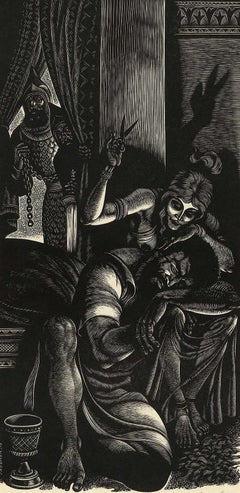
And His Strength Went From Him (Samson And Delilah)

And His Strength Went From Him (Samson And Delilah)

By Fritz Eichenberg

Located in New Orleans, LA

Fritz Eichenberg created wood engravings to illustrate the biblical scene of Samson and Goliath German born wood engraver and lithographer, Eichenberg studied at the School of Appli...

Category

Late 20th Century American Modern Fritz Eichenberg. Art
Materials

Wood, Engraving

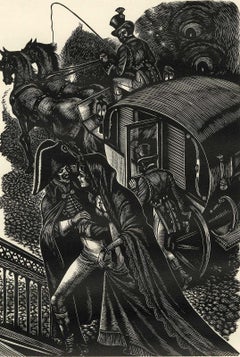
Mlle. Celine and Escort (Celine is a dancer former mistress of Mister Rochester)

Mlle. Celine and Escort (Celine is a dancer former mistress of Mister Rochester)

By Fritz Eichenberg

Located in New Orleans, LA

Fritz Eichenberg did some original wood engravings for "Jane Eyre." Céline Varens was Adèle's mother and Mr. Rochester's former mistress. A French opera dancer, Céline pretended to ...

Category

Late 20th Century American Modern Fritz Eichenberg. Art
Materials

Wood, Engraving

Fritz Eichenberg. art for sale on 1stDibs.
Find a wide variety of authentic Fritz Eichenberg. art available for sale on 1stDibs. You can also browse by medium to find art by Fritz Eichenberg. in woodcut print, engraving, wood and more. Much of the original work by this artist or collective was created during the 20th century and is mostly associated with the modern style. Not every interior allows for large Fritz Eichenberg. art, so small editions measuring 4 inches across are available. Customers who are interested in this artist might also find the work of Charles Frederick William Mielatz, Harry Sternberg, and Jacques Monory. Fritz Eichenberg. art prices can differ depending upon medium, time period and other attributes. On 1stDibs, the price for these items starts at $125 and tops out at $1,800, while the average work can sell for $450.