Fritz Hansen Coffee and Cocktail Tables

Danish, 1847-1902

When the Copenhagen-based furniture maker Fritz Hansen opened for business more than 140 years ago, the company — which today styles itself The Republic of Fritz Hansen — adhered to the traditional, time-honored Danish values of craftsmanship in woodworking and joinery. Yet thanks to the postwar innovations of Arne Jacobsen and others, Fritz Hansen would become the country’s leader in Scandinavian modern design using new, forward-looking materials and methods.

Fritz Hansen started his company in 1872, specializing in the manufacture of small furniture parts. In 1915, the firm became the first in Denmark to make chairs using steam-bent wood (a technique most familiar from birch used in the ubiquitous café chairs by Austrian maker Thonet). At the time, Fritz Hansen was best known for seating that featured curved legs and curlicue splats and referenced 18th-century Chippendale designs.

In the next few decades, the company promoted simple, plain chairs with slatted backs and cane or rush seats designed by such proto-modernist masters as Kaare Klint and Søren Hansen. Still, the most aesthetically striking piece Fritz Hansen produced in the first half of the 20th century was arguably the China chair of 1944 by Hans Wegner — and that piece, with its yoke-shaped bentwood back- and armrest, was based on seating manufactured in China during the Ming dynasty. (Wegner was moved by portraits he’d seen of Danish merchants in the Chinese chairs.) 

Everything changed in 1952 with Arne Jacobsen’s Ant chair. The collaboration between the architect and Fritz Hansen officially originated in 1934 — that year, Jacobsen created his inaugural piece for the manufacturer, the solid beechwood Bellevue chair for a restaurant commission. The Ant chair, however, was the breakthrough.

With assistance from his then-apprentice Verner Panton, Jacobsen designed the Ant chair for the cafeteria of a Danish healthcare company called Novo Nordisk. The chair was composed of a seat and backrest formed from a single piece of molded plywood attached, in its original iteration, to three tubular metal legs. Its silhouette suggests the shape of the insect’s body, and the lightweight, stackable chair and its biomorphic form became an international hit.

Jacobsen followed with more plywood successes, such as the Grand Prix chair of 1957. The following year he designed the SAS Royal Hotel in Copenhagen and its furnishings, including the Egg chair and the Swan chair. Those two upholstered pieces, with their lush, organic frames made of fiberglass-reinforced polyurethane, have become the two chairs most emblematic of mid-20th-century cool. Moreover, the Egg and Swan led Fritz Hansen to fully embrace new man-made materials, like foam, plastic and steel wire used to realize the avant-garde creations of later generations of designers with whom the firm collaborated, such as Piet Hein, Jørn Utzon (the architect of the Sydney Opera House) and Verner Panton. If the Fritz Hansen of 1872 would not now recognize his company, today’s connoisseurs certainly do.

Find a collection of vintage Fritz Hansen tables, lounge chairs, sofas and other furniture on 1stDibs.

to
2
Height
to
Width
to
Depth
to
35
26
36
23
3
40
17
4
36
26
28
7
1
6
15
3
4
42
28
26
18
14
62
58
58
2
2
62
40
43
459
309
271
233
153
Creator: Fritz Hansen
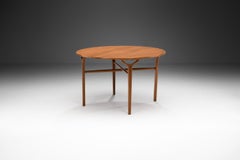
Peter Hvidt & Orla Mølgaard Nielsen "AX" Coffee Table, Denmark 1950s

Peter Hvidt & Orla Mølgaard Nielsen "AX" Coffee Table, Denmark 1950s

By Peter Hvidt, Fritz Hansen, Orla Mølgaard-Nielsen

Located in Utrecht, NL

With warm tones, exceptional versatility, and crafted with a range of appealing materials, Peter Hvidt & Orla Mølgaard Nielsen furniture showcase the Danish duo’s penchant for innovation and durable design. For decades, the pair created sleek coffee tables - like this piece - that are characterised by the practicality and elegance commonly attributed to Scandinavian modernism. In mid-century modern design, the use of wood held a special significance: it was not merely a material choice, but a philosophy that emphasised the natural and organic over the ornate and extravagant. The design of this coffee table is inspired by the mid-century inclination towards elemental shapes, featuring a simple, elegant circle as its tabletop, supported by four straight legs connected by overlapping cross stretchers. This minimalist approach combined with solid wood creates a timeless appearance that resonates with any design style. Furthermore, round tables, such as this model, held a special place in mid-century design. Their open, unobtrusive look fosters social interaction, making them ideal for gathering, discussion, and shared experiences. The absence of sharp corners enhances safety and flow within a space, promoting a harmonious environment. This table has a humble but well-thought-out structure that relies on its material for its aesthetic, with a natural expression dominated by the natural beauty of the wood and its characteristics. The most eye-catching design (and functional) element remains the cross stretchers connecting the legs. Albeit simple, its uncommon overlap - as opposed to bisecting - design catches the eye, and contrasts effectively with the top. The design of this table encapsulates a rich moment in furniture design history. It's a tangible embodiment of the mid-20th century era’s focus on materiality and craftsmanship, while also reflecting the innovative spirit of Danish designers like Peter Hvidt & Orla Mølgaard Nielsen. Condition: In good vintage condition. Wear consistent with age and use. Some marks and scratches on the wood. Dimensions: 36.22 in Ø x 22.05 in H 92 cm Ø x 56 cm H Literature: Fritz Hansen catalogue, 1951 About the Designers: Both Hvidt and Mølgaard-Nielsen attended what is now the Royal Danish Academy of Fine Arts, with Mølgaard-Nielsen having completed his studies under the Danish furniture design pioneer and architect Kaare Klint. Trained as an architect and cabinetmaker, Hvidt established his own firm in 1940 and taught at his alma mater for a few years. After they won a design competition held in Stockholm, Hvidt partnered with Mølgaard-Nielsen in 1944 to establish their firm in Copenhagen. The collaboration between Hvidt and Mølgaard-Nielsen yielded more than 250 designs and lasted over 30 years. Aside from having created a wardrobe for the Queen of Denmark as well as numerous architectural structures, the pair’s flagship achievements include 1944’s teak Portex chair...

Category

1950s Danish Mid-Century Modern Vintage Fritz Hansen Coffee and Cocktail Tables

Materials

Wood

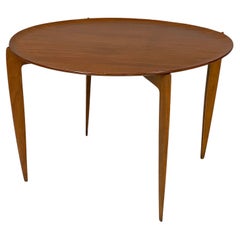
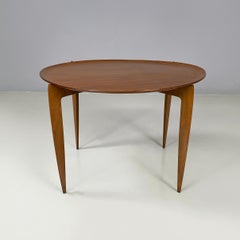
Denmark Coffee table tray 4508 by Svend Age Willumsen Engholm Fritz Hansen 1960s

Denmark Coffee table tray 4508 by Svend Age Willumsen Engholm Fritz Hansen 1960s

By Fritz Hansen

Located in MIlano, IT

Denmark mid-century modern Coffee table with tray 4508 by Fritz Hansen, 1960s Coffee table mod. 4508 with round tray top, entirely in teak. The paws tend to tighten towards the foot....

Category

1960s Italian Mid-Century Modern Vintage Fritz Hansen Coffee and Cocktail Tables

Materials

Teak

Fritz Hansen coffee and cocktail tables for sale on 1stDibs.

Fritz Hansen coffee and cocktail tables are available for sale on 1stDibs. These distinctive items are frequently made of wood and are designed with extraordinary care. There are many options to choose from in our collection of Fritz Hansen coffee and cocktail tables, although brown editions of this piece are particularly popular. We have 25 vintage editions of these items in-stock, while there is 1 modern edition to choose from as well. Many of the original coffee and cocktail tables by Fritz Hansen were created in the Scandinavian Modern style in europe during the 20th century. If you’re looking for additional options, many customers also consider coffee and cocktail tables by Børge Mogensen, Peter Hvidt, and CFC Silkeborg. Prices for Fritz Hansen coffee and cocktail tables can differ depending upon size, time period and other attributes — on 1stDibs, these items begin at $754 and can go as high as $16,703, while a piece like these, on average, fetch $2,350.