Grant Wood Prints and Multiples

American, 1891-1942
One of the major American Regionalist painters along with Thomas Hart Benton and John Steuart Curry, Grant Wood was born in Anamosa, Iowa, and spent his childhood in Cedar Rapids. Unlike Curry and Benton, he never moved East but remained in the Middle West where he found inspiration for his paintings of prosperous farms and people reflecting idealized American values. However, his work was set apart from many regionalists in that provoked both laughter and social indignation. A good example Daughters of Revolution, 1932, depicting the aloof smugness of women who regarded themselves as emblematic of the country's founding values This painting was a retaliation by Wood against DAR members who had criticized him for completing their window in Germany instead of America. Much of his satire was good natured and humorous. For two summers, Wood attended the Minneapolis School of Design and Handicraft and Normal Art as a student of Ernest Batchelder, and he had brief times of study at Iowa State University and the Art Institute of Chicago from 1913 to 1916. After World War I, he taught high school art in Cedar Rapids. Asserting that he "had to go to France to appreciate Iowa," he had several trips abroad, and in 1923 enrolled in the Academie Julian in Paris, but he determined to make his life in Iowa because "all the really good ideas I'd ever had came to me while I was milking a cow." In 1932, he was co-founder of the Stone City Art Colony and Art School and he became director of the Public Works Art Project in Iowa. He was also an Associate Professor of Fine Arts at the University of Iowa. His work can be divided into two periods, the first being views of Cedar Rapids, other landscapes including scenes of Europe, and a few portraits. However, in 1928, his work changed when he traveled to Munich to oversee the making of a stained-glass window for the Cedar Rapids Veterans Memorial Building commissioned by the Daughters of the American Revolution. Seeing the severe, austere new style of painting in Germany combined with work from the late Gothic period, he developed a unique new style of his own that treated mid-western subjects with Gothic overtones, satire, and caricature. In 1930, he produced his first major landscape painting, Stone City, that had exaggerated perspective and unique naive treatment. From that time, his paintings had a simple innocence and fantasy that transported the viewer into another world, often that of a child. He also did many murals and a few lithographs, completing nineteen between 1937 and 1942, the year he died of cancer at age 50 in Iowa City. Sources include: Matthew Baigell, Dictionary of American Art Michael David Zellman, 300 Years of American Art
to
1
1
Overall Width
to
Overall Height
to
3
1,320
1,030
921
902
2
1
1
2
2
1
1
1
1
1
1
1
2
1
1
1
2
Artist: Grant Wood
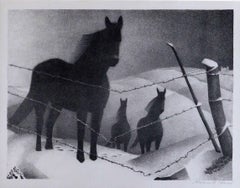
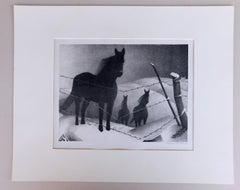
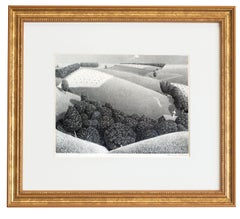
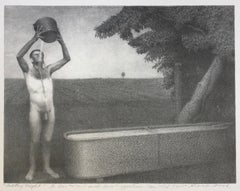
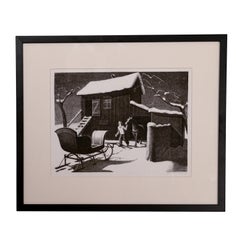
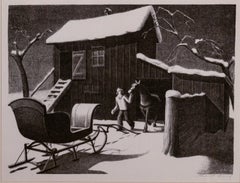
Grant Wood Original Pencil Signed Lithograph, 1940 - February

Grant Wood Original Pencil Signed Lithograph, 1940 - February

By Grant Wood

Located in Phoenix, AZ

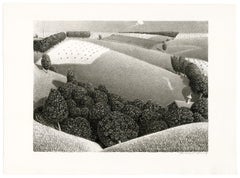
Original pencil signed Grant Wood lithograph, "February," created 1940. A fine impression and one of the most important of the 19 lithographs created by the painter of "American Goth...

Category

1940s Grant Wood Prints and Multiples

Materials

Paper, Lithograph
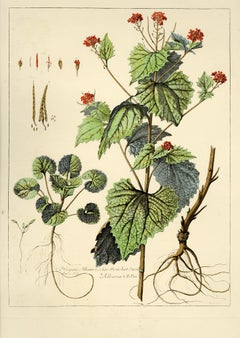
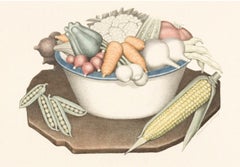
Vegetables
Vegetables

Vegetables

By Grant Wood

Located in New York, NY

Lithograph with hand coloring in watercolor, 1939. Edition of 250. Signed by the artist in pencil, lower right margin. The sheet with full margins. Published by Associated Ameri...

Category

1930s Gothic Grant Wood Prints and Multiples

Materials

Watercolor, Lithograph

Related Items
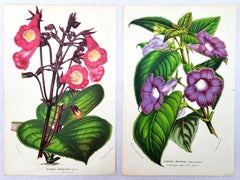
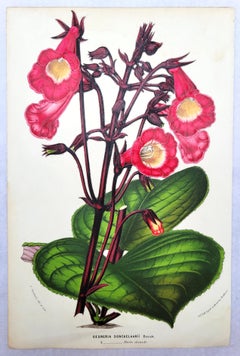
Set of Two Hand-Colored Lithographs by Louis van Houtte /// Botanical Flowers

Set of Two Hand-Colored Lithographs by Louis van Houtte /// Botanical Flowers

Located in Saint Augustine, FL

Artist: Louis van Houtte (Belgian, 1810-1876) Titles: "Gesneria Donckelaarii (Sinningia) (Vol. 9, Plate 902)" and "Scheeria Mexicana (Achimenes) (Vol. 9, Plate 891)" Portfolio: Flore...

Category

1850s Victorian Grant Wood Prints and Multiples

Materials

Watercolor, Lithograph

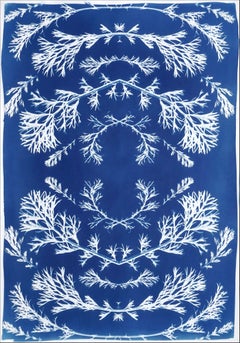
Classic Botanical Cyanotype, Handmade Using Natural Sunlight, Limited Edition

Classic Botanical Cyanotype, Handmade Using Natural Sunlight, Limited Edition

By Kind of Cyan

Located in Barcelona, ES

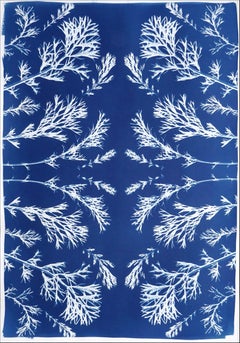
This is an exclusive handprinted limited edition cyanotype. Details: + Title: Vintage Pressed Flowers Nº3 + Year: 2023 + Edition Size: 20 + Stamped and Certificate of Authenticity provided + Measurements : 70x100 cm (28x 40 in.), a standard frame size + All cyanotype prints are made on high-quality Italian watercolor paper WHAT IS A CYANOTYPE? The cyanotype (a.k.a. sun-print) process is one of the oldest in the history of photography, dating back to the 1840's. Cyanotypes were then made famous by Anna Atkins, considered the first female photographer. Inspired by nature, we feel the need to look back at a craft that is handmade, analogue, and using an all-natural light source: the sun. Our cyanotypes are made by coating high-quality Italian watercolor paper with a light-sensitive emulsion. We then expose it in direct sunlight for several minutes using a photo negative...

Category

2010s American Modern Grant Wood Prints and Multiples

Materials

Emulsion, Watercolor, Paper, Lithograph
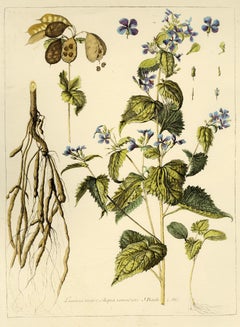
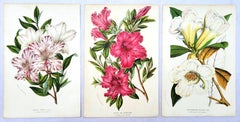
Set of Three Hand-Colored Lithographs by Louis van Houtte /// Botanical Flowers

Set of Three Hand-Colored Lithographs by Louis van Houtte /// Botanical Flowers

Located in Saint Augustine, FL

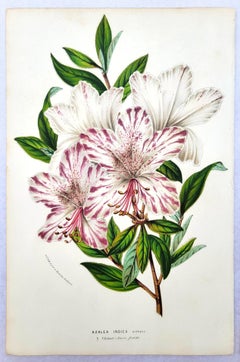
Artist: Louis van Houtte (Belgian, 1810-1876) Titles: "Azalea Indica vittata (Rhododendron Indicum) (Vol. 9, Plate 887)", "Azalea Ind. Crispiflora (Rhododendron Indicum) (Vol. 9, Pla...

Category

1850s Victorian Grant Wood Prints and Multiples

Materials

Watercolor, Lithograph

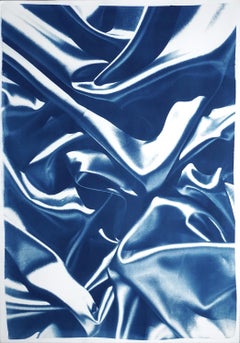
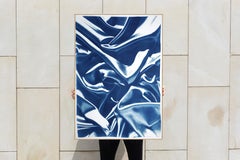
Sculptured Marble in Classic Blue, Extra Large Cyanotype Print, Abstract Silk

Sculptured Marble in Classic Blue, Extra Large Cyanotype Print, Abstract Silk

By Kind of Cyan

Located in Barcelona, ES

This is an exclusive handprinted limited edition cyanotype. Details: + Title: Marble Blue Silk Pattern + Year: 2022 + Edition Size: 50 + Medium: Cyanotype on Watercolor Paper + Sta...

Category

2010s Abstract Grant Wood Prints and Multiples

Materials

Emulsion, Watercolor, Rag Paper, Lithograph
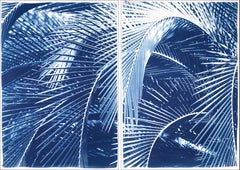
Lush Palm Bushes, Botanical Diptych, Still Life in Blue Tones, Tropical Style

Lush Palm Bushes, Botanical Diptych, Still Life in Blue Tones, Tropical Style

By Kind of Cyan

Located in Barcelona, ES

This is an exclusive handprinted limited edition cyanotype. "Lush Palm Bushes" is a gorgeous original cyanotype diptych showing gorgeous tropical palm leaves. Details: + Title: Lu...

Category

2010s Art Deco Grant Wood Prints and Multiples

Materials

Watercolor, Lithograph

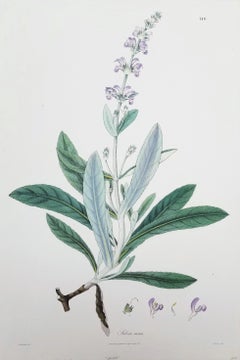
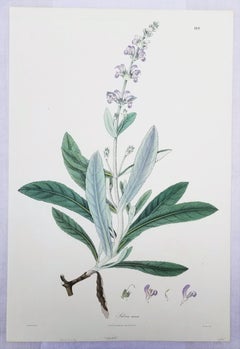
Salvia cana (Woolly Sage) /// Botanical Botany Flowers Plants Science Art Print

Salvia cana (Woolly Sage) /// Botanical Botany Flowers Plants Science Art Print

By Nathaniel Wallich

Located in Saint Augustine, FL

Artist: Nathaniel Wallich (Danish, 1786-1854) Title: "Salvia cana (Woolly Sage)" (Plate 116) Portfolio: Plantae Asiaticae Rariores; or, Descriptions and Figures of a Select Number of Unpublished East Indian Plants Year: 1830-1832 Medium: Original Hand-Colored Lithograph on J. Whatman paper Limited edition: 254 Printer: Engelmann, Graf, Coindet & Co., London, UK Publisher: Richard Taylor for Treuttel & Würtz, London, UK Sheet size: 21.13" x 14.25" Reference: Nissen BBI No. 2099; Pritzel No. 9957; Stafleu-Cowan No. 16583; Dunthorne No. 326 Condition: Some scattered tiny handling creases to sheet. Has been professionally stored away for decades. In excellent condition with strong colors Rare Notes: Provenance: private collection - Aspen, CO. Lithography by Maltese artist...

Category

1830s Victorian Grant Wood Prints and Multiples

Materials

Watercolor, Lithograph

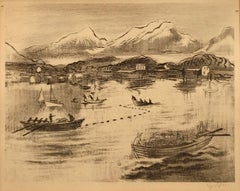
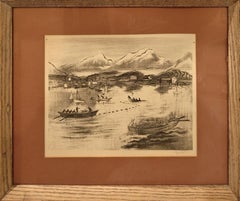
"Fishing Village" Joe Jones, Mid-Century, American Life, Small Town Scene

"Fishing Village" Joe Jones, Mid-Century, American Life, Small Town Scene

By Joe Jones

Located in New York, NY

Joe Jones Fishing Village, 1949 Signed in pencil lower right margin Lithograph on wove paper Image 9 5/16 x 12 9/16 inches Sheet 12 x 15 15/16 inches From the edition of 250 The initial details of Jones' career are sparse, and this is intentional. The young artist was engaged in a process of self-reinvention, crafting a persona. When he submitted a work to the Sixteen Cities Exhibition at New York City's Museum of Modern Art in 1933, he briefly characterized himself: "Born St. Louis, 1909, self-taught. " Jones intentionally portrayed himself to the art community as an authentic working-class figure, backed by a compelling history. He was the youngest of five children in a family led by a one-armed house painter from St. Louis, a Welsh immigrant, and his German American spouse. At the age of ten, Jones found himself in a Missouri reformatory due to authorities' concerns over his graffiti activities. After completing elementary school, he traveled by freight car to California and back, even being arrested for vagrancy in Pueblo, Colorado. Returning to St. Louis, he attempted to settle down by working alongside his father. Yet, Jones felt a profound restlessness and was drawn toward a more elevated artistic pursuit in his late teenage years. He discovered a local collective of budding artists that formed St. Louis’s "Little Bohemia," sharing a studio and providing mutual support until he managed to secure his own modest workspace in a vacant garage. Jones’s initial creations comprised still lifes, landscapes, and poignant portraits of those close to him. These subjects were not only accessible but also budget-friendly, as hiring models was beyond his means. He depicted himself, his father, mother, and eventually, his wife. In December 1930, at the age of 21, Jones wed Freda Sies, a modern dancer and political activist who was four years older than him. By 1933, Jones had started gaining noteworthy local recognition through a solo exhibition at the Artists’ Guild of Saint Louis. Of the twenty-five paintings on display, one, titled River Front (private collection, previously with Hirschl and Adler Galleries), was selected to illustrate a feature article about his show in The Art Digest (February 15, 1933, p. 9). Shortly before this exhibition, a young surgeon named Dr. Robert Elman took an interest in Jones’s art, purchasing several pieces and forming a group of potential patrons committed to providing the emerging artist with a monthly stipend in exchange for art. This group was officially known as the "Co-operative Art Society," but it was informally dubbed the "Joe Jones Club. " Jones became an active participant in the St. Louis artistic scene, particularly within its bohemian segments. He embraced modernism and was a founding member of the "New Hat" movement in 1931, a playful rebellion against the conservative and traditional mainstream art establishment. The summer of 1933 marked a significant shift in Jones’s journey. Sponsored by a dedicated ally, Mrs. Elizabeth Green, Jones, along with Freda and Green, embarked on an eastward road trip. In Washington, D. C., they explored the Corcoran Gallery of Art, the Freer Gallery (part of the Smithsonian Institution), the Library of Congress, and Mount Vernon. Following this whirlwind of art and American culture, they made their way to New York, where they visited various museums and galleries, including a stop at The New School for Social Research, which featured notable contemporary murals by fellow Missourian Thomas Hart Benton and the politically active Mexican artist, José Clemente Orozco. From June through August, Jones and Freda resided in the artist colony of Provincetown, Massachusetts, later returning home via Detroit to see Diego Rivera’s Detroit Industry mural housed at the Detroit Institute of Fine Arts. While Elizabeth Green allegedly hoped that Jones would refine his artistic skills under the guidance of Charles Hawthorne or Richard Miller in Provincetown, Jones followed a different path. Rather than pursuing conservative mentors, he connected with an engaging network of leftist intellectuals, writers, and artists who dedicated their time to reading Marx and applying his theories to the American landscape. Jones's reaction to the traditional culture of New England was captured in his statement to a reporter from the St. Louis Post Dispatch: “Class consciousness . . . that’s what I got of my trip to New England. Those people [New Englanders] are like the Chinese—ancestor worshipers. They made me realize where I belong” (September 21, 1933). The stark social divisions he witnessed there prompted him to embrace his working-class identity even more fervently. Upon returning to St. Louis, he prominently identified himself as a Communist. This newfound political stance created friction with some of his local supporters. Many of his middle-class advocates withdrew their backing, likely influenced not only by Jones’s politics but also by his flamboyant and confrontational demeanor. In December 1933, Jones initiated a complimentary art class for unemployed individuals in the Old Courthouse of St. Louis, the same location where the Dred Scott case was deliberated and where slave auctions formerly took place. Concurrently, the St. Louis Art League was offering paid courses. Emphasizing the theme of social activism, with a studio adorned with Soviet artwork, Jones’s institution operated for just over a year before being removed from the courthouse by local officials. The school’s political focus and unconventional teaching practices, along with its inclusion of a significant number of African American students during a period marked by rigid racial segregation, certainly contributed to its challenges. Under Jones’s guidance, the class created a large chalk pastel mural on board, measuring 16 by 37 feet, titled Social Unrest in St. Louis. Mural painting posed no challenge for the former housepainter, who was adept at handling large wall surfaces. His first significant commission in St. Louis in late 1931 was a mural that celebrated the city’s industrial and commercial fortitude for the local radio station, KMOX. This mural, aimed at conveying optimism amid severe economic hardship, showcased St. Louis's strengths in a modernist approach. When Jones resumed mural work in late 1933, his worldview had evolved considerably. The mural produced for the school in the courthouse, conceived by Jones, featured scenes of modern St. Louis selected to highlight political messages. Jones had observed the technique of utilizing self-contained scenes to craft visual narratives in the murals he encountered in the East. More locally, this compositional strategy was commonly employed by the renowned Missouri artist...

Category

1940s American Realist Grant Wood Prints and Multiples

Materials

Paper, Lithograph
Jim Dine Watercolor Litho, Signed, Ten Winter Tools, Three Adjustable Wrenches

Jim Dine Watercolor Litho, Signed, Ten Winter Tools, Three Adjustable Wrenches

By Jim Dine

Located in Washington, DC

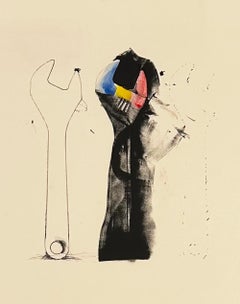
Artist: Jim Dine Medium: Lithograph hand-colored with watercolor on Auvergne Narcisse Title: Three Adjustable Wrenches Portfolio: 1973 Ten Winter Tools (Hand-Colored) Year: 1973 Edit...

Category

1970s Grant Wood Prints and Multiples

Materials

Watercolor, Lithograph
Group of seven (7) prints from Engravings of Plants + 1 Redouté

Group of seven (7) prints from Engravings of Plants + 1 Redouté

By Abraham Bosse

Located in Middletown, NY

Each a lithograph with hand coloring on watermarked Arches wove paper with a deckle edge. Each 16 1/4 x 12 1/4 (412 x 312 mm); sheet 26 x 19 3/4 inches (661 x 502 mm), each with full...

Category

Late 17th Century French School Grant Wood Prints and Multiples

Materials

Watercolor, Lithograph
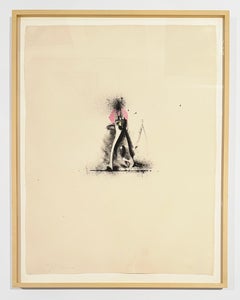
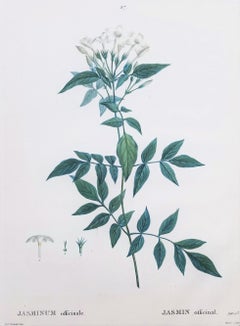
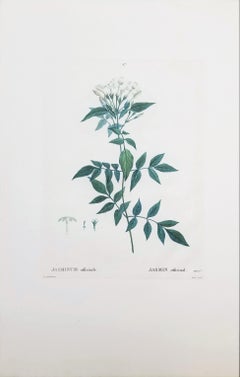
Jasminum Officinale (Common Jasmine) /// Pierre-Joseph Redouté Botanical Flower

Jasminum Officinale (Common Jasmine) /// Pierre-Joseph Redouté Botanical Flower

By Pierre-Joseph Redouté

Located in Saint Augustine, FL

Artist: (after) Pierre-Joseph Redouté (French, 1759-1840) Title: "Jasminum Officinale (Common Jasmine)" (Plate 27, page 93) Portfolio: Traité des Arbres et Arbustes que l'on Cultive ...

Category

Early 1800s Old Masters Grant Wood Prints and Multiples

Materials

Watercolor, Engraving

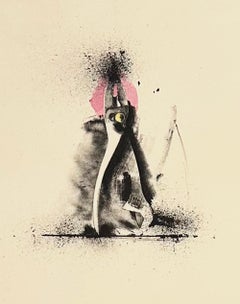
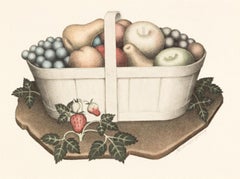
Jim Dine Watercolor Litho, Signed, Ten Winter Tools, Pliers and Adjust Wrench

Jim Dine Watercolor Litho, Signed, Ten Winter Tools, Pliers and Adjust Wrench

By Jim Dine

Located in Washington, DC

Artist: Jim Dine Medium: Lithograph hand-colored with watercolor on Auvergne Narcisse Title: Pliers and Adjustable Wrench Portfolio: 1973 Ten Winter Tools (Hand-Colored) Year: 1973 E...
Category

1970s Grant Wood Prints and Multiples

Materials

Watercolor, Lithograph
Previously Available Items
Fruits
Fruits

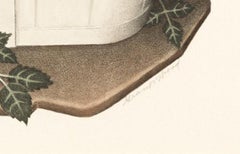
Grant WoodFruits, 1939

Sold

H 7.5 in W 10 in

Fruits

By Grant Wood

Located in New York, NY

Lithograph with hand coloring in watercolor, 1939. Edition of 250. Signed by the artist in pencil, lower right margin. The sheet with full margins. Published by Associated Ameri...
Category

1930s American Modern Grant Wood Prints and Multiples

Materials

Watercolor, Lithograph
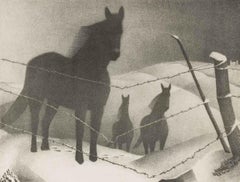
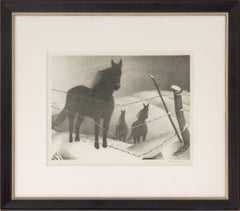
Grant Wood "February" Lithograph, 1941

Grant Wood "February" Lithograph, 1941

By Grant Wood

Located in Astoria, NY

Grant Wood (American, 1891-1942), "February", Lithograph on Rives BFK Paper, 1941, signed in pencil lower right, from an edition of 250, published by Associated American Artists, ebo...
Category

1940s American Modern Grant Wood Prints and Multiples

Materials

Paper, Lithograph
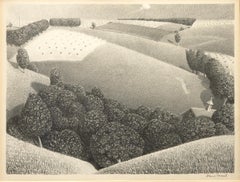
July Fifteenth
July Fifteenth

Grant WoodJuly Fifteenth, 1938

Sold

H 9.75 in W 12.5 in

July Fifteenth

By Grant Wood

Located in Palm Desert, CA

"July Fifteenth" is a lithograph from 1938 by Grant Wood. The artwork size is 9 3/4 x 12 1/2 inches. The framed size is 17 x 19 1/2 x 5/8 inches. The piece is signed in pencil, lower...
Category

Early 20th Century American Realist Grant Wood Prints and Multiples

Materials

Lithograph
Fertility
Fertility

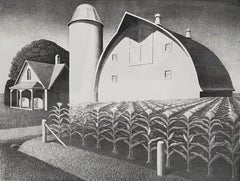
Grant WoodFertility, 1939

Sold

H 12.625 in W 19.125 in

Fertility

By Grant Wood

Located in Rancho Santa Fe, CA

Lithograph on wove paper 9 x 12 in. (image size) 12 5/8 x 19 1/8 in. (sheet size) Signed lower right Edition of 250 Published by Associated American Artists (AAA), New York This ite...
Category

1930s American Modern Grant Wood Prints and Multiples

Materials

Lithograph

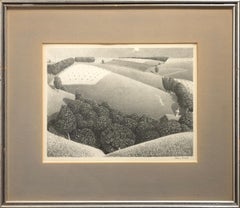
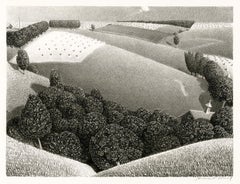
'July Fifteenth, 1938' — American Regionalism, 1930s

'July Fifteenth, 1938' — American Regionalism, 1930s

By Grant Wood

Located in Myrtle Beach, SC

Grant Wood, 'July Fifteenth, 1938', lithograph, edition 250, 1938, Cole 5. Signed in pencil. A superb impression on off-white wove paper, with full margins (1 3/16 to 2 inches), in excellent condition. Image size 9 x 11 7/8 inches; sheet size 11 3/4 x 15 7/8 inches. Matted to museum standards, unframed. Printed by master lithographer George C. Miller. Published by Associated American Artists, New York, in 1938. Reproduced and Exhibited: 'American Master Prints from the Betty and Douglas Duffy Collection', the trust for museum exhibitions Washington, D.C., 1987; 'Pressed In Time: American Prints 1905-1950', Henry E. Huntington Library and Art Gallery, San Marino, 2007. Impressions of this work are in the following museum collections: Amon Carter Museum of American Art, Art Institute of Chicago, Cedar Rapids Museum of Art, Des Moines Art Center, Detroit Institute of Arts, Harvard Art Museums, Huntington Library Art Museum, Los Angeles County Museum of Art, Fine Arts Museums of San Francisco, Milwaukee Art Museum, Museum of Fine Arts Boston, National Gallery of Art, Philadelphia Museum of Art, Rhode Island School of Design Museum, Smithsonian America Art Museum, Sioux City Art Center, Whitney Museum of American Art. ABOUT THE ARTIST Grant Wood (1892- 1942) was born in Anamona, Iowa, and lived for ten years on a farm in that area. When his father died in 1901, his mother sold the farm and moved to Cedar Rapids, which was to remain the center of Wood’s world. Principally self-taught, Wood received his art education in a summer class at the Minneapolis School of Design, Handicraft and Normal Art; two years at the University of Iowa; and night school at the Art Institute of Chicago. He made several trips to Europe and studied briefly at the Académie Julien in Paris. Wood was cofounder of the Stone City Art Colony and Art School and was director of the Public Works of Art Project in Iowa from 1933-1934. On a trip to Munich in 1928 to supervise the execution of a stained glass window for the Cedar Rapids Veterans Memorial Building, he studied the northern Renaissance masters, whose crystalline realism and work with layered oil glazes influenced his highly-crafted style of painting. Wood’s other sources of inspiration were American folk paintings and nineteenth-century townscapes. The turning point in Wood’s career came in 1930 when he won a bronze medal at the Art Institute of Chicago for his painting American Gothic. The image received national recognition, and Wood became famous overnight. In 1937, Wood began making lithographs for the Associated American Artists. These works, imbued with the same humorous satire and meticulous craftsmanship that Wood employed in his paintings, are celebrated as iconic images of American Regionalism...
Category

1930s American Modern Grant Wood Prints and Multiples

Materials

Lithograph

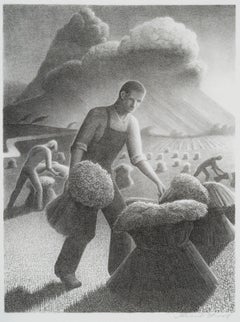
Approaching Storm

Grant WoodApproaching Storm, 1940

Sold

H 11.75 in W 8.75 in

Approaching Storm

By Grant Wood

Located in New York, NY

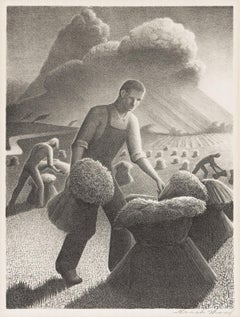
A very good impression of this lithograph. Edition of 250. Signed in pencil, lower right. Published by Associated American Artists, New York.

Category

1940s American Realist Grant Wood Prints and Multiples

Materials

Lithograph

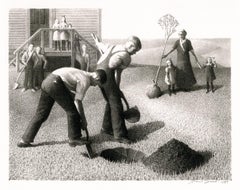
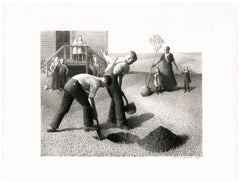
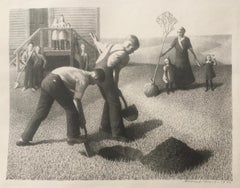
Tree Planting Group — 1930s American Regionalism

Tree Planting Group — 1930s American Regionalism

By Grant Wood

Located in Myrtle Beach, SC

Grant Wood, 'Tree Planting Group', lithograph, 1937, edition 250, Cole 1. Signed and dated in pencil. A fine, richly-inked impression, on off-white wove pap...

Category

1930s American Realist Grant Wood Prints and Multiples

Materials

Lithograph

Approaching Storm

Approaching Storm

By Grant Wood

Located in Portland, ME

Wood, Grant. APPROACHING STORM. Lithograph, 1940. Cole 19. 11 7/8 x 9 inches (304 x 230 mm). Published by Associated American Artists in an edition o...

Category

Mid-20th Century American Realist Grant Wood Prints and Multiples

Materials

Lithograph

TREE PLANTING GROUP - Woods First Print

TREE PLANTING GROUP - Woods First Print

By Grant Wood

Located in Santa Monica, CA

GRANT WOOD (1891 - 1942) TREE PLANTING GROUP. 1937 (Cole 1) Lithograph as published by Associated American Artists. Signed and dated in pencil. Edition 2...

Category

1930s American Modern Grant Wood Prints and Multiples

Materials

Lithograph

Original Grant Wood Lithograph 1938 Framed American Investment Quality Rare

Original Grant Wood Lithograph 1938 Framed American Investment Quality Rare

By Grant Wood

Located in Buffalo, NY

July Fifteenth, 1938 Lithograph on paper under glass; Associated American Artists, New York, pub. Edition of 250, hand signed lower right: Grant Wood Image: 9" H x 12" W Literature:...

Category

1930s American Modern Grant Wood Prints and Multiples

Materials

Lithograph

Sultry Night - Banned by the Post Office in 1939 - Provenance: Nan Wood

Sultry Night - Banned by the Post Office in 1939 - Provenance: Nan Wood

By Grant Wood

Located in Santa Monica, CA

GRANT WOOD ( 1891 - 1942) SULTRY NIGHT, 1939 (Cole 6) Lithograph, signed in pencil. Edition 100. In very good condition, Image 9 x 11 3/4 inches, sheet slightly trimmed being 11 1/2...

Category

1930s American Modern Grant Wood Prints and Multiples

Materials

Lithograph

Grant Wood prints and multiples for sale on 1stDibs.

Find a wide variety of authentic Grant Wood prints and multiples available for sale on 1stDibs. You can also browse by medium to find art by Grant Wood in lithograph and more. Not every interior allows for large Grant Wood prints and multiples, so small editions measuring 11 inches across are available. Customers who are interested in this artist might also find the work of Gene Kloss, Reginald Marsh, and Louis Oscar Griffith. Grant Wood prints and multiples prices can differ depending upon medium, time period and other attributes. On 1stDibs, the price for these items starts at $11,800 and tops out at $11,800, while the average work can sell for $11,800.
Questions About Grant Wood Prints and Multiples
  • 1stDibs ExpertFebruary 13, 2024
    Grant Wood is from Iowa. The American artist was born in Anamosa, Iowa, in 1891 and grew up in nearby Cedar Rapids. Unlike other American regionalist painters like John Steuart Curry and Thomas Hart Benton, Wood never moved East but remained in the Middle West, where he found inspiration for his paintings of prosperous farms and people reflecting idealized American values. He died in Iowa City, Iowa, in 1942, at the age of 51. Find an extraordinary collection of art for sale on 1stDibs.
  • 1stDibs ExpertSeptember 9, 2024
    How much a Grant Wood painting is worth varies based on its size, historical significance, condition and other factors. In 2005, his piece Spring Plowing fetched more than $6.9 million at a New York auction. The American artist developed a unique style of his own that treated Midwestern subjects with Gothic overtones, satire and caricature. His paintings have a simple innocence and fantasy that transport the viewer into another world, often that of a child. To learn the estimated value of a particular Wood piece, consult a certified appraiser or knowledgeable art dealer. Find a range of Grant Wood art on 1stDibs.