Henri Fantin-Latour Prints and Multiples

French, 1836-1904
Henri Fantin-Latour, in full Ignace-Henri-Jean-Théodore Fantin-Latour (born Jan. 14, 1836, Grenoble, France—died Aug. 25, 1904, Buré), French painter, printmaker, and illustrator noted for his still lifes with flowers and his portraits, especially group compositions, of contemporary French celebrities in the arts. Fantin-Latour’s first teacher was his father, a well-known portrait painter. Later, he studied at the school of Lecoq de Boisbaudran and attended the École des Beaux-Arts. He exhibited at the official French Salons, but in 1863 he also showed his work in the rebel Salon des Refusés. Although academic in manner, Fantin-Latour was independent in style. He had numerous friends among the leading French painters of his day, including J.-A.-D. Ingres, Eugène Delacroix, Camille Corot, Édouard Manet, and Gustave Courbet. His portrait groups, often arranged in rows of heads and figures like 17th-century Dutch guild portraits, are perhaps most interesting for their portrayal of various literary and artistic persons of the time. Fantin-Latour’s flower paintings were particularly appreciated in England, where, through James McNeill Whistler and Sir John Everett Millais, Fantin-Latour found a patron in Edwin Edwards. A wealthy amateur engraver, he supported Fantin-Latour for years by purchasing his still lifes. The last period of Fantin-Latour’s life was primarily devoted to lithography. In the Salon of 1876 he exhibited L’Anniversaire, honouring composer Hector Berlioz, and thereafter his lithographs were shown regularly. Most characteristic were his delicate portraits and imaginative drawings illustrative of the music of Richard Wagner, Berlioz, and others. He also illustrated Adolphe Jullien’s biographies of Wagner (1886) and Berlioz (1888).
to
1
11
2
2
Overall Width
to
Overall Height
to
7
4
1
17
1,436
1,056
910
903
11
5
5
12
3
14
10
7
6
5
3
2
2
1
1
1
1
1
1
15
1
1
1
2
6
8
8
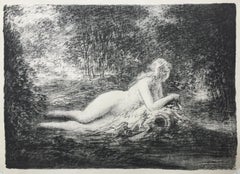
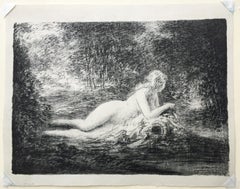
Artist: Henri Fantin-Latour
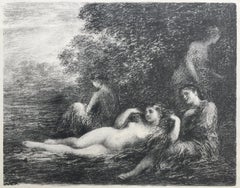
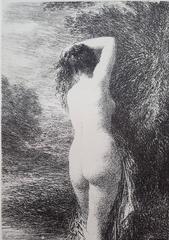
BAIGNEUSES
BAIGNEUSES

BAIGNEUSES

By Henri Fantin-Latour

Located in Santa Monica, CA

HENRI FANTIN-LATOUR (French 1836-1904) BAIGNEUSES (4e grande planche), 1898 (Hediard 138 II/II) It’s one of 6 works that formed a suite of images published ...

Category

1890s French School Henri Fantin-Latour Prints and Multiples

Materials

Lithograph

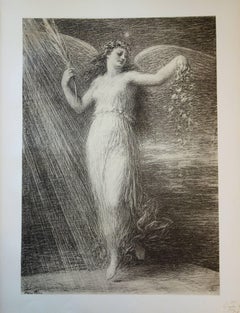
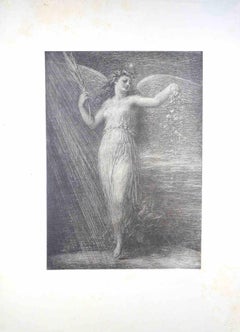
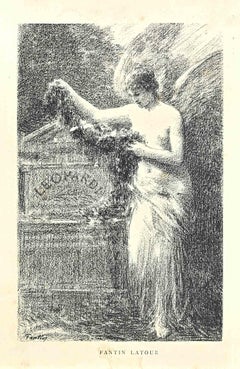
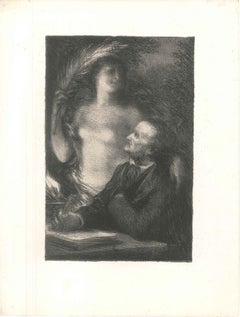
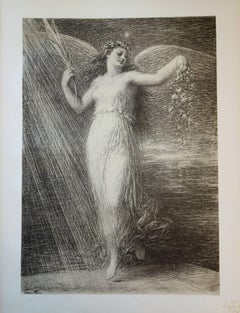
Immortality - Original lithograph (1897/98)

Immortality - Original lithograph (1897/98)

By Henri Fantin-Latour

Located in Paris, IDF

Henri Fantin-Latour Immortality Original lithograph Printed signature in the plate 1897/98 Printed on paper Vélin Size 40 x 31 cm (c. 16 x 12in) INFORMATION : Published by 'Estam...

Category

1890s Art Nouveau Henri Fantin-Latour Prints and Multiples

Materials

Lithograph

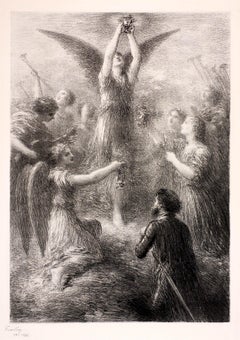
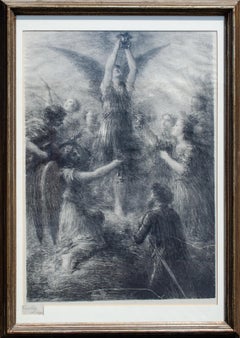
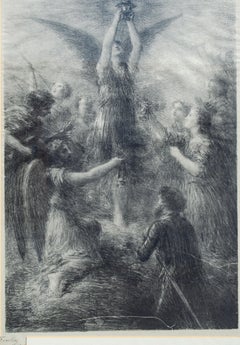
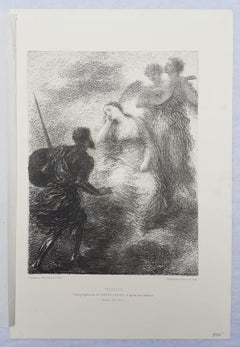
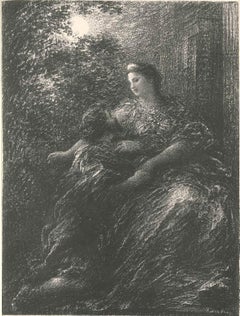
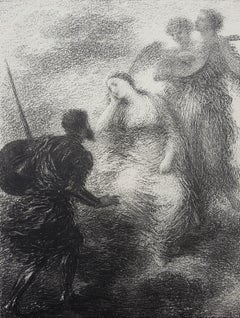
Prelude de Lohengrin (2e planche)     (The Appearance of the Holy Grail)

Prelude de Lohengrin (2e planche) (The Appearance of the Holy Grail)

By Henri Fantin-Latour

Located in Fairlawn, OH

Prelude de Lohengrin (2e planche) (The appearance of the Holy Grail) Lithograph, 1898 Signed and dated in the stone lower left (see photo) Printed on chine collee paper Condition...

Category

1890s Romantic Henri Fantin-Latour Prints and Multiples

Materials

Lithograph

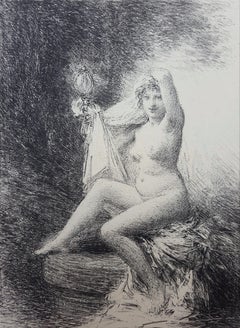
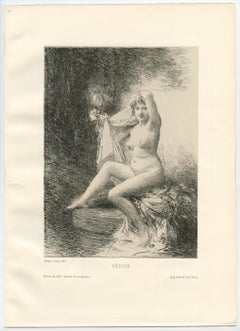
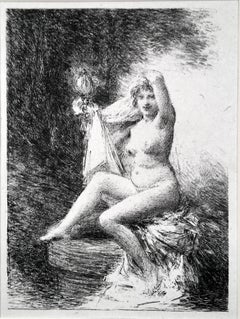
Vérité (Truth) /// Henri Fantin-Latour Modern Impressionist Nude Figurative Art

Vérité (Truth) /// Henri Fantin-Latour Modern Impressionist Nude Figurative Art

By Henri Fantin-Latour

Located in Saint Augustine, FL

Artist: Henri Fantin-Latour (French, 1836-1904) Title: "Vérité (Truth)" Portfolio: Revue de l'Art Ancien & Moderne *Issued unsigned Year: 1900 (third state of three) Medium: Original...

Category

Early 1900s Impressionist Henri Fantin-Latour Prints and Multiples

Materials

Lithograph, Chine Colle

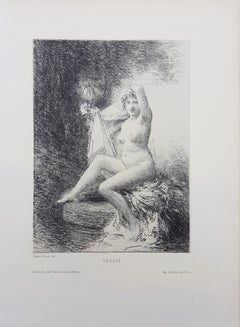
"Verite" original lithograph

"Verite" original lithograph

By Henri Fantin-Latour

Located in Henderson, NV

Medium: original lithograph. This impression on chine-colle paper was printed in 1900 and published in Paris by the Revue de l'Art ancien et moderne. Image size: 7 1/2 x 5 1/2 inches...

Category

Early 1900s Expressionist Henri Fantin-Latour Prints and Multiples

Materials

Lithograph

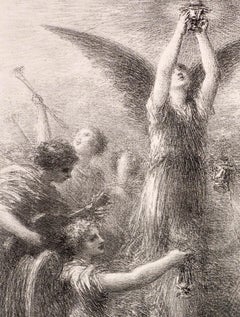
Henri Fantin-Latour "The Appearance of the Holy Grail" Old Master Print

Henri Fantin-Latour "The Appearance of the Holy Grail" Old Master Print

By Henri Fantin-Latour

Located in New York, NY

Henri Fantin-Latour Prelude de Lohengrin (2e planche) (The Appearance of the Holy Grail), 1898 Sight: 19 1/2 x 13 3/4 in. Framed: 24 3/4 x 17 1/2 x 1 1/2 in. Signed and dated in the ...

Category

1890s French School Henri Fantin-Latour Prints and Multiples

Materials

Lithograph

Le Paradis et la Péri -  Lithograph by Henri Fantin-Latour - 1901

Le Paradis et la Péri - Lithograph by Henri Fantin-Latour - 1901

By Henri Fantin-Latour

Located in Roma, IT

Le Paradis et la Péri is a wonderful black and white lithograph on China paper applied, realized in 1901 by the French artist Henri Fantin-Latour (Grenoble, 1836- Buré 1906). From Robert Schumann...

Category

Early 1900s Modern Henri Fantin-Latour Prints and Multiples

Materials

Lithograph

L'Immortalité - Lithograph by Henri Fantin-Latour - 1898

L'Immortalité - Lithograph by Henri Fantin-Latour - 1898

By Henri Fantin-Latour

Located in Roma, IT

Lithograph on laid paper, printed in tones of grey. Published in L’Estampe Moderne, Paris, in 1898. Full margins. Very good condition except for some foxing. A refined and symbolis...

Category

1890s Modern Henri Fantin-Latour Prints and Multiples

Materials

Lithograph

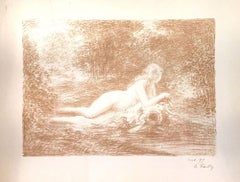
La Source dans les Bois - Lithograph by Henri Fantin-Latour - 1898

La Source dans les Bois - Lithograph by Henri Fantin-Latour - 1898

By Henri Fantin-Latour

Located in Roma, IT

Autographie (Calcography on paper transfer and Lithograph). Beautiful Proof in sanguine on China paper. In Excellent conditions and full margins. Ref. Cat. Hédiart-Mason n.139; Jo...

Category

1890s Modern Henri Fantin-Latour Prints and Multiples

Materials

Lithograph

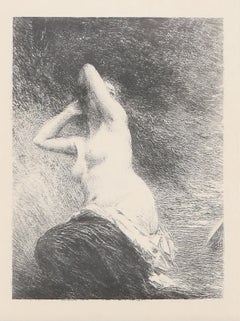
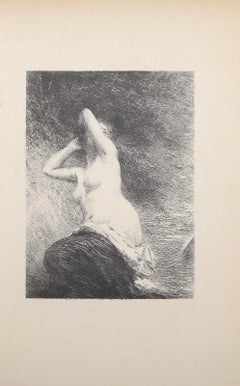
Ariane, Impressionist Nude Lithograph by Henri Fantin-Latour

Ariane, Impressionist Nude Lithograph by Henri Fantin-Latour

By Henri Fantin-Latour

Located in Long Island City, NY

Ariane Henri Fantin-Latour, French (1836–1904) Date: 1901 Lithograph Image Size: 6.25 x 4.75 inches Size: 10.75 x 7 in. (27.31 x 17.78 cm)

Category

Early 1900s Impressionist Henri Fantin-Latour Prints and Multiples

Materials

Lithograph

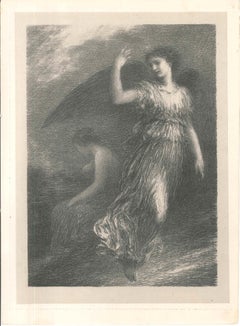
Vision /// French Romantic Classical Figurative Lady Woman Soldier Angel Litho

Vision /// French Romantic Classical Figurative Lady Woman Soldier Angel Litho

By Henri Fantin-Latour

Located in Saint Augustine, FL

Artist: Henri Fantin-Latour (French, 1836-1904) Title: "Vison" Portfolio: Gazette des Beaux-Arts *Issued unsigned Year: 1895 Medium: Original Lithograph on chine appliqué on wove pap...

Category

1890s Impressionist Henri Fantin-Latour Prints and Multiples

Materials

Lithograph

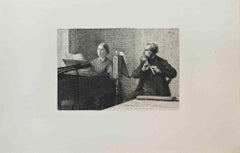
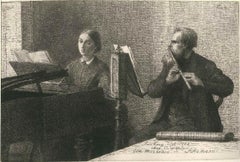
Un Morceau de Schumann - Etching by Henri Fantin-Latour - 1863

Un Morceau de Schumann - Etching by Henri Fantin-Latour - 1863

By Henri Fantin-Latour

Located in Roma, IT

Etching on laid paper Signed and dated in plate lower center: Dresde Oct. 1863 / Fantin Inscribed: Un morceau de Schumann Published by Cadart & Luquet, Éditeurs, 79 Rue Richelieu, Pa...

Category

1860s Modern Henri Fantin-Latour Prints and Multiples

Materials

Etching

Vérité (petite planche)

Vérité (petite planche)

By Henri Fantin-Latour

Located in New York, NY

Henri Fantin-Latour (1836-1904),Vérité (petite planche), 1900, lithograph. Hediard-Mason 156, first state (of 3). A proof of the first state before the edition published in La Revue...

Category

Early 1900s Impressionist Henri Fantin-Latour Prints and Multiples

Materials

Lithograph

The Muse -  Lithograph by Henri Fantin-Latour - 1886

The Muse - Lithograph by Henri Fantin-Latour - 1886

By Henri Fantin-Latour

Located in Roma, IT

The muse is a beautiful black and white lithograph, realized in 1886 by the French artist, Henri Theodore Fantin-Latour (Grenoble 1836- Buré 1906). A plate from "Richard Wagner, sa v...

Category

1880s Modern Henri Fantin-Latour Prints and Multiples

Materials

Lithograph

Duo des Troyens Lithograph on Chinese Paper, Modern, Signed, 1890s

Duo des Troyens Lithograph on Chinese Paper, Modern, Signed, 1890s

By Henri Fantin-Latour

Located in Roma, IT

Beautiful lithograph on Chinese paper, hand signed on plate on the lower right margin. Third state on four. Excellent conditions, including an ivory colored cardboard passepartout 47...

Category

1890s Modern Henri Fantin-Latour Prints and Multiples

Materials

Lithograph

Related Items
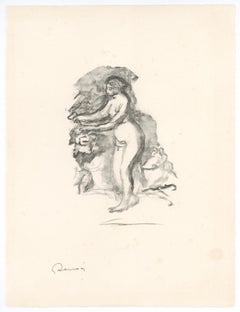
"Femme au cep de vigne" original lithograph

"Femme au cep de vigne" original lithograph

By Pierre-Auguste Renoir

Located in Henderson, NV

Medium: original lithograph. Catalogue references: Delteil 44 or Roger-Marx 19. Printed in Paris by Clot and published in 1919 by Ambroise Vollard for the rare "Douze Lithographies O...

Category

1910s Impressionist Henri Fantin-Latour Prints and Multiples

Materials

Lithograph

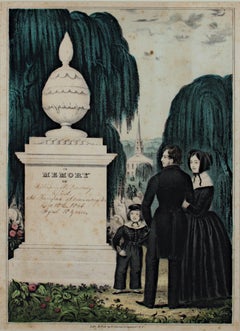
19th century color lithograph figures cemetery willow tree memorial headstone

19th century color lithograph figures cemetery willow tree memorial headstone

By Nathaniel Currier

Located in Milwaukee, WI

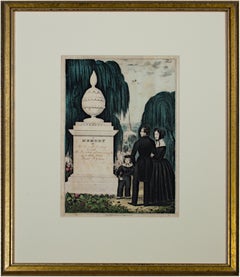
The present hand-colored lithograph was produced as part of the funeral and mourning culture in the United States during the 19th century. Images like this were popular as ways of remembering loved ones, an alternative to portraiture of the deceased. This lithograph shows a man, woman and child in morning clothes next to an urn-topped stone monument. Behind are additional putto-topped headstones beneath weeping willows, with a steepled church beyond. The monument contains a space where a family could inscribe the name and death dates of a deceased loved one. In this case, it has been inscribed to a young Civil War soldier: William W. Peabody Died at Fairfax Seminary, VA December 18th, 1864 Aged 18 years The young Mr. Peabody probably died in service for the Union during the American Civil War. Farifax Seminary was a Union hospital and military headquarters in Alexandria, Virginia. The hospital served nearly two thousand soldiers during the war time. Five hundred were also buried on the Seminary's grounds. 13.75 x 9.5 inches, artwork 23 x 19 inches, frame Published before 1864 Inscribed bottom center "Lith. & Pub. by N. Currier. 2 Spruce St. N.Y." Framed to conservation standards using 100 percent rag matting and TruVue Conservation Clear glass, housed in a gold gilded moulding. Nathaniel Currier was a tall introspective man with a melancholy nature. He could captivate people with his piercing stare or charm them with his sparkling blue eyes. Nathaniel was born in Roxbury, Massachusetts on March 27th, 1813, the second of four children. His parents, Nathaniel and Hannah Currier, were distant cousins who lived a humble yet spartan life. When Nathaniel was eight years old, tragedy struck. Nathaniel’s father unexpectedly passed away leaving Nathaniel and his eleven-year-old brother Lorenzo to provide for the family. In addition to their mother, Nathaniel and Lorenzo had to care for six-year-old sister Elizabeth and two-year-old brother Charles. Nathaniel worked a series of odd jobs to support the family, and at fifteen, he started what would become a life-long career when he apprenticed in the Boston lithography shop of William and John Pendleton. A Bavarian gentleman named Alois Senefelder invented lithography just 30 years prior to young Nat Currier’s apprenticeship. While under the employ of the brothers Pendleton, Nat was taught the art of lithography by the firm’s chief printer, a French national named Dubois, who brought the lithography trade to America. Lithography involves grinding a piece of limestone flat and smooth then drawing in mirror image on the stone with a special grease pencil. After the image is completed, the stone is etched with a solution of aqua fortis leaving the greased areas in slight relief. Water is then used to wet the stone and greased-ink is rolled onto the raised areas. Since grease and water do not mix, the greased-ink is repelled by the moisture on the stone and clings to the original grease pencil lines. The stone is then placed in a press and used as a printing block to impart black on white images to paper. In 1833, now twenty-years old and an accomplished lithographer, Nat Currier left Boston and moved to Philadelphia to do contract work for M.E.D. Brown, a noted engraver and printer. With the promise of good money, Currier hired on to help Brown prepare lithographic stones of scientific images for the American Journal of Sciences and Arts. When Nat completed the contract work in 1834, he traveled to New York City to work once again for his mentor John Pendleton, who was now operating his own shop located at 137 Broadway. Soon after the reunion, Pendleton expressed an interest in returning to Boston and offered to sell his print shop to Currier. Young Nat did not have the financial resources to buy the shop, but being the resourceful type he found another local printer by the name of Stodart. Together they bought Pendleton’s business. The firm ‘Currier & Stodart’ specialized in "job" printing. They produced many different types of printed items, most notably music manuscripts for local publishers. By 1835, Stodart was frustrated that the business was not making enough money and he ended the partnership, taking his investment with him. With little more than some lithographic stones, and a talent for his trade, twenty-two year old Nat Currier set up shop in a temporary office at 1 Wall Street in New York City. He named his new enterprise ‘N. Currier, Lithographer’ Nathaniel continued as a job printer and duplicated everything from music sheets to architectural plans. He experimented with portraits, disaster scenes and memorial prints, and any thing that he could sell to the public from tables in front of his shop. During 1835 he produced a disaster print Ruins of the Planter's Hotel, New Orleans, which fell at two O’clock on the Morning of the 15th of May 1835, burying 50 persons, 40 of whom Escaped with their Lives. The public had a thirst for newsworthy events, and newspapers of the day did not include pictures. By producing this print, Nat gave the public a new way to “see” the news. The print sold reasonably well, an important fact that was not lost on Currier. Nat met and married Eliza Farnsworth in 1840. He also produced a print that same year titled Awful Conflagration of the Steamboat Lexington in Long Island Sound on Monday Evening, January 18, 1840, by which melancholy occurrence over One Hundred Persons Perished. This print sold out very quickly, and Currier was approached by an enterprising publication who contracted him to print a single sheet addition of their paper, the New York Sun. This single page paper is presumed to be the first illustrated newspaper ever published. The success of the Lexington print launched his career nationally and put him in a position to finally lift his family up. In 1841, Nat and Eliza had their first child, a son they named Edward West Currier. That same year Nat hired his twenty-one year old brother Charles and taught him the lithography trade, he also hired his artistically inclined brother Lorenzo to travel out west and make sketches of the new frontier as material for future prints. Charles worked for the firm on and off over the years, and invented a new type of lithographic crayon which he patented and named the Crayola. Lorenzo continued selling sketches to Nat for the next few years. In 1843, Nat and Eliza had a daughter, Eliza West Currier, but tragedy struck in early 1847 when their young daughter died from a prolonged illness. Nat and Eliza were grief stricken, and Eliza, driven by despair, gave up on life and passed away just four months after her daughter’s death. The subject of Nat Currier’s artwork changed following the death of his wife and daughter, and he produced many memorial prints and sentimental prints during the late 1840s. The memorial prints generally depicted grief stricken families posed by gravestones (the stones were left blank so the purchasers could fill in the names of the dearly departed). The sentimental prints usually depicted idealized portraits of women and children, titled with popular Christian names of the day. Late in 1847, Nat Currier married Lura Ormsbee, a friend of the family. Lura was a self-sufficient woman, and she immediately set out to help Nat raise six-year-old Edward and get their house in order. In 1849, Lura delivered a son, Walter Black Currier, but fate dealt them a blow when young Walter died one year later. While Nat and Lura were grieving the loss of their new son, word came from San Francisco that Nat’s brother Lorenzo had also passed away from a brief illness. Nat sank deeper into his natural quiet melancholy. Friends stopped by to console the couple, and Lura began to set an extra place at their table for these unexpected guests. She continued this tradition throughout their lives. In 1852, Charles introduced a friend, James Merritt Ives, to Nat and suggested he hire him as a bookkeeper. Jim Ives was a native New Yorker born in 1824 and raised on the grounds of Bellevue Hospital where his father was employed as superintendent. Jim was a self-trained artist and professional bookkeeper. He was also a plump and jovial man, presenting the exact opposite image of his new boss. Jim Ives met Charles Currier through Caroline Clark, the object of Jim’s affection. Caroline’s sister Elizabeth was married to Charles, and Caroline was a close friend of the Currier family. Jim eventually proposed marriage to Caroline and solicited an introduction to Nat Currier, through Charles, in hopes of securing a more stable income to support his future wife. Ives quickly set out to improve and modernize his new employer’s bookkeeping methods. He reorganized the firm’s sizable inventory, and used his artistic skills to streamline the firm’s production methods. By 1857, Nathaniel had become so dependent on Jims’ skills and initiative that he offered him a full partnership in the firm and appointed him general manager. The two men chose the name ‘Currier & Ives’ for the new partnership, and became close friends. Currier & Ives produced their prints in a building at 33 Spruce Street where they occupied the third, fourth and fifth floors. The third floor was devoted to the hand operated printing presses that were built by Nat's cousin, Cyrus Currier, at his shop Cyrus Currier & Sons in Newark, NJ. The fourth floor found the artists, lithographers and the stone grinders at work. The fifth floor housed the coloring department, and was one of the earliest production lines in the country. The colorists were generally immigrant girls, mostly German, who came to America with some formal artistic training. Each colorist was responsible for adding a single color to a print. As a colorist finished applying their color, the print was passed down the line to the next colorist to add their color. The colorists worked from a master print displayed above their table, which showed where the proper colors were to be placed. At the end of the table was a touch up artist who checked the prints for quality, touching-in areas that may have been missed as it passed down the line. During the Civil War, demand for prints became so great that coloring stencils were developed to speed up production. Although most Currier & Ives prints were colored in house, some were sent out to contract artists. The rate Currier & Ives paid these artists for coloring work was one dollar per one hundred small folios (a penny a print) and one dollar per one dozen large folios. Currier & Ives also offered uncolored prints to dealers, with instructions (included on the price list) on how to 'prepare the prints for coloring.' In addition, schools could order uncolored prints from the firm’s catalogue to use in their painting classes. Nathaniel Currier and James Merritt Ives attracted a wide circle of friends during their years in business. Some of their more famous acquaintances included Horace Greeley, Phineas T. Barnum, and the outspoken abolitionists Rev. Henry Ward, and John Greenleaf Whittier (the latter being a cousin of Mr. Currier). Nat Currier and Jim Ives described their business as "Publishers of Cheap and Popular Pictures" and produced many categories of prints. These included Disaster Scenes, Sentimental Images, Sports, Humor, Hunting Scenes, Politics, Religion, City and Rural Scenes, Trains, Ships, Fire Fighters, Famous Race Horses, Historical Portraits, and just about any other topic that satisfied the general public's taste. In all, the firm produced in excess of 7500 different titles, totaling over one million prints produced from 1835 to 1907. Nat Currier retired in 1880, and signed over his share of the firm to his son Edward. Nat died eight years later at his summer home 'Lion’s Gate' in Amesbury, Massachusetts. Jim Ives remained active in the firm until his death in 1895, when his share of the firm passed to his eldest son, Chauncey. In 1902, faced will failing health from the ravages of Tuberculosis, Edward Currier sold his share of the firm to Chauncey Ives...

Category

Mid-19th Century Romantic Henri Fantin-Latour Prints and Multiples

Materials

Watercolor, Lithograph
19th century color lithograph watercolor landscape figurative animal print

19th century color lithograph watercolor landscape figurative animal print

By Nathaniel Currier

Located in Milwaukee, WI

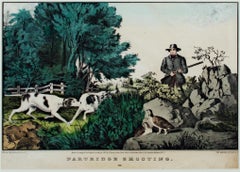
The present hand-colored lithograph presents the viewer with a hunting scene in a picturesque landscape. In the foreground, a man approaches two partridges as his two pointers prepare to flush them out. Beyond, a white fence draws our eyes to the homestead in the distance. Images like this one show how people in the United States were trying to identify themselves as a new nation in the North American landscape - as separate from their European counterparts but with similar similar and specific wildlife and magesties of nature. It also identifies hunting in this landscape as an American pastime. 9.25 x 12.5 inches, artwork 18.38 x 22 inches, frame Entitled bottom center "Partridge Shooting...

Category

Mid-19th Century Romantic Henri Fantin-Latour Prints and Multiples

Materials

Watercolor, Lithograph
Marc Chagall - Inspiration - Original Lithograph from "Chagall Lithographe" v. 2

Marc Chagall - Inspiration - Original Lithograph from "Chagall Lithographe" v. 2

By Marc Chagall

Located in Collonge Bellerive, Geneve, CH

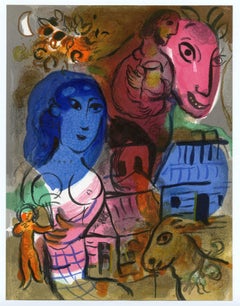
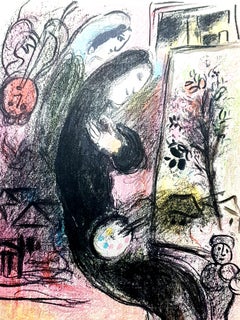
Marc Chagall Original Lithograph from Chagall Lithographe 1957-1962. VOLUME II. 1963 Dimensions: 32 x 24 cm From the unsigned edition of 10000 copies without margins Reference: Mourlot 398 Condition : Excellent Marc Chagall (born in 1887) Marc Chagall was born in Belarus in 1887 and developed an early interest in art. After studying painting, in 1907 he left Russia for Paris, where he lived in an artist colony on the city’s outskirts. Fusing his own personal, dreamlike imagery with hints of the fauvism and cubism popular in France at the time, Chagall created his most lasting work—including I and the Village (1911)—some of which would be featured in the Salon des Indépendants exhibitions. After returning to Vitebsk for a visit in 1914, the outbreak of WWI trapped Chagall in Russia. He returned to France in 1923 but was forced to flee the country and Nazi persecution during WWII. Finding asylum in the U.S., Chagall became involved in set and costume design before returning to France in 1948. In his later years, he experimented with new art forms and was commissioned to produce numerous large-scale works. Chagall died in St.-Paul-de-Vence in 1985. The Village Marc Chagall was born in a small Hassidic community on the outskirts of Vitebsk, Belarus, on July 7, 1887. His father was a fishmonger, and his mother ran a small sundries shop in the village. As a child, Chagall attended the Jewish elementary school, where he studied Hebrew and the Bible, before later attending the Russian public school. He began to learn the fundamentals of drawing during this time, but perhaps more importantly, he absorbed the world around him, storing away the imagery and themes that would feature largely in most of his later work. At age 19 Chagall enrolled at a private, all-Jewish art school and began his formal education in painting, studying briefly with portrait artist Yehuda Pen. However, he left the school after several months, moving to St. Petersburg in 1907 to study at the Imperial Society for the Protection of Fine Arts. The following year, he enrolled at the Svanseva School, studying with set designer Léon Bakst, whose work had been featured in Sergei Diaghilev's Ballets Russes. This early experience would prove important to Chagall’s later career as well. Despite this formal instruction, and the widespread popularity of realism in Russia at the time, Chagall was already establishing his own personal style, which featured a more dreamlike unreality and the people, places and imagery that were close to his heart. Some examples from this period are his Window Vitebsk (1908) and My Fianceé with Black Gloves (1909), which pictured Bella Rosenfeld, to whom he had recently become engaged. The Beehive Despite his romance with Bella, in 1911 an allowance from Russian parliament member and art patron Maxim Binaver enabled Chagall to move to Paris, France. After settling briefly in the Montparnasse neighborhood, Chagall moved further afield to an artist colony known as La Ruche (“The Beehive”), where he began to work side by side with abstract painters such as Amedeo Modigliani and Fernand Léger as well as the avant-garde poet Guillaume Apollinaire. At their urging, and under the influence of the wildly popular fauvism and cubism, Chagall lightened his palette and pushed his style ever further from reality. I and the Village (1911) and Homage to Apollinaire (1912) are among his early Parisian works, widely considered to be his most successful and representative period. Though his work stood stylistically apart from his cubist contemporaries, from 1912 to 1914 Chagall exhibited several paintings at the annual Salon des Indépendants exhibition, where works by the likes of Juan Gris, Marcel Duchamp and Robert Delaunay were causing a stir in the Paris art world. Chagall’s popularity began to spread beyond La Ruche, and in May 1914 he traveled to Berlin to help organize his first solo exhibition, at Der Sturm Gallery. Chagall remained in the city until the highly acclaimed show opened that June. He then returned to Vitebsk, unaware of the fateful events to come. War, Peace and Revolution In August 1914 the outbreak of World War I precluded Chagall’s plans to return to Paris. The conflict did little to stem the flow of his creative output, however, instead merely giving him direct access to the childhood scenes so essential to his work, as seen in paintings such as Jew in Green (1914) and Over Vitebsk (1914). His paintings from this period also occasionally featured images of the war’s impact on the region, as with Wounded Soldier (1914) and Marching (1915). But despite the hardships of life during wartime, this would also prove to be a joyful period for Chagall. In July 1915 he married Bella, and she gave birth to a daughter, Ida, the following year. Their appearance in works such as Birthday (1915), Bella and Ida by the Window (1917) and several of his “Lovers” paintings give a glimpse of the island of domestic bliss that was Chagall’s amidst the chaos. To avoid military service and stay with his new family, Chagall took a position as a clerk in the Ministry of War Economy in St. Petersburg. While there he began work on his autobiography and also immersed himself in the local art scene, befriending novelist Boris Pasternak, among others. He also exhibited his work in the city and soon gained considerable recognition. That notoriety would prove important in the aftermath of the 1917 Russian Revolution when he was appointed as the Commissar of Fine Arts in Vitebsk. In his new post, Chagall undertook various projects in the region, including the 1919 founding of the Academy of the Arts. Despite these endeavors, differences among his colleagues eventually disillusioned Chagall. In 1920 he relinquished his position and moved his family to Moscow, the post-revolution capital of Russia. In Moscow, Chagall was soon commissioned to create sets and costumes for various productions at the Moscow State Yiddish Theater...

Category

1960s Surrealist Henri Fantin-Latour Prints and Multiples

Materials

Lithograph

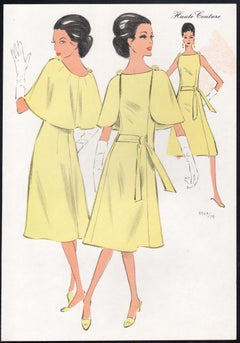
French Mid-Century 1970s Fashion Design Vintage Lithograph Print

French Mid-Century 1970s Fashion Design Vintage Lithograph Print

By Alice Kauffmann

Located in Melbourne, Victoria

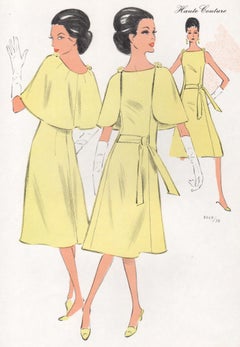
Original colour lithograph of a French fashion design from 'Haute Couture'. Published in a folio of designs for Summer 1971. 32cm by 22cm (sheet)

Category

1970s Post-War Henri Fantin-Latour Prints and Multiples

Materials

Lithograph

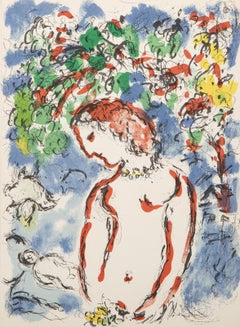
Spring Day from Derrier Le Miroir, Impressionist Lithograph by Marc Chagall

Spring Day from Derrier Le Miroir, Impressionist Lithograph by Marc Chagall

By Marc Chagall

Located in Long Island City, NY

Marc Chagall, Russian (1887 - 1985) - Spring Day from Derrier Le Miroir, Year: 1972, Medium: Lithograph, Size: 15 x 11 in. (38.1 x 27.94 cm), Printer: Mourlot, Paris, Publisher: Ma...

Category

1970s Impressionist Henri Fantin-Latour Prints and Multiples

Materials

Lithograph

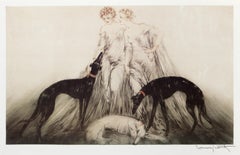
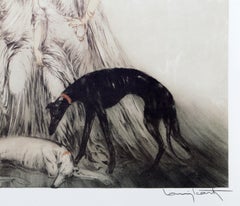
Coursing 3, Art Nouveau Offset Lithograph after Louis Icart

Coursing 3, Art Nouveau Offset Lithograph after Louis Icart

By Louis Icart

Located in Long Island City, NY

Louis Icart, After, French (1888 - 1950) - Coursing 3, Medium: Offset Lithograph on paper, signed in plate, Image Size: 14.5 x 23.75 inches, Size: 16 x 25 in. (40.64 x 63.5 cm), D...

Category

Early 20th Century Art Nouveau Henri Fantin-Latour Prints and Multiples

Materials

Lithograph, Offset

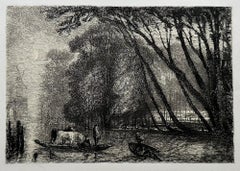
Bois de la Haye

Paul HuetBois de la Haye, 1867

$350

H 6 in W 8.75 in

Bois de la Haye

By Paul Huet

Located in Middletown, NY

Etching and lithograph on cream wove paper, 6 x 8 3/4 inches (151 x 220 mm), full margins. With some scattered light spots of yellowing in the margins on the recto, outside of image ...

Category

Mid-19th Century French School Henri Fantin-Latour Prints and Multiples

Materials

Handmade Paper, Etching, Lithograph
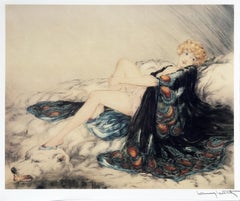
Silk Robe, Art Nouveau Offset Lithograph by Louis Icart
Silk Robe, Art Nouveau Offset Lithograph by Louis Icart
By Louis Icart

Located in Long Island City, NY

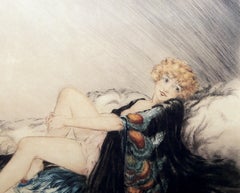
Louis Icart, French (1888 - 1950) - Silk Robe, Medium: Offset Lithograph on paper, signed in plate, Image Size: 17.5 x 21.5 inches, Size: 19 x 22.5 in. (48.26 x 57.15 cm), Descrip...
Category

Early 20th Century Art Nouveau Henri Fantin-Latour Prints and Multiples

Materials

Lithograph, Offset

XXe Siecle-Hommage a Marc Chagall

XXe Siecle-Hommage a Marc Chagall

By Marc Chagall

Located in Fairlawn, OH

XXe Siecle-Hommage a Marc Chagall Color lithograph, 1969 Unsigned as issued by XXe Siecle From: XXe Siecle, Volume, Special Issue Marc Chagall Published by G. di San Lazzaro for A. M...

Category

1960s French School Henri Fantin-Latour Prints and Multiples

Materials

Lithograph
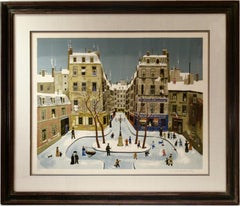
La Place de Furstenberg, Paris

La Place de Furstenberg, Paris

By Michel Delacroix

Located in San Francisco, CA

This artwork titled "La Place de Furstenberg Sous la Neige, Paris" 1979 is an original colors lithograph on Wove paper by noted French artist Michel Delacroix, born 1933. It is hand ...
Category

Late 20th Century French School Henri Fantin-Latour Prints and Multiples

Materials

Lithograph
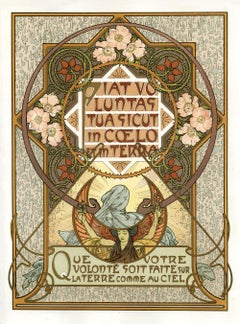
"On Earth as it is in Heaven" Original 1899 Color Lithograph by Alphonse Mucha
"On Earth as it is in Heaven" Original 1899 Color Lithograph by Alphonse Mucha
By Alphonse Mucha

Located in Palm Beach, FL

Alphonse Mucha worked mainly as a poster artist and became an influential figure of Art Nouveau in late 1890s, when poster illustrations were emerging as popular art form and new pri...

Category

1890s Art Nouveau Henri Fantin-Latour Prints and Multiples

Materials

Lithograph
Previously Available Items
La Source dans les Bois

La Source dans les Bois

By Henri Fantin-Latour

Located in Santa Monica, CA

HENRI FANTIN-LATOUR (French 1836-1904) LA SOURCE DANS DE BOIS, 1898 (Hédiart. 139; Johnson 41-2) Lithograph, unsigned, on chine. Image, 11 3/...

Category

1890s Barbizon School Henri Fantin-Latour Prints and Multiples

Materials

Lithograph

Immortality - original lithograph (1897/98)

Immortality - original lithograph (1897/98)

By Henri Fantin-Latour

Located in Paris, IDF

Henri Fantin-Latour Immortality Original lithograph Plate signed 1897/98 Printed on paper Vélin Size 40 x 31 cm (c. 16 x 12in) INFORMATION : Published by 'Estampe Moderne, Paris,...

Category

1890s Art Nouveau Henri Fantin-Latour Prints and Multiples

Materials

Lithograph

Un Morceau de Schumann

Henri Fantin-LatourUn Morceau de Schumann, 1864

Sold

H 13.12 in W 20.87 in D 0.04 in

Un Morceau de Schumann

By Henri Fantin-Latour

Located in Roma, IT

Very beautiful etching on Chinese paper, signed and dated on plate on the upper right margin. Third and final state of three. Hand-written title on plate on the lower right margin. T...

Category

1860s Modern Henri Fantin-Latour Prints and Multiples

Materials

Etching

Immortality - original lithograph (1897/98)

Immortality - original lithograph (1897/98)

By Henri Fantin-Latour

Located in Paris, IDF

Henri Fantin-Latour Immortality Original lithograph Plate signed 1897/98 Printed on paper Vélin Size 40 x 31 cm (c. 16 x 12in) INFORMATION : Published by 'Estampe Moderne, Paris,...

Category

1890s Art Nouveau Henri Fantin-Latour Prints and Multiples

Materials

Lithograph

Baigneuse
Baigneuse

Baigneuse

By Henri Fantin-Latour

Located in Saint Augustine, FL

An original lithograph by French artist Henri Fantin-Latour (1836-1904) titled "Baigneuse", 1899. Published by Revue de l'Art Ancien Moderne in Paris, France 1899. Sheet size: 12" x 8.25". Image size: 8" x 5.5". Excellent condition. One light spot on far right margin which would be covered my a mat. Henri Fantin-Latour, in full Ignace-Henri-Jean-Théodore Fantin-Latour (born Jan. 14, 1836, Grenoble, France—died Aug. 25, 1904, Buré), French painter, printmaker, and illustrator noted for his still lifes with flowers and his portraits, especially group compositions, of contemporary French celebrities in the arts. Fantin-Latour’s first teacher was his father, a well-known portrait painter. Later, he studied at the school of Lecoq de Boisbaudran and attended the École des Beaux-Arts. He exhibited at the official French Salons, but in 1863 he also showed his work in the rebel Salon des Refusés. Although academic in manner, Fantin-Latour was independent in style. He had numerous friends among the leading French painters of his day, including J.-A.-D. Ingres, Eugène Delacroix, Camille Corot, Édouard Manet, and Gustave Courbet. His portrait groups, often arranged in rows of heads and figures like 17th-century Dutch guild portraits...

Category

1890s Impressionist Henri Fantin-Latour Prints and Multiples

Materials

Lithograph

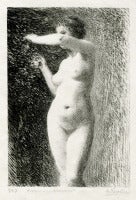
Etude pour Eve

Etude pour Eve

By Henri Fantin-Latour

Located in Fairlawn, OH

Signed in pencil lower right: H Fantin (rare); Dedicated "A mon ami Hardicourt" in pencil by the artist Edition: 150 examples this state Provenance: M. Hardicourt (dedicated) Pr...

Category

Late 19th Century Henri Fantin-Latour Prints and Multiples

Materials

Lithograph

Henri Fantin-latour prints and multiples for sale on 1stDibs.

Find a wide variety of authentic Henri Fantin-Latour prints and multiples available for sale on 1stDibs. You can also browse by medium to find art by Henri Fantin-Latour in lithograph and more. Much of the original work by this artist or collective was created during the 19th century and is mostly associated with the modern style. Not every interior allows for large Henri Fantin-Latour prints and multiples, so small editions measuring 6 inches across are available. Customers who are interested in this artist might also find the work of Aristide Maillol, Ker Xavier Roussel, and André Dunoyer de Segonzac. Henri Fantin-Latour prints and multiples prices can differ depending upon medium, time period and other attributes. On 1stDibs, the price for these items starts at $150 and tops out at $2,610, while the average work can sell for $400.