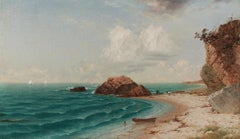
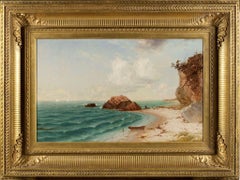
New England Coastal Scene with Figures
By John Frederick Kensett
Located in New York, NY
Monogramed and dated lower right: JF.K. / ‘64.
Category
Mid-19th Century Hudson River School John Frederick Kensett Paintings
Materials
Canvas, Oil
New England Coastal Scene with Figures
By John Frederick Kensett
Located in New York, NY
Monogramed and dated lower right: JF.K. / ‘64.
Canvas, Oil
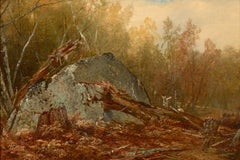
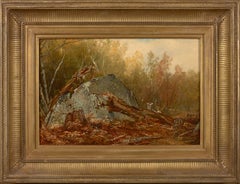
Wood Interior with Rocks–a Study
By John Frederick Kensett
Located in New York, NY
Prior to his studies in painting, Hudson River School artist John Frederick Kensett trained and worked as an engraver. In Wood Interior with Rocks–a Study, Kensett draws upon his eng...
Oil
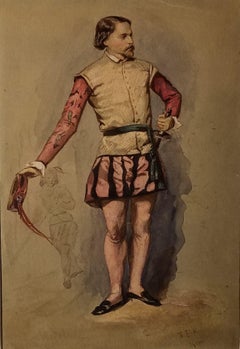
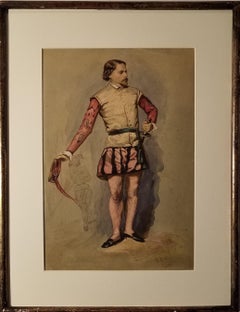
"Portrait of an Italian Fencer, " John Frederick Kensett, Hudson River School
By John Frederick Kensett
Located in New York, NY
John Frederick Kensett (1816 - 1872) Portrait of an Italian Fencer, circa 1845-47 Watercolor on wove paper 13 1/8 x 8 1/8 inches Signed with initials and inscribed lower right "J.F.K. Rome" From October 1845 through the spring of 1847, Kensett lived in Rome. He attended classes where he sketched from live models, and he sketched in the countryside outside Rome and around Florence, Perugia, and Venice, places he visited with his artist friends. He fulfilled commissions for paintings from Americans in Italy, and by 1847 his career was well established. Son of an English immigrant engraver, John Kensett lacked enthusiasm for that medium and became one of the most accomplished painters of the second generation of Hudson River School painters. His reputation is for Luminism, careful depiction of light, weather, and atmosphere as they affect color and texture of natural forms. He was particularly influenced by the painting of Asher Durand in that he focused on realism and detail rather than the highly dramatic views associated with Thomas Cole. Going to the western United States in the mid 1850s and the 1860s, he was the first of the Hudson River School painters to explore and paint the West. Kensett was born and raised in Cheshire, Connecticut, and learned his engraving from his father, Thomas Kensett with whom he worked in New Haven, Connecticut until 1829. He continued working until 1840 as an engraver of labels, banknotes and maps and was employed part of that time by the American Bank Note Company in New York City. There he met Thomas Rossiter, John Casilear, and other artists who urged him to pursue painting. In 1840, he and Rossiter, Asher Durand, and Casilear went to Europe where Kensett stayed for seven years and supported himself by doing engraving but became accomplished in landscape painting. Having sent canvases of Italian landscapes back to New York, he had a reputation for skillful painting that preceded him. When he returned to New York City in 1847, he was an "instant success" and very sought after by collectors. Two of his Italian landscapes had already been purchased by the American Art Union. By 1849, he was a full member of the National Academy of Design and was generally popular among his peers. His studio was a gathering place with travelers stopping by to see his canvases and to identify "precise locations in the Catskills or Newport or New England in the oil sketches and drawings that covered his walls." (Zellman 170). For the women, he was a popular bachelor, "romantic looking with high forehead and sensitive expression." (Samuels 262) He was also sought after by many organizations. Among his activities were serving on the committee to oversee the decoration of the United States Capitol in Washington DC, and becoming one of the founders of the Metropolitan Museum in New York. An inveterate traveler, Kensett spent summers on painting excursions away from New York City. One of these trips was a special painting excursion with fifteen other artists sponsored by the B & O Railroad from Baltimore, Maryland to Wheeling, West Virginia. Unlike many of the Hudson River painters...
Paper, Watercolor
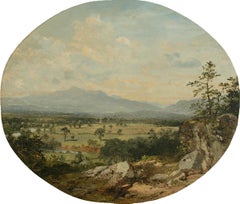
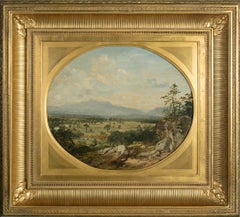
Mount Chocorua
By John Frederick Kensett
Located in New York, NY
Leading Hudson River School Painter Famous for New England Views.
Oil
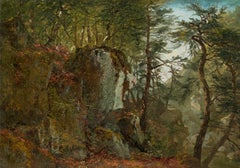
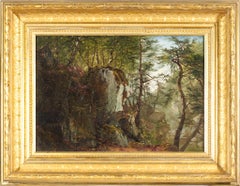
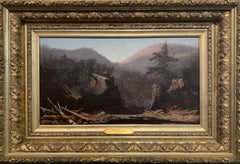
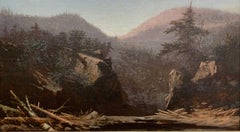
Wooded Landscape with Boulders
By John Frederick Kensett
Located in New York, NY
In his oil painting titled, “Wooded Landscape with Boulders,” John Frederick Kensett depicts a rocky outcropping in a dense forest, with the slope of a mountain behind.
Canvas, Oil

$1,380
H 20 in W 24 in D 1 in
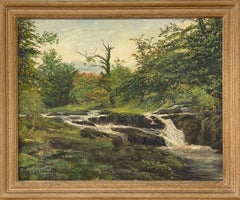
River Forest Landscape Oil Painting by 20th Century Post War Irish Artist
Located in Preston, GB
Oil Painting of River Forest Landscape in Ireland by 20th Century Post War Irish Artist, Tobias Everet Spence Art measures 20 x 16 inches Frame measures in...
Canvas, Oil

$2,544
H 35.44 in W 35.44 in D 1.5 in
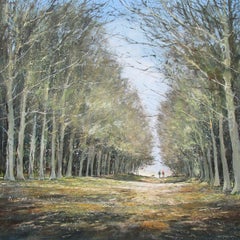
Michael Sanders, A Walk in Felbrigg, Original Landscape Painting Traditional Art
By Michael Sanders
Located in Deddington, GB
MICHAEL SANDERS A Walk at Felbrigg Original mixed-media painting Mixed-media on canvas Canvas Size: H 90cm x W 90cm x D 3.8cm Sold Unframed Ready to Hang Please note that in situ ima...
Canvas, Oil
$12,000
H 21.25 in W 28.5 in
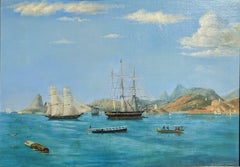
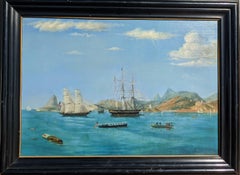
"Harbour of Rio de Janeiro, Brazil, " Julius Montalant, Maritime Port Trade
Located in New York, NY
Julius Montalant (1823 - 1898) Harbour of Rio Janeiro, 1843-1850 Oil on canvas 17 x 24 inches Signed and dated lower right; conservator's inscription on the reverse Born in Virginia, probably Norfolk, Julius Montalant is known for his drawings and paintings inspired by his travels on board navy ships. Attached to the USS St. Louis around 1844-45, he sketched ports of call he visited, including Brazil, Chile, New Zealand, Australia, and China. Many of his works are held in the Museum of the U.S. Naval Academy. Navy records indicate his rank as 'C. Clerk', which may mean that he held a civilian position. During the 1850s he lived in Philadelphia, and in 1851-61 he exhibited at the Philadelphia Art Union and the Pennsylvania Academy of the Fine Arts. Included were paintings of North America, Greece...
Canvas, Oil
$6,000
H 19 in W 29 in
"Grand Manan" Harrison Bird Brown, Maine Landscape, Hudson River School Seascape
By Harrison Bird Brown
Located in New York, NY
Harrison Bird Brown (1831 - 1915) Grand Manan Oil on canvas 12 x 20 inches Signed with initials lower left Harrison Bird Brown was born in 1831 in Portland, Maine, and is best known for his White Mountain landscapes and marine paintings of Maine's Casco Bay...
Canvas, Oil
$125,000
H 12 in W 19 in
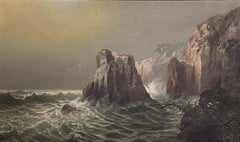
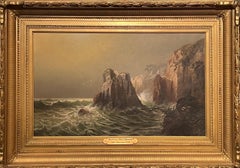
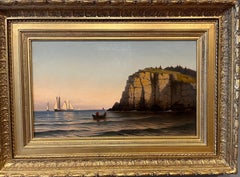
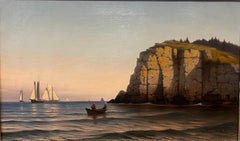
19th Century Signed Oil Painting of Sailing Off the Coast, Framed
By William Frederick de Haas
Located in Fredericksburg, VA
This coastal landscape is done by the famed painted William Frederick De Haas (1830-1880). This painting shows two men in a canoe paddling off the cliff shore in the foreground with ...
Oil, Canvas
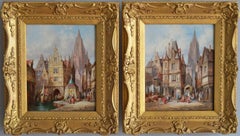
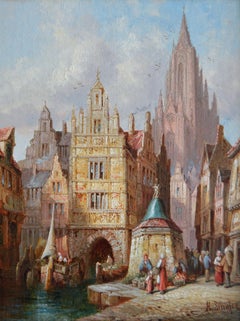
19th Century pair of French townscape oil paintings
By Henry Schafer
Located in Nr Broadway, Worcestershire
**PLEASE NOTE: EACH PAINTING INCLUDING THE FRAME MEASURES 15 INCHES x 13 INCHES** Henry Schafer German/British, (1841-c.1914) Chartres, France & Metz, Lorraine Oil on canvas, pair, both signed Image size: 10 inches x 8 inches (each) Size including frame: 15 inches x 13 inches (each) A lovely pair of French townscape paintings featuring Cathedrals by Henry Schafer. The first offers a view of Metz Cathedral and other medieval buildings from the river Moselle. On the right, figures can be seen at a market stall whilst others walk down a street. Meanwhile to the left, a boat is shown docking at a quayside in front of an archway. The other painting is of Chartres Cathedral seen from a cobbled town square lined with Medieval buildings. Two figures are depicted next to a market stall on the left as others chat or make their way towards the square along a lane to the right. Henry Schafer was born in Hanover, Germany in 1841. Although little is recorded about his upbringing, he was known to have studied at the l'Ecole National de Beaux-Arts in Paris. After leaving art school, he travelled throughout Europe painting town scenes and buildings of Northern France, Belgium and Germany. By 1864, Schafer had travelled to England with his wife Theresa, to work in London where they settled and started a family. All four of their children were born in England. One of his daughters Emilie Anna Schafer (1871-1937) became a painter and art teacher. Around 1871, the family were living at 53 Vauxhall Bridge Road and in 1881 were recorded as residing at 6, Sophia Terrace, Beulah Road, Thornton Heath in Surrey, with Henry continuing to work as an artist. By 1891, he had moved to 7 St Peters Road in Islington where he lived for the rest of his life. Sometime around the turn of the century, he became a British subject. Schafer is believed to have died in London c1914. Many of his works depict the architecture of gothic cathedrals and churches, as in these two fine examples. He also produced interior studies of churches. Schafer's style resembles that of Alfred Montague...
Canvas, Oil
$3,475
H 15 in W 19 in D 2 in
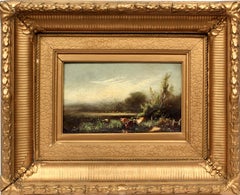
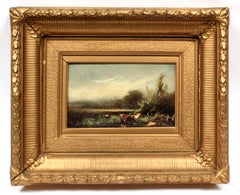
Luminous Hudson River School Landscape Cows Grazing Wide Gold Frame Oil Painting
Located in Buffalo, NY
A finely rendered 19th century Hudson River School landscape depicting cattle grazing within an expansive open field, set beneath a softly illuminated sky. The composition is anchore...
Canvas, Oil
$9,500
H 9.5 in W 7 in
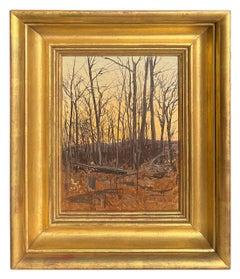
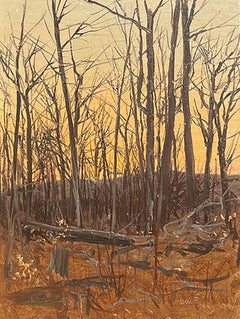
Dusk Forest Scene, Catskills by Lockwood DeForest (American, 1850-1932)
By Lockwood DeForest
Located in New York, NY
"Dusk Forest Scene, Catskills," 1875 by Hudson River School painter Lockwood DeForest (American, 1850-1932) is oil on artists card-stock and measures 9.5 x 7 inches. The work is signed by DeForest, and dated May 13, 1875 at lower right. The work is framed in an elegant, period appropriate frame, and ready to hang. Lockwood DeForest was born in New York in 1850 to a prominent family. He grew up in Greenwich Village and on Long Island at the family summer estate in Cold Spring Harbor. As was customary for a cultivated family in the Gilded Age, the DeForests made frequent trips abroad. Excursions to the great museums, which were prominent on the DeForests agenda, deepened the young Lockwood's familiarity with European painting and sculpture. Though he had begun drawing and painting somewhat earlier, it was during a visit to Rome in 1868 that nineteen-year-old DeForest first began to study art seriously, taking painting lessons from the Italian landscapist Hermann David Salomon Corrodi (1844–1905). More importantly, on the same trip, Lockwood met one of America’s most celebrated painters, (and his maternal great- uncle by marriage) Frederic Edwin Church (1826–1900), who quickly became his mentor. DeForest accompanied Church on sketching trips around Italy and continued this practice when they both returned to America in 1869. Early on in his career, de Forest made a habit of recording the date and often the place of his oil sketches, as to create a visual diary of his travels. Lockwood’s profession as a landscape painter can be primarily attributed to Frederic E. Church and his belief in the young artist’s talent. DeForest often visited Church in the Hudson River community of Catskill where, in addition to sketching trips and afternoons of painting, he assisted with the architectural drawings and planning of Olana. In 1872, DeForest took a studio at the Tenth Street Studio Building in New York. During these formative years DeForest counted among his friend’s artists such as Sanford Robinson Gifford (1823–80), George Henry Yewell (1830–1923), John Frederick Kensett (1816–72), Jervis McEntee (1828–91), and Walter Launt Palmer (1854–1932). Over the next decade DeForest experienced success as a painter. He exhibited for the first time at the National Academy of Design in 1872, and made two more painting trips abroad, in 1875–76 and 1877–78, traveling to the major continental capitals but also the Middle East and North Africa. His trip to the Middle East and the library at Church’s home, Olana, established his interest in design during his mid-twenties. From about 1878 to 1902, landscape painting was overshadowed by his activities and preoccupation with East Indian architecture and décor, a style that became quite fashionable in late nineteenth century America. From 1879-1883, de Forest founded Associated Artists along with Louis Comfort Tiffany, Candace Wheeler...
Oil, Board
$9,500
H 12 in W 17 in
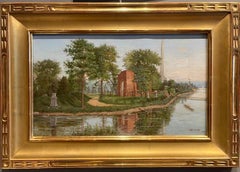
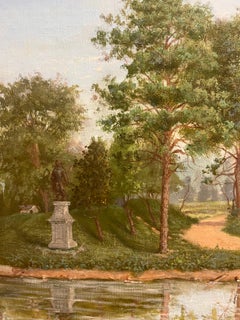
Early 20th Century Oil Painting of Jamestown, Virginia Landscape
Located in Fredericksburg, VA
John A Mooney is a Virginian artist who has been known to paint trompe loeil and landscape paintings. Born in Buffalo, New York, John A. Mooney (1843-1918) traveled to Georgia to enl...
Oil, Canvas
$1,401
H 15.36 in W 11.23 in D 1.58 in
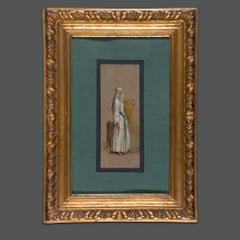
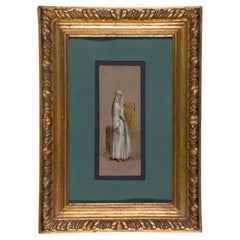
Domenico Morelli 19th Century Orientalist Watercolor
By Domenico Morelli
Located in Roma, IT
Beautiful and interesting watercolor painting on paper attributed to the great Neapolitan artist Domenico Morelli. It depicts one of his favorite subjects, namely an oriental woman c...
Paper, Watercolor
$16,334
H 32.68 in W 38.19 in
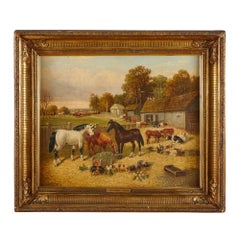
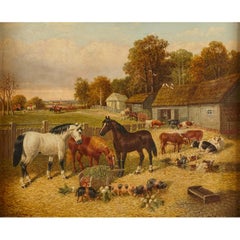
Painting of horses and farm animals by Herring the Younger
By John Frederick Herring Jr
Located in London, GB
Painting of horses and farm animals by Herring the Younger British, 19th Century Frame: Height 83cm, width 97cm Canvas: Height 64cm, width 77cm This charming painting is by John Fre...
Canvas, Oil
$26,000
H 20 in W 22 in D 2 in
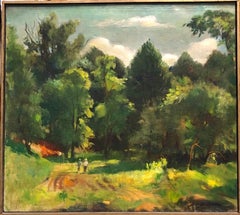
Landscape American Hungarian European Modernism 1938 Realism Long Island WPA era
By Stephen Csoka
Located in New York, NY
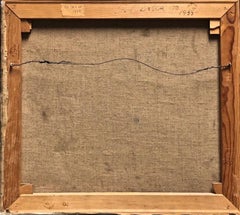
Landscape American Hungarian European Modernism 1938 Realism Long Island WPA era. The canvas measures 18” x 20". The artist signed the stretcher as well as the canvas. The scene depicts a spots in New York where Queens borders with Nassau county, Rosedale, which abuts the Five Towns. The border runs through Hook Creek, another painting we are currently offering. Stephen (Istvan) Csoka was born in Gárdony, Hungary on January 2, 1897 and died in New York in 1989. He is best remembered as a painter and etcher of portraits, nudes, landscapes, genre, and horses. Csoka studied at the Budapest Royal Academy of Art and his memberships include Associate of the National Academy of Design in New York City; the Society of American Etchers in Brooklyn, NY; the Society of Brooklyn Artists; and the Hungarian Etchers Association. Csoka's exhibitions and awards include a medal at the Barcelona International Exhibition in 1929; a prize at the City of Budapest Exhibit in 1930; prizes at the Society of American Etchers in 1942 and 1945; prizes at the Library of Congress in 1944 and 1946; a prize at the Society of Brooklyn Artists in 1944; a prize at the Philadelphia Watercolor Club in 1945; the Corcoran Gallery of Art in 1945; the Carnegie Institute in 1943, 1944, and 1945; the Art Institute of Chicago in 1944; the Los Angeles Museum of Art in 1945; the National Academy of Design from 1940 through 1945; one-artist shows at the Contemporary Artists in 1940, 1943, and 1945; and the Minneapolis State Fair in 1943. *Stephen continued to recieve awards and exhibit his work throughout his life. In 1997, Hofstra Museum sponsored a Retrospective/Centennial exhibition in honor of his birth. Collections representing Csoka's work are the Metropolitan Museum of Art, New York, NY; the Brooklyn Museum, Brooklyn, NY; the Museum of Fine Arts, Boston, MA; the British Museum, London, England; the Bezalel National Museum, Jerusalem, Israel; the Butler Institute of American Art, Youngstown, Ohio; Whistler House Museum of Art, Lowell, MA; the Cleveland Museum of Art, Cleveland, OH; Columbus Museum of Art, Columbus, OH; the Sheldon Swope Art Museum, Terre Haute, IN; the Mobile Museum of Art, Mobile, AL; the Frederick R. Weisman Art Museum, Minneapolis, MN; the Museum of New Mexico, Santa Fe, NM; the Budapest Museum of Fine Arts, Budapest, Hungary; Hungarian National Gallery, Budapest, Hungary, the Museum of the City of Budapest, Budapest, Hungary; the Library of Congress, Washington, DC; Carnegie Museums of Pittsburgh, Pittsburgh, PA; the Chrysler Museum of Art, Norfolk, VA; Georgia Museum of Art, Athens, GA; Hofstra Museum, Hofstra University, Hempstead, NY; Holocaust Museum, Glen Cove, NY; National Academy of Art, New York, NY; New Orleans Museum of Art, New Orleans, LA; New York Historical Society, New York, NY;New York Public Library, New York, NY; National Gallery of Art, Washington, DC; Peabody Museum, Cambridge, MA; Pennsylvania Academy of the Fine Arts, Philadelphia, PA; Reading Public Museum, Reading, PA; Livingston Arts Center, Mount Morris, NY; Ball State Teachers College, Muncie, IN; City College, New York, NY; Fashion Institute of Technology, New York, NY; Hungarian Consulate, New York, NY; Hungarian Heritage, New Brunswick, NJ; Hunter College, New York, NY; IBM Collections; Princeton Print Club...
Canvas, Oil
Sold
H 12 in W 15 in
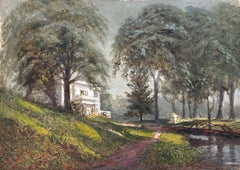
"White House and Trees, " John Frederick Kensett, Hudson River School, New Jersey
By John Frederick Kensett
Located in New York, NY
John Frederick Kensett White House and Trees, circa 1853 Oil and gouache on paper 6 3/4 x 9 3/4 inches Provenance: Estate of Vincent Colyer (1824 - 1888) By descent Paul Magriel Collection Private Collection, Long Island Exhibited: New York, The Finch College Museum of Art; Southampton, New York, The Parrish Art Museum; New Orleans, Louisiana, Isaac Delgado Museum of Art; Norfolk, Virginia, Norfolk Museum of Art; Montclair, New Jersey, Montclair Art Museum; New London, Connecticut, Lyman Allyn Museum; Manchester, New Hampshire, The Currier Gallery of Art; Providence, Rhode Island, Rhode Island School of Design; Youngstown, Ohio, The Butler Institute of American Art, American Drawings (Benjamin West to the present) from the Paul Magriel Collection, June 1961 - December 1962. Portland, Oregon, Portland Art Museum, April 14 - May 15, 1963. Boston International Fine Art Show at the Cyclorama, Lincoln Glenn, October 19 - 23, 2022. In the 1850s through 1860, John Frederick Kensett, painted a series of at least five landscapes of the "Shrewsbury River" (now the Navesink River) along the New Jersey shore. Art historians have described Kensett’s paintings of the river as having evolved from a trip in the fall of 1853 at the invitation of Kensett's friend, author and lecturer George Curtis. However, letters viewable at the Smithsonian Archives of American Art website make it clear that Kensett had become acquainted with the area over a year earlier, most likely in connection with fellow artist and friend Thomas Prichard Rossiter. Kensett and Rossiter had been friends since at least the 1830s. As aspiring artists, they had traveled to Europe together in the 1840s. In 1851 Rossiter married Anna Ehrick Parmly, then in her early 20s, and Kensett attended the wedding. Anna was one of four daughters of Eleazer and Anna Maria Parmly. Eleazer, one of the major figures in American dentistry history, was a wealthy and accomplished member of New York society. When not in the city, the Parmly family gathered at Bingham Place, a sprawling estate on 275 pastoral acres spanning the peninsula between the Shrewsbury and Navesink Rivers along the New Jersey shore. The Bingham Place estate encompassed much of what is now Rumson, then known as Oceanic, N.J. It was a wide-open landscape of ocean views, orchards, lawns, and cattle-dotted pastures. There the Parmlys opened their doors to family, friends, and the summer breeze. Rossiter, newly-married into the Parmly family, was likely the reason that Kensett paid a social visit to Bingham Place in the summer of 1852. On July 11, 1852, having reluctantly departed, Kensett wrote Rossiter who was still at Bingham Place: New York to me now is that of a deserted place…marking a dismal contrast to the green lawns at Bingham Place. I saw the receding shores of Shrewsbury & the line of dust which marked your homeward course & finally the last glimpse of the Locust trees that shade the pleasant mansion & happy inmates at Bingham with any thing but a joyous spirit. A major figure in the American luminist tradition and one of the most renowned painters of the Civil War era, John Frederick Kensett was born in Cheshire, Connecticut, in 1816. He was the son of Thomas Kensett, a British immigrant engraver, and it was in his father's New Haven firm that Kensett first learned to draw. After mastering the rudiments of the graphic arts, he worked as an engraver in print shops in New Haven, Albany, and New York throughout the 1830's. During this period, he began to paint on his own, encouraged by a friend and fellow artist, John W. Casilear. In 1838, he made his first submission, a landscape, to the annual exhibitions of the National Academy of Design. Desirous of continuing his training, Kensett traveled to Europe in 1840. For the next seven years, often in the company of artists such as Casilear and Asher B...
Paper, Oil
Sold
H 15 in W 22 in D 2.5 in
Kaaterskill Falls, New York, Hudson River School Landscape, Signed and Framed
By John Frederick Kensett
Located in Doylestown, PA
"Kaaterskill Falls" is a 9" x 16" oil on canvas landscape by Hudson River School and luminist painter John Frederick Kensett. The painting is framed and monogrammed in the lower left...
Canvas, Oil