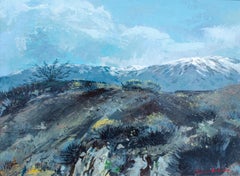
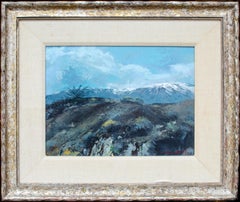
Orovida Pissarro Landscape Paintings

1893-1968

Orovida Pissarro, the only child of Lucien and Esther Pissarro, was the first woman in the Pissarro family to become a professional artist and the first Pissarro of her generation to take up painting. Born in Epping, England, in 1893, she lived and worked predominantly in London, where she was a prominent member of several British arts clubs and societies.

Orovida first learned to paint in the Impressionist style from her father and, after a brief period of formal study with Walter Sickert in 1913, she renounced formal art schooling.

Throughout her career, Orovida always remained outside mainstream British art movements. Much to Lucien's disappointment, she soon turned away from naturalistic painting and developed an unusual style that combined elements of Japanese, Chinese, Persian and Indian art. Her rejection of Impressionism, which, for the Pissarro family, was a way of life, and her simultaneous decision to drop her famous last name and use simply Orovida as a nom de peintre, reflected a desire for independence and distance from the family legacy, of which she nevertheless remained proud.

Orovida's most distinctive works are her paintings from the 1920s and 1930s in gouache (she called her mixture body color) and tempera, applied in thin, delicate washes to silk, linen, paper or gold leaf and embellished with brocade borders. These elegant and richly decorative works generally depict non-Western subjects, for example: Mongolian horseback riders, African dancers and Persian princes, often engaged in activities such as dancing or hunting rituals.

The second half of Orovida's painting career is marked by a dramatic change in both style and subject matter. In the mid-1940s, she began to embrace contemporary subjects from everyday life and returned to a more naturalistic style. Her new style was more suited to oils, and thus, she returned to that medium.

Over the course of her life, Orovida was aware of the mixed blessing of having famous artists in the family; not only a grandfather and father but also four uncles, and towards the end of her life, she was instrumental in developing the Pissarro family archive that her mother had established at the Ashmolean Museum in Oxford.

(Biography provided by Stern Pissarro Gallery)

to
1
Overall Width
to
Overall Height
to
1
1
1
1
1
1
1
1
1
1
1
36
643
633
444
330
1
1
Artist: Orovida Pissarro
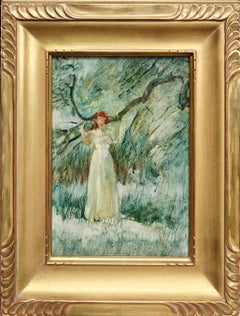
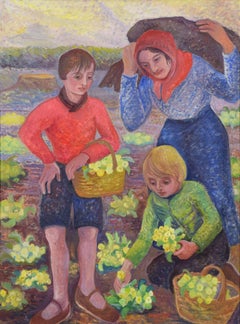
Spring (Primrose Gathering) by Orovida Pissarro - Oil painting

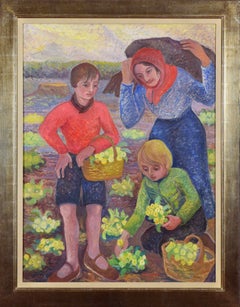
Spring (Primrose Gathering) by Orovida Pissarro - Oil painting

By Orovida Pissarro

Located in London, GB

Spring (Primrose Gathering) by Orovida Pissarro (1893-1968) Oil on board 101.5 x 76.4 cm (40 x 30 inches) Signed and dated lower centre Orovida 1956 Provenance Estate of Orovida Pis...

Category

1950s Modern Orovida Pissarro Landscape Paintings

Materials

Oil, Board

Related Items
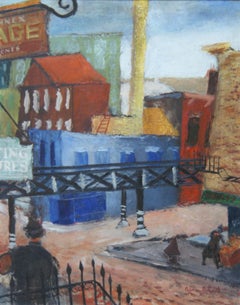
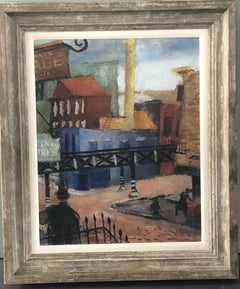
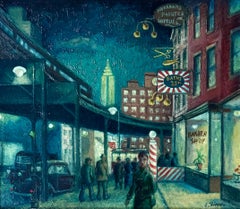
"Industrial Cityscape, Chicago" WPA Modernism Mid-Century Cityscape 20th Century

"Industrial Cityscape, Chicago" WPA Modernism Mid-Century Cityscape 20th Century

By Aaron Bohrod

Located in New York, NY

"Industrial Cityscape, Chicago" WPA Modernism Mid-Century Cityscape 20th Century Aaron Bohrod (American 1907 – 1992) Industrial Cityscape 20 x 16 inches Oil on board Signed lower ri...

Category

1930s American Modern Orovida Pissarro Landscape Paintings

Materials

Oil, Board

Vintage 1970's Harbour Scene with Moored Boats & Fishermen by British Artist

Vintage 1970's Harbour Scene with Moored Boats & Fishermen by British Artist

Located in Preston, GB

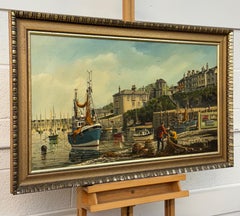
Vintage 1970's Harbour Scene with Moored Boats & Fishermen by British Artist, William Stockman (1935-2021). Art measures 31 x 15 inches Frame measures 36 x 20 inches Fishermen mend...

Category

1970s Modern Orovida Pissarro Landscape Paintings

Materials

Oil, Board

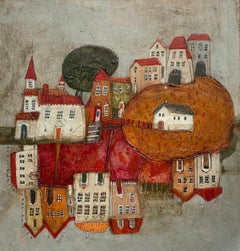
A town 10. Contemporary figurative mixed media artwork, Landscape, Polish art

A town 10. Contemporary figurative mixed media artwork, Landscape, Polish art

By Dominika Stawarz-Burska

Located in Warsaw, PL

This artwork presents a surreal village scene, characterized by its whimsical depiction of architecture. The painting captures a cluster of quaint, red-roofed houses that defy grav...

Category

2010s Modern Orovida Pissarro Landscape Paintings

Materials

Mixed Media, Oil, Cardboard

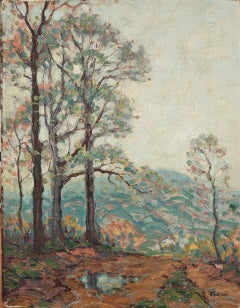
"Woodstock Landscape" Albert Heckman, American Modernist, Atmospheric Valley

"Woodstock Landscape" Albert Heckman, American Modernist, Atmospheric Valley

By Albert Heckman

Located in New York, NY

Albert Heckman Woodstock Landscape Oil on board 10 x 8 inches Albert Heckman was born in Meadville, Western Pennsylvania, 1893. He went to New York City to try his hand at the art ...

Category

1940s American Modern Orovida Pissarro Landscape Paintings

Materials

Oil, Board

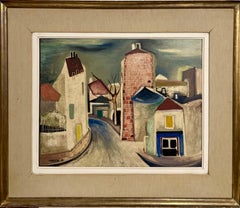
Charles Chartier 1951 French Cubist Modernist Oil Painting Surreal Paris Village

Charles Chartier 1951 French Cubist Modernist Oil Painting Surreal Paris Village

Located in Surfside, FL

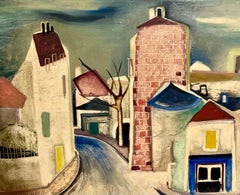
Alex Charles Chartier, French, 1894-1957 Oil painting on board 1951 Quartier Plaisance, Paris village scene Hand signed and dated '51 lower left. Dimensions: 21" x 25-3/4", frame...

Category

Mid-20th Century Modern Orovida Pissarro Landscape Paintings

Materials

Oil, Board

"Skating Party" WPA Regionalism American Scene Mid 20th Century Modern Realism

"Skating Party" WPA Regionalism American Scene Mid 20th Century Modern Realism

By Roger Medearis

Located in New York, NY

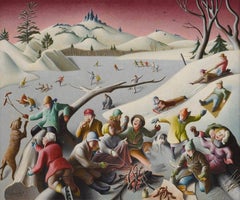
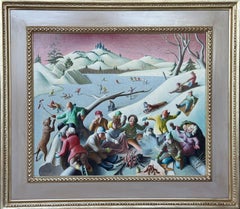
"Skating Party" WPA Regionalism American Scene Mid 20th Century Modern Realism Roger Medearis (1920 – 2001) "Skating Party" 20 x 24 inches Tempera on board, 1949 Signed Medearis and...

Category

1980s American Modern Orovida Pissarro Landscape Paintings

Materials

Oil, Board

"Into the Woods" Henry Prellwitz, Lyrical Woman In Wooded Landscape Painting

"Into the Woods" Henry Prellwitz, Lyrical Woman In Wooded Landscape Painting

By Henry Prellwitz

Located in New York, NY

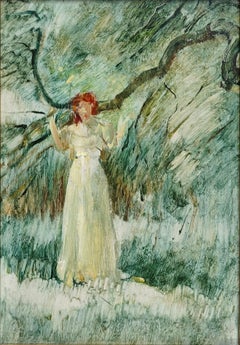
Henry Prellwitz Into the Woods Oil on board 11 1/2 x 8 3/4 inches Henry Prellwitz studied art at the Art Students League of New York, where his chief mentor was Thomas Wilmer Dewing; he later became its director.[3] He also studied at the Académie Julian in Paris. In 1892, he set up his studio in the Holbein Studios building on West 55th Street in Manhattan, where his future wife, the artist Edith Mitchill, also had a studio. They married in 1894 and had a son, Edwin. By the mid 1890s, he was teaching portrait painting at the Pratt Institute, where one of his students was the Cubist artist Max Weber. In 1899, Henry and Edith moved to the north shore of Peconic Bay on Long Island, where their artist friends Irving Ramsay Wiles and Edward August Bell were already established. They painted plein air paintings and also worked in adjoining studios at High House, their Peconic Bay home. Prellwitz painted Impressionist and Tonalist waterscapes of Peconic Bay and allegorical figure paintings such as the 1904 Lotus and Laurel. He exhibited mainly on the east coast and at expositions like the St. Louis World's Fair, where he won a silver medal. He won the Third Hallgarten Prize from the National Academy of Design (NAD) in 1893 for The Prodigal Son, and his Venus won the Thomas B. Clarke Prize at the 1907 NAD exhibition for the best figure composition by an American citizen painted in the United States. Both Prellwitzes disappeared into obscurity for several decades after their deaths in the early 1940s. Rediscovered in the 1980s, they have been called one of the best-kept secrets in art...

Category

Early 20th Century Modern Orovida Pissarro Landscape Paintings

Materials

Oil, Board

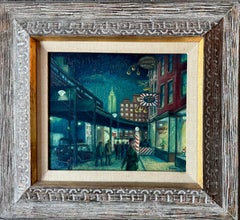
"6th Avenue El" American Scene Social Realism Mid-20th Century New York City

"6th Avenue El" American Scene Social Realism Mid-20th Century New York City

By Ernest Fiene

Located in New York, NY

"6th Avenue El" American Scene Social Realism Mid-20th Century New York City Ernest Fiene (1894-1965) "6th Avenue El" 12 1/4 x 14 1/4 Oil on canvas board, c. 1940s Signed lower righ...

Category

1940s American Modern Orovida Pissarro Landscape Paintings

Materials

Oil, Board

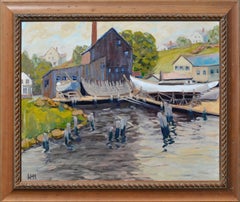
Mid Century Boat Docks Pacific Grove Landscape

Mid Century Boat Docks Pacific Grove Landscape

Located in Soquel, CA

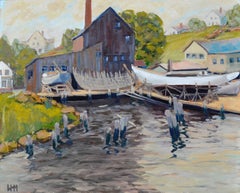
Painterly scene of boats and boats being built at the docks in old Pacific Grove, California by an unknown artist (American, 20th Century). Signed"WHM" lower left. Presented in a fau...

Category

1950s Modern Orovida Pissarro Landscape Paintings

Materials

Canvas, Oil, Illustration Board

Post Soviet Russian Jewish Oil Painting Marc Klionsky Jerusalem Angel & Shofar

Post Soviet Russian Jewish Oil Painting Marc Klionsky Jerusalem Angel & Shofar

Located in Surfside, FL

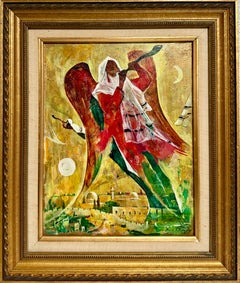
Marc Khonsky (American Russian, 1927-2017) Untitled (Winged Prophet Playing Music) 1978 Oil on board Hand signed and dated lower right Dimensions: board: 14"h x 11"w, overall (with frame): 19.5"h x 16.5"w This depicts a winged angel in the guise of a rabbi, possibly the messiah, moshiach, or Prophet Elijah blowing a shofar over the old city of Jerusalem. A masterpiece laden with mystical symbolism. Marc Klionsky (Марк Клионский) (1927 – 2017) was a Russian-American Jewish artist who worked in New York City from his immigration in 1974 until his passing in 2017. Klionsky developed a style of American Realism uniquely defined by his classical training in the Soviet Union and his perspective of daily life in New York and America. Over the course of his career, Klionsky painted portraits of prominent world figures who shaped the 20th century. John Russell, art critic for The New York Times, described him as "a good man and a brave man and one of the most eloquent painters around. We need him" and as "one of the best portrait painters around." Marc Klionsky was born in Minsk, Belarus to a Jewish family in 1927. His father, Leo (Zev Vulf) Klionsky was a printer from Borisov, Belarus. The son of a woodcutter and engraver Klionsky's father moved to Minsk and eventually married Liza (née Rozenstein) in 1926. As a child, Klionsky attended the Art School for Gifted Children in Minsk. During World War II, Klionsky's family was evacuated to Kazan, Republic of Tatarstan, where Klionsky began to earn a living producing anti-Fascist posters and illustrations for local newspapers and other publications. Klionsky studied at the Drama Institute at the Kazan Theater, where he primarily focused on developing costume designs for various productions. After the war, Mark Klionsky attended first the Serov Art Institute before entering the Ilya Repin Leningrad Institute for Painting, Sculpture and Architecture (now known as the Russian Academy of Arts in Saint Petersburg). Klionsky's diploma piece was reproduced in an edition of 50,000 copies and distributed throughout the USSR. Klionsky received his PhD in 1957, during which period he studied with Professor Boris Ioganson. Klionsky became the youngest artist to be exhibited at the Tretyakov National Gallery in Moscow. During this period, Klionsky met his future wife of nearly 59 years, Irina Klionsky (née Korolik), with whom he had two daughters, Nadia, an artist, and Elena, a pianist. Klionsky established himself in the Soviet Union initially by producing official Social Realist works that depicted political figures and daily life in the Soviet Union. However, in the privacy of his own studio, Klionsky began to explore the themes of Jewish life, anti-Semitism and the Holocaust. He soon discovered the creative and intellectual restrictions of working as a Jewish artist in the Soviet Union. After Klionsky left the Soviet Union with his family in 1974, traveling first to Rome, Italy and then to New York, he expressed in his work the newborn freedom that he found in America. Shortly after his arrival, he was recognized in an ABC television production about his work, Canvases of Freedom. This was followed by a U.S. State Department documentary (produced by the U.S. Information Agency) shown in ninety-two countries about one of his exhibitions at Hammer Galleries. During this period, Klionsky also taught at the School of Visual Arts in New York and at the Pennsylvania Academy of Fine Arts in Philadelphia, birthplace of the Ashcan School of American Realism. While Klionsky took advantage of his creative freedom in the United States to explore a range of abstract styles and media, he ultimately gained prominence as a master of portrait painting and of American Realism. His works include portraits of leaders in the world of politics and humanitarianism, such as Israeli premier Golda Meir, Elie Wiesel, Prince Bandar Bin Sultan, and Vernon Jordan; music, including Dizzy Gillespie, Mstislav Rostropovich, and B.B. King; business leaders Armand Hammer, Steve Forbes, and Dwayne Andreas; and many others. His portraits are in the permanent collections of the National Portrait Gallery in Washington, D.C., the Russian Museum in St. Petersburg, and the Museum of Contemporary Art in Lausanne, Switzerland. Klionsky was also honored during his lifetime to have been selected to sculpt the Nobel Peace Prize Commemorative Medal for Elie Wiesel. During his lifetime, Marc Klionsky's paintings and prints were exhibited throughout the Soviet Union, Europe, America, Israel and Asia, as well as Australia and New Zealand. His Soviet works were exhibited in the Tretyakov National Gallery in Moscow and the State Russian Museum in Leningrad multiple times throughout the 1950s. In 1962, his work was shown alongside that of Marc Chagall at Grosvenor Gallery in London. Separately, his work was shown along with other Soviet artists at the time in West Berlin, Hiroshima, Rome, and New York. After emigrating to New York in 1974, his first international exhibition was held in Paris at the Salon des Reprouves with Galleries Hardy in 1978. His first solo New York show took place a Nakhamkin Fine Arts Gallery on Madison Avenue in 1979, after which Klionsky was represented by Hammer Galleries for the remainder of his career. Klionsky had several solo shows in Europe between 1991 and 1992, showing at the Musée d’Art Contemporain in Lausanne, Switzerland, the Salon Internationale des Musées at the Grand Palais in Paris, France, and his "God Bless America" traveling retrospective that began at the St. Ingbert Museum in Germany. The last exhibition of Klionsky's work during his lifetime was at an event titled "Painting the Face of Russian Jewry: The Art and Journey of Marc Klionsky” at Brandeis University in Waltham, Massachusetts in 2010, with presentations made by Sir Antony Polonsky, Emeritus Professor of Holocaust Studies, and Professor Nancy Scott, former chair of the Fine Arts department at Brandeis University. Marc Klionsky's works hang in the collections of the National Portrait Gallery in Washington, D.C., The Elie Wiesel Foundation for Humanity in New York, the Musée d’Art Contemporain in Lausanne, Switzerland, the Yad Vashem Art Museum in Jerusalem, Israel, and the State Hermitage Museum and the State Russian Museum in St. Petersburg, Russia, among other private and public collections internationally. He was part of a tradition of Soviet Jewish artists that included El Lissitzky, and Natan Altman, Marc Chagall, Robert Falk, Anatoly Kaplan, Ilya Kabakov, Oscar Rabin...

Category

1970s Modern Orovida Pissarro Landscape Paintings
Materials

Oil, Board

Coney Island, Fourth of July

Coney Island, Fourth of July

Located in Los Angeles, CA

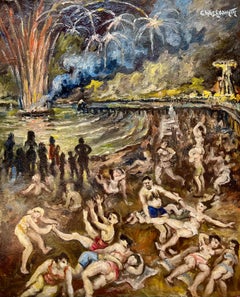
Coney Island, Fourth of July, c. 1940s, oil on canvas applied to Masonite, signed upper right, 26 x 21 1/2 inches, presented in its original frame During the 1930s and 40s, Coney I...

Category

1940s American Modern Orovida Pissarro Landscape Paintings
Materials

Canvas, Oil, Board

Orovida Pissarro landscape paintings for sale on 1stDibs.

Find a wide variety of authentic Orovida Pissarro landscape paintings available for sale on 1stDibs. You can also browse by medium to find art by Orovida Pissarro in board, oil paint, paint and more. Much of the original work by this artist or collective was created during the 1950s and is mostly associated with the modern style. Not every interior allows for large Orovida Pissarro landscape paintings, so small editions measuring 31 inches across are available. Customers who are interested in this artist might also find the work of Andre Hambourg, Enid Smiley, and Harold Vincent Skene. Orovida Pissarro landscape paintings prices can differ depending upon medium, time period and other attributes. On 1stDibs, the price for these items starts at $14,872 and tops out at $14,872, while the average work can sell for $14,872.