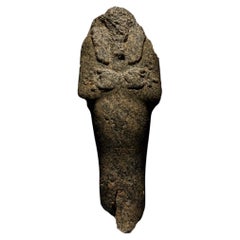
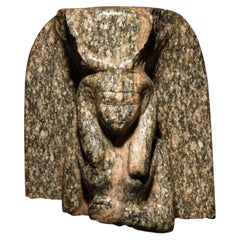
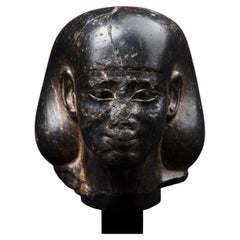
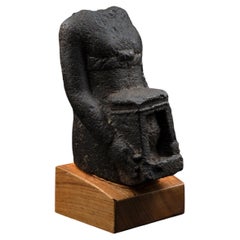
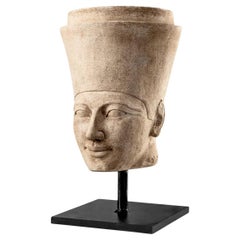
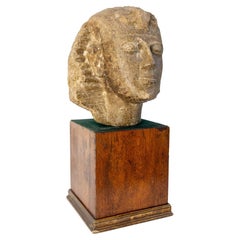
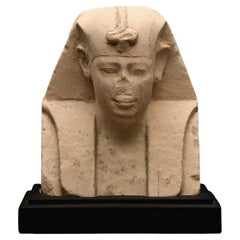
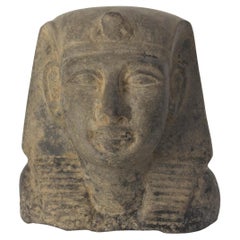
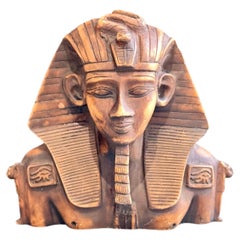
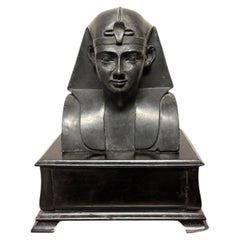
32.3 cm with the stand.
Provenance:
- Galerie Samarcande, Paris, France, since 1973.
- Drouot Richelieu, Paris, October 7 - 8, 1996, lot 324.
- Private collection, Boulonnais, France. Acquired from the previous one.
- Private collection, B. Partie, France.
- Delorme & Collin du Bocage, Paris, 2010.
Published:
- Delorme & Collin Du Bocage. Archeologie. Entiere collection de Monsieur. Part I. Paris-France. 24 de Febrero de 2010, lote 58.
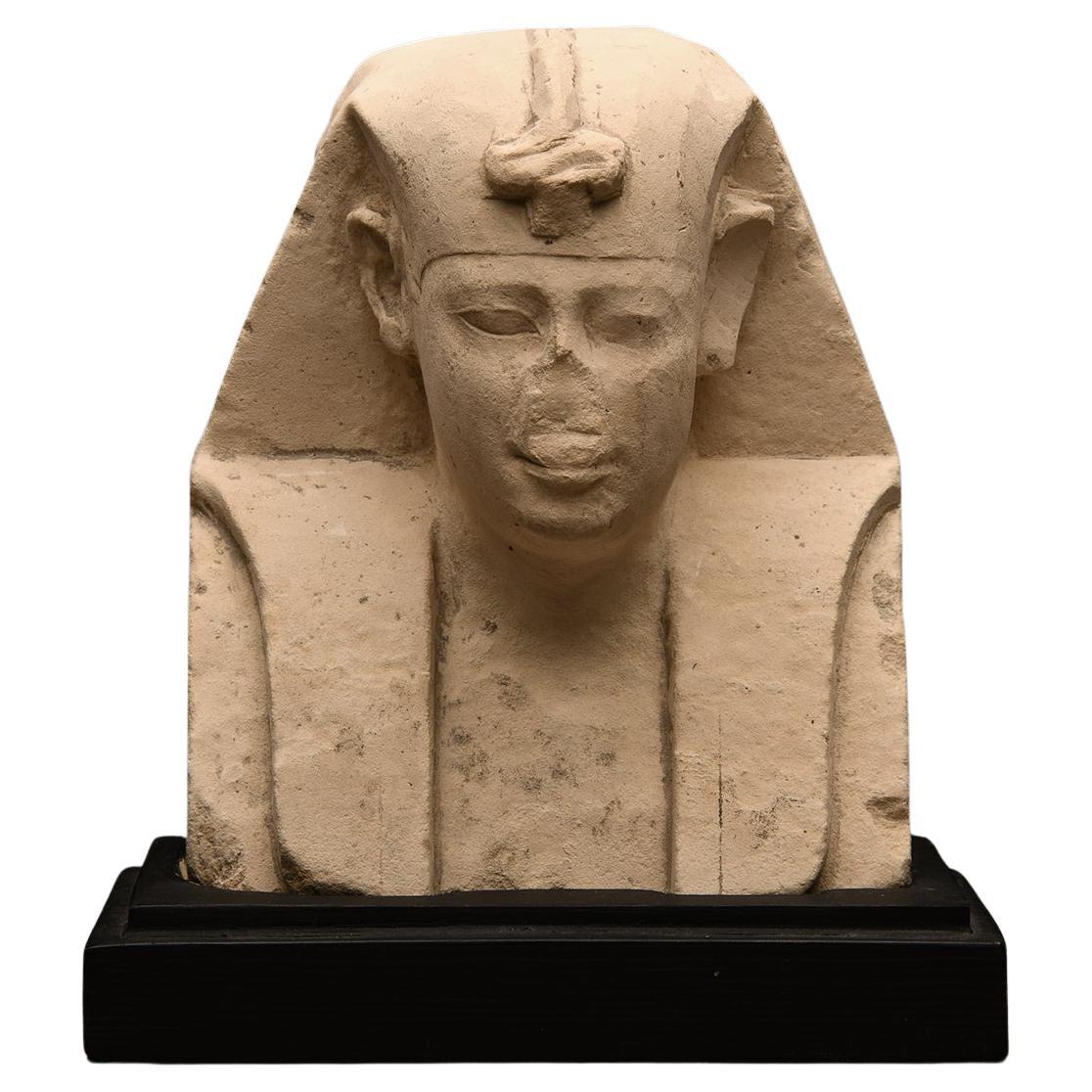
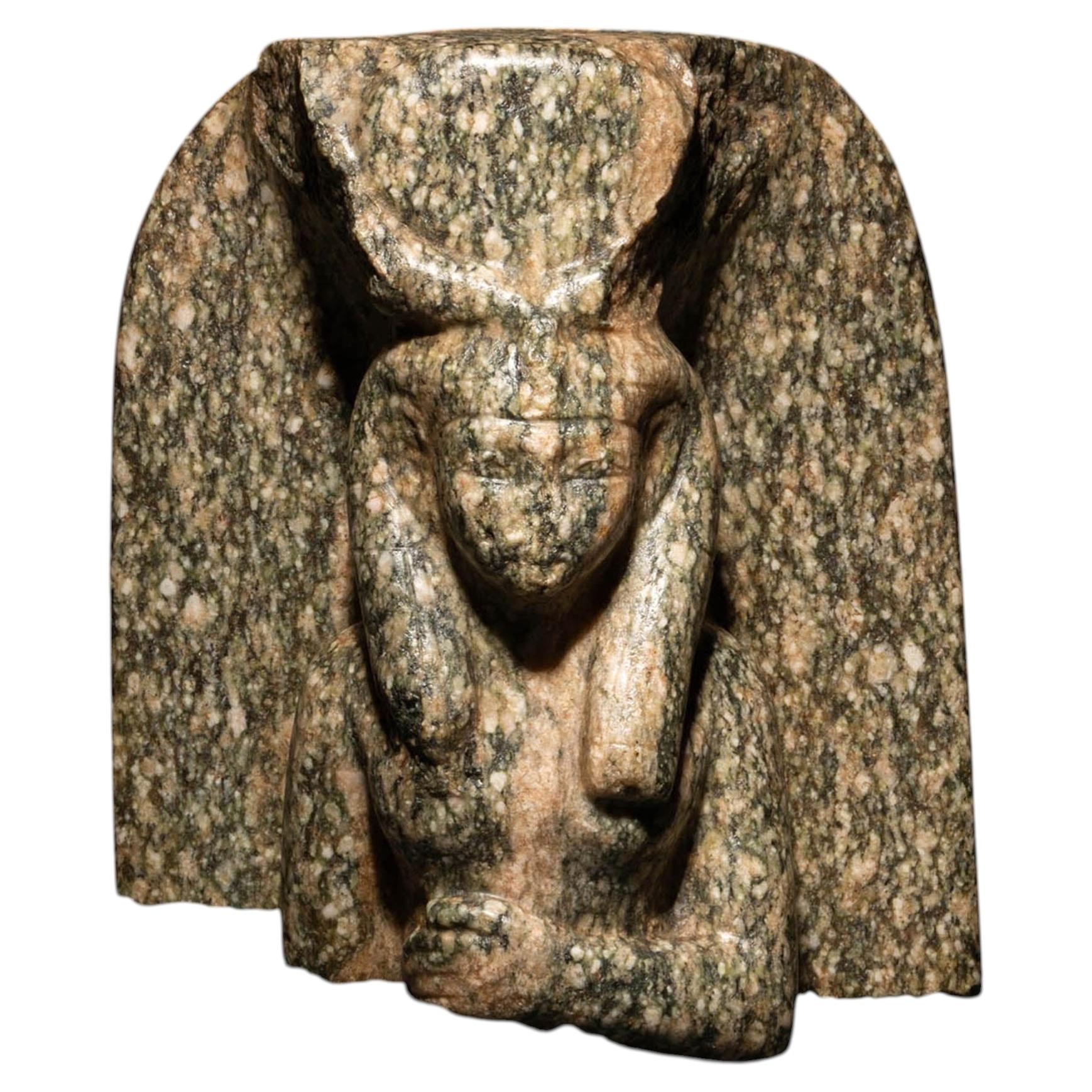
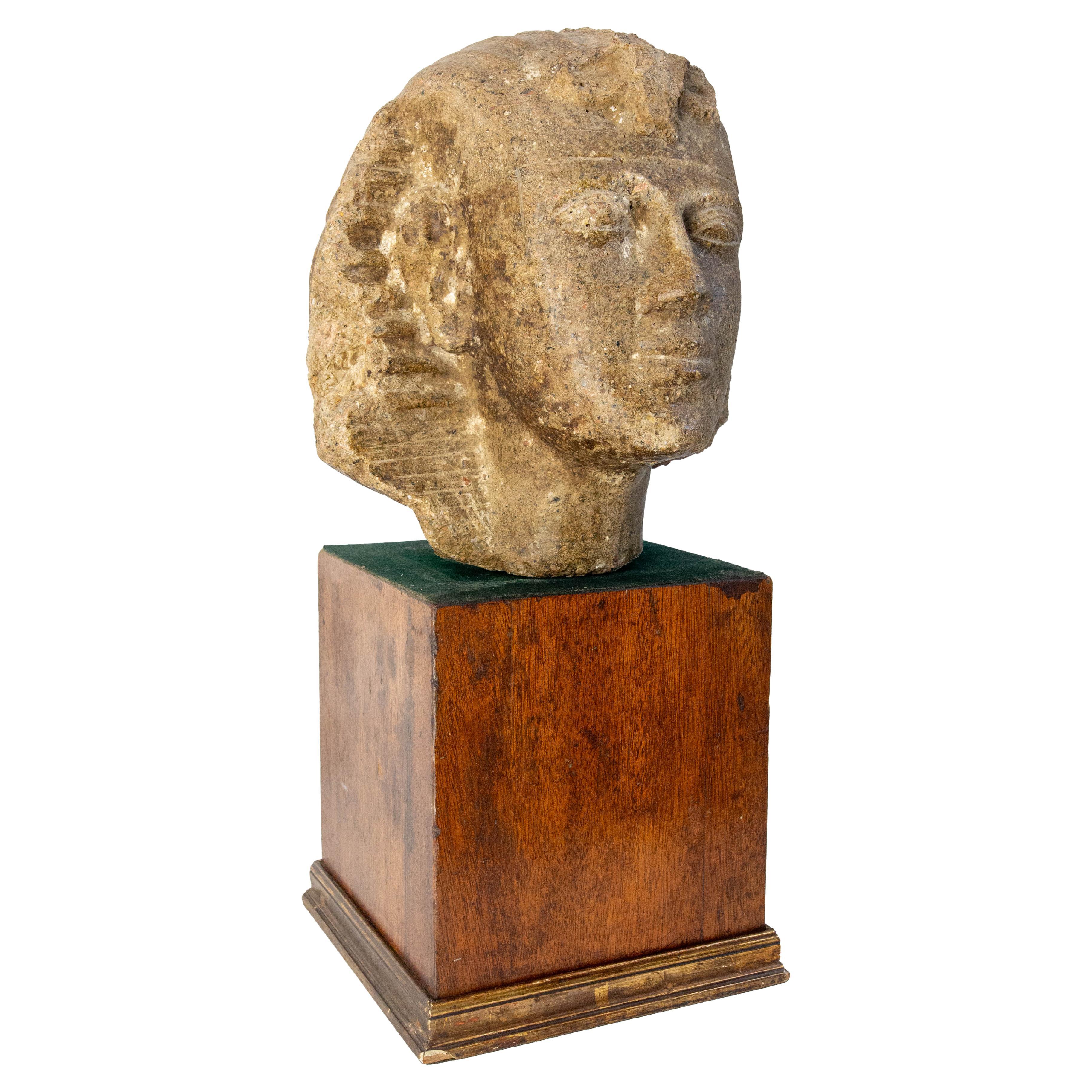
Bust of a granite sculpture carved in the round, representing a middle-aged man, with a back pillar bearing a hieroglyphic inscription arranged in two columns. The figure wears a khat headdress, also known as the “purse-shaped” headdress, which is associated with the Twenty-Sixth Dynasty, or Saite Period. This was a fine textile headdress worn over the wig, with rounded ends resting on the shoulders. It was gathered behind the ears and extended across the forehead, almost reaching the eyebrows.
Despite the idealisation of the anatomy, the age of the individual is reflected in his facial features, particularly in the deep folds extending from the corners of the mouth. The man wears a garment that leaves part of the torso exposed and is fastened beneath the chest, creating a thick decorative fold. A sculpture preserved in the British Museum depicts a figure wearing a similar costume, with the upper edge of the kilt rolled and folded beneath the chest.
The fact that the left arm is bent forwards indicates that this sculpture belongs to the type known as a naophoros, characterised by representations of individuals either kneeling or standing while holding a small shrine, or naos, containing the image of a deity. A bust preserved in London shows the arm extended in a similar manner to support a small shrine that is now lost. Naophoroi have been found primarily in tombs, where they fulfilled a funerary function, but also in temples, where they were placed so that their owners could participate in the worship of the deity and in the offerings made in its honour. This sculptural type originated during the Eighteenth Dynasty and is generally understood as expressing the patron’s devotion to a particular god, while also invoking mutual protection between the donor and the deity.
For the ancient Egyptians, everything represented in art, whether through sculpture in the round or wall reliefs, was believed to acquire life. Consequently, anyone who could afford to do so included representations of themselves in their tomb, created according to the idealised rather than portrait-like style characteristic of ancient Egyptian artistic conventions. These could take the form of images on walls or sculpted figures. Such representations preserved the individual’s physical integrity and identity, ensuring that even if the body were to perish, the deceased would continue to live in the Afterlife.
The unused surfaces of sculptures, such as thrones, back pillars, and bases, were often employed for inscriptions recording the name of the deceased and owner of the tomb, together with their titles, as well as a series of funerary magical formulae and offering formulae. The latter were essential to ensure the continued receipt of food offerings throughout eternity. These sculptures of the deceased also served as temporary dwellings for the spirit should the need arise.
Regarded as a brilliant period of revival in Egyptian art, the Saite Period takes its name from its capital, Sais, located west of the Nile Delta. It was the last native dynasty to rule Egypt and marked the beginning of the Late Period. It commenced in 664 BC, when Psamtik I, the first pharaoh of the Twenty-Sixth Dynasty, expelled the Assyrian invaders.
Although it was a prosperous era, the Saite rulers governed at a time when Egypt was no longer a major international political power and was instead focused on preserving its survival as a nation in the face of external threats. Victory over foreign invaders prompted a renewed interest in Egypt’s rich and ancient traditions, leading to a flourishing of the arts based on the emulation of models from the Old and Middle Kingdoms. Generations later, Saite art would come to be regarded as the quintessential expression of Egyptian artistic culture, and its forms and prototypes would once again be adopted. The Twenty-Sixth Dynasty came to an end in 525 BC, when the Persian conquest brought not only the Saite Period but also native Egyptian rule to a close.
The sculptors of the Saite Dynasty produced remarkable portraits of officials associated with the royal court and the highest religious circles, rendered in reliefs, sarcophagi, and statues of medium and small scale. These latter works, representing specific individuals clearly identified through inscriptions referring to their lives and status, were created for placement in temples, where they could worship the gods eternally and receive divine blessings, as well as for deposition in tombs, where they served as temporary abodes for the spirit of the deceased should the need arise.