Video Loading
Want more images or videos?
Request additional images or videos from the seller
1 of 12

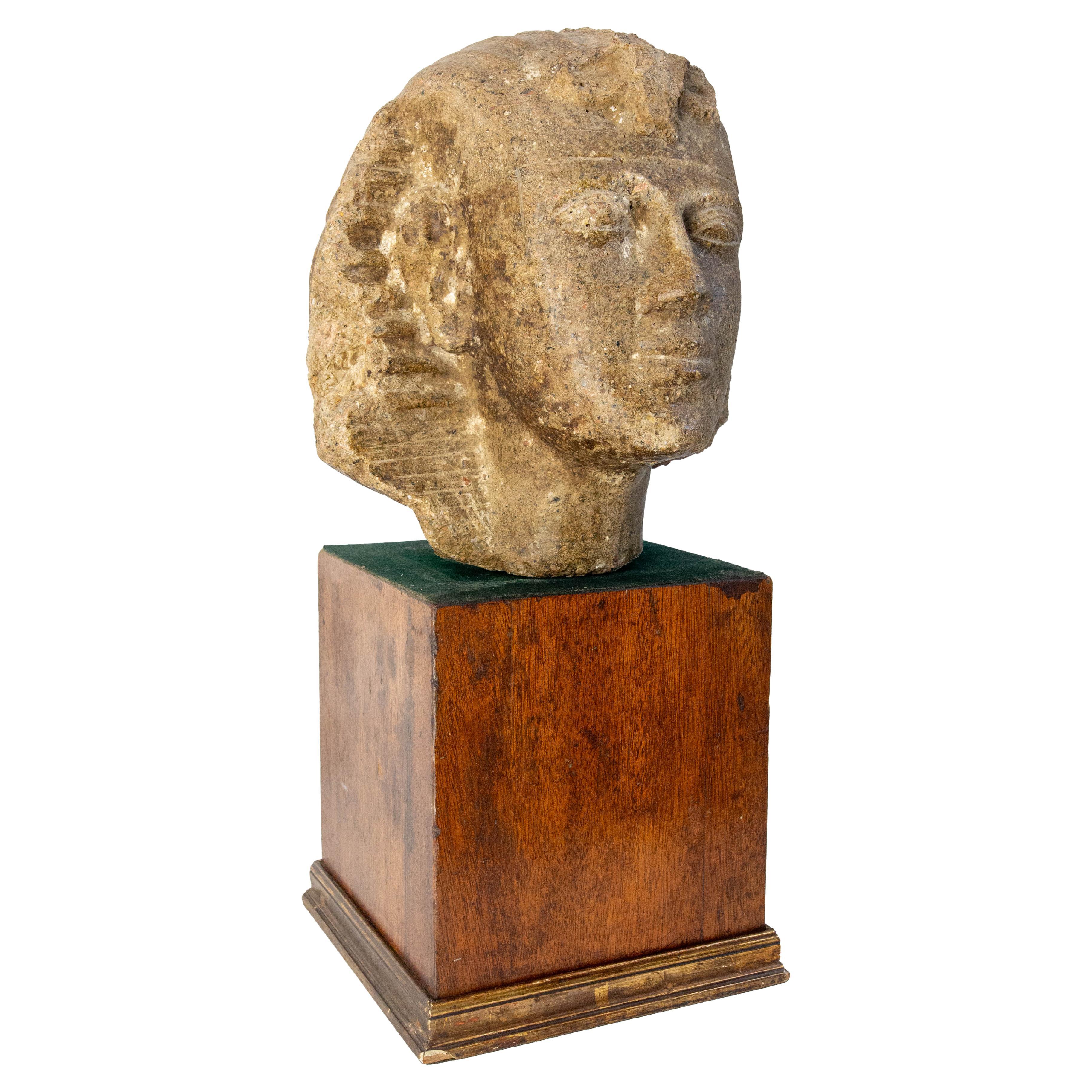
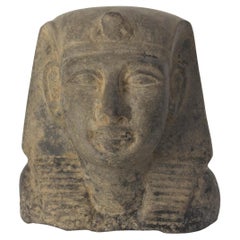
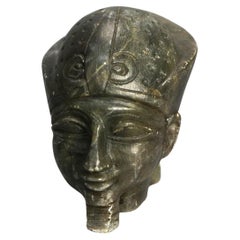
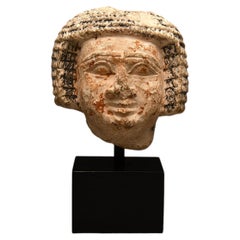
Ancient Egypt Head of the dignitary “Udjahormeehet” in basalt

$140,143.42
£105,012.83
€120,000VAT Included
CA$196,940.46
A$201,611.72
CHF 114,298.17
MX$2,446,216.68
NOK 1,347,037.51
SEK 1,354,558.59
DKK 914,948.73

About the Item

28 cm with the stand. Provenance Private collection, Mrs. Claude Marcault, France. Formed in 1970. Documents - Attached is a study on the antiquity of the piece issued by an Egyptologist. Head corresponding to a full-length statue, carved in basalt in the round, smaller than life-size (about 84 cm high). It represents the idealised portrait of a dignitary and shows a quality of workmanship that is made more relevant by the small size; the dimensions limit the treatment of the details, but each one of them is interpreted with admirable skill. The man wears a short, flared wig, gathered behind the ears and covered by a simple textile headdress called a khat, following an ancient style but very much in the taste of the XXVI or Saite dynasty, as evidenced by the numerous preserved examples. The khat was a large linen cloth with both ornamental and practical purposes, since it held the hair and was cooler than braided wigs. It is considered the oldest headdress used by Egyptian kings, since it already appears in the representation of the Pharaoh Horus Den, of the I dynasty, engraved on a small ivory plaque found in Abydos. From then on, it was used in the images of various pharaohs, especially those of Queens Hatshepsut and Nefertiti, as well as those of the latter's husband, Akhenaten, and his successor, Tutankhamun. The face is also characteristic of the statuary of this Saite period: particularly full, with rounded cheekbones and jaw, with a small but prominent and well-differentiated chin. The eyes are elongated, almond-shaped, and are framed by clean profiles in relief that represent the eyelids in an unnaturalistic, archaic way. The thin eyebrows, straight over the eyes, arch down towards the temples. The nose, which has practically disappeared, can still be seen in its general form, being very narrow at the top and noticeably wider towards the nostrils. The mouth outlines a slight smile, and shows thick, rounded and soft-looking lips, with gently blurred profiles. This smile has been called the Saite smile, since it is a hallmark of the statuary of this period. Also noteworthy is the representation of the ears, finely detailed with naturalism and precision, based on wavy and well-modelled lines, despite the small size of the piece. The head has a round and clean cut on the neck, possibly indicating the presence of a necklace worked by incision, of the type shown in a contemporary naophora sculpture preserved in the Louvre Museum. On the back of the head, above the nape of the neck and slightly overlapping the wig, the upper part of the support pillar of the sculpture can still be seen, which preserves hieroglyphic writing. These pillars, with a long tradition in Egyptian statuary, usually housed texts that identified the character represented or praised the pharaoh or the gods. In the case of the piece under study, the incomplete inscription Udjahorheh can be read, possibly the beginning of the portrait's proper name, which begins with the group Udja, an invocation to Horus common in the Saite period that could be translated as "Horus is prosperous." It is likely that the inscription refers to Udjahormeehet, a high official and priest of the goddess Neith in Sais, who would have commissioned this statue as an essential part of the funerary chapel of his tomb or as an ex-voto offered in the temple of Neith. The ideal features of this portrait reveal the particular taste of this period of the history of Ancient Egypt. The Egyptian Museum in Florence preserves a head, also made of basalt, which shows an identical treatment of the eyelids. The nose also follows models typical of the time, reproducing a prototype that contrasts a narrow start with a much wider base, projected towards the front. The way the lips are worked, enhancing the volume and blurring the profile of the upper lip, is also common in portraits from the Saite period. Considered a brilliant moment of renaissance of Egyptian art, the Saite period takes its name from its capital, Sais, located west of the Nile Delta. It was the last native dynasty to rule Egypt, and marked the beginning of the Late Period. It began in 664 BC with the expulsion of the Assyrian invaders by Psamtik I, first pharaoh of the 26th dynasty. Although it was a prosperous period, the Saites ruled in a context in which Egypt was no longer an international political power, but was instead focused on its survival as a nation in the face of external threats. The victory over the foreign invader marked a return to the rich and ancient Egyptian tradition, which resulted in a special development of the arts with the emulation of the models of the Old and Middle Kingdoms as a starting point. Generations later, Saite art would be seen as the quintessence of Egyptian art, so its forms and prototypes would be taken up again. The 26th Dynasty would come to an end in 525 BC, when the Persian conquest would put an end not only to the Saite Period, but also to native control over Egypt. The sculptors of the Saite dynasty produced impressive portraits of officials associated with the court and the high religious spheres in reliefs, sarcophagi and statues of medium and small format. The latter, representations of specific individuals clearly identified by inscriptions alluding to their life and rank, were made to be placed in temples, where they could worship the gods eternally and receive blessings, and also to be placed in tombs, as temporary housing for the spirit of the deceased in case of need.
  • Dimensions:
    Height: 5.52 in (14 cm)Width: 4.73 in (12 cm)Depth: 4.73 in (12 cm)
  • Style:
    Egyptian (Of the Period)
  • Materials and Techniques:
  • Place of Origin:
  • Period:
  • Date of Manufacture:
    Saite Period, 664 – 525 BC.
  • Condition:
    Wear consistent with age and use. Four fracture lines dividing the lower part of the face and the upper section into three parts. There are no modern areas and all the fragments fit together perfectly. There are scrapes on the front, nose, lips, forehead and chin.
  • Seller Location:
    BARCELONA, ES
  • Reference Number:
    Seller: 220024431stDibs: LU10999250351432

More From This Seller

View All
Ancient Egyptian Sculpture of a Noble in Granodiorite

Ancient Egyptian Sculpture of a Noble in Granodiorite

Located in BARCELONA, ES

Sculpture of a Noble. Ancient Egypt · Old Kingdom, 4th – 6th Dynasty, 2625 – 2450 BC. Material: Granodiorite. Size: Height 126 cm; width 42 cm and weight 170 kg; 190 cm with the ...

Category

Antique 15th Century and Earlier Egyptian Egyptian Busts

Materials

Stone

Ancient Egypt Bust of a Naophorus statue in Stone

Ancient Egypt Bust of a Naophorus statue in Stone

Located in BARCELONA, ES

32.3 cm with the stand. Provenance: - Galerie Samarcande, Paris, France, since 1973. - Drouot Richelieu, Paris, October 7 - 8, 1996, lot 324. - Private collection, Boulonnais, Fran...

Category

Antique 15th Century and Earlier Egyptian Egyptian Busts

Materials

Stone

Ancient Egypt Sculpture of the God Ptah in hardened limestone

Ancient Egypt Sculpture of the God Ptah in hardened limestone

Located in BARCELONA, ES

16.4 cm with the stand. Provenance - Private collection, Marquis Pierre d'Archanges (1886 - 1973), France. Head of a sculpture, carved from a block of stone in round bulk with a d...

Category

Antique 15th Century and Earlier Egyptian Egyptian Figurative Sculptures

Materials

Limestone

Ancient Egypt, Nubia, Statue of Osiris in Granite

Ancient Egypt, Nubia, Statue of Osiris in Granite

Located in BARCELONA, ES

52.5 cm with the stand. Provenance - Private collection, Paris, France, 1975. - Private collection, Petrus Hermanus Meeuws, Maastricht, 2002. - Private collection, Paris, France, ac...

Category

Antique 15th Century and Earlier Egyptian Egyptian Busts

Materials

Granite

Ancient Egypt Sculpture of the Goddess Isis-Hathor in Diorite

Ancient Egypt Sculpture of the Goddess Isis-Hathor in Diorite

Located in BARCELONA, ES

27 cm with the stand. Provenance - Private collection, Paris, France. Sculpture in an almost round shape of the goddess Isis-Hathor attached to a stela carved from a single block o...

Category

Antique 15th Century and Earlier Egyptian Figurative Sculptures

Materials

Stone

Ancient Egypt Parietal relief with the figure of the god Onuris.

Ancient Egypt Parietal relief with the figure of the god Onuris.

Located in BARCELONA, ES

Parietal relief with the figure of the god Onuris. Ancient Egypt, Late Period - P. Ptolemaic, 664 - 30 B.C. Limestone. 40 cm height. Provenance - Private collection, Mr. and Mrs....

Category

Antique 15th Century and Earlier Egyptian Egyptian Figurative Sculptures

Materials

Limestone

You May Also Like

19th Century Egyptian Black Stone Pharaoh Bust Statue

19th Century Egyptian Black Stone Pharaoh Bust Statue

Located in Labrit, Landes

Antique Egyptian stone bust 19th century This sculpture was purchased at a wine-producing château in Bordeaux. Good condition with good patina due to age. Shipping: 14 / 12 / 15 c...

Category

Antique 19th Century French Egyptian Busts

Materials

Stone

Ancient Egyptian Painted Sandstone Head of an Official

Ancient Egyptian Painted Sandstone Head of an Official

Located in Beverly Hills, CA

A beautifully preserved example, this superb sandstone head depicts an official wearing a smooth shoulder-length headcloth, over large naturalistic ears and fleshy, round face. The...

Category

Antique 15th Century and Earlier Egyptian Egyptian Antiquities

Materials

Sandstone

Antique Egyptian Revival Carved Hardstone Sculpture, Man with Headdress, 19thC

Antique Egyptian Revival Carved Hardstone Sculpture, Man with Headdress, 19thC

Located in Big Flats, NY

Antique Egyptian Revival Carved Hardstone Sculpture, Man with Headdress, 19thC Measures - 4"H x 3"W x 4.25"D A finely carved hardstone sculpture from the 19th century, reflecting the...

Category

Antique 19th Century Asian Egyptian Revival Busts

Materials

Stone

Sculpture, Sandstone Bust in the Taste of Ancient Egypt, XXth Century.

Sculpture, Sandstone Bust in the Taste of Ancient Egypt, XXth Century.

Located in Saint-Ouen, FR

Sculpture, sculpted sandstone bust in the taste of ancient Egypt, XXth century. Bust, carved sandstone sculpture in the taste of ancient Egypt, 20th century. Dimensions : H: 58cm, ...

Category

21st Century and Contemporary Egyptian Egyptian Busts

Materials

Sandstone

Ancient Egyptian Bust of a Goddess in Red-Orange Quartzite

Ancient Egyptian Bust of a Goddess in Red-Orange Quartzite

Located in London, GB

An exquisite ancient Egyptian hardstone bust of a female deity, with tripartite wig and Usekh collar, displaying all the hallmarks of early Nineteenth Dynasty art. Described by the d...

Category

Antique 15th Century and Earlier Egyptian Egyptian Busts

Materials

Stone

Old Kingdom Egyptian Limestone Head of an Official

Old Kingdom Egyptian Limestone Head of an Official

Located in Beverly Hills, CA

This delicately carved limestone head once belonged to a statue of an official and represents a classic example of old kingdom sculpture in the round. We can see the remarkable atte...

Category

Antique 15th Century and Earlier Egyptian Egyptian Antiquities

Materials

Limestone