Want more images or videos?
Request additional images or videos from the seller
1 of 9

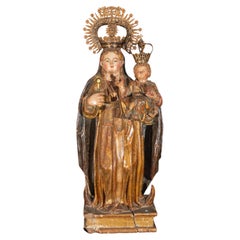
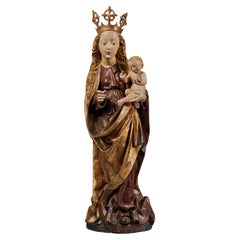
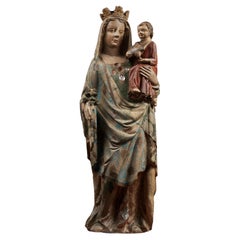
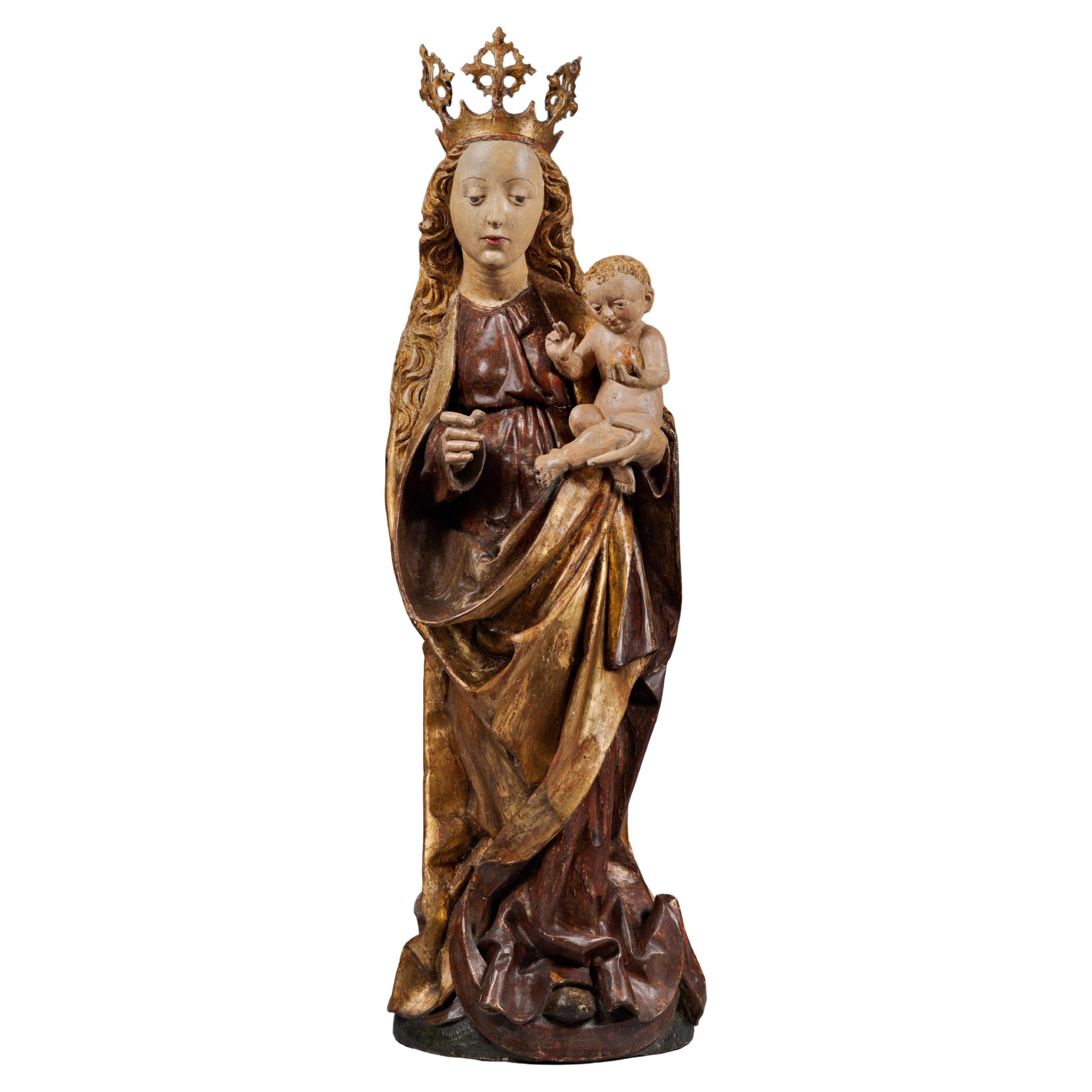
Flemish Field Altar Virgin, Burgundy, 15th Century

$14,150.75
£10,489.03
€12,000VAT Included
CA$19,741
A$20,026.53
CHF 11,434.09
MX$242,490.03
NOK 134,607.14
SEK 134,160.40
DKK 91,527.03

About the Item

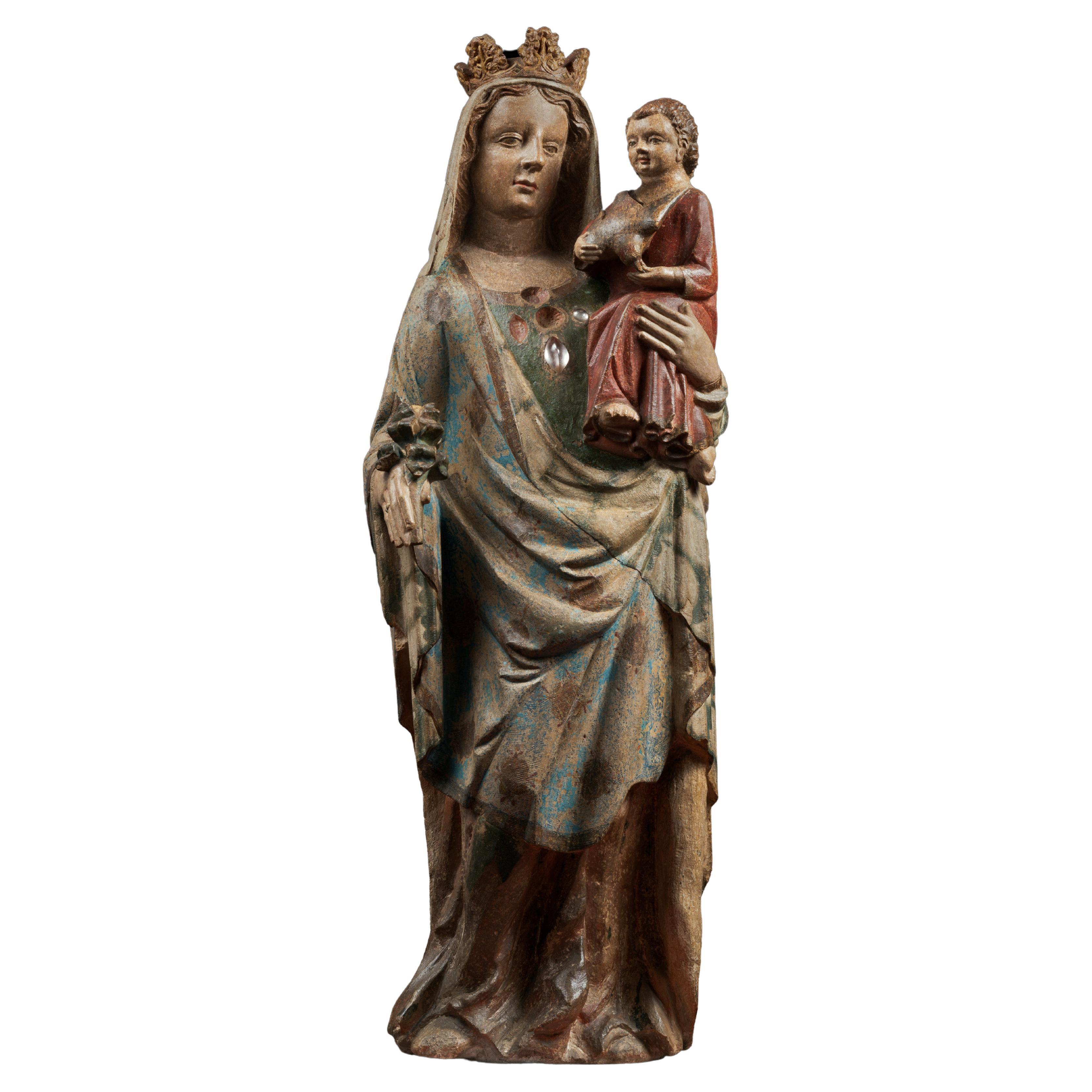
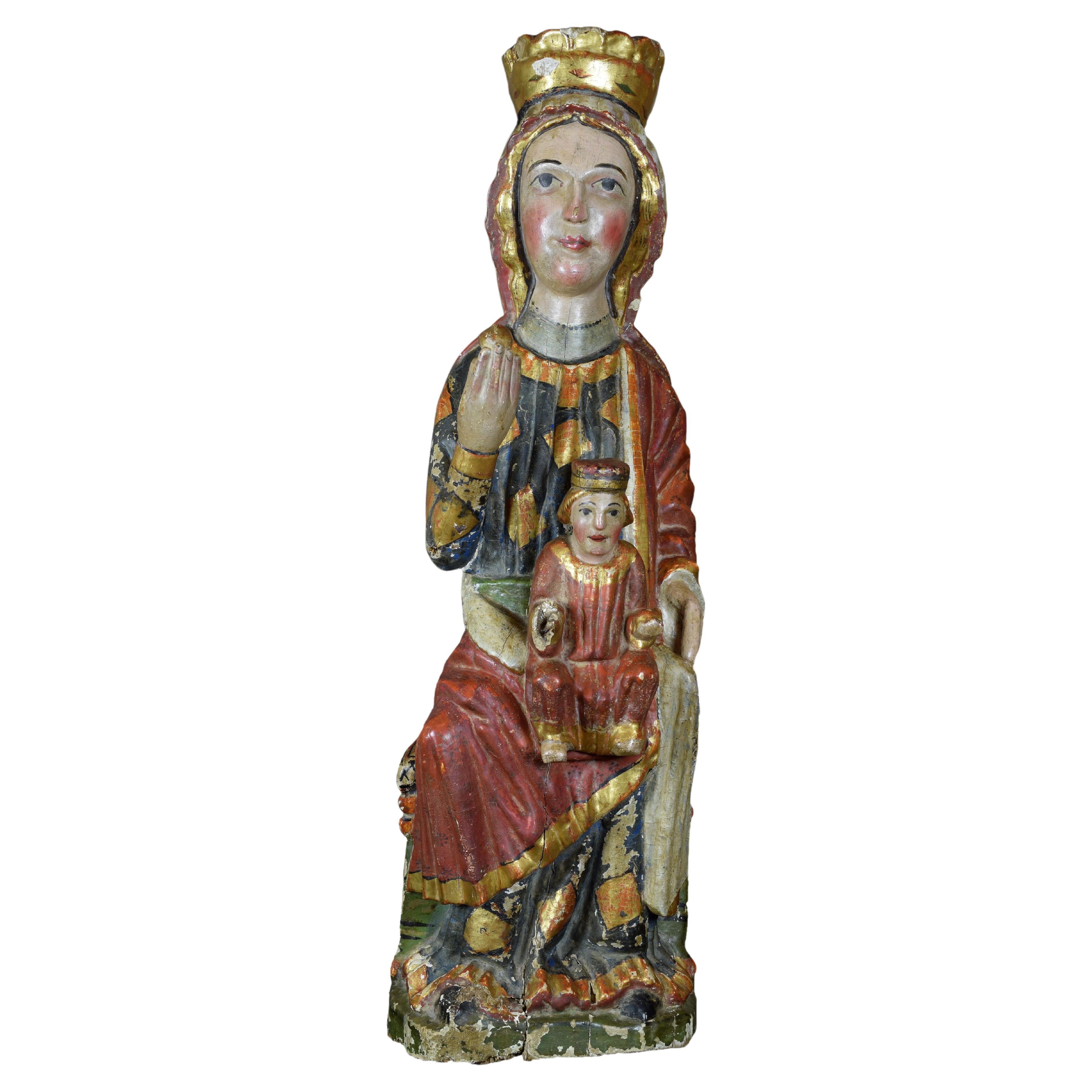
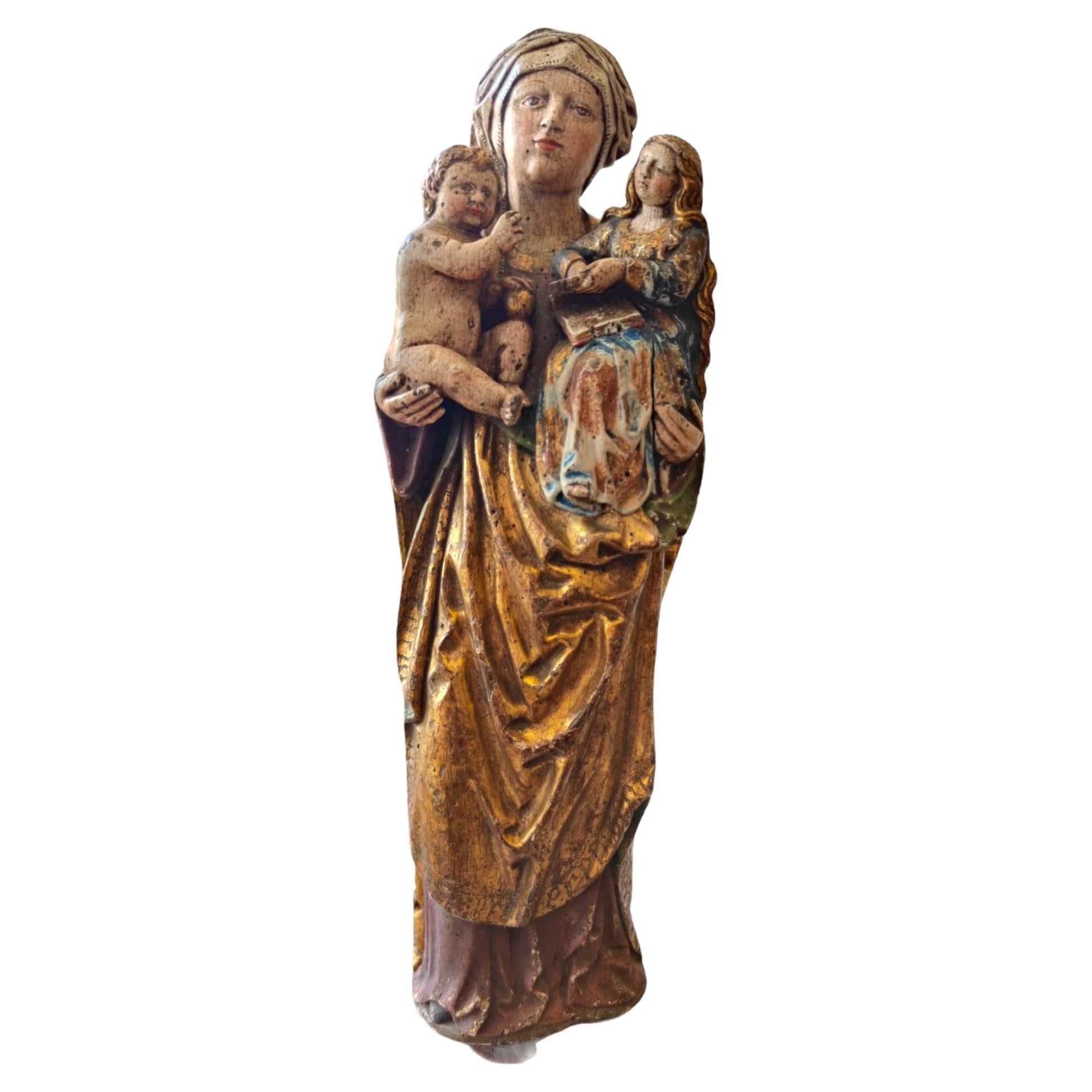
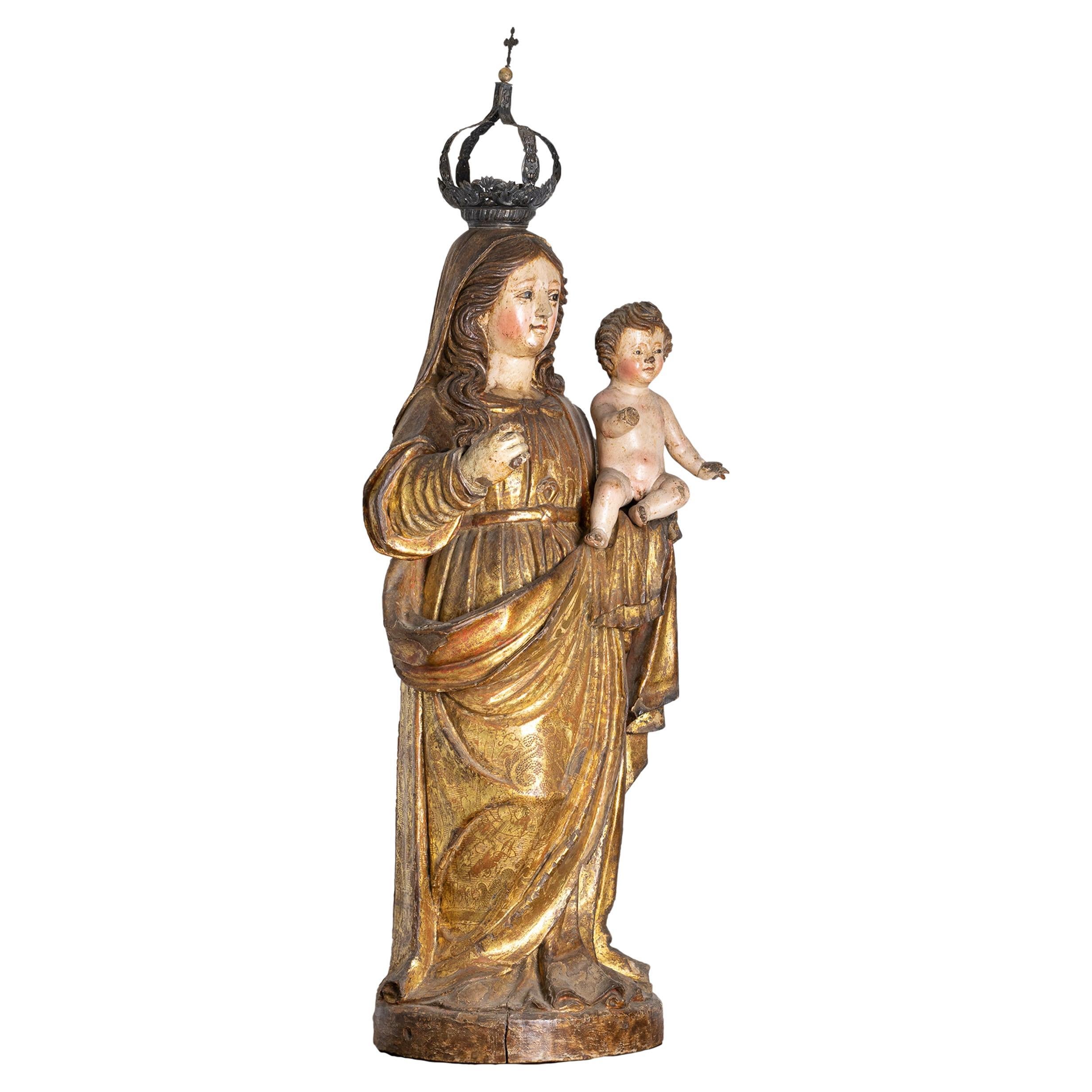
Flemish Field Altar Virgin, Burgundy, 15th Century An extraordinary 15th-century Flemish carving from Burgundy, made of polychrome and gilded wood, depicting the Virgin and Child. Approximately 30 cm tall, this image was designed for private devotion on a field altar, intended to accompany nobles and prelates on journeys and campaigns. The Virgin is crowned and retains traces of original polychromy, highlighting the serenity of her face and the delicate folds of her mantle, characteristic of late medieval Burgundian sculpture. A devotional piece of great rarity and historical interest, ideal for collectors of Flemish Gothic imagery. 31 cm high x 12 cm wide
  • Dimensions:
    Height: 12.21 in (31 cm)Diameter: 4.73 in (12 cm)
  • Style:
    Baroque (Of the Period)
  • Materials and Techniques:
  • Place of Origin:
  • Period:
  • Date of Manufacture:
    1450/1450
  • Condition:
    Wear consistent with age and use. good condition for the age.
  • Seller Location:
    Madrid, ES
  • Reference Number:
    1stDibs: LU5779247684992

More From This Seller

View All
Early 16th Century Spanish Polychrome Virgin and Child Sculpture

Early 16th Century Spanish Polychrome Virgin and Child Sculpture

Located in Madrid, ES

A finely carved Spanish Virgin and Child sculpture dating to the early 16th century, executed in polychromed and gilded wood. The composition reflects the transition from the late G...

Category

Antique 16th Century Spanish Gothic Figurative Sculptures

Materials

Wood

Virgin and Child, polychrome wood carving, Hispanic school, 16th-17th century

Virgin and Child, polychrome wood carving, Hispanic school, 16th-17th century

Located in Madrid, ES

Virgin and Child, polychrome wood carving, Hispanic school, 16th-17th century This carved and polychrome wood sculpture depicts the Virgin Mary with the Child in her arms, crowned an...

Category

Antique 16th Century Spanish Baroque Figurative Sculptures

Materials

Silver

Virgin and Child, polychrome wood carving, Colonial school, 18th century

Virgin and Child, polychrome wood carving, Colonial school, 18th century

Located in Madrid, ES

Virgin and Child, polychrome wood carving, colonial school, 18th century This sculpture of the Virgin and Child, carved and polychromed in wood, is attributed to an 18th-century colo...

Category

Antique Early 18th Century Spanish Baroque Figurative Sculptures

Materials

Silver

Renaissance polychrome and gilded wooden sculpture of Saint Anne, Spain, 16th ce

Renaissance polychrome and gilded wooden sculpture of Saint Anne, Spain, 16th ce

By Spanish Manufactory

Located in Madrid, ES

Renaissance polychrome and gilded wooden sculpture of Saint Anne, Spain, 16th century Imposing carved, polychrome, and gilded wooden sculpture, representing Saint Anne. Made in the ...

Category

Antique 16th Century Spanish Baroque Figurative Sculptures

Materials

Silver

Large Spanish Colonial Polychrome Virgin Mary, 18th Century

Large Spanish Colonial Polychrome Virgin Mary, 18th Century

Located in Madrid, ES

A striking Spanish Colonial polychrome carved wood sculpture depicting the Immaculate Conception, dating from the late 18th The Virgin is represented standing with open arms in a w...

Category

Antique 18th Century Peruvian Spanish Colonial Figurative Sculptures

Materials

Wood

17th Century Spanish Polychrome Immaculate Conception Sculpture

17th Century Spanish Polychrome Immaculate Conception Sculpture

Located in Madrid, ES

A beautifully carved Spanish sculpture of the Immaculate Conception dating from the 17th century, executed in polychromed and gilded wood. Measuring 75 cm high, 38 cm wide and 24 cm...

Category

Antique 17th Century Spanish Baroque Figurative Sculptures

Materials

Wood

You May Also Like

Polychrome carved wood Virgin and Child from the 15th Century

Polychrome carved wood Virgin and Child from the 15th Century

Located in Saint-Ouen, FR

POLYCHROME CARVED WOOD VIRGIN AND CHILD FROM THE 15TH CENTURY   ORIGIN: SOUTH GERMANY, SWABIA, NUREMBERG REGION PERIOD: 15th CENTURY   Height: 94,6cm Width : 28 cm Depth : 18 cm   Lime wood Original Polychromy Good state of conservation     From 1430 onwards, sculpture underwent a profound stylistic renewal which continued until 1530, the so-called late Gothic period. In the Germanic countries, original sculptures flourished in an expressive and sensitive vein.
This renewal was inspired by the art of Nicholas of Leiden, who was active in Strasbourg in the 1460's. His style broke with the refined and delicate art of the international Gothic style in force throughout Europe around 1400. The figures became more authentic and realistic. The bodies became denser. Clothes are animated by deep, broken folds, the fabrics are heavy and have a great decorative value. In addition, the polychromy is intended to be illusionistic. The painting makes it possible to restore the texture of the materials, the richness of the textiles and the natural skin tone of the characters.   The dissemination of images through engraving and the great mobility of the artists led to the success of this style, which conquered the Upper Rhine, Swabian, Tyrolean and Franconian regions, contributing to the formation of a common stylistic identity in these regions. The economic boom in the flourishing German cities was conducive to the development of original production. Attracted by this prosperity, numerous workshops were set up in order to meet the orders of religious communities, the Church and the laity, including a clientele of middle-class rockers.      This precious Virgin and Child is depicted standing on a crescent moon, her head encircled by a crown of tall flowers. Her long wavy hair spreads over her shoulders, framing her beautiful oval face. Under fine eyebrows drawn with a brushstroke, her almond-shaped, slightly drooping eyes look at the Child with infinite softness. She is dressed in a long red dress with a rounded neckline, belted under the chest. The heavy fabric of her dress spreads out in broken folds at her feet. On her shoulders she wears a golden cloak. The drapery has deep folds. She holds out her right hand while she holds the Christ Child with her left.   Christ, with his well-defined hair, is naked. His cheeks are highlighted with red, he holds an apple in his left hand and with the other hand makes a sign of blessing towards the faithful.   Virgins with Child on a crescent moon were very popular in the second half of the 15th century, especially as the central subject of altarpieces in southern Germany and Austria. The crescent moon on which Mary is standing is reminiscent of the Woman of the Apocalypse. Often equated with the Virgin Mary.    This episode is taken from the Book of Revelation (12:1-6)   1 Then a great sign appeared in heaven: a woman clothed with the sun, with the moon under her feet and a crown of twelve stars on her head. ; 2 She was pregnant, and she cried out because she was in labor, in pain from giving birth. ; 3 Then another sign appeared in heaven: it was a great fiery red dragon, with seven heads and ten horns, and seven royal crowns on his heads. ; 4 His tail swept down a third of heaven's stars and threw them to the earth. The dragon stood in front of the woman who was about to give birth so that when she gave birth, he might devour her child. ; 5 She gave birth to a son, a male child who is to rule all the nations with an iron rod. Her child was snatched up to God and his throne. ; 6 Then the woman fled into the desert, where God has prepared a place for her. There she will be taken care of for one thousand two hundred sixty days.   Some theologians see in this woman a reference to the Virgin Mary and in the child, Jesus.    
This remarkable work is a very fine example of sculpture from Swabian workshops in the last decades of the 15th century. It presents all the characteristic stylistic elements: a highly girdled silhouette, an abundant drapery with angular folds, but also a great physical presence accentuated by the polychromy that restores the anatomical details. This group is made of a wooden log. The deep folds of the drapery highlight the movement of the Virgin holding the child.       Bibliography :   Sophie Guillot de Suduiraut, Dévotion et Séduction, Sculptures souabes des musées de France, vers 1460-1530, Paris musée du Louvre-Éditions somogy, 2015   “Revelation 12 -   Common English Bible...

Category

Antique 15th Century and Earlier German Gothic Figurative Sculptures
Materials

Wood

Important 15th Century Polychrome Wood Virgin and Child

Important 15th Century Polychrome Wood Virgin and Child

Located in Saint-Ouen, FR

Important 15th century polychrome wood virgin and child Origin: Southern Germany Period: Late 15th Century, Ca. 1480-1490 Height : 125 cm Polychrome limewood Good condition Provenance : Private collection, Alsace, France. As soon as 1430, sculpture starts a major and deep stylistic evolution than will unfold over a century, until around 1530. We call it the International Gothic. This production is particularly interested in a quest for realism. This important Virgin and Child wears a long red dress with a round gilded neckline. A delicate golden belt...

Category

Antique 15th Century and Earlier Figurative Sculptures

Materials

Wood

Polychrome Carved Wooden Virgin In Prayer, 16th Century, Italy

Polychrome Carved Wooden Virgin In Prayer, 16th Century, Italy

Located in MARSEILLE, FR

A remarkable carved and polychromed wooden sculpture depicting the Virgin Mary standing in prayer, her hands joined in a gesture of devotion and contemplation. Executed in Italy duri...

Category

Antique 16th Century Italian Renaissance Figurative Sculptures

Materials

Fruitwood

18th Century Italian Carved Wood Polychrome Virgin Mary Sculpture

18th Century Italian Carved Wood Polychrome Virgin Mary Sculpture

Located in Doha, QA

This is an outstanding Italian 18th century carved wood polychromed sculpture of Virgin Mary. The Sculpture is hand painted with some remains of a gold gilt in few places and originated until lately in a private Villa in Tuscany (Italy). The colors are typical red, blue and green are spectacular on this large figure. The Virgin's hands are joined together in a prayer, while standing on a pedestal on the both sides of which are devil's horns (bottom left side horn missing ) symbolising Holly Mary defeating the Evil, protected by the Holly Ghost and an Angel. A story tells the pose of the Virgin Mary sculpture...

Category

Antique 18th Century Italian Baroque Figurative Sculptures

Materials

Wood, Pine

Important 14th Century Polychrome Limestone Virgin from Lorraine

Important 14th Century Polychrome Limestone Virgin from Lorraine

Located in Saint-Ouen, FR

Provenance : - Kunsthaus Heinrich Hahn, Frankfurt am Main, sale 16, June 17, 1930, lot 16. - Sotheby's, Amsterdam, Feb. 26, 2006, lot 201. HISTORIC Located between Moselle valley and Meuse valley, framed by the Vosges Mountains on the south side and the duchy of Luxembourg on the north side, the duchy of Lorraine is the result of several partitions. It starts with the 9th century when the Carolingian empire is divided, with Lothar 1st inheriting Lotharingia. In 959 this territory was in turn divided in two; Lower and Upper Lotharingia, the latter being the forebear of the duchy of Lorraine. This duchy was under the rule of the Holy Roman Germanic Empire until 1736 when it was absorbed by the kingdom of France. All along its history the duchy of Lorraine has found itself in the midst of many conflicts. Alliances and feuds marking European history were always particularly sensible in Lorraine where instability was frequent. Because of its geographic position the duchy of Lorraine was also an artistic crossroad. Hence the duchy of Lorraine becomes from the 13th century onwards an important artistic centre where a particular type of Virgin and Child appears. According to professor J. A. Schmoll the characteristics of Lorraine sculpture burgeon around 1280-1300 in the Aube region. It presents “vigorous volumes, restrained movements, rare but solemn gestures and a strong interiorised and stern expression”. Those Virgins look similar with a wide forehead, a shield- or oval-shaped face, large neck, small lips and a cleft chin. This model is particularly in favour during the 13th century because of the revival for Marial worship and for the theme of the Virgin and Child. It bears witness to a new religious sensibility with a more intimate vision of religious practice. DESCRIPTION The important 14th century Virgin we present to you is one of the most beautiful examples of sculptural art from Eastern France, with her fascinating distant gaze. Her contrapposto posture is induced by the weight of the child she carries high on her left side. The child has a chubby face framed by blond hair with well defined curls and he wears a long red V-collared tunic from which emerge his feet. The fabric is animated by long folds. The position of the right foot turned to the back is a detail we can notice on several Virgins from Lorraine. He holds a bird that seems to be pecking his thumb. “The bird /held by the child in his hands/ has been read as a reference to an episode from Christ’s childhood when he has moulded sparrows with clay before giving them life. It appears in the apocryphal gospel of Pseudo-Matthew (ch. 27) and later in the Quran (III, 43, v. 110). However the iconography seems to be more influenced by the concept of Redemption or of Eucharist, the bird symbolising the soul of the Christian about to be redeemed or revitalised.” Mary wears a long dress with two rock crystal cabochons remaining from the original five. She is covered by a red cloak enriched with old-gold motifs draped as an apron falling in long pleats along her left hip. The relief treatment and the volume of the cloak developing a network of concentric pleats contrast with the the flat pleating of her dress. They nevertheless suggest the curve of her bent right leg. She wears a floret crown securing a short thin veil carved in very low relief. From it emerges her blond curled hair characteristic of the 13th century. The large face with almond-shaped eyes, straight nose, small lips and cleft chin casts its gaze afar in a fashion typical of 13th century Virgins. In her right hand she holds a lily flower. In a very refined manner the artist has carved a band on her right ring-finger. In the back, carefully sculpted, spreads the minutely detailed short veil. COMPARATIVE STUDIES This sculpture of great quality presents obvious similarities with Virgins from Lorraine, designated by William Forsythe...

Category

Antique 15th Century and Earlier French Gothic Figurative Sculptures
Materials

Limestone