Want more images or videos?
Request additional images or videos from the seller
1 of 5

Large Cast and Chiseled Bronze Plaque - Saint Sebastian, Rome 17th century

$9,707.04
$12,942.7125% Off
£7,187.57
£9,583.4325% Off
€8,250VAT Included
€11,00025% Off
CA$13,520.52
CA$18,027.3625% Off
A$13,755.38
A$18,340.5125% Off
CHF 7,883.21
CHF 10,510.9525% Off
MX$165,623.35
MX$220,831.1425% Off
NOK 92,140.15
NOK 122,853.5425% Off
SEK 92,544.53
SEK 123,392.7025% Off
DKK 62,909.69
DKK 83,879.5825% Off

About the Item

Large Cast and Chiseled Bronze Plaque Saint Sebastian after the model by Guido Reni (Capitoline Museum) Rome, 17th century Large rectangular bronze plaque depicting the martyrdom of Saint Sebastian within a quadrilobe frame. The background of the plaque is adorned with relief flowers, garlands, and torches in the ancient style. Inspired by the famous martyrdom of Saint Sebastian by Guido Reni, preserved in the Capitoline Museum in Rome, the nimbed saint appears with his wrists tied above his head to a tree trunk, covered with drapery around his loins; his face slightly tilted towards his shoulder, eyes to the sky. The shots have begun and his young flesh is pierced by three arrows: one on the left, on his right side, at the level of the ribs, one below the left armpit, piercing his lung; an additional arrow pierces the abdomen of the Saint, just below the navel (as in the Capitoline version). The ambiguous attitude of the martyr is confusing. Pierced by arrows, he does not seem to be in a state of suffering. With his mouth slightly open and his gaze turned towards the sky, he seems to almost betray a moment of pure ecstasy. Guido Reni painted the Saint as a martyr seven times. As in our plaque, the Saint Sebastian of Genoa (and the one almost identical with a few details from the Capitoline Museum) presents a tight framing at the level of the torso of the youth, who has his hands tied above his head, which forces the saint into some contortions of the spine: the thorax is then projected forward, and the back shows a delicate curvature. The extension of his body highlights, under a smooth modeling, the muscles of the arms and torso as well as the ribs. The perizonium seems to slide along the hips, ready to unravel or fall to the ground. A religious subject, it takes on secular dimensions. Nudity, with its dual dimension of eroticism and Beauty, reinvigorates the gaze. Perpetuating the cult of beauty and grace despite the violence of the subject, the scene, devoid of vulgarity, is imbued with poetry and gentleness. The elegant figure of the Saint with pure lines conforms to a classical ideal canon (almost childlike face, curly hair, displayed sensuality). Enlisted in Rome at the end of the 3rd century, Sebastian, captain of the Praetorian Guard of Emperor Diocletian, protected persecuted Christians. He was then tied to a pole and pierced with arrows from which he miraculously recovered. He returned to the imperial palace and reproached Diocletian for his attitude towards Christians. He was then beaten with rods and his body was thrown into the sewers so as not to be venerated by Christians. The account of his martyrdom made him one of the patron saints of the early Christian churches. He is also considered the patron saint of soldiers in general but is primarily the saint protector against the plague and more broadly the protector against epidemics. Plaques were among the objects often found in the environment of the studiolo and the cabinet of curiosities, alongside other small forms such as classical coins and engraved gems. The artists who created them were generally bronze sculptors, also creating small figurines and objects such as inkwells, or goldsmiths, who often worked in the related field of engraving. They were relatively inexpensive and portable, and quickly spread widely in Europe, offering artists the opportunity to showcase their virtuosity and sophistication, and to promote themselves beyond their own city. Plaques, like prints, played an important role in the dissemination of styles and trends in iconography, especially for classical subjects. Some drawings for plaque models have survived; others copied prints, book illustrations, and designs in other media, including engraved gems and classical sculptures.
  • Dimensions:
    Height: 10.95 in (27.8 cm)Width: 7.09 in (18 cm)Depth: 0.12 in (3 mm)
  • Style:
    Baroque (Of the Period)
  • Materials and Techniques:
    Bronze,Cast
  • Place of Origin:
  • Period:
  • Date of Manufacture:
    17th century
  • Condition:
    Wear consistent with age and use.
  • Seller Location:
    Bruxelles, BE
  • Reference Number:
    1stDibs: LU6666239255502

More From This Seller

View All
Hercules Holding a Coat of Arms, Flemish, XVII Century

Hercules Holding a Coat of Arms, Flemish, XVII Century

Located in Bruxelles, BE

Hercules holding a coat of arms Flemish, XVII century White and black marble Measures: 67 x 32 x 19 cm Hercules is depicted naked, holding a coat of arms with the right hand an...

Category

Antique 17th Century Belgian Renaissance Figurative Sculptures

Materials

Marble, Belgian Black Marble

Large Terracotta Relief - Lombardy, First Half of 17th Century

Large Terracotta Relief - Lombardy, First Half of 17th Century

Located in Bruxelles, BE

Large Terracotta relief of the flight into Egypt Lombardy, first half of 17th century Painted terracotta 91 x 85 x 11,5 cm This event in the early life of Christ is recounted i...

Category

Antique 17th Century Italian Baroque Figurative Sculptures

Materials

Terracotta

Saint John the Baptist - Central Italy, 16th century

Saint John the Baptist - Central Italy, 16th century

Located in Bruxelles, BE

Saint John the Baptist Central Italy, 16th century Carved limestone, traces of polychromy H 43,5 x L 24 x P 15 This remarkable carved limestone sculpture depicts Saint John the Bap...

Category

Antique 16th Century Italian Renaissance Figurative Sculptures

Materials

Limestone

Arm Holding a Shield - Spain, 17th century

Arm Holding a Shield - Spain, 17th century

Located in Bruxelles, BE

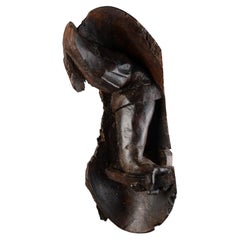
Arm Holding a Shield Spain, 17th century Wood 18 x 47 x 15 cm This remarkable fragment depicts a right arm grasping a shield, most likely detached from a monumental figure of a knig...

Category

Antique 17th Century Spanish Renaissance Figurative Sculptures

Materials

Wood

Sleeping Eros - Rome, 16th century

Sleeping Eros - Rome, 16th century

Located in Bruxelles, BE

Sleeping Eros Rome, 16th century
 Carrara marble, on a wooden base
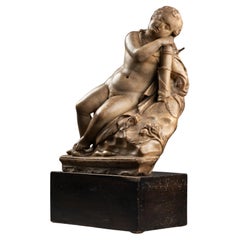
 of an ancient collection 31 × 44 x 17 cm Carved from a fine block of Carrara marble, this sculpture depicts Eros ...

Category

Antique 16th Century Italian Renaissance Figurative Sculptures

Materials

Carrara Marble

Saint Crespin - Renaissance sculpture - Loire Valley, 16th century

Saint Crespin - Renaissance sculpture - Loire Valley, 16th century

Located in Bruxelles, BE

Saint Crispin
Loire Valley, 16th century
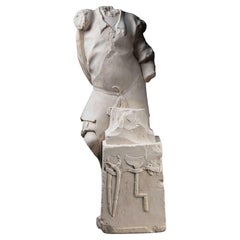
tuffeau stone Height: 67 cm Provenance: Private French collection since the 1960s This fragmentary limestone sculpture represents Saint Cris...

Category

Antique 16th Century French Renaissance Figurative Sculptures

Materials

Stone

You May Also Like

HALF OF THE 18th CENTURY PAINTED WOOD SCULPTURE OF SAINT SEBASTIAN

HALF OF THE 18th CENTURY PAINTED WOOD SCULPTURE OF SAINT SEBASTIAN

Located in Firenze, FI

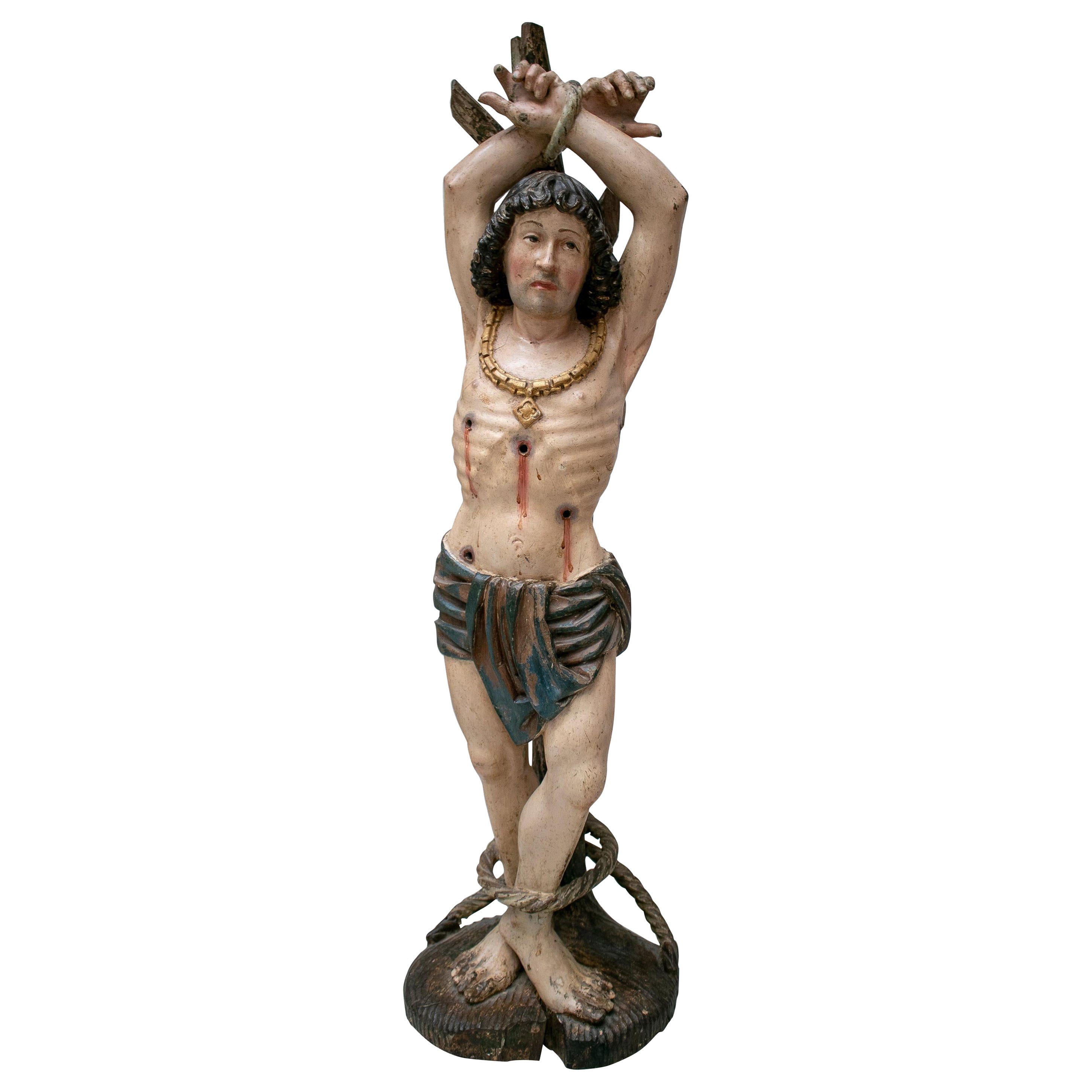
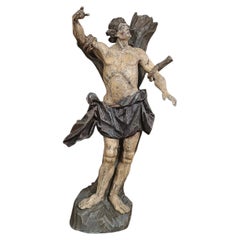
Elegant and unique sculpture in Swiss pine, finely carved and painted. The saint is depicted tied to a trunk, which also serves as a support for the sculpture. He is depicted standin...

Category

Antique Late 18th Century Italian Louis XV Figurative Sculptures

Materials

Wood, Paint

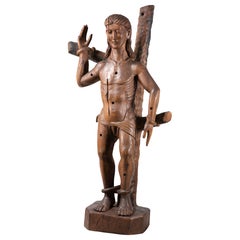
Saint Sebastian. Carved wood. Possibly Spanish school, 18th century.

Saint Sebastian. Carved wood. Possibly Spanish school, 18th century.

Located in Madrid, ES

Saint Sebastian. Carved wood. Possibly Spanish school, 18th century. It has faults. Figurative carving in wood depicting a semi-nude youth tied to a tree with ropes carved from the ...

Category

Antique 18th Century Other Religious Items

Materials

Wood

19th Century Italian Bronze Plaque with Putti

19th Century Italian Bronze Plaque with Putti

Located in Delft, NL

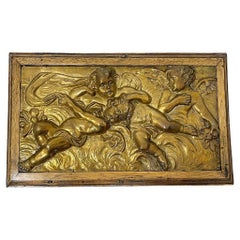
19th century Italian bronze plaque with Putti In bas-relief bronze plaque in oak wooden frame with scene of 3 reclining putti with fruit and ...

Category

Antique Late 19th Century Italian Wall-mounted Sculptures

Materials

Bronze

Antique Plaque Wall Decor Renaissance Battle Bronze Relief Henri I Duke of Guise

Antique Plaque Wall Decor Renaissance Battle Bronze Relief Henri I Duke of Guise

Located in Greven, DE

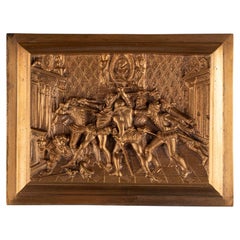
Antique Plaque Wall Decor Renaissance Battle Bronze Relief Henri I Duke of Guise Continental Bronze Late 19th Century Dimensions: H x W x D: 13.5cm x 18cm x 1.5cm This late ...

Category

Antique Late 19th Century Renaissance Wall-mounted Sculptures

Materials

Bronze, Ormolu

19th Century Neoclassical Patinated Bronze Relief of Prometheus

19th Century Neoclassical Patinated Bronze Relief of Prometheus

Located in Queens, NY

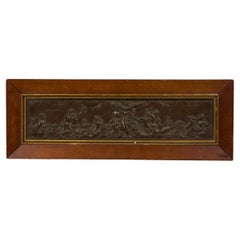
Italian Neo-classical style patinated bronze relief depicting the mythical Prometheus chained to a large stone surrounded by merfolk and sea creatures in a brown walnut frame (ARTIST...

Category

Antique 19th Century Unknown Neoclassical Wall-mounted Sculptures

Materials

Bronze

18th Century Bronze Sculpture of a Young Bacchus in the style of Ponce Jacquiot

18th Century Bronze Sculpture of a Young Bacchus in the style of Ponce Jacquiot

By Ponce Jacquiot

Located in Kittery Point, ME

A young Bacchus cast in bronze, the Roman god of wine, half kneels half sits on a rock while holding grapes in one hand raised above his head and a cup in the other, his head tilted ...

Category

Antique Late 18th Century French Renaissance Figurative Sculptures

Materials

Bronze