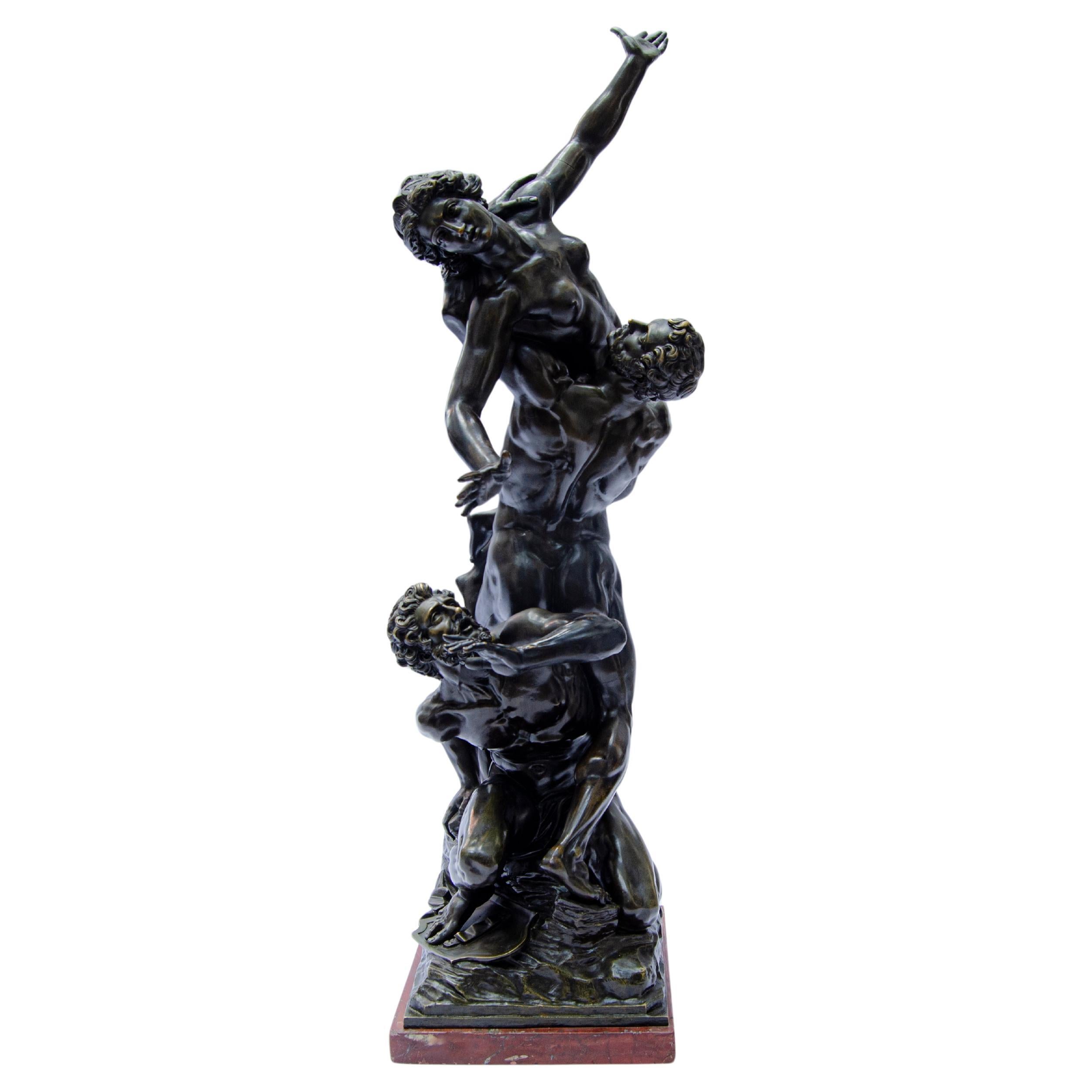
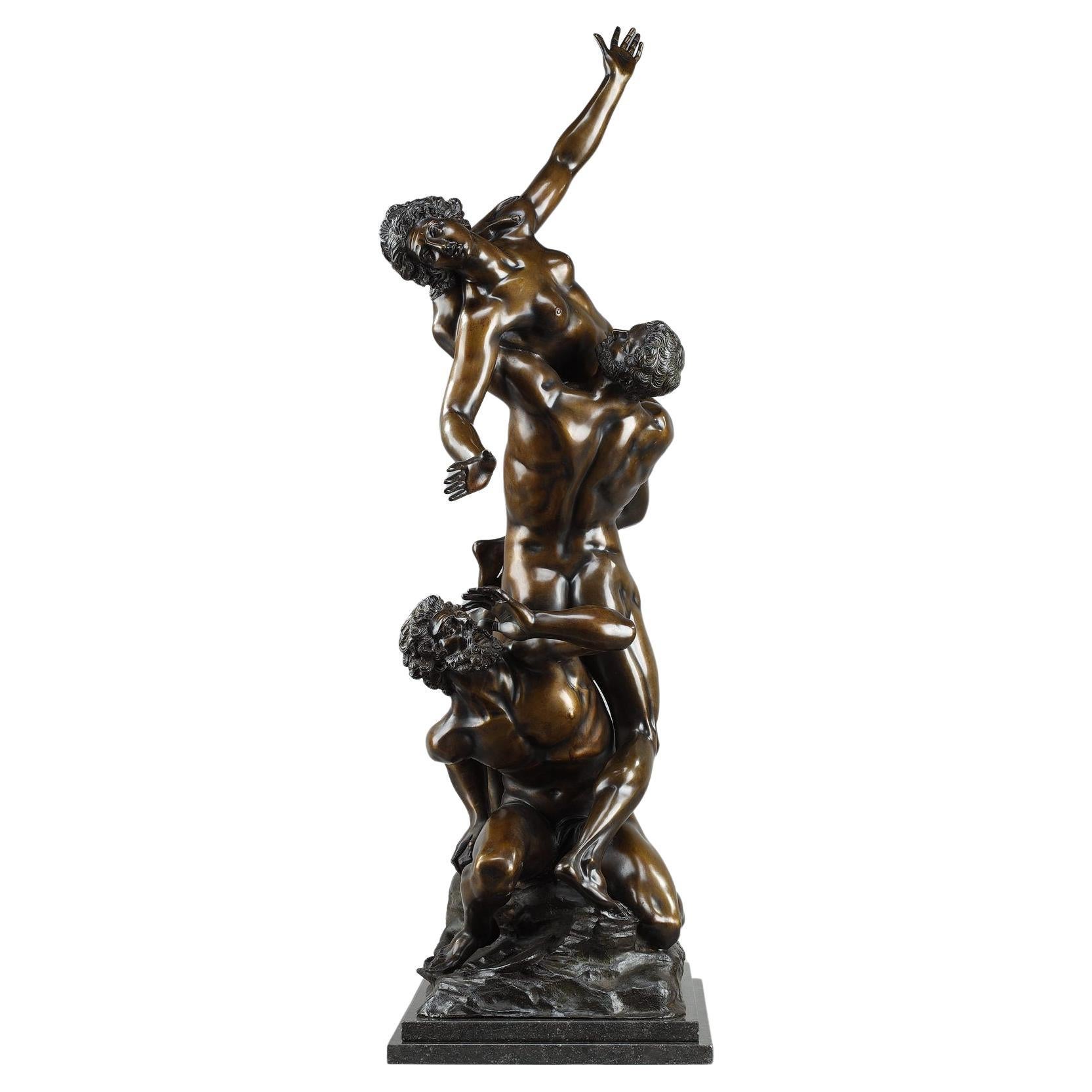
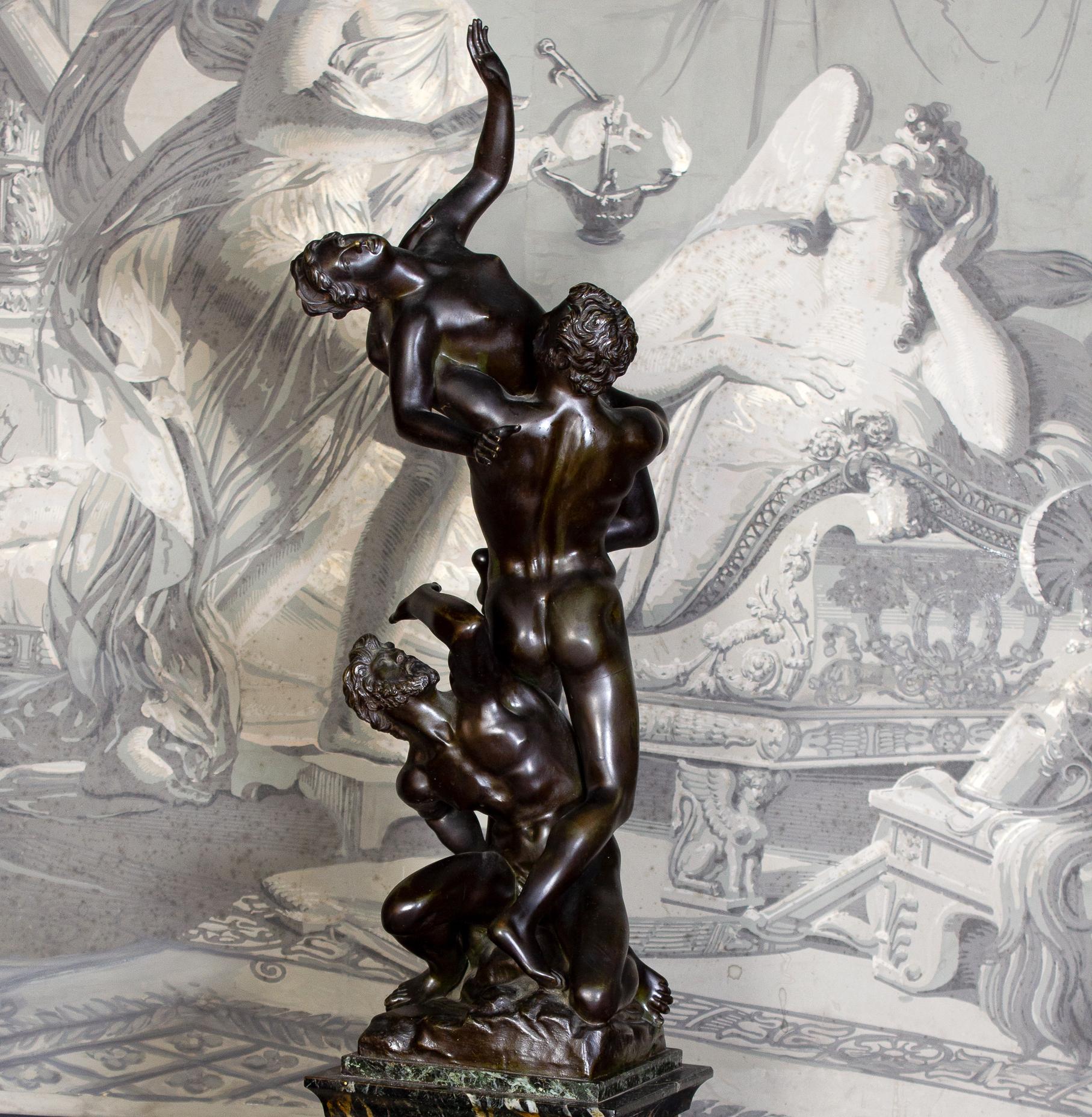
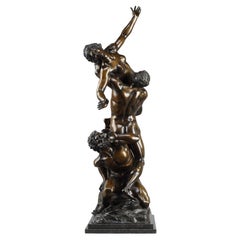
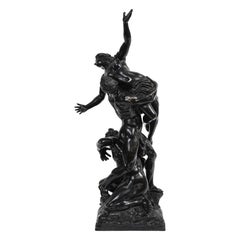
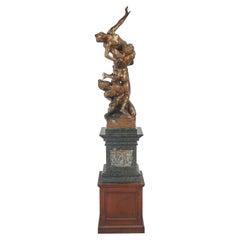
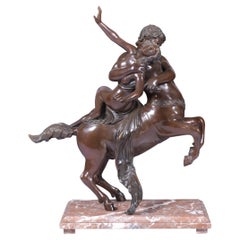
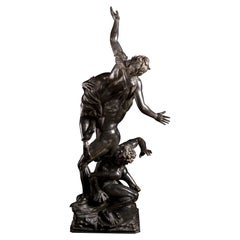
In reference to the remarkaple marble group of three larger-than-life figures, known as ‘The Rape of the Sabine Women’, which is located under the right arcade of the Loggia dei Lanzi in Piazza della Signoria in Florence, Giambologna created a smaller bronze version for the Duke of Parma, Ottavio Farnese, at the same time, in 1579.
This is now in Naples, in the Museo di Capodimonte, and serves as the template for our model.
The defeated Sabine is no longer depicted here, while the victorious Roman has been given a flowing drape that gives the group dynamism and direction and further emphasises the expansive stride. Furthermore, our model is supported by a tree trunk and stands on an oval plinth on an oval, dark flamed marble base.
‘Giambologna may well have been the first artist of the modern era to pursue art for art's sake and for the sake of its perfection’ (Beaucamp 1978). He was not concerned with a message, but solely with moving and moving beauty. It is fair to describe Giambologna's group of figures as the pinnacle of Mannerist sculpture, because it is ‘equally beautiful from all sides’, that is, there is no main view. Around the middle of the 16th century, theoretical discussions
repeatedly demanded that a perfect sculptural work of art must have numerous equally valid perspectives. Furthermore, Giambologna's Rape of the Sabine Woman is the perfect realisation of the figura serpentinata. The figura serpentinata is a figure moving fluidly upwards with a twisted body axis – whereby this twist need not be
based on the action. For the Mannerist sculptor, beauty is ‘no longer static, but dynamic. A beautiful body is still a
well-proportioned body. But the emphasis is no longer on the proportion, but on the elegance of the movement’ (Moser 2006).
syndrome-de-stendhal blogspot - Beautiful from all sides
Beaucamp, Eduard: The Anti-Michelangelo. The artistic world of figures by Giambologna. In: F.A.Z. of 23 December 1978;
Moser, Claus: Giambologna. Web
Design: After Giambologna (1529 - 1608)
Giovanni da Bologna, actually Jean de Boulogne, called Giambologna, was a Flemish-Italian sculptor of the Florentine school of Mannerism and Early Baroque. He came from the County of Flanders, which was ruled by the House of Habsburg and extended far into present-day France, but was mainly active in Italy. His work can be assigned to Mannerism, a form of the Late Renaissance. Giovanni Bologna created numerous sculptures and figures for fountains for the Italian nobility, especially for the Medici. One of his students was the South German and Tyrolean sculptor Hans Reichle.
Manufactured first half of 20th century
Bronze modeling and casting, natural old patina, marble base
Dimensions:
Height: 73,5 cm / 28.93 in
Width: 30,0 cm / 11.81 in
Depth: 24,0 cm / 9.44 in
Weight: 24.240 grams / 853.24 oz / 779.42 troy oz
Very well maintained - natural old patina, signs of age and wear on the marble base