Ernesto Basile (1857–1932)
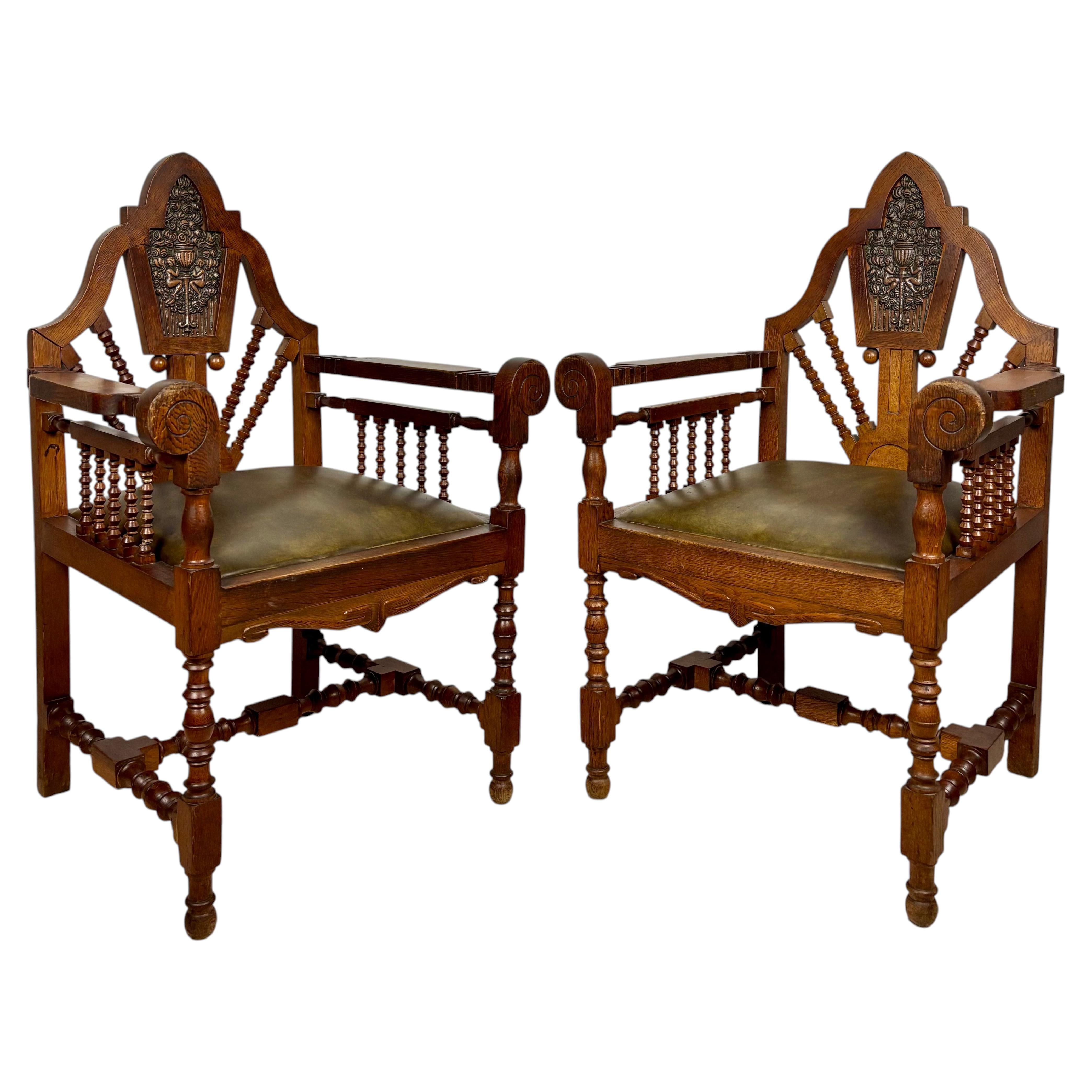
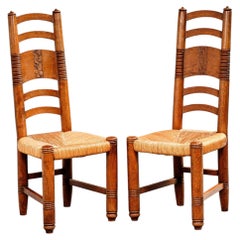
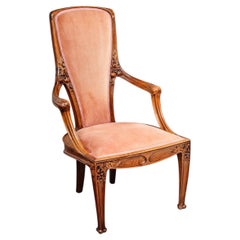
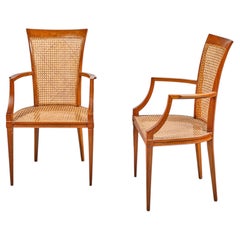
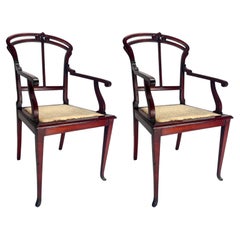
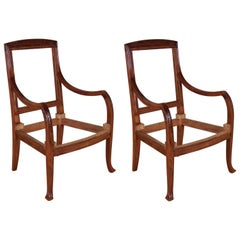
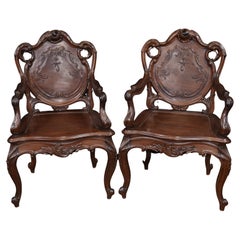
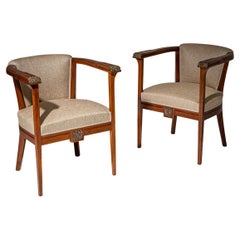
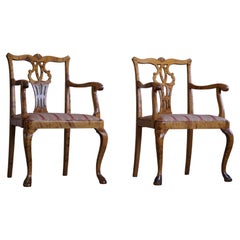
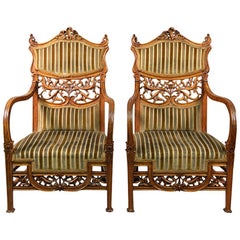
Pair of corner armchairs in molded and carved natural wood,
The armrests are adorned with female heads, the backrests feature shell motifs and openwork water lilies filled with straw; square straw seats; openwork apron
H. 78 cm – W. 45 cm – D. 45 cm
Traces of moisture on the wicker.
Biographical Information
A renowned Sicilian architect and designer, Ernesto Basile is one of the leading figures of Italian Liberty, the equivalent of Art Nouveau. His work is characterized by the use of organic lines, naturalistic motifs, and sculpted decoration inspired by plant forms. Educated in Palermo at the Regia Scuola di Applicazione per Ingegneri e Architetti, where he began his university career as an assistant of his father, Giovan Battista Filippo Basile (Palermo 1825-1891) holder of the chair of Technical Architecture, Ernesto Basile, after a short assistantship (which started in 1882) at the University chair held by Enrico Guj in Rome, became a professor and later (in 1891) an academic of Technical Architecture first at Rome University (until 1890) and then at Palermo University (basically until his death on August 26, 1932). He was born in Palermo on January 31, 1857 the first of six children - three boys, Alceste and Edoardo were born later, and three girls, Benedetta, Marcella and Maria, born after their father's second marriage, to Alessandra Vasari, the sister of his first wife who died prematurely in 1867. A genuine interpreter, in the last two decades of the 19th century, of a problematic eclecticism, well anchored to a leading Sicilian tradition in search of "new architectural systems" (that he had inherited from his father), Ernesto Basile had been considerably motivated, since his debut, by innovative methodological aspirations and a will to meet the most advanced international cultures. An example is offered by the Roman projects of the 1880s and, the following decade, by Sicilian production (worthy of note, the Ossario di Calatafimi, the fabric complex for the IV National Exposition in Palermo, Villa Bordonaro, Palazzo Francavilla, for its interiors deco¬rations and the furnishings above all, and the kiosks Ribaudo and Vicari in Piazza Verdi). His journalistic output during the years of his collaboration with the review Pensiero ed Arte within the column Letteratura, Arte e Critica was considerable. His articles ranged from theory and treatises to studies of art history and the history of architecture, and criticaI and technical essays. He used the pseudonym "Astragalo" for his serious writings and theoretical essays, which were already symptomatic of both his later scientific production and architectural modes and in which he delineated some of his explanatory variations on the arts. He used the pseudonym "Zambajon" for his social criticism articles, and used "Volando" for his essays. To this latter category belongs the article Arte Accademica e Arte Personale, an early manifesto of a program of the aesthetic reestablishment of a culture of architectural planning and artistic thinking. In 1882 he wrote, in the form of a treatise (not completed, and published in 1891), Architettura: dei suoi principi e del suo rinnovamento in which he rehandled made coherent his ideas on architectural planning and the history of "styles," providing it with numerous architectonic sketches, facade elements, and geometrical shapes that explain the optical relations between straight lines and systems of perspective constructions. Of interest, also, are his dissertations on coeval architectural planning, such as Il Concorso per il Monumento a Vittorio Emanuele in Torino (1879), Sulla costruzione dei teatri: Le dimensioni e l'ordinamento dei palchi in rispondenza al costume italiano (1883), Sui mezzi atti a garantire la sicurez¬za dei teatri in caso d'incendio (1889), and Il Palazzo del Parlamento di Berlino. Notizie storiche, artistiche e tecniche (1889). Among his several memoirs of the bids projects he worked on, he published an article entitled Per il mio progetto del palazzo di Giustizia e per l'Arte (1884) as an answer to the observations on the style he had adopted. Lastly, his essay on Giacomo Serpotta (1656-1732) (in R. Lentini, Le sculture e gli stucchi di Giacomo Serpotta, Torino 1911) is remarkable, and one of the first critical and historical revaluations of Sicilian Baroque art, in the style of writings by Gioacchino Di Marzo and Vincenzo Pitini. Defined by the contemporary critics as the pioneer of the national artistic and architectural "renewal" of the years of Belle Époque, Basile achieved his international popularity in the period been 1899 and 1918, principally for some buildings in Palermo, most of them with a definition of the interior spaces (entirely or affecting only the principal guest rooms) , such as the Palazzina Paternò, the Villino Florio, the Grand Hòtel villa Igiea, the second Utveggio residence, the complex of pavilions for the First Agricultural Exposition, his house in Via Syracuse, the Villino Fassini, the Villa Deliella, the seat of Cassa di Risparmio, the Kursaal Biondo, the second kiosk Ribaudo, (and a remarkable number of aristocratic chapels) and with such Roman works as the Palazzina Vanoni, the villa of the marquis of Rudinì, the palace of the Chamber of Deputies in Montecitorio, and the Gran Caffè Faraglia (Roma). He successfully participated in the modern international arts and decorations expositions, taking place in Turin (1902) and in Venice (in 1903, 1905 and 1909), as well as the one in Milan (1906), which confirmed his commitment and inventiveness in both the application of the modernist principle of integral architectural planning (applied to several sectors of applied arts, though with a notable prevalence in the furnishing field, the latter leading, beginning in 1899, to the successful association, lasting for little more than a decade, with the renown Palermo furniture factory Golia-Ducrot), and in the aesthetic ideal of the equality of the arts, in whose name he organized an interdisciplinary circle. This involved some of Palermo's best artists in the realization of some of the most meaningful Italian expressions of the "total work of art" (his most assiduous co-workers were the sculptors Antonio Ugo and Gaetano Geraci and the painters Ettore De Maria Bergler, Giuseppe Enea, Rocco Lentini, Luigi Di Giovanni, Michele Cortegiani and Salvatore Gregorietti). The English, German, Austrian and, of course, Italian reviews of the epoch bear testimony to the attention given to his architectural production (and to his singular Sicilian conjugation of the principle of Gesamtkunstwerk) acknowledging, thus, his leading role (in Italy) in the modernity of language and his sensitivity to the new aesthetic taste that replaced 19th century eclecticism. Concerning this, he was one of the most problematic Italian figures in the transition phase towards the new "artistic sensibility." Though older than the other protagonists of the Liberty style, he acted with academic authoritativeness with a view to promoting the renewal movement in Italy, and supported the phenomenon in its premature expressions (among the fewest in Europe) by giving birth to a school of the "modern architectural project" (whose best disciples and assistants, besides some qualified protagonists of late Sicilian modernism (see, Ernesto Armò, Francesco Fichera, Saverio Fragapane, Salvatore Benfratel¬lo, Giovan Battista Santangelo, Enrico Calandra, Francesco La Grassa, Salvatore Caronia Roberti, and Giuseppe Samonà). Soon brought back to a mannered current, the school ended up, in the1920s, isolating most of its members from the new international orientations of the architectural culture. A process, this latter, parallel to the future of Sicil¬ian society, of whose magnificence (as an exemplar phe¬nomenon of economical and cultural rebirth in the period between the two centuries) Basile had been a subtle and impeccable interpreter. His professional activity, carried out in several Italian towns and cities, above alI in Palermo, Rome and a large number of Sicilian towns, rose through a peculiar skilfulness in architectural planning and an exceptional graphic rendition, which make his designs authentic works of art.