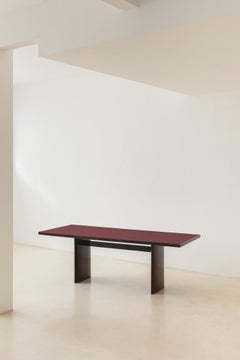
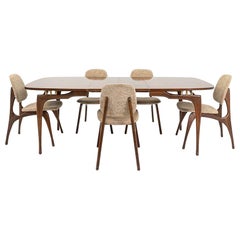
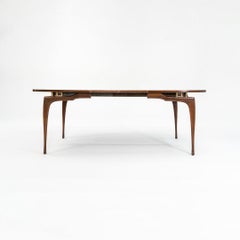
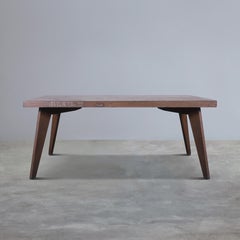
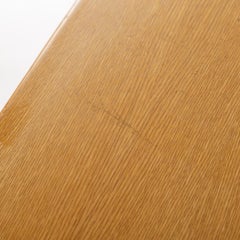
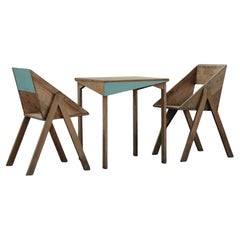
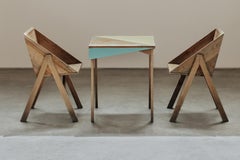
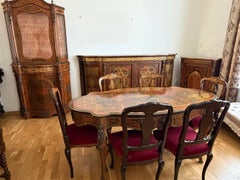
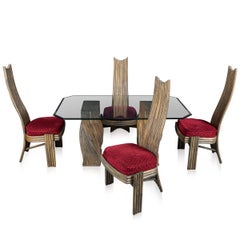
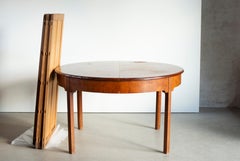
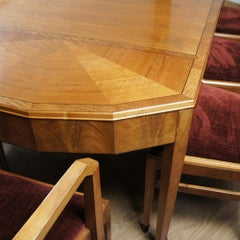
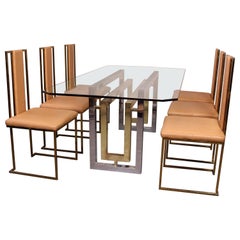
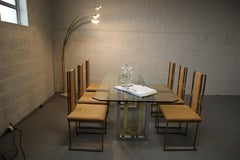
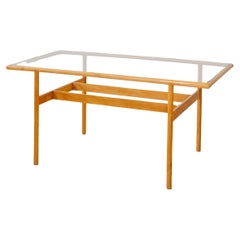
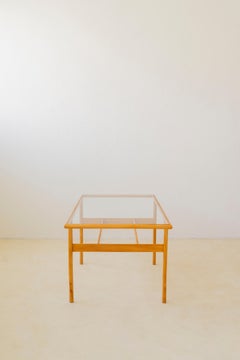
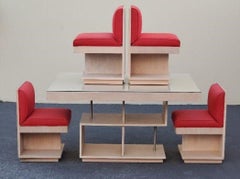
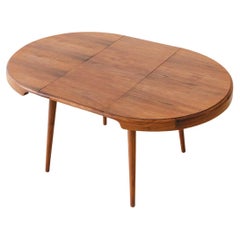
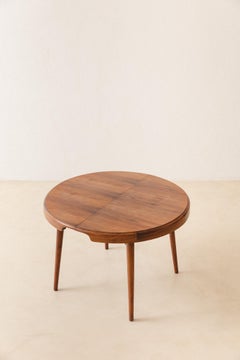
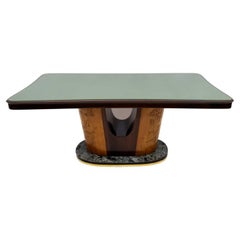
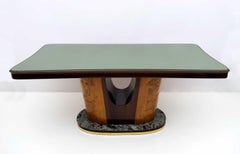
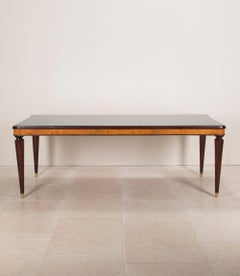
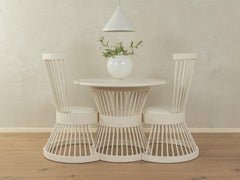
Solid Imbuia with Red Glass Top Dining Table by Joaquim Tenreiro, Brazil C. 1949
By Langbach & Tenreiro, Joaquim Tenreiro
Located in New York, NY
Restored.
Brazilian Mid-Century Modern Vintage 20th Century Dining Room Sets
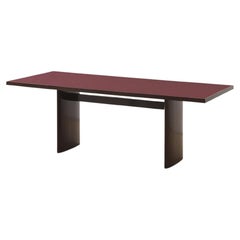
Glass, Imbuia, Wood
Solid Imbuia with Red Glass Top Dining Table by Joaquim Tenreiro, Brazil C. 1949
By Langbach & Tenreiro, Joaquim Tenreiro
Located in New York, NY
Restored.
Glass, Imbuia, Wood
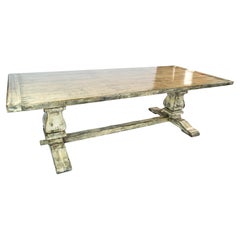
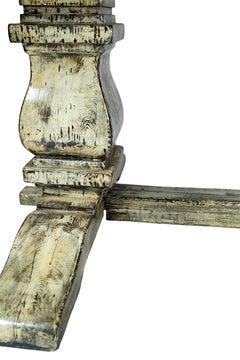
Long Table on Column with original condition & patina from 1920s
Located in Lejre, DK
Originating in China and manufactured around the 1920s, this long columned table is an exquisite example of early 20th century Chinese furniture...
Wood
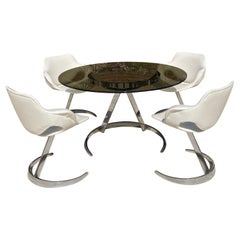
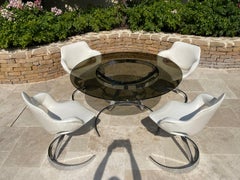
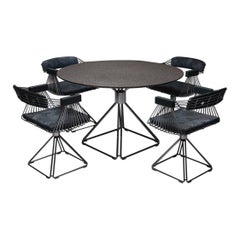
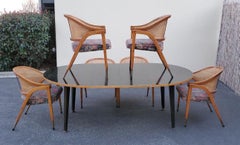
Mid-Century Steel and Glass Dining Set, Table And 4 Chairs, Euro International
Located in Beaune, FR
Mid-Century Steel and Glass Dining Set, Table And 4 Chairs, Euro International Consisting of a round table with stainless steel base and smoked glass top and 4 chairs. Very beautifu...
Stainless Steel
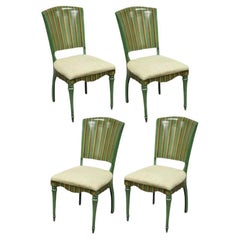
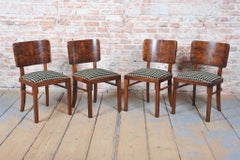
French Country Style Hollywood Regency Green Painted Dining Side Chairs - Set 4
Located in Philadelphia, PA
French Country Style Hollywood Regency Green Painted Dining Side Chairs - Set of 4. Item features a green painted finish with yellow and red stripes, solid wood frames with curved wo...
Fabric, Wood
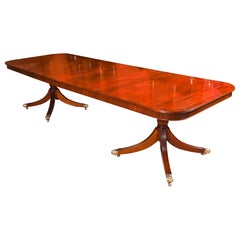
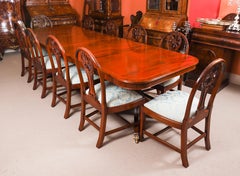
Vintage Regency Revival Twin Pillar Flame Mahogany Dining Table Mid 20th Century
Located in London, GB
This is a fabulous high quality vintage flame mahogany Regency revival twin pillar dining table that can seat 10 people in comfort and dating from mid-20th century. The table is mad...
Mahogany
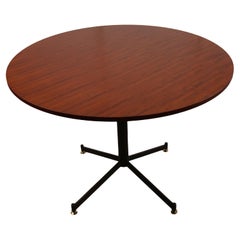
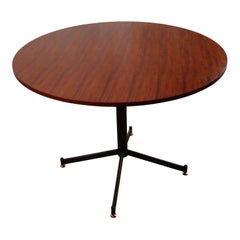
Vittorio Nobili Mid-Century Teak Medea Table, 1956
Located in Vicenza, IT
Medea dining circular table, designed by Vittorio Nobili for Fratelli Tagliabue in 1954. Made of teak iron and brass, excellent vintage condition. Reported at “Compasso d’Oro Prize...
Iron
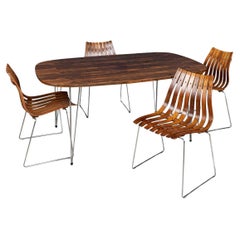
20thC Rosewood Dining Table & Chairs By Hans Brattrud For Hove Mobler, Norway
By Hans Brattrud for Hove Möbler, Hans Battrud, Hove Möbler
Located in Royal Tunbridge Wells, Kent
A rosewood dining table and chairs by Hans Brattrud for Hove Mobler, Norway, 1960s. This stunning set consists of four rosewood 'Scand...
Metal
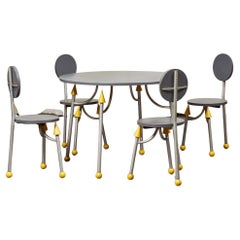
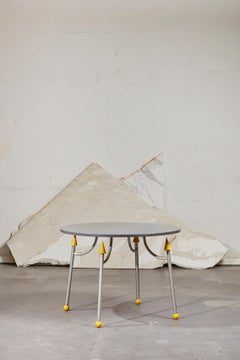
Sculptural set of 8 chairs and table in the manner of Totem
By TOTEM
Located in PARIS, FR
Studio Totem (in the manner of) Set of a table and 8 chairs, Ca. 1983 Made for the Saint-Étienne Cultural Center in France Gray lacquered metal and yellow and gray laminated wood H. ...
Laminate, Wood
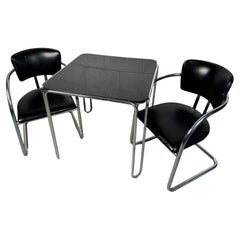
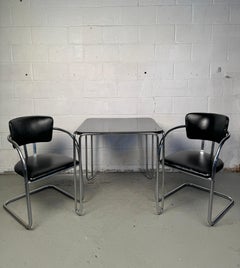
Sleek Bauhaus "B10" Table Set by Marcel Breuer
By Thonet, Chromcraft, Marcel Breuer
Located in Brooklyn, NY
Bring a rare fusion of historic design and modernist elegance into your space with this stunning vintage set. At its heart is the iconic "B10" Table, designed by Marcel Breuer—a pion...
Metal
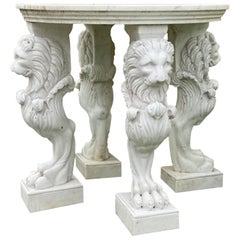
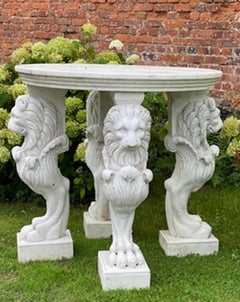
Large and Round Marble Table with Feet in the Shape of Lions, Italy
Located in Brussels, BE
Large and round marble table with feet in the shape of lions, Italy.
Marble
$9,653Sale Price / set|34% Off
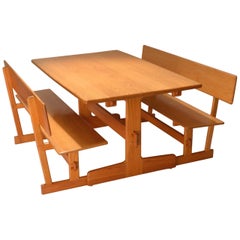
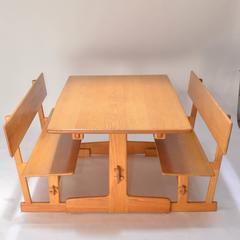
Gerald McCabe Oak Trestle Dining Table and Benches for Orange Crate Modern
By Gerald McCabe, Orange Crate Modern
Located in Los Angeles, CA
This is a beautiful trestle dining table with matching benches by Gerald McCabe for Orange Crate Modern. This table retains its original finish over soli...
Oak
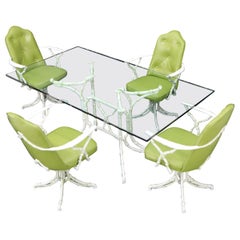
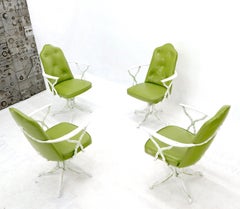
Cast Aluminum Faux Bamboo Dining Table w/ 4 Matching Chairs Outdoors Green Vinyl
By Arthur Court
Located in Rockaway, NJ
Mid-Century Modern quality cast aluminum dining set consisting of 4 chairs and rectangular glass top table. Good quality set. Green vinyl upho...
Aluminum
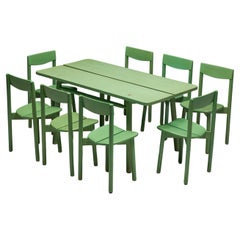
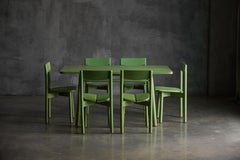
Green "Coffee Bean" Dining Set by Pierre Gautier Delaye, France, 1965
Located in Antwerp, BE
This dining set by Pierre Gautier Delaye, circa 1965, pairs one green beechwood table with eight matching “Coffee Bean” chairs for a striking look. The table’s design features two el...
Wood
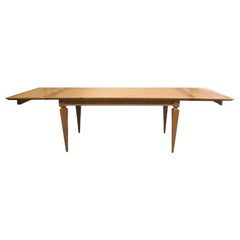
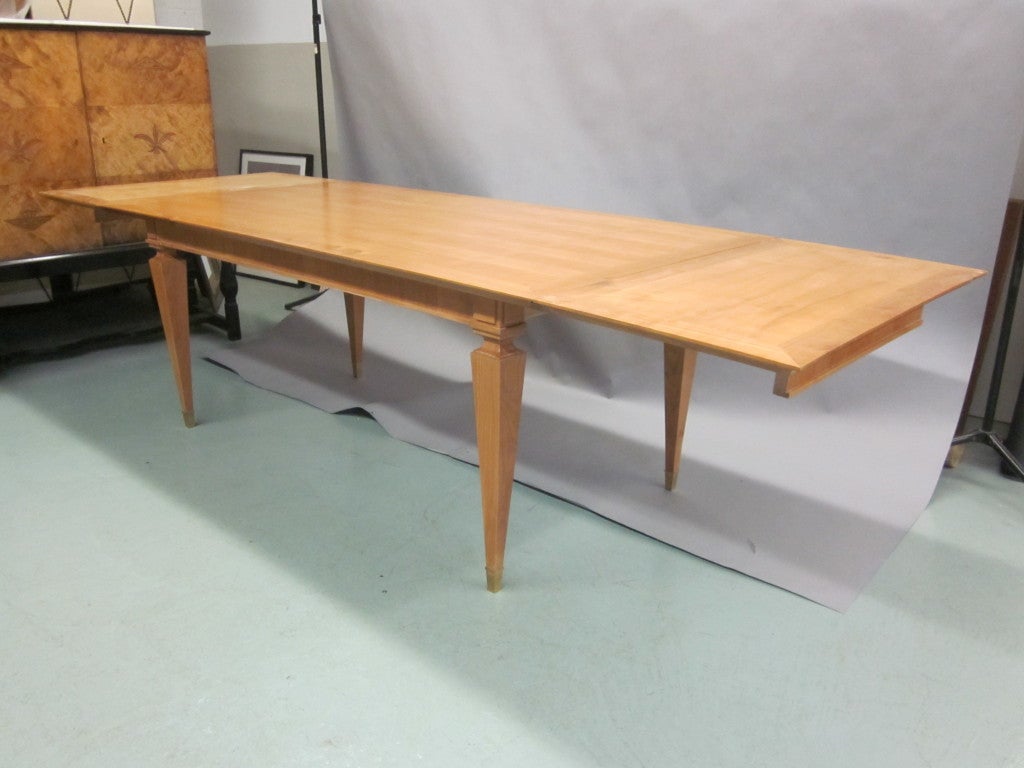
French Mid-Century Modern Neoclassical Dining Table by Andre Arbus, Paris, 1949
By André Arbus
Located in New York, NY
An Elegant And Timeless French Late Art Deco / Modern Neoclassical dining room table in Cherry wood by Andre Arbus. The table without leaves is 72" ...
Brass
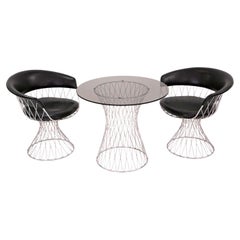
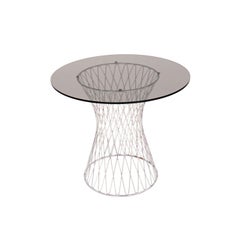
Space Age Chrome Bistro Set with Glass Top Table, Italy, 1970s
Located in Wien, AT
This Space Age bistro set dates from the 1970s and reflects the playful and futuristic design language of the period. The set consists of a round glass-top table and two matching cha...
Chrome
$7,800Sale Price|20% Off
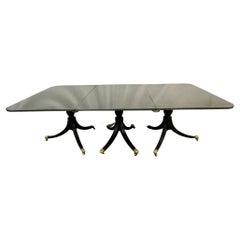
Hollywood Regency Triple Pedestal Ebony Dining Table, Maison Jansen
Located in Stamford, CT
Maison Jansen Style Triple Pedestal Ebony Dining Table. Part of our extensive collection of over forty dining tables and chair sets as seen on this site, thus why we are referred to ...
Brass
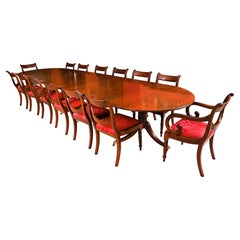
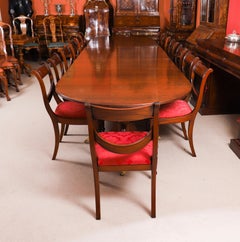
Vintage 15ft Regency Revival 3 pillar dining table & 14 Swagback chairs 20th C
Located in London, GB
This is fabulous Vintage Regency Revival dining set comprising a triple pillar dining table and a superb set of fourteen swag back dining chairs, mid 20th Century in date The tabl...
Mahogany
1950s Bertha Schaefer Walnut Dining Set w/ Table & 5 Chairs
By Bertha Schaefer, M. Singer & Sons
Located in Philadelphia, PA
This is a handsome oiled-walnut dining set designed by Bertha Schaefer for M. Singer & Sons in 1952 and produced in Italy for the Singer Modern collection. The set includes a large o...
Steel
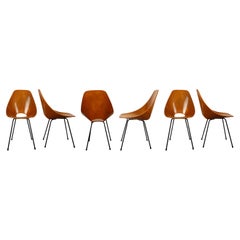
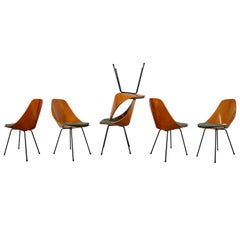
Vittorio Nobili Midcentury Beech Wood Medea Dining Room Chairs, 1956, Set of 6
Located in Vicenza, IT
Set of Six Medea Chairs Designed by Vittorio Nobili for Fratelli Tagliabue, 1956 This set of six Medea dining chairs features: - Elegant beech plywood shell construction - Sculptura...
Iron
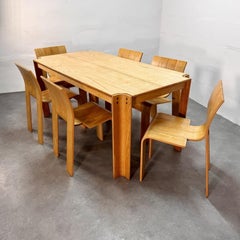
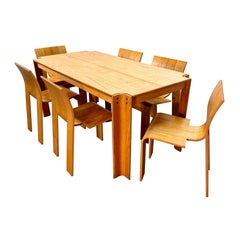
Gijs Bakker 'Strip' Dining Set, Ash Wood, Rectangular Table, 1970
By Gijs Bakker
Located in CASTENRAY, NL
Gijs Bakker is actually best known for his jewelry. This ‘Strip’ table and 6 Chairs is one of the few known pieces of furniture that he designed. Perhaps that is also the reason wh...
Birch
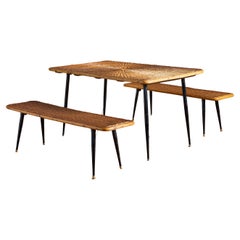
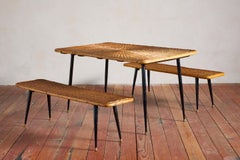
Danny Ho Fong attributed Table & Bench
By Calif-Asia
Located in Beverly Hills, CA
Wonderful wicker Table & Bench Set in the style of Danny Ho Fong Produced by Calif-Asia - 1960's Angled iron legs with intricate weaved patterned top indicative of the quality prod...
Iron
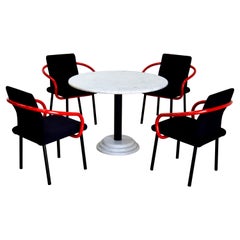
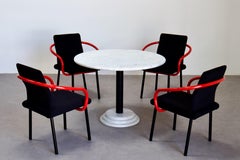
Ettore Sottsass Mandarin Dining Set in Carrara Marble, Red & Black, 1986 Italy
By Ettore Sottsass, Knoll
Located in Grand Cayman, KY
Icon of the Memphis Milano Movement. A set of four Ettore Sottsass Mandarin chairs for Knoll. Black Alcantara upholstery. Arms in red lacquer. Additionally, a Carrara marble round pe...
Metal, Steel
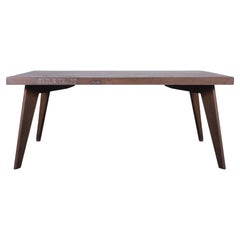
Pierre Jeanneret PJ-TA-01-A Dining Table / Authentic Mid-Century Modern
Located in Zürich, CH
Here we see a decision to project the universal ideals of modernity onto Indian reality. However, this piece was inspired by North Indian culture, as well the cosmic and spiritual I...
Wood
Carlo Scarpa Cognac Leather “Kentucky” Dining Chair for Bernini, 1977, Set of 5
By Carlo Scarpa, Bernini
Located in Vicenza, IT
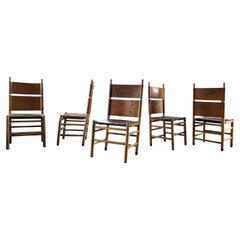
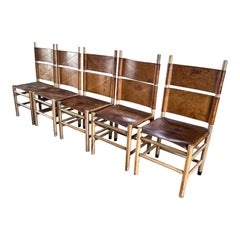
Set of 5 mod. 783 “Kentucky” dining chairs, designed by Carlo Scarpa for the Italian manufacturer Bernini in 1977. Structure made from oak and walnut timber. Seats and backrest made from cognac leather. Excellent vintage condition. Carlo Scarpa designed this chair for the “Scuderia” series., the last project he made for Bernini. The architect took inspiration from the “shaker” movement. He designed the chair slightly inclined at the front. This feature allows you to swing backward (until you lean on a wall) and remain in balance. Born in Venice on June 2nd, 1906, Carlo Scarpa began working at a very early age. A year after he had first qualified as an architect in 1926, he began working for the Murano glassmakers Cappellin & Co. in a consultative capacity. From 1927, Carlo Scarpa began to experiment with the Murano glass, and this research not only gave him excellent results here but would also inform his progress for many years to come. Between 1935 and 1937, as he entered his thirties, Carlo Scarpa accepted his first important commission, the renovation of Venice’s Cà Foscari. He adapted the spaces of this stately University building that stands on the Grand Canal banks, creating rooms for the Dean’s offices and a new hall for academic ceremonies; Mario Sironi and Mario De Luigi were charged with doing the restoration work on the frescos. After 1945, Carlo Scarpa found himself constantly busy with new commissions, including various furnishings and designs for the renovation of Venice’s Hotel Bauer and designing a tall building in Padua and a residential area in Feltre, all worth mentioning. One of his key works, despite its relatively modest diminished proportions, was the [bookshop known as the] Padiglione del Libro, which stands in Venice’s Giardini di Castello and clearly shows Scarpa’s passion for the works of Frank Lloyd Wright. In the years which were to follow, after he had met the American architect, Scarpa repeated similar experiments on other occasions, as can be seen, in particular, in the sketches he drew up in 1953 for villa Zoppas in Conegliano, which show some of his most promising work. However, this work unfortunately never came to fruition. Carlo Scarpa later created three museum layouts to prove pivotal in terms of how twentieth-century museums were set up from then on. Between 1955 and 1957, he completed extension work on Treviso’s Gipsoteca Canoviana [the museum that houses Canova’s sculptures] in Possagno, taking a similar experimental approach to the one he used for the Venezuelan Pavilion at [Venice’s] Giardini di Castello which he was building at the same time (1954-56). In Possagno Carlo Scarpa was to create one of his most significant ever works, which inevitably bears comparison with two other museum layouts that he was working on over the same period, those of: – Galleria Nazionale di Sicilia, housed in the Palazzo Abatellis in Palermo (1953-55) – Castelvecchio in Verona (1957- 1974), all of which were highly acclaimed, adding to his growing fame. Two other buildings, which are beautifully arranged in spatial terms, can be added to this long list of key works that were started and, in some cases, even completed during the nineteen fifties. After winning the Olivetti award for architecture in 1956, Scarpa began work in Venice’s Piazza San Marco on an area destined to house products made by the Industrial manufacturers Ivrea. Over the same period (1959-1963), he also worked on the renovation and restoration of the gardens and ground floor of the Fondazione Querini Stampalia in Venice, which many consider one of his greatest works. While he busied himself working on-site at the Fondazione Querini Stampalia, Carlo Scarpa also began work building a villa in Udine for the Veritti family. To shed some light on the extent to which his work evolved over the years, it may perhaps be useful to compare this work with that of his very last building, villa Ottolenghi Bardolino, which was near to completion at the time of his sudden death in 1978. Upon completion of villa Veritti over the next ten years, without ever letting up on his work on renovation and layouts, Scarpa accepted some highly challenging commissions, working on the Carlo Felice Theatre in Genoa and another theatre in Vicenza. Towards the end of this decade, in 1969, Rina Brion commissioned Carlo Scarpa to build the Brion Mausoleum in San Vito d’Altivole (Treviso), a piece he continued to work on right up until the moment of his death. Nevertheless, even though he was totally absorbed by work on this mausoleum, there are plenty of other episodes which can offer some insight into the final years of his career. As work on the San Vito d’Altivole Mausoleum began to lessen from 1973, Carlo Scarpa started building the new headquarters for the Banca Popolare di Verona. He drew up plans that were surprisingly different from the work he was carrying out at the same time on the villa Ottolenghi. However, the plans Carlo Scarpa drew up, at different times, for a monument in Brescia’s Piazza della Loggia commemorating victims of the terrorist attack on May 28th, 1974, make a sharp contrast to the work he carried out in Verona, almost as if there is a certain hesitation after so many mannered excesses. The same Pietas that informs his designs for the Piazza Della Loggia can also be seen in the presence of the water that flows through the Brion Mausoleum, almost as if to give a concrete manifestation of pity in this twentieth-century work of art. Carlo Scarpa has put together a highly sophisticated collection of structures, occupying the mausoleum’s L-shaped space stretching across both sides of the old San Vito d’Altivole cemetery. A myriad of different forms and an equally large number of different pieces, all of which are separate and yet inextricably linked to form a chain that seems to offer no promise of continuity, rising up out of these are those whose only justification for being there is to bear the warning “si vis vitam, para mortem,” [if you wish to experience life prepare for death] as if to tell a tale that suggests the circle of time, joining together the commemoration of the dead with a celebration of life. At the entrance of the Brion Mausoleum stand the “propylaea” followed by a cloister which ends by a small chapel, with an arcosolium bearing the family sarcophagi, the main pavilion, held in place on broken cast iron supports, stands over a mirror-shaped stretch of water and occupies one end of the family’s burial space. The musical sound of the walkways teamed with the luminosity of these harmoniously blended spaces shows how, in keeping with his strong sense of vision, Carlo Scarpa could make the most of all of his many skills to come up with this truly magnificent space. As well as a great commitment to architectural work, with the many projects which we have already seen punctuating his career, Carlo Scarpa also made many equally important forays into the world of applied arts. Between 1926 and 1931, he worked for the Murano glassmakers Cappellin, later taking what he had learned with him when he went to work for the glassmakers Venini from 1933 until the 1950s. The story of how he came to work on furniture design is different, however, and began with the furniture he designed to replace lost furnishings during his renovation of Cà Foscari. The later mass-produced furniture started differently, given that many pieces were originally one-off designs “made to measure.” Industrial manufacturing using these designs as prototypes came into being thanks to the continuity afforded him by Dino Gavina, who, as well as this, also invited Carlo Scarpa to become president of the company Gavina SpA, later to become SIMON, a company Gavina founded eight years on, in partnership with Maria Simoncini (whose own name accounts for the choice of company name). Carlo Scarpa and Gavina forged a strong bond in 1968 as they began to put various models of his into production for Simon, such as the “Doge” table, which also formed the basis for the “Sarpi” and “Florian” tables. In the early seventies, other tables that followed included “Valmarana,” “Quatour,” and “Orseolo.” While in 1974, they added couch and armchair “Cornaro” to the collection and the “Toledo” bed...
Walnut, Leather, Plastic
Vintage Anglo-Indian Bamboo & Walnut Dining Table With 8 Chairs c1950
Located in Big Flats, NY
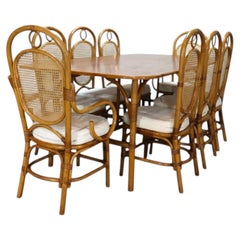
This vintage Anglo-Indian dining set, dating to approximately 1950, features a rectangular table crafted from walnut with a bamboo base, accompanied by eight matching chairs. The cha...
Bamboo
Restored Art Deco Dinig Set, Caucasian Walnut, Thuja, Polished, England, 1920s
Located in Brandys nad Labem, Středočeský kraj
Introducing a truly unique and magnificent British Art Deco dining set from the 1920s, an embodiment of luxury and timeless elegance. This set, meticulously restored to a shellac pol...
Fabric, Upholstery, Walnut, Lacquer, Wood
Thinline Dining Set: Cast Aluminum Table & 6 Chairs, 1960s USA
By Thinline
Located in Ross, CA
Set six chairs and one table made by made in California in the 1960's by Thinline. The cast aluminum set has the original gold paint and original vinyl seat cushions. The set would ...
Aluminum
$3,624Sale Price / set|20% Off
Hansen Sorensen Dining room table with 6 chairs, 1970 Denmark
Located in Oirlo, LI
Hansen Sorensen Dining room table with 6 chairs, 1970 Denmark The Hansen Sorensen dining room table with 6 chairs from 1970 is a beautiful additio...
Fabric, Wood
1970 McGuire Rattan Games Flip Top Extension Dining Table and Four Chairs
By McGuire
Located in Sheridan, CO
McGuire comprising revolving flip top games and dining table with two woven rattan side chairs and two armchairs. Chairs feature McGuire "M" logo inlay in back of each chair seat (se...
Textile, Bamboo, Rattan
Vintage Modernist Table Set From France, Circa 1970
Located in Nashville, TN
Vintage Modernist Table Set From France, Circa 1970. Unusual set in solid pine with nice original paint and use. Chairs measure : H-33 / W-21 / D-22 / S-18.5
Pine
Italian Boulle Style Dining Room Suite, Napoleon III, 5-Piece Set
Located in BŘECLAV, CZ
Exceptional and richly decorated Italian dining room suite in the French Napoleon III style and inspired by the celebrated Boulle tradition. The set is composed of a large dining tab...
Marble, Brass, Bronze
Neoclassical Dining Table and 8 Chairs From Mastercraft
By Mastercraft
Located in North Canton, OH
This set would be virtually impossible to replicate. Gorgeous original Patina in extremely fine condition. One 37" filler has a slightly darker patina from lack of use. Pls refer to ...
Elm
William Doezema for Mastercraft Mid-Century Burl Wood Extension Dining Table Set
By William Doezema, Mastercraft
Located in Brooklyn, NY
An exceptional and highly sought-after Mid-Century Modern dining set designed by William Doezema for Mastercraft, showcasing the luxurious craftsmanship and timeless sophistication t...
Brass
$10,314 / set
Art Deco Black Walnut Dining Suite to Seat Six
Located in Altrincham, GB
Art Deco Black Walnut Dining Suite to Seat 6 - a Double Pedestal Table with Stylistic Shaped Top and 6 Upholstered Chairs with Outswept Legs - Table 72" x 36" x 30.5"h Chairs 19"w x ...
Walnut
20th Century American Dining Table & Four Chairs By McGuire
By McGuire
Located in Royal Tunbridge Wells, Kent
Welcome to the timeless legacy of John and Elinor, the beloved founders of the iconic McGuire Furniture, a San Francisco-based institution that has been synonymous with craftsmanship and creativity since its inception in 1948. As a dynamic couple, their lifelong partnership laid the foundation for the distinctive McGuire style, a harmonious fusion of natural materials such as rattan and hide with the sleek lines inspired by Asian aesthetics. Discover the essence of their visionary work embodied in this exquisite dining table and matching chairs—a testament to their enduring impact on design. Crafted in the latter part of the 20th century, this McGuire dining set showcases the hallmark bamboo frame that is quintessentially McGuire. The table, adorned with a rectangular beveled glass top in pristine condition, stands as a testament to the timeless elegance of McGuire's craftsmanship. The bamboo base boasts a delightful warm hue, effortlessly infusing any modern interior with the inviting, relaxed ambiance reminiscent of California design. Immerse yourself in the classic beauty of McGuire Furniture, where each piece tells a story of innovation, craftsmanship, and the enduring allure of mid-century California style. Some history about the manufacturers: Like so many artists and designers, husband and wife John McGuire (1920–2013) and Elinor Stevenson (1914–2005) became masters in their trade by accident. The couple met just before the start of World War II (during which John was in the U.S. Navy and Elinor was a navigation instructor) and got married after it ended. They settled down in San Francisco where John held a couple of jobs — among them selling newspaper ads for the San Francisco Examiner while Elinor worked for Boeing Aircraft. Soon, an old Navy buddy of John’s asked him to help sell a bunch of rattan furniture and, needing the money, John agreed. His side business became so successful that John decided to quit his ad-sales job and work full-time in design. In 1948, McGuire Furniture Company was born. Alongside themed-century modern furniture designs then gaining popularity in the United States, John introduced an unconventional idea: traditional armchairs, stools and tables made of natural materials such as bamboo, which was strong yet could be rendered pliable when steamed, that were intended for the indoors rather than the front porch. The brand’s first success was the now famous Director’s X-Chair byLeonard Linden. The military-campaign-style solid oak folding chair launched in 1956 and saw rattan binded with rawhide strips and a high-grade leather slug seat and back that eliminated the need for a plush cushion. Elinor, too, designed some of the brand’s popular pieces, such as 1968’s Cracked Ice chair. With its rattan oval back a dazzling celebration of geometric forms that give it its charming moniker, the Cracked Ice chair was an instant classic and is one of the brand’s most recognisable designs. Today, McGuire and another American furniture manufacturer, Baker Furniture Company, comprise Baker Interiors Group. McGuire remains true to the founders’ ideals and commitment to crafting the kind of organic modern furnishings that are synonymous with the warm and relaxed feel of California design. The company has collaborated with interior designersSteven Volpe, Orlando Diaz-Azcuy and Nicole Hollis...
Glass, Fabric, Bamboo
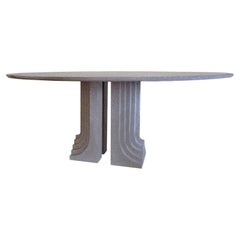
Studio Simon Granite Brutalist Samo Table in the Style of Carlo Scarpa, 1970
Located in Vicenza, IT
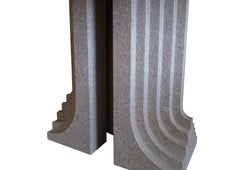
Dining table mod. ‘Samo’ by Studio Simon. Series ‘Ultrarazionale’. Italy, 1970. Made of granite. Literature: Giuliana Gramigna, Repertorio 1950-2000, Allemandi, Torino, 2003, p.180. Excellent vintage condition. The Samo table was designed in 1970 by the project office of Studio Simon. Carlo Scarpa was the brand's artistic director, and the Venetian architect's style inspired the shapes of this table. Born in Venice on June 2nd, 1906, Carlo Scarpa began working at a very early age. Only a year after he had first qualified as an architect in 1926, he began working for the Murano glassmakers Cappellin & Co. in a consultative capacity; from 1927, he began to experiment with the Murano glass, and this research not only gave him excellent results here but would also inform his progress for many years to come. Between 1935 and 1937, as he entered his thirties, Carlo Scarpa accepted his first important commission, the renovation of Venice’s Cà Foscari. He adapted the spaces of this stately University building which stands on the banks of the Grand Canal, creating rooms for the Dean’s offices and a new hall for academic ceremonies; Mario Sironi and Mario De Luigi were charged with doing the restoration work on the frescos. After 1945, Carlo Scarpa found himself constantly busy with new commissions, including various furnishings and designs for the renovation of Venice’s Hotel Bauer and designing a tall building in Padua and a residential area in Feltre, which are all worth mention. One of his key works, despite its relatively modest diminished proportions, was the first of many works which were to follow in the nineteen fifties: the [bookshop known as the] Padiglione del Libro, which stands in Venice’s Giardini di Castello and shows clearly Scarpa’s passion for the works of Frank Lloyd Wright. In the years which were to follow, after he had met the American architect, Scarpa repeated similar experiments on other occasions, as can be seen, in particular, in the sketches he drew up in 1953 for villa Zoppas in Conegliano, which show some of his most promising work. However, this work unfortunately never came to fruition. Carlo Scarpa later created three museum layouts to prove pivotal in terms of how 20th century museums were to be set up from then on. Between 1955 and 1957, he completed extension work on Treviso’s Gipsoteca Canoviana [the museum that houses Canova’s sculptures] in Possagno, taking a similar experimental approach to the one he used for the Venezuelan Pavilion at [Venice’s] Giardini di Castello which he was building at the same time (1954-56). In Possagno Carlo Scarpa was to create one of his greatest ever works, which inevitably bears comparison with two other museum layouts that he was working on over the same period, those of the Galleria Nazionale di Sicilia, housed in the Palazzo Abatellis in Palermo (1953-55) and at the Castelvecchio in Verona (1957- 1974), all of which were highly acclaimed, adding to his growing fame. Two other buildings, which are beautifully arranged in spatial terms, can be added to this long list of key works that were started and, in some cases, even completed during the nineteen fifties. After winning the Olivetti award for architecture in 1956, Scarpa began work in Venice’s Piazza San Marco on an area destined to house products made by the Industrial manufacturers Ivrea. Over the same period (1959-1963), he also worked on renovation and restoration of the gardens and ground floor of the Fondazione Querini Stampalia in Venice, which many consider being one of his greatest works. While he busied himself working on-site at the Fondazione Querini Stampalia, Carlo Scarpa also began work building a villa in Udine for the Veritti family. To shed some light on the extent to which his work evolved over the years, it may perhaps be useful to compare this work with that of his very last building, villa Ottolenghi Bardolino, which was near to completion at the time of his sudden death in 1978. Upon completion of villa Veritti over the next ten years, without ever letting up on his work on renovation and layouts, Scarpa accepted some highly challenging commissions which were to make the most of his formal skills, working on the Carlo Felice Theatre in Genoa as well as another theatre in Vicenza. Towards the end of this decade, in 1969, Rina Brion commissioned Carlo Scarpa to build the Brion Mausoleum in San Vito d’Altivole (Treviso), a piece he continued to work on right up until the moment of his death. Nevertheless, even though he was totally absorbed by work on this mausoleum, there are plenty of other episodes which can offer some insight into the final years of his career. As work on the San Vito d’Altivole Mausoleum began to lessen from 1973, Carlo Scarpa began work building the new headquarters for the Banca Popolare di Verona. He drew up plans that were surprisingly different from the work he was carrying out at the same time on the villa Ottolenghi. However, the plans Carlo Scarpa drew up, at different times, for a monument in Brescia’s Piazza della Loggia commemorating victims of the terrorist attack on May 28th, 1974, make a sharp contrast to the work he carried out in Verona, almost as if there is a certain hesitation after so many mannered excesses. The same Pietas that informs his designs for the Piazza Della Loggia can also be seen in the presence of the water that flows through the Brion Mausoleum, almost as if to give a concrete manifestation of pity in this 20th century work of art. Carlo Scarpa has put together a highly sophisticated collection of structures, occupying the mausoleum’s L-shaped space stretching across both sides of the old San Vito d’Altivole cemetery. A myriad of different forms and an equally large number of different pieces, all of which are separate and yet inextricably linked to form a chain that seems to offer no promise of continuity, rising up out of these are those whose only justification for being there is to bear the warning “si vis vitam, para mortem”, [if you wish to experience life prepare for death] as if to tell a tale that suggests the circle of time, joining together the commemoration of the dead with a celebration of life. At the entrance of the Brion Mausoleum stand the “propylaea” followed by a cloister which ends by a small chapel, with an arcosolium bearing the family sarcophagi, the main pavilion, held in place on broken cast iron supports, stands over a mirror-shaped stretch of water and occupies one end of the family’s burial space. The musical sound of the walkways teamed with the luminosity of these harmoniously blended spaces shows how, in keeping with his strong sense of vision, Carlo Scarpa could make the most of all of his many skills to come up with this truly magnificent space. As well as a great commitment to architectural work, with the many projects which we have already seen punctuating his career, Carlo Scarpa also made many equally important forays into the world of applied arts. Between 1926 and 1931, he worked for the Murano glassmakers Cappellin, later taking what he had learned with him when he went to work for the glassmakers Venini from 1933 until the 1950s. The story of how he came to work on furniture design is different, however, and began with the furniture he designed to replace lost furnishings during his renovation of Cà Foscari. The later mass-produced furniture started differently, given that many pieces were originally one-off designs “made to measure”. Industrial manufacturing using these designs as prototypes came into being thanks to the continuity afforded him by Dino Gavina, who, as well as this, also invited Carlo Scarpa to become president of the company Gavina SpA, later to become SIMON, a company Gavina founded 8 years on, in partnership with Maria Simoncini (whose own name accounts for the choice of company name). Carlo Scarpa and Gavina forged a strong bond in 1968 as they began to put various models of his into production for Simon, such as the “Doge” table, which also formed the basis for the “Sarpi” and “Florian” tables. In the early seventies, other tables that followed included “Valmarana”, “Quatour” and “Orseolo”. While in 1974, they added couch and armchair “Cornaro” to the collection and the “Toledo” bed...
Granite
Kaare Klint Dinning Table for Rud. Rasmussen
Located in Copenhagen, DK
Kaare Klint dinning table in mahogany. Executed by Rud. Rasmussen. Underside with manufacturer's paper label RUD. RASMUSSENS/SNEDKERIER/45 NØRREBROGAD/KØBENHAVN, pencilled serial nu...
Mahogany
Set of Six Arne Hovmand Olsen Dining Chairs in Teak
Located in Berkeley, CA
Origin: Denmark Designer: Arne Hovmand Olsen Manufacturer: Onsild Møbelfabrik Era: 1958 Materials: Teak Measurements: 19″ wide x 20″ deep x 33.75″ tall, Seat: 18"
Teak
An Art Deco Eight Seater Dining Suite by Heal's of London
Located in Forest Row, East Sussex
An Art Deco Eight Seater extendable dining suite by Heal's of London. Burr and figured walnut dining table with ebonised inlay and original heal's stamp. Six dining chairs and two ca...
Walnut
$2,918Sale Price / set|20% Off
Italian leather, brass and glass dining set by Renato Zevi, 1970's
By Zevi & C., Renato Zevi
Located in Langemark-Poelkapelle, BE
1970's Italian dining set by Renato Zevi! Dining table in chrome and brass, very thick glass top. Six brass dining chairs upholstered in soft supple Italian leather. Stamped with th...
Brass, Chrome
Solid Pau Marfim Wood Estrutural Table by Joaquim Tenreiro, Brazilian Design
Located in New York, NY
Restored
Glass, Wood
Extension Table & 6 Matching Chairs, Harry Østergaard, Randers, Denmark, 1960's
Located in Deland, FL
Introducing a rare matching dining set (one extension dining table and six matching Model 58 dining chairs) designed by the influential Harry Østergaard for Randers Møbelfabrik. Craf...
Teak
1940s Maximilian For Karp Dining Set Table And 4 Dining Chairs Mid Century
Located in Monrovia, CA
Designed In The 1940s Maximilian Karp Dining Set, The Dining Table Also Has A Glass Top With 4 Upholstered Dining Chairs. This Is A 1940s Five Piece Dining Set...
Upholstery, Glass, Wood
$26,885 / set
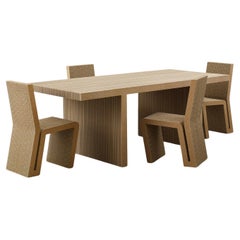
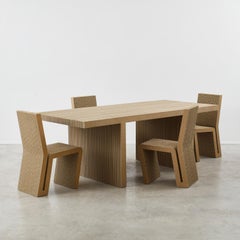
Frank Gehry 1970s cardboard dining set for Vitra.
By Frank Gehry, Vitra
Located in London, GB
TABLE: Frank Gehry, the ‘gratuitously eccentric’ architect behind the Guggenheim Bilbao gained attention in the 1970s with his ‘Easy Edges’ furniture series (1969-73). Constructed i...
Paper
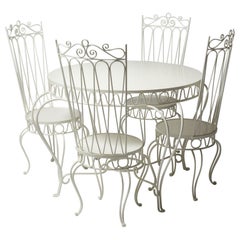
1950s Garden Furniture Including a Table and Four Chairs
Located in Paris, FR
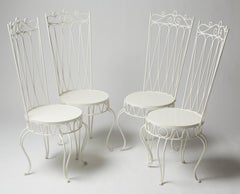
Garden furniture including a large round table and four chairs, white lacquered wrought iron structure, circa 1950. Measures: Table diameter 39.37 in Table height 29.92 in.
Wrought Iron
Giorgio Collection Huge Extending Burr Satinwood Dining Table Suite
Located in West Sussex, Pulborough
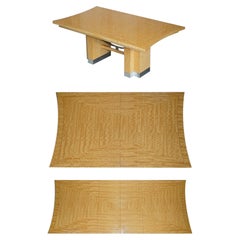
We are delighted to offer this very fine original RRP £12,000 extra large Burr Satinwood Giorgio Collection extending dining table This piece is part of a monumental £50,000+ dining room suite which includes the extra large extending table...
Satinwood
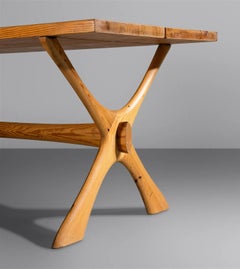
Scandinavian Table and Bench Set
Located in New York, NY
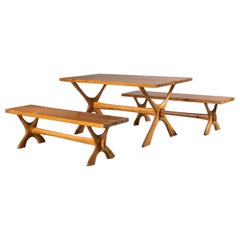
Scandinavian Table and Bench set. The set is solid elm with an X stretcher base. Dining Room Set. Benches measures: 16.75H x 59W x 14.5D. Table Measures: 2...
Elm
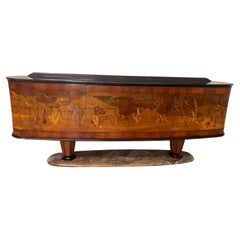
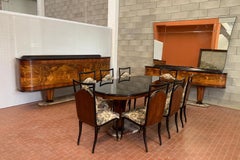
Inlaid Salon Set by Dassi Mobili Moderni, 1950s, Set of 12
Located in Montelabbate, PU
Inlaid Salon Set by Vittorio Dassi and Piero Del Grande for Dassi Mobili Moderni, 1950s – Set of 12 An exceptional and extremely rare salon set design...
Rosewood
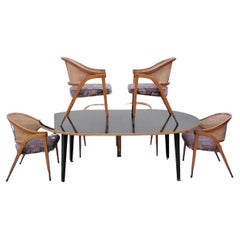
1950s Edward Wormley for Dunbar Extension Dining Set 6 Chairs 2 Leaves
Located in Monrovia, CA
1950s Dunbar, designer Edward Wormley extention dining table with 2 leaves model 5462 with 6 chairs model 5480. Rare Mid-Century Modern 1950s Edward Wormley extension dining table...
Upholstery, Cane, Wood
Restored Art Deco Dining Set, Beech, Spruce, Walnut Veneer, Czech, 1920s
Located in Brandys nad Labem, Středočeský kraj
Chair dimensions: Height: 78 cm / 30.71″ Width: 40 cm / 15.75″ Depth: 47 cm / 18.5″ Seat height: 44 cm / 17.32″ Table dimensions: Height: 80 cm / 31.5″ Width: 83.5 cm / 32.87″ Depth...
Fabric, Upholstery, Wood, Beech, Walnut, Spruce, Lacquer
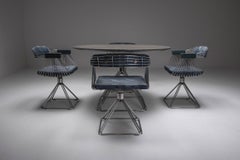
Mid-Century Modern Novalux Dining Set by Rudi Verelst, Belgium, 1970s
By Rudi Verelst
Located in Antwerp, BE
Extraordinary dining set created by Rudi Verelst for Novalux in 1970s Belgium. The set features swivel dining chairs crafted from gleaming chromed steel wire, elegantly complemented ...
Chrome
Expandable Dining Table in Caviuna by Carlo Hauner and Martin Eisler, circa 1955
By Carlo Hauner and Martin Eisler, Carlo Hauner, Martin Eisler
Located in New York, NY
Carlo Hauner and Martin Eisler are most known for well-shaped armchairs made in iron, but the production is far more complex, handcrafted, and extensive. The wood pieces produced by ...
Wood
Ercol Vintage Mid Century Solid Elm Drop Leaf Table & Dining Chair Set PG185A
Located in Nottingham, GB
A beautifully preserved Ercol dining set featuring a rare drop-leaf table design paired with four classic stickback chairs, showcasing the timeless craftsmanship and quality material...
Wood
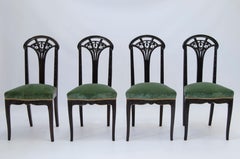
Art Nouveau Dining Set by Louis Majorelle, Walnut & Marble, c. 1905
Located in Ciudad Autónoma Buenos Aires, C
An Art Nouveau set consisting of a wooden table with a Violet d'Afyon marble top, two open-sided armchairs, and four chairs, model "AUX CLEMATITES," all with carved and openwork deco...
Breccia Marble
$7,907 / set
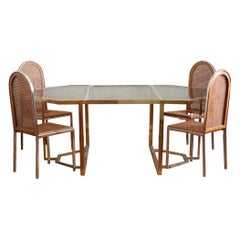
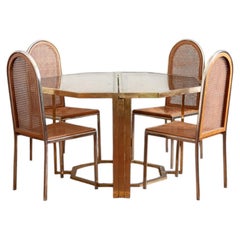
Glass and Brass Dining Set – 1970s
Located in Roma, RM
Glass and Brass Dining Set – 1970s Set comprising an extendable table with brass structure and smoked glass top, together with four chairs featuring a chromed metal structure and sea...
Brass
$4,606Sale Price|30% Off
Vittorio Dassi Iconic Design Mid-Century Modern Italian Dining Table, 1950s
Located in Puglia, Puglia
Beautiful table designed by the famous Italian Mid-Century Modern designer Vittorio Dassi, 1950. The exceptional woodwork is highlighted by the curved green glass top and the rounded...
Marble
Art Deco Paul Frankl for Johnson Furniture Mahogany and Cork Dining 9 Piece Set
By Paul Frankl, Johnson Furniture Co.
Located in Chicago, IL
Art Deco Paul Frankl for Johnson Furniture mahogany and cork dining set - 9 piece set. An exquisite, iconic and truly timeless and unparalleled classic dining set...
Fabric, Mahogany, Cork
$4,765Sale Price / set|30% Off
Vintage Art Deco Burr Walnut Ornately Carved Dining Table and 6 Dining Chairs
Located in West Sussex, Pulborough
We are delighted to offer for sale this exquisite heavily carved Art Deco Burr Walnut dining table with six sculptural dining chairs A beautiful example of this kind of work, the ...
Walnut
$13,202 / set
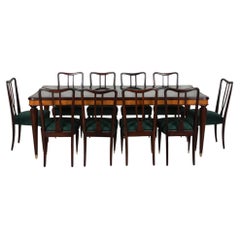
Large Mid-Century Italian Dining Suite
Located in Gloucestershire, GB
Large Mid-Century Italian ten-seater dining set with dark green reverse-lacquered glass table top. Chairs are newly upholstered in matching green velvet. 3 Details Table and cha...
Velvet, Glass, Wood
$6,000 / set
1970s Furniture suite, Horst Romanus Wanke
Located in Neuss, NW
Rare furniture suite by Horst Romanus Wanke from the 1970s consisting of two chairs and a table. High-quality solid beech wood frame and table top lacquered in white. The chairs have...
Beech