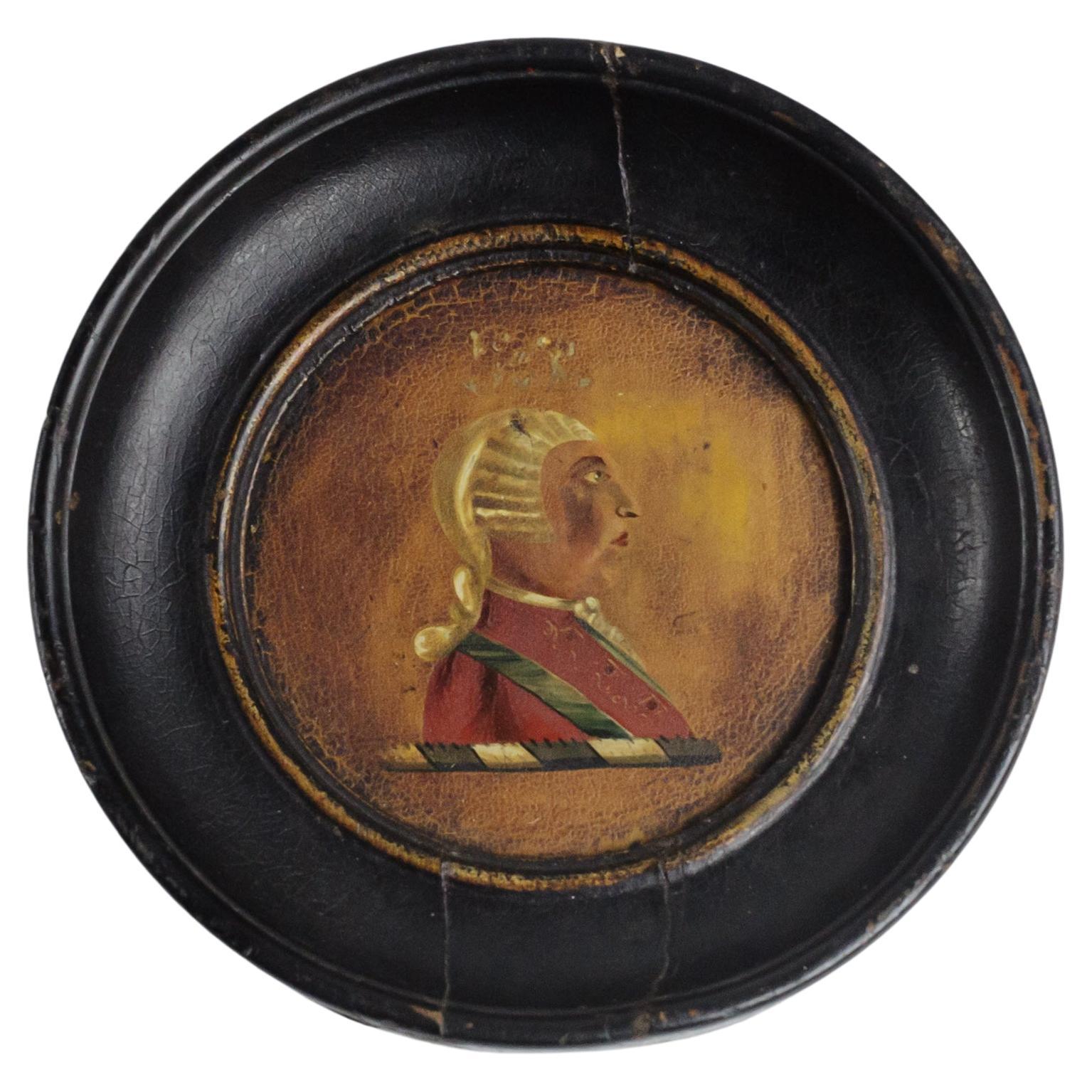
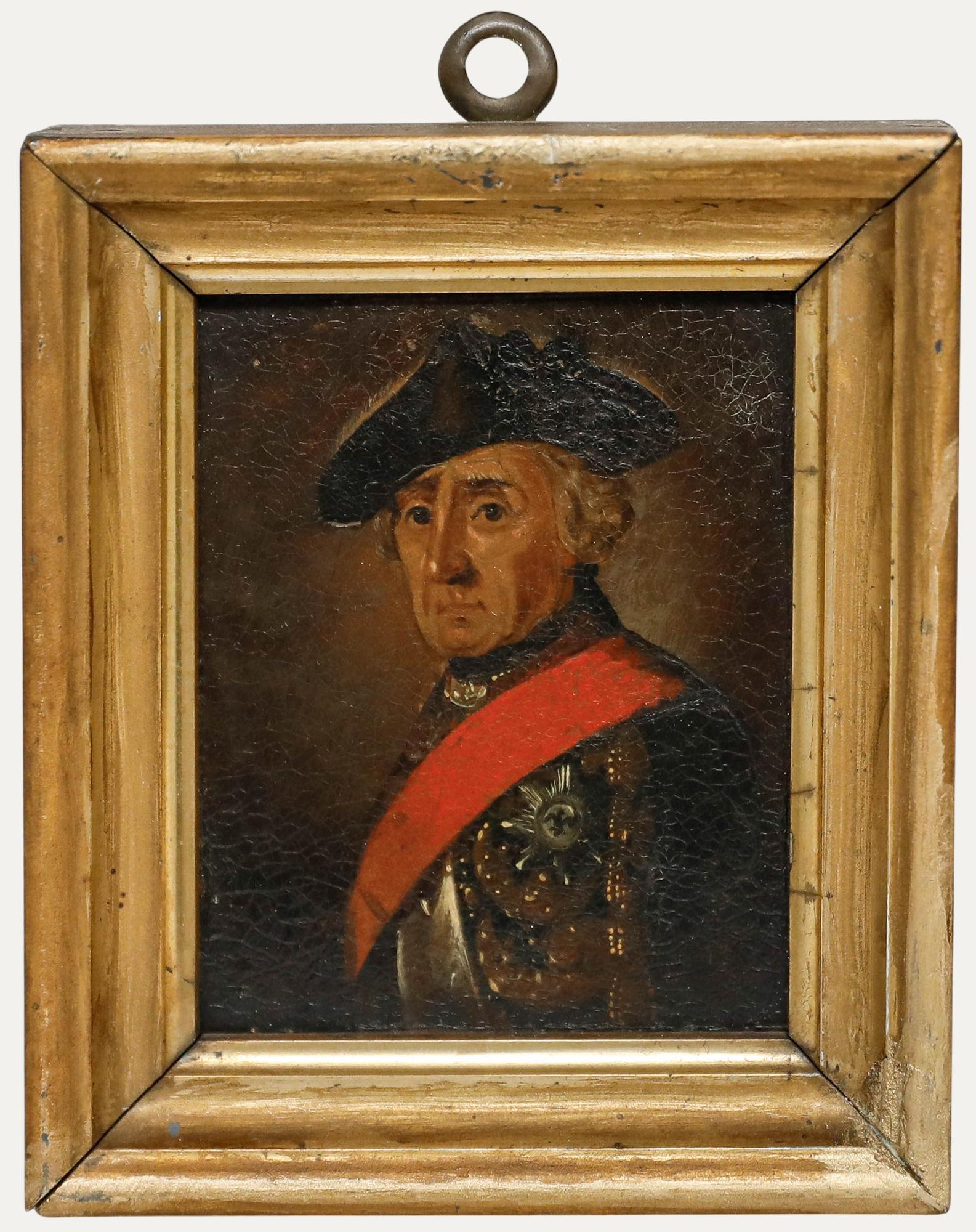
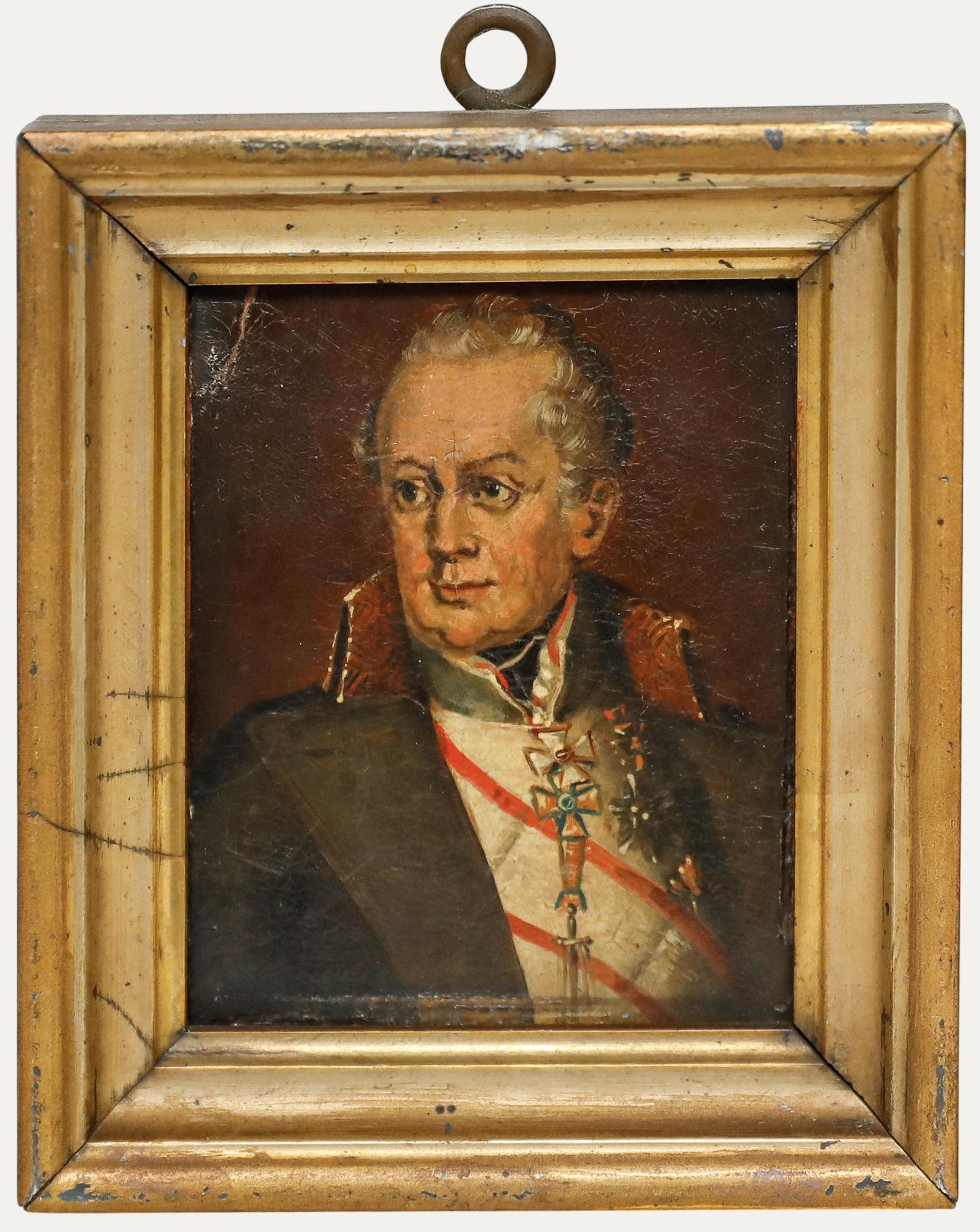
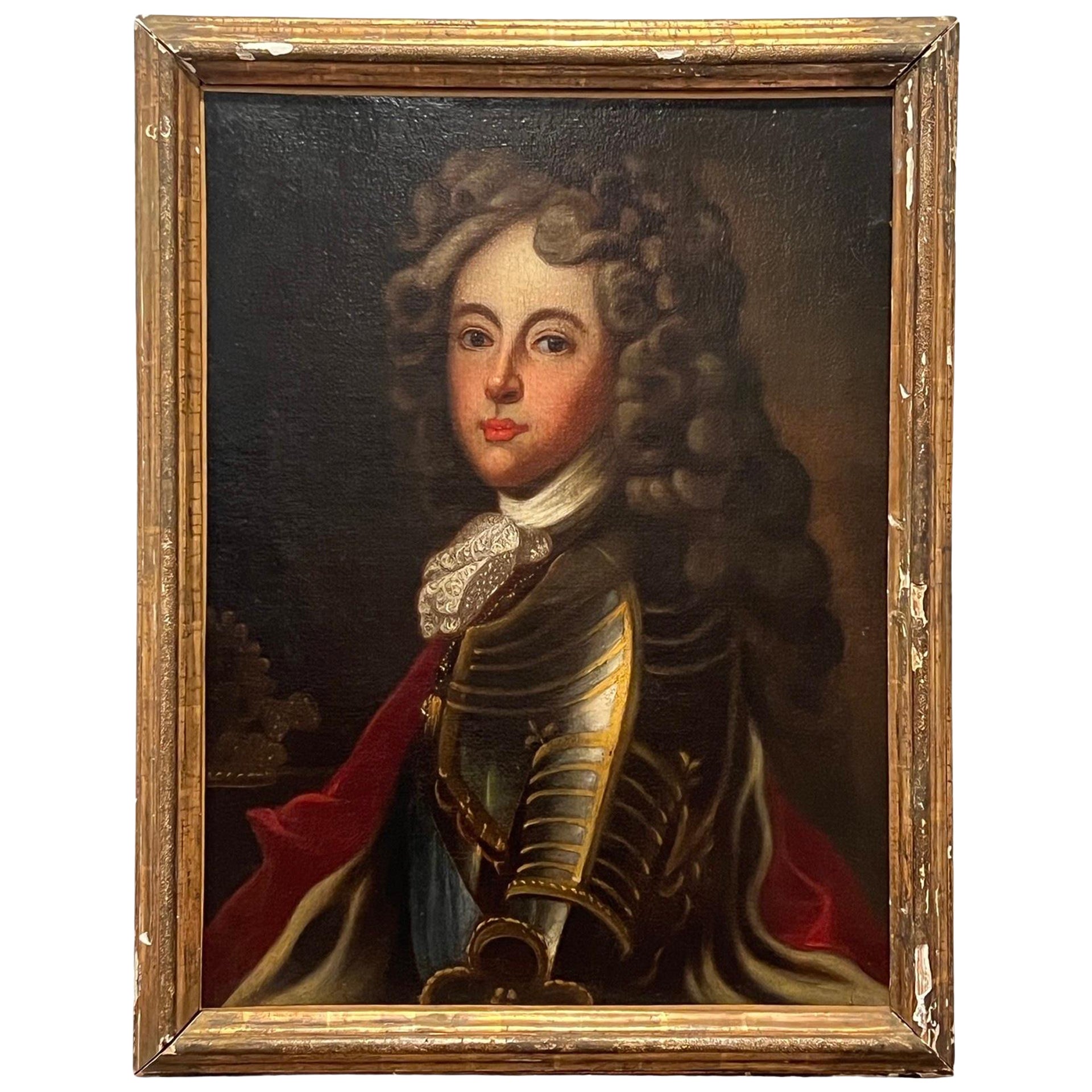
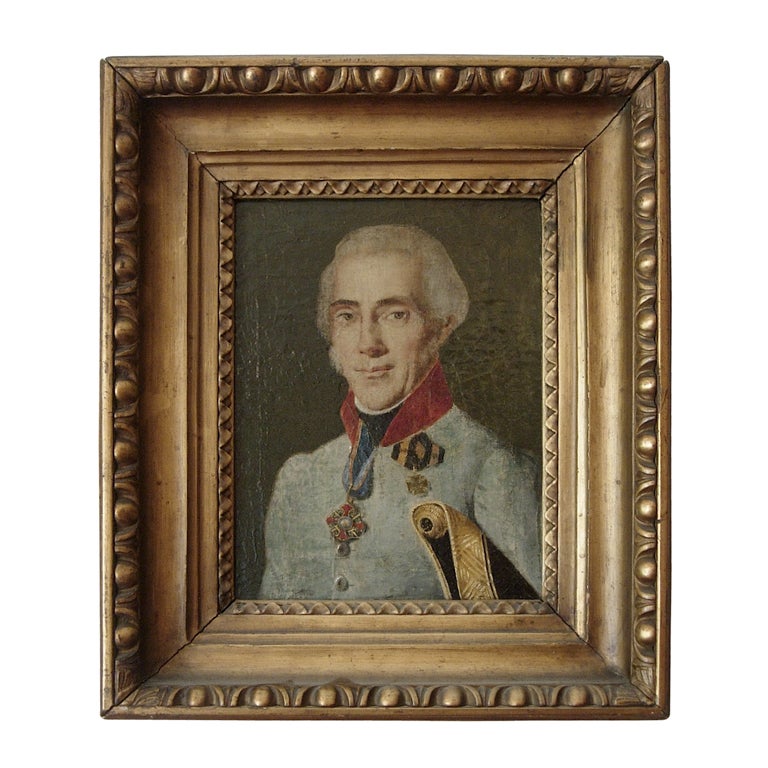
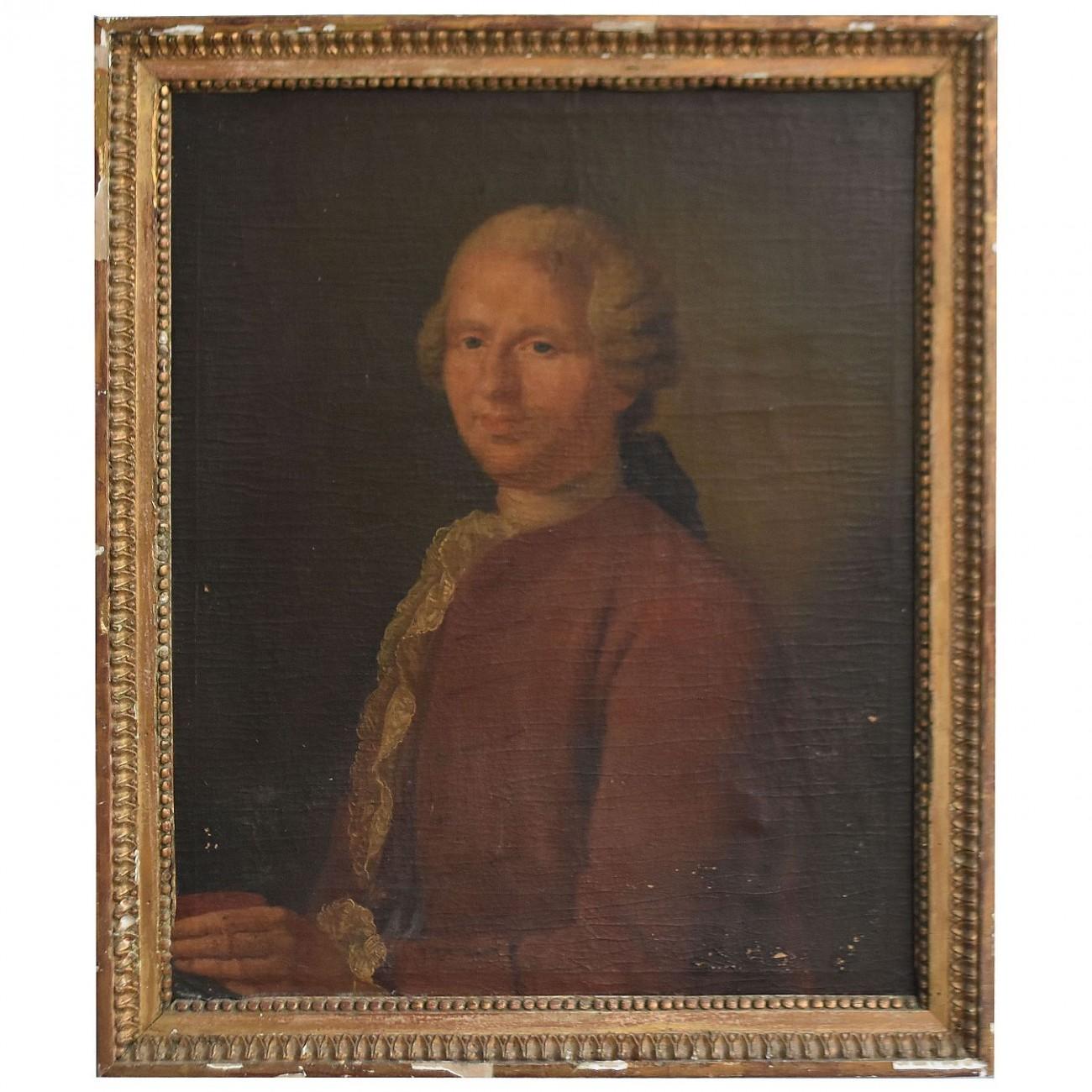
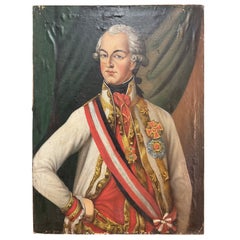
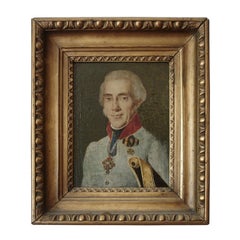
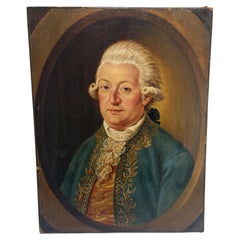
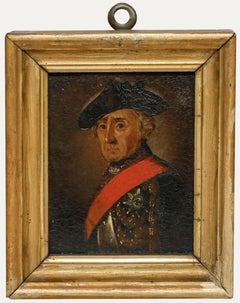
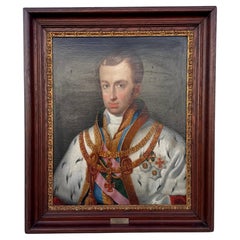
Habsburg Dynasty, early to mid-19th Century oil on board, Royal / Monarchy Portrait painting of Ferdinand I, Austria (1793-1875) in original handmade frame. A seated Ferdinand is wearing his ceremonial white fur robe, adored with gold embroidered trim. Hanging around his neck are the gold Collar and Badges of a Knight of the Spanish Order or "Distinguished Order of the Golden Fleece" , plus the Order of Saint Stephen of Hungary. Also displaying embodied ancient symbols of rank, family, and authority. Such as the green and pink sash, his Austrian Imperial order of Leopold medal, Military Order of Christ medal among others. See his full list of honours below. Paper label on frame translates to: Modeler and Gilder, Master Cabinetmaker VIENNA Vº2, Hicschengasse No. 14. Also, appears to have an Austrian Stamp, possibly for export and the numbers 99 or 66, along with No. 1445 and Ferdinand I, and the years he ruled 1838-1848 in pencil. No signature found.
(Art) Board size is 28.25" h x 23.63" w
Attributed to Leopold Kupelwieser (17 October 1796, Markt Piesting – 17 November 1862, Vienna) was an Austrian painter, often associated with the Nazarene movement, who also painted Ferdinand I portrait in 1847.
Ferdinand I (German: Ferdinand I. 19 April 1793 – 29 June 1875) was Emperor of Austria from March 1835 until his abdication in December 1848. He was also King of Hungary, Croatia, and Bohemia (as Ferdinand V), King of Lombardy–Venetia and holder of other lesser titles (see grand title of the Emperor of Austria). Due to his passive but well-intentioned character, he gained the sobriquet The Benign (German: Der Gütige) or The Benevolent (Czech: Ferdinand Dobrotivý, Polish: Ferdynand Dobrotliwy)
Ferdinand succeeded his father Francis I upon his death on 2 March 1835. He was incapable of ruling the empire because of severe epilepsy, so his father, before he died, made a will promulgating that Ferdinand should consult his uncle Archduke Louis on all aspects of internal policy and urged him to be influenced by Prince Metternich, Austria's Foreign Minister.[3]
Following the Revolutions of 1848, Ferdinand abdicated on 2 December 1848. He was succeeded by his nephew, Franz Joseph. Following his abdication, he lived in Hradčany Palace, Prague, until his death in 1875.
Ferdinand married Maria Anna of Savoy, the sixth child of Victor Emmanuel I of Sardinia. They had no children.
EARLY LIFE:
Ferdinand was the eldest son of Francis II, Holy Roman Emperor and Maria Theresa of Naples and Sicily. Possibly as a result of his parents' genetic closeness (they were double first cousins), Ferdinand had hydrocephalus, neurological problems including epilepsy, and a speech impediment. He was educated by Baron Josef Kalasanz von Erberg, and his wife Countess Josephine von Attems
Although Ferdinand has been depicted as feeble-minded and incapable of ruling, he kept a coherent and legible diary and has even been said to have had a sharp wit. However, suffering as many as twenty seizures per day severely restricted his ability to rule with any effectiveness. Though he was not declared incapacitated, a Regent's Council (Archduke Louis, Count Kolowrat, and Prince Metternich) steered the government.
When Ferdinand married Princess Maria Anna of Savoy, the court physician considered it unlikely that he would be able to consummate the marriage.[6] When he tried to consummate the marriage, he had five seizures. He is also remembered for his command to his cook: when told he could not have apricot dumplings (Marillenknödel) because apricots were out of season, he said "I am the Emperor, and I want dumplings!" (German: Ich bin der Kaiser und ich will Knödel!)
Ferdinand was the last King of Bohemia to be crowned as such. Due to his sympathy with Bohemia (where he spent the rest of his life in Prague Castle) he was given the Czech nickname "Ferdinand V, the Good" (Ferdinand Dobrotivý). In Austria, Ferdinand was similarly nicknamed "Ferdinand der Gütige" (Ferdinand the Benign), but also ridiculed as "Gütinand der Fertige" (Goodinand the Finished).
Ferdinand was also the last ruler to be crowned with the Iron Crown of Lombardy in his capacity as King of Lombardy-Venetia.
He is interred in tomb number 62 in the Imperial Crypt in Vienna.
The Habsburg era (c. 1273–1918) was a dominant period in European history defined by a powerful German noble dynasty that ruled Austria, the Holy Roman Empire, Spain, and other territories for centuries. Known for strategic marriage diplomacy and Catholic patronage, the dynasty, featuring key figures like Charles V and Maria Theresa, shaped European politics and culture until the empire collapsed after World War I.
Honours
Austrian Empire
Knight of the Golden Fleece, 1793
Grand Cross of the Royal Hungarian Order of St. Stephen, 1830
Grand Cross of the Imperial Order of Leopold
Knight of the Iron Crown, 1st Class
France:
French Empire: Grand Eagle of the Legion of Honour
Kingdom of France: Knight of the Holy Spirit, 1816
Kingdom of Bavaria: Knight of St. Hubert, 1824
Duchy of Parma: Senator Grand Cross of the Constantinian Order of St. George, with Collar, 1826
Grand Duchy of Hesse: Grand Cross of the Ludwig Order, 11 April 1830
Hesse Electorate of Hesse: Grand Cross of the Golden Lion, 26 December 1830
Baden:
Grand Cross of the House Order of Fidelity, 1830
Grand Cross of the Zähringer Lion, 1830
Kingdom of Saxony: Knight of the Rue Crown, 1830
Two Sicilies:
Knight of St. Januarius, 1830
Grand Cross of St. Ferdinand and Merit
Württemberg: Knight of the Golden Eagle, 1830
Kingdom of Sardinia: Knight of the Annunciation, 12 January 1831
Kingdom of Prussia: Knight of the Black Eagle, 24 January 1831
Denmark: Knight of the Elephant, 1 February 1831
Empire of Brazil: Grand Cross of the Southern Cross
Kingdom of Portugal:
Grand Cross of the Royal Military Order of Our Lord Jesus Christ
Grand Cross of the Tower and Sword
Russian Empire: Knight of St. Andrew, 28 February 1835
Saxe-Weimar-Eisenach: Grand Cross of the White Falcon, 2 April 1835
Sweden Sweden-Norway: Knight of the Seraphim, 14 April 1835
Saxe-Coburg and Gotha Duchy of Saxe-Altenburg Saxe-Meiningen Ernestine duchies: Grand Cross of the Saxe-Ernestine House Order, May 1835
Ascanian duchies: Grand Cross of Albert the Bear, 18 March 1837
Kingdom of Hanover:
Knight of St. George, 1847
Grand Cross of the Royal Guelphic Order, 1847
Spain: Grand Cross of the Order of Charles III, 23 April 1849
Tuscany Grand Duchy of Tuscany: Grand Cross of St. Joseph
Keywords : Royal Oil Portrait , Military Oil Portrait
Category
Antique Mid-19th Century Austrian Empire Paintings