Want more images or videos?
Request additional images or videos from the seller
1 of 13

Antique Louvre Sculptures & Institut Ceiling Ornament Prints – Baltard 1803

$1,401.10per set
£1,037.06per set
€1,190per setVAT Included
CA$1,951.93per set
A$1,985.30per set
CHF 1,135.23per set
MX$24,013.78per set
NOK 13,301.06per set
SEK 13,297.86per set
DKK 9,073.85per set

About the Item

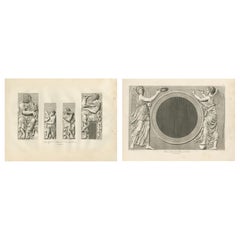
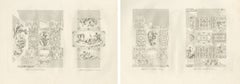
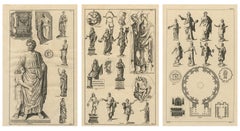
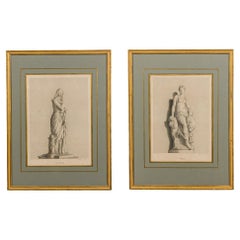
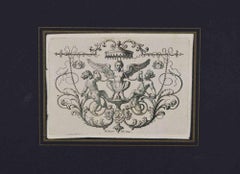
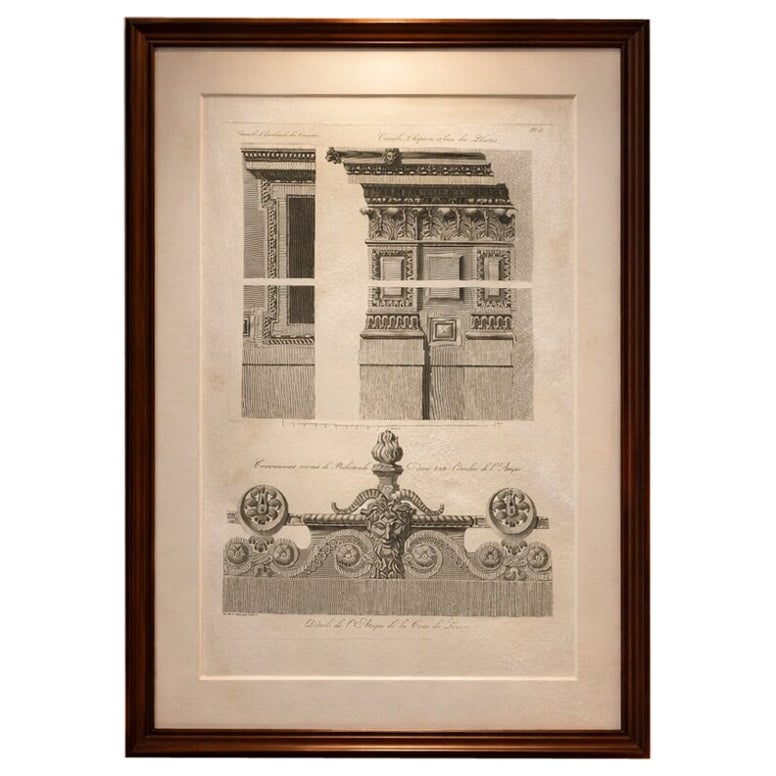
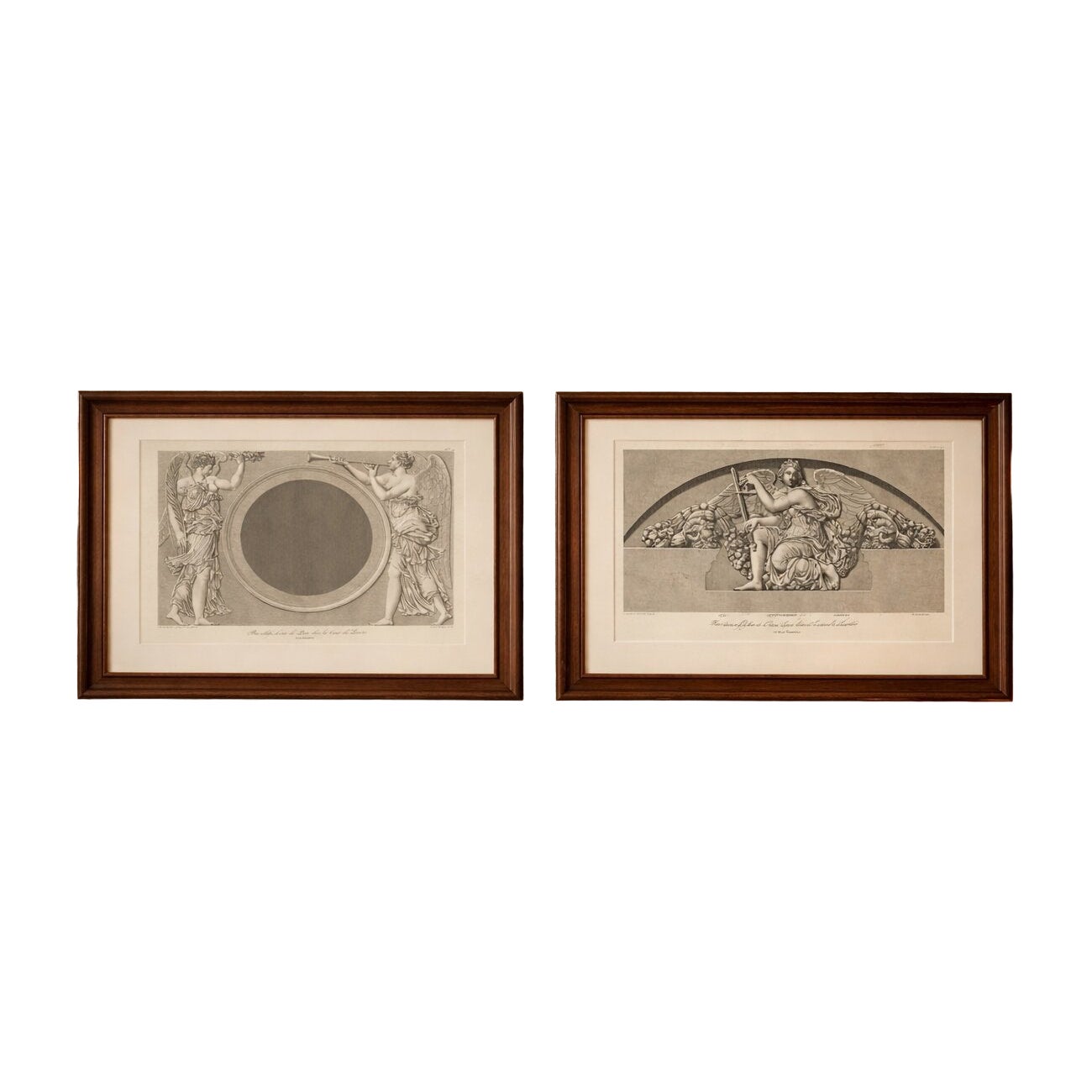
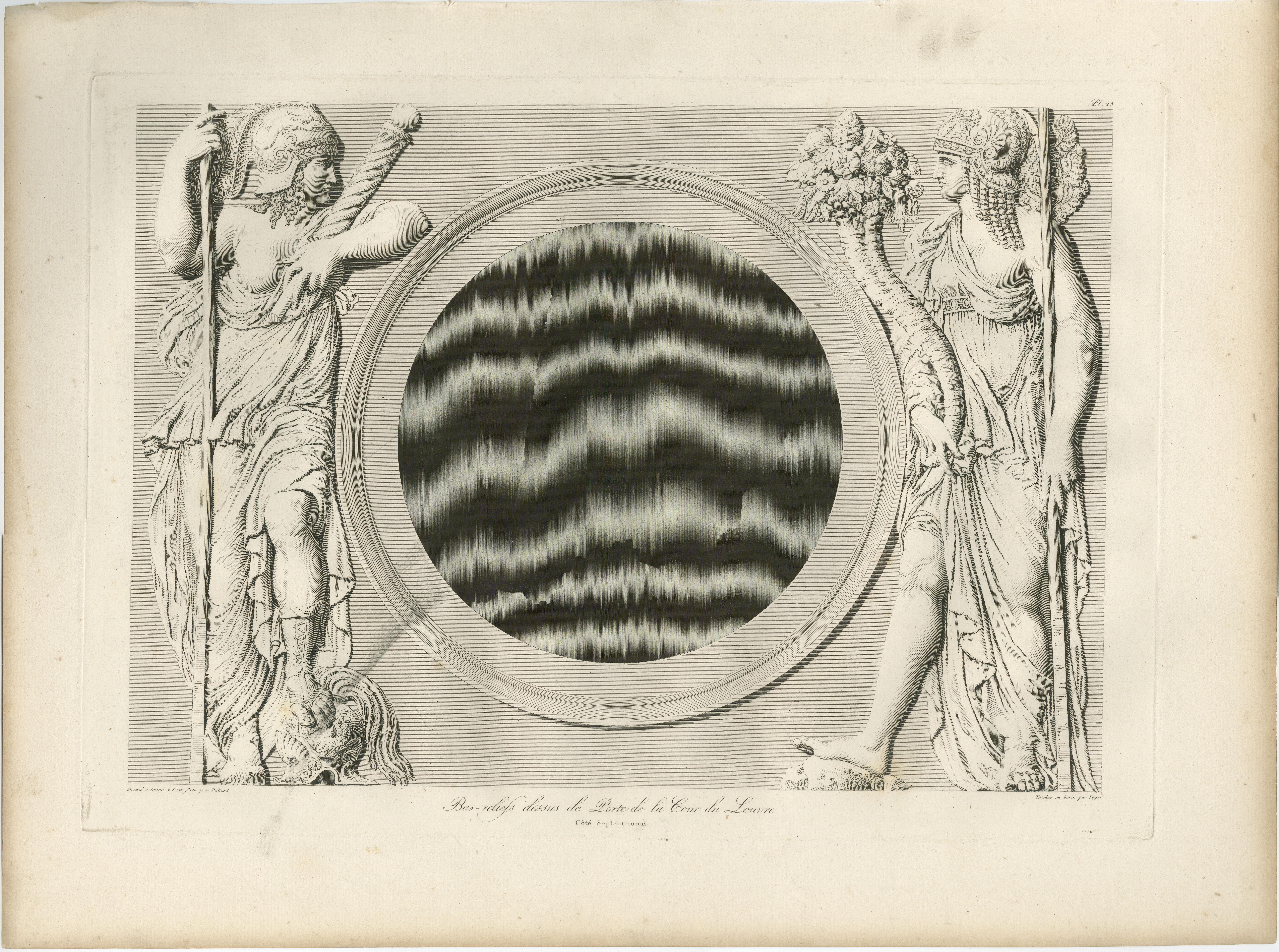
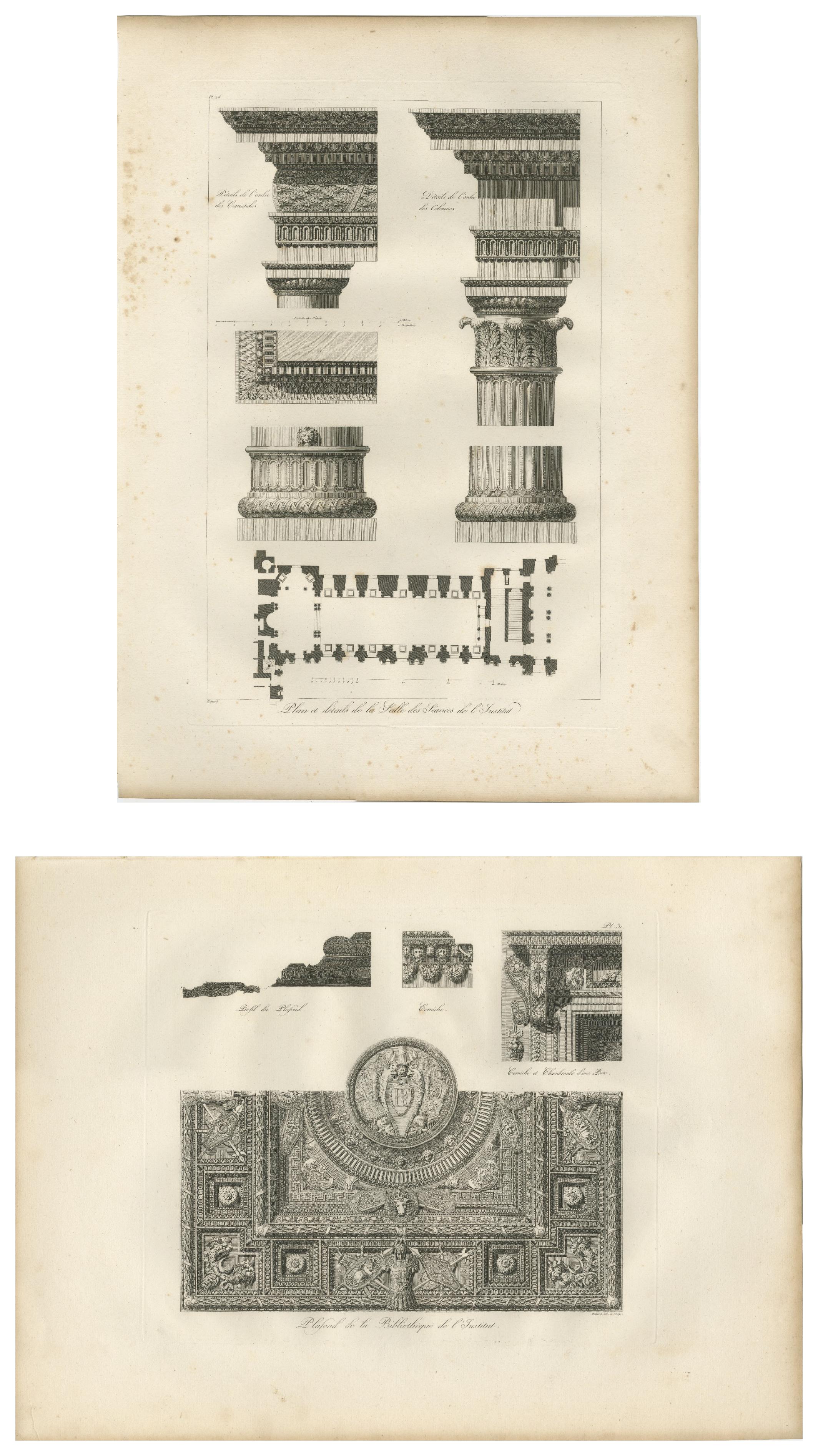
Antique Louvre Sculptures & Institut Ceiling Ornament Prints – Baltard 1803 Description: This rare pair of early 19th-century architectural engravings originates from the important French publication Paris et ses Monuments, mesurés, dessinés et gravés, produced by the architect and engraver Louis-Pierre Baltard and published in Paris in 1803. Baltard’s ambitious work sought to document the architectural treasures of Paris with exceptional precision, combining artistic refinement with scholarly measurement and documentation. The publication was dedicated to Napoleon Bonaparte and stands as one of the earliest systematic visual surveys of the monuments of Paris. The first engraving illustrates four sculptural figures from the Bas-reliefs de l’Attique de la Cour du Louvre, the attic bas-reliefs decorating the inner courtyard of the Louvre Palace. These sculptural decorations were designed during the French Renaissance for the celebrated Lescot Wing of the Louvre, which served as the royal residence for King Francis I and later French monarchs. The reliefs are attributed to the renowned sculptor Jean Goujon (c.1510–1567), one of the most influential artists of the French Mannerist period and a central figure in the School of Fontainebleau. Each figure is rendered individually, allowing the viewer to appreciate the refined sculptural language of Goujon’s work. The figures display elongated proportions and graceful poses typical of the Fontainebleau style. Their drapery demonstrates Goujon’s famous “wet drapery” effect, where fabric clings delicately to the body, accentuating the anatomy and creating a sense of elegant movement. Such figures often represent allegorical or mythological subjects—personifications such as Fame, Victory, or Virtue—designed to celebrate the grandeur and cultural aspirations of the French monarchy. The second engraving, titled Détails de l’Escalier de l’Institut (Plate 29), presents three richly ornamented decorative panels documenting Renaissance ceiling designs. Despite the title referencing the Institut, the motifs actually derive from the celebrated Grand Escalier (Henri II staircase) of the Louvre Palace. At the time of Baltard’s publication, the Institut de France was temporarily housed within the Louvre before relocating to the Collège des Quatre-Nations in 1805. Baltard’s engraving groups several decorative fragments together in a single “imaginary” composition to display the intricacy of the original carvings. The panels depict elaborate ceiling coffers richly decorated with fruit garlands, architectural moldings, medallions, and allegorical figures. One panel features a winged figure—likely a Victory—within an oval medallion framed by dense ornamental foliage. Another panel presents a square composition with a draped figure in dynamic movement, while a third contains an oval medallion with paired mythological figures associated with royal iconography such as Peace and Justice. Executed using copperplate engraving with refined burin work, Baltard’s prints demonstrate remarkable technical precision. The engraver skillfully reproduced the illusion of depth and sculptural texture, allowing the viewer to appreciate the three-dimensional quality of the original stone carvings. This careful documentation reflects the Neoclassical fascination with historical monuments and the desire to preserve the achievements of Renaissance architecture for future generations of artists, architects, and scholars. Together, these engravings offer a fascinating glimpse into the artistic heritage of the Louvre and the architectural study of Paris during the early Napoleonic era. They are both historically significant and visually striking works that appeal to collectors of architectural prints, French history, and Renaissance sculpture. The prints are offered unframed, allowing the buyer complete freedom to choose framing appropriate to their interior or collection. Any framed examples shown in photographs are for inspiration only. Condition: Good antique condition with general age-related toning and occasional light foxing. Margins wide and well preserved. Strong impressions with visible plate marks. Minor handling wear consistent with age. Framing tips: These architectural engravings display beautifully when framed with generous ivory or warm off-white mats and dark walnut, ebonized, or gilded frames. Pairing the prints together in matching frames creates an elegant museum-style presentation suitable for classical, library, or gallery interiors. Technique: copperplate engraving Maker: Louis-Pierre Baltard, Paris, 1803 Keyword block: antique architectural print, baltard paris monuments, louvre sculpture engraving, jean goujon reliefs, french renaissance sculpture print, institut staircase ornament, louvre attic bas relief, napoleon era architecture print, french neoclassical engraving, architectural ornament engraving, paris monument print, 1803 copperplate engraving, louvre palace decoration, school of fontainebleau sculpture, french architectural study print
  • Dimensions:
    Height: 18.39 in (46.7 cm)Width: 24.65 in (62.6 cm)Depth: 0.01 in (0.2 mm)
  • Sold As:
    Set of 2
  • Materials and Techniques:
    Paper,Engraved
  • Place of Origin:
  • Period:
  • Date of Manufacture:
    1803
  • Condition:
    Good antique condition with general age-related toning and occasional light foxing. Margins wide and well preserved. Strong impressions with visible plate marks. Minor handling wear consistent with age.
  • Seller Location:
    Langweer, NL
  • Reference Number:
    Seller: BG-14258-31, BG-14258-371stDibs: LU3054349068582

More From This Seller

View All
Two Antique Louvre Architectural Study Prints, Institut Details – Baltard 1803

Two Antique Louvre Architectural Study Prints, Institut Details – Baltard 1803

Located in Langweer, NL

Two Antique Louvre Architectural Study Prints, Institut Details – Baltard 1803 Description: This elegant pair of early 19th-century architectural engravings originates from the rare and influential publication *Paris et ses Monuments, mesurés, dessinés et gravés*, produced by the French architect and engraver Louis-Pierre Baltard and published in Paris in 1803. Dedicated to Napoleon Bonaparte, Baltard’s monumental work sought to document the architectural treasures of Paris through precise measured drawings and highly refined copperplate engravings. The publication remains one of the earliest systematic visual surveys of Parisian monuments produced during the Napoleonic era. The two engravings present detailed architectural studies associated with the Louvre Palace and the Institut de France. Baltard’s work was conceived not only as an artistic publication but also as a technical reference for architects and designers studying classical architecture and Renaissance ornament. The first plate illustrates architectural details and a plan of the *Salle des Séances de l’Institut*. The engraving presents finely rendered sections of cornices, column capitals, and decorative architectural elements alongside a floor plan of the hall. These measured studies demonstrate Baltard’s careful analytical approach to architecture, documenting proportions, ornamental profiles, and structural relationships with remarkable precision. Such plates were intended as educational tools for architects and artists studying classical architectural language. The second engraving depicts richly ornamented decorative elements from the *Plafond de la Bibliothèque de l’Institut*. The plate presents fragments of a highly elaborate ceiling decoration composed of geometric coffers, sculptural reliefs, and classical decorative motifs. The composition includes medallions, garlands, rosettes, and mythological ornament arranged in an intricate Renaissance-inspired decorative program. At the center appears a prominent medallion surrounded by radiating architectural ornament, demonstrating the remarkable complexity and richness of the original ceiling design. Baltard’s engravings combine artistic refinement with technical precision. Using delicate burin work and dense hatchings, he carefully recreated the textures of carved stone, molded plaster, and architectural ornament. The plates function as both works of art and architectural documents, preserving important details of Parisian monuments during the early 19th century. Architectural prints from *Paris et ses Monuments* are highly sought after today by collectors of architectural engravings, historians of French art and architecture, and interior designers seeking authentic classical imagery. The combination of architectural plans and decorative ornament makes this pair particularly appealing for display, offering both visual richness and scholarly interest. These are original prints from the year of publication, not later reproductions. The prints are offered unframed, allowing the buyer full freedom to select framing appropriate to personal taste or interior design preferences. Any framed examples shown in photographs are for visual inspiration only. Condition: Good antique condition with general age-related toning and scattered foxing visible mainly in the margins. Wide margins preserved with strong impressions and visible plate marks. Minor handling wear consistent with age. Framing tips: These architectural studies display beautifully when framed as a pair with generous ivory or warm cream mats and dark walnut, ebonized, or gilded frames. Displayed together they create a refined museum-style presentation ideal for classical interiors, libraries, or gallery walls devoted to architectural subjects. Technique: copperplate engraving Maker: Louis-Pierre Baltard, Paris, 1803 Keyword block: antique architectural prints set, baltard paris monuments, louvre architecture engraving, institut de france architectural study, french neoclassical architecture print...

Category

Antique Early 19th Century French Prints

Materials

Paper

Antique Louvre Architectural Relief Engravings – French Neoclassical Plates 1803

Antique Louvre Architectural Relief Engravings – French Neoclassical Plates 1803

Located in Langweer, NL

Antique Louvre Architectural Relief Engravings Pair – French Neoclassical Plates A refined pair of antique French architectural engravings depicting sculptural relief details from t...

Category

Antique Early 19th Century French Prints

Materials

Paper

Antique Decorative Ceiling Designs, Fontainebleau Gallery, Baltard, 1803 – Pair

Antique Decorative Ceiling Designs, Fontainebleau Gallery, Baltard, 1803 – Pair

By Louis-Pierre Baltard

Located in Langweer, NL

Antique Decorative Ceiling Designs, Fontainebleau Gallery, Baltard, 1803 – Pair This elegant pair of architectural engravings presents richly detailed ceiling designs from the Châte...

Category

Antique Early 19th Century French Neoclassical Prints

Materials

Paper

Antique Louvre Sculpture Reliefs Print, Institut Fireplace – Baltard 1803

Antique Louvre Sculpture Reliefs Print, Institut Fireplace – Baltard 1803

Located in Langweer, NL

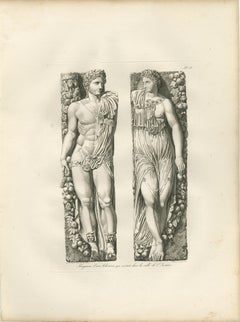
Antique Louvre Sculpture Reliefs Print, Institut Fireplace – Baltard 1803 Description: This elegant early 19th-century copperplate engraving originates from the rare architectural publication Paris et ses Monuments, mesurés, dessinés et gravés, produced by the French architect and engraver Louis-Pierre Baltard and published in Paris in 1803. Dedicated to Napoleon Bonaparte, the monumental work aimed to carefully document the architectural masterpieces of Paris through measured drawings and highly refined engravings. Baltard’s publication remains one of the earliest systematic visual surveys of Parisian monuments produced during the Napoleonic period. The present engraving illustrates two sculptural relief figures titled Fragments d’une Cheminée qui existoit dans la salle de l’Institut (Fragments of a fireplace that existed in the hall of the Institute). The plate depicts architectural fragments that once decorated an elaborate Renaissance fireplace associated with the Louvre complex and the early halls used by the Institut de France. The two vertical relief figures are shown separately, allowing detailed study of the sculptural forms. The left figure represents a classical male figure wearing a laurel wreath and partially draped garment that falls across one shoulder and around the waist. The sculpted anatomy is rendered with remarkable clarity, reflecting Renaissance admiration for antique Roman sculpture. Surrounding the figure are rich garlands of fruit and foliage, motifs frequently used in French Renaissance ornament inspired by classical Roman decorative programs. The right relief depicts a graceful female figure clad in flowing classical drapery. Her stance is relaxed and elegant, with one leg slightly forward and the drapery falling in delicate rhythmic folds. The sculptural treatment of the fabric demonstrates the Renaissance fascination with classical sculpture and the mastery of artists influenced by the School of Fontainebleau. The figure is framed by ornamental garlands and vegetal motifs similar to those surrounding the male figure, reinforcing the balanced decorative scheme typical of Renaissance architectural interiors. These sculptural fragments reflect the artistic vocabulary of the French Renaissance, when classical mythology, allegorical figures, and antique decorative elements were incorporated into royal architecture. Such motifs were widely used in the decorative programs of the Louvre Palace during the reigns of Francis I and Henry II, when French artists embraced Italian Renaissance ideals and classical antiquity. Baltard engraved these sculptures with extraordinary precision, using fine burin work to capture the subtle modeling of the figures and the deep shadows within the relief carvings. His engravings were intended not only as illustrations but also as instructional references for architects and artists studying historical ornament. By isolating and carefully rendering architectural fragments, Baltard allowed viewers to examine the sculptural details with exceptional clarity. Today prints from *Paris et ses Monuments* are highly valued by collectors of architectural prints, historians of French Renaissance art, and interior designers seeking authentic classical imagery. The composition of two complementary relief figures makes this engraving particularly decorative and well suited for framing. This is an original print from the year of publication, not a later reproduction. The print is offered unframed, allowing the buyer full freedom of framing according to personal taste or interior design preferences. Any framed examples shown in photographs are for visual inspiration only. Condition: Good antique condition with general age-related toning and occasional light foxing. Wide margins preserved. Strong impression with visible plate mark. Minor handling wear consistent with age. Framing tips: This engraving frames beautifully with a generous ivory or warm cream mat and a dark walnut, ebonized, or gilded frame. The vertical sculptural panels create a balanced composition that works particularly well in classical interiors, libraries, or architectural gallery walls. Technique: copperplate engraving Maker: Louis-Pierre Baltard, Paris, 1803 Keyword block: antique architectural print, baltard paris monuments, louvre sculpture engraving, institut fireplace sculpture, french renaissance relief, classical sculpture engraving, french neoclassical architecture print, paris monument engraving 1803, renaissance fireplace ornament, architectural ornament engraving, classical figure relief print, french renaissance decoration, antique paris architecture print...

Category

Antique Early 19th Century French Prints

Materials

Paper

Antique Louvre Bas-Relief Print, Cour Carrée Allegorical Figures – Baltard 1803

Antique Louvre Bas-Relief Print, Cour Carrée Allegorical Figures – Baltard 1803

Located in Langweer, NL

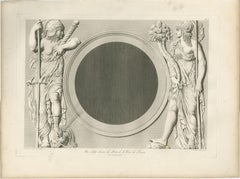
Antique Louvre Bas-Relief Print, Cour Carrée Allegorical Figures – Baltard 1803 Description: This elegant early 19th-century architectural engraving originates from the rare and influential publication *Paris et ses Monuments, mesurés, dessinés et gravés*, created by the French architect and engraver Louis-Pierre Baltard and published in Paris in 1803. Dedicated to Napoleon Bonaparte, Baltard’s monumental work was conceived as a comprehensive visual record of the most important architectural monuments of Paris. Through carefully measured drawings and highly refined copperplate engravings, Baltard documented sculptural and architectural details with remarkable clarity and precision. The present plate is titled *Bas-reliefs dessus de Porte de la Cour du Louvre* (Bas-relief above a door in the courtyard of the Louvre). The engraving illustrates a sculptural relief located in the celebrated Cour Carrée of the Louvre Palace, specifically on the Lescot Wing, one of the earliest Renaissance sections of the palace. The sculptural composition frames a large circular oculus at the center of the relief. On either side stand two monumental allegorical female figures dressed in classical drapery and wearing antique helmets. These figures originate from the sculptural program of the Louvre designed during the French Renaissance and are attributed to the renowned sculptor Jean Goujon (c.1510–1567), one of the most influential artists of the School of Fontainebleau. The left figure is generally interpreted as the allegory of History. She is shown in classical dress, leaning upon a staff and poised as if ready to record events. Such representations symbolized the preservation of royal deeds and historical memory, themes closely associated with Renaissance court culture. Opposite her stands the allegorical figure of Fame (Renommée). She holds symbolic attributes associated with renown and glory, reinforcing the celebratory tone of the sculptural program that decorated the royal palace. Together these allegories were designed to glorify the monarchy and commemorate the achievements of the French crown. Jean Goujon’s sculptural style is evident in the elongated proportions and graceful poses of the figures. The drapery falls in soft, fluid folds that cling delicately to the bodies, a technique often described as “wet drapery,” characteristic of Goujon’s work and the broader aesthetic of the Fontainebleau school. Surrounding the figures, the circular architectural opening is framed by smooth classical moldings that contrast with the finely modeled sculpture. Baltard’s engraving captures these Renaissance sculptures with extraordinary technical precision. Using fine burin work and dense hatchings, he recreated the sculptural depth and subtle modeling of the stone relief. The careful rendering of textures—from the smooth architectural surfaces to the delicate folds of drapery—demonstrates the scientific and artistic rigor with which Baltard approached the documentation of Parisian monuments. Architectural engravings such as this were produced both as scholarly records and as educational tools for artists and architects studying classical ornament and Renaissance architecture. Today prints from *Paris et ses Monuments* remain highly sought after by collectors of architectural prints, historians of French art, and interior designers seeking authentic classical imagery. This is an original print from the year of publication, not a later reproduction. The print is offered unframed, allowing the buyer complete freedom to select framing appropriate to personal taste or interior design preferences. Any framed examples shown in photographs are for visual inspiration only. Condition: Good antique condition with general age-related toning and occasional light foxing. Wide margins preserved. Strong impression with visible plate mark. Minor handling wear consistent with age. Framing tips: This engraving displays beautifully with a generous ivory or warm cream mat and a dark walnut, ebonized, or gilded frame. The wide horizontal composition makes it ideal above desks, console tables, or as part of a curated wall of architectural studies. Technique: copperplate engraving Maker: Louis-Pierre Baltard, Paris, 1803 Keyword block: antique architectural print, louvre bas relief engraving, baltard paris monuments, cour carrée sculpture print, jean goujon relief, french renaissance architecture print, allegorical sculpture engraving, louvre palace decoration print, neoclassical architectural engraving, paris monument engraving 1803, classical allegory sculpture print, french architectural ornament print, antique paris architecture print...

Category

Antique Early 19th Century French Prints

Materials

Paper

Antique Roman Sculpture Engravings, Set of 3 – Montfaucon, 1721

Antique Roman Sculpture Engravings, Set of 3 – Montfaucon, 1721

Located in Langweer, NL

Antique Roman Sculpture Engravings Set of 3 – Montfaucon 1721 Plates A striking and scholarly set of three early 18th-century engravings depicting classical Roman sculpture and anti...

Category

Antique Early 18th Century French Prints

Materials

Paper

You May Also Like

Monuments of French Sculpture - Lithograph by Auguste Wahlen - 1844

Monuments of French Sculpture - Lithograph by Auguste Wahlen - 1844

By Auguste Wahlen

Located in Roma, IT

Monuments of French Sculpture is a lithograph made by Auguste Wahlen in 1844. Good condition. Drawing in black and white. At the center of the artwork is the original title "Monum...

Category

1840s Modern Figurative Prints

Materials

Lithograph

Pair of Steel Engraving from the 19th Century

Pair of Steel Engraving from the 19th Century

Located in Saint-Ouen, FR

Pair of steel engraving from the 19th century “Le Depart Du Courier” and " L’Arrive du Courrier” dedicated to Madame la Marquise de Montesquieu. Conta...

Category

Antique 19th Century French Romantic Prints

Materials

Paper

French Baroque - Lithograph - 19th Century

French Baroque - Lithograph - 19th Century

Located in Roma, IT

French Baroque is an artwork realized in 19th century. Lithograph on paper. The artwork represents decorative patterns of French Renaissance Architecture. The artwork is depicted s...

Category

19th Century Modern Figurative Prints

Materials

Lithograph

Framed 19th Century French Victorian Engraving Prints in Giltwood

Framed 19th Century French Victorian Engraving Prints in Giltwood

Located in Queens, NY

PAIR of French Victorian (19th Century) prints of engravings titled \"Vestale\" (a reference to Gaspare Spontini\'s 1807 opera \"La vestale\") and \"Euterpe\" (Greek mythology\'s mus...

Category

Antique 19th Century French Victorian Prints

Materials

Giltwood

Motifs Decorative - Etching by Bernard Picart - 1729

Motifs Decorative - Etching by Bernard Picart - 1729

By Bernard Picart

Located in Roma, IT

Motifs decorative is a black and white etching on paper, realized in 1729 by Bernard Picart.   Signed and dated on plate on the lower margin. The artwork is attached on black passep...

Category

1720s Modern Figurative Prints

Materials

Etching

Suite of 5 engravings of Antique scenes after Moitte by Janinet

Suite of 5 engravings of Antique scenes after Moitte by Janinet

By Jean François Janinet

Located in Paris, FR

Suite of 5 Directoire-period etchings and aquatint engravings depicting scenes from antiquity, after drawings by Jean-Guillaume MOITTE (1746-1810), author, and by the engraver Jean F...

Category

Antique 1790s French Directoire Prints

Materials

Paper