Located in Downingtown, PA
The Road 1825: ‘Commercial Traveller’ — A Large Hand-Coloured Aquatint
After Owen Bailey; published in London,
Circa 1825–1830
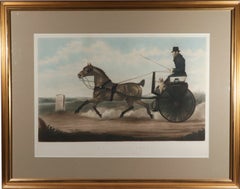
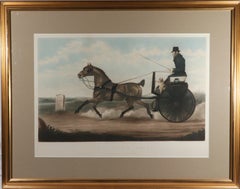
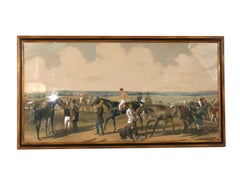
A particularly large and imposing hand-coloured aquatint depicting a trotting horse — named in the lower margin as ‘Commercial Traveller’ — shown in full action drawing a two-wheeled gig at speed along an open road. The horse, a powerful bay or dark chestnut rendered with muscular authority, is caught at the moment of extended trot: near foreleg advanced, haunches driving, the ground thrown up in a small cloud of dust at the hooves.
The gentleman driver, dressed in a dark coat and low-crowned hat, sits upright in the gig holding the reins with composed ease, a small terrier or spaniel seated beside him on the box — an appealing detail that gives the composition unusual intimacy. To the left of the road stands a simple stone or wooden milestone, a quietly functional element that anchors the composition geographically and suggests the turnpike road context of the scene. The background opens to a spacious, rolling landscape with a glint of water or estuary in the middle distance and a broadly rendered sky of cumulus cloud.
The composition is typical of the ambitious large-format trotting horse print as produced for the English sporting market of the 1820s and 1830s: a wide horizontal format, the horse dominating the picture plane, the landscape ground kept low and unencumbered to emphasise speed and energy. The hand-colouring is applied with care and consistency: the horse’s warm brown coat is modelled with subtlety, the gig’s dark ironwork contrasting with the pale covered seat, and the sky washed in the greys and ochres characteristic of period aquatints in good preservation.
The lower margin carries the title ‘THE ROAD 1825’ in spaced capitals, with the subtitle ‘Commercial Traveller’ in italic script below. The plate is signed ‘Owen Bailey, London’ in the lower margin.
Dimensions
30¼ inches (76.8 cm) high,
38 inches (96.5 cm) wide,
1¼ inches (3.2 cm) deep, framed.
Provenance
Private American collection.
Condition: Good with with Truguard UV glass to protect from light damage.
Historical Context
Owen Bailey was a London-based sporting artist active in the second and third decades of the nineteenth century, working in the tradition of F.C. Turner, James Pollard, and Henry Alken. His paintings of trotting horses and driving subjects were reproduced as large-format hand-coloured aquatints published for the broad sporting print market. The ‘Road’ series — of which ‘The Road 1825’ is a representative title — celebrated the open turnpike road as a theatre for the display of horses’ speed and quality, and reflected the intense popular interest in trotting and fast driving that characterised the Regency sporting world.
The 1820s were the peak period for the English trotting and fast-driving print. Publishers catering to the sporting and aspiring middle-class market produced large-format plates that were sold individually or in matched pairs for display in dining rooms, libraries, and halls. The format of a single named horse in harness, shown at speed with a stone milestone or country background, became a near-standard formula, and prints of this type were produced in considerable numbers. The finest examples — of which this is one — combine genuine artistic quality with a social documentary interest in the fashions of dress, vehicle design, and road culture of the Regency period.
Selected Bibliography
Egerton, Judy. British Sporting and Animal Paintings, 1655–1867: The Paul Mellon Collection. London: Tate Gallery / Yale Center for British Art, 1978.
Nevill, Ralph. Old English Sporting Prints...
Category
1820s English Antique Regency Prints