387 results for "frida kahlo"

to
37
294
58
88
65
246
94
34
157
93
47
41
49
Overall Height
to
Overall Width
to
127
90
30
19
18
6
2
2
1
193
131
88
54
47
41
41
36
30
29
29
15
14
12
11
10
10
9
9
9
2
147
238
2
24
21
8
8
27
14
3
37
34
28
24
23
151
98
86
86
62
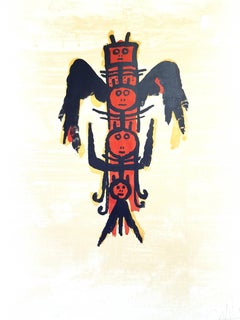
Wifredo Lam - Original Handsigned Lithograph -El ultimo viaje del buque fantasma

Wifredo Lam - Original Handsigned Lithograph -El ultimo viaje del buque fantasma

By Wifredo Lam

Located in Collonge Bellerive, Geneve, CH

Original lithograph, hand-signed and hand-numbered in pencil by the artist. Edition: 56/99 Excellent Conditions Dimensions: 76 x 56 cm Reference : Catalogue raisonné Tonneau-Ryckely...

Category

1970s Post-Modern Figurative Prints

Materials

Lithograph

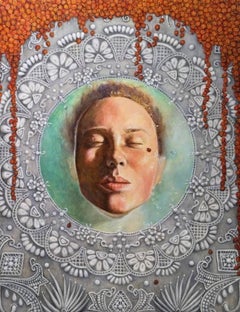
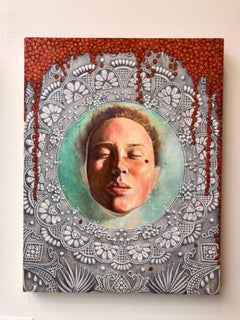
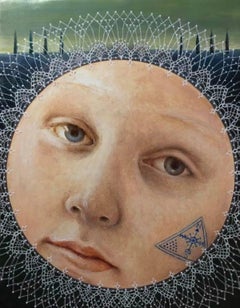
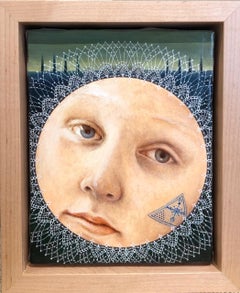
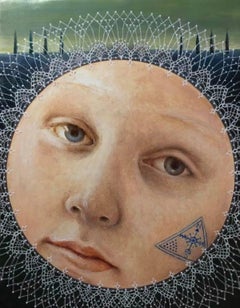
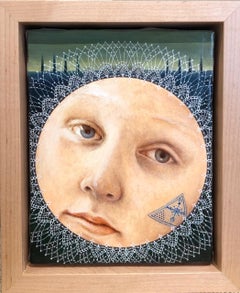
Void / oil on wood panel

Void / oil on wood panel

By Chikako Okada

Located in Burlingame, CA

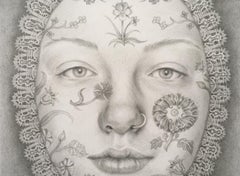
'Void' features the face of a young woman with ladybugs and intricately patterned queen's lace. The painting in red-orange, sea green and white and is 16 x 12 1/2 inches, unframed, w...

Category

21st Century and Contemporary Realist Figurative Paintings

Materials

Wood, Oil

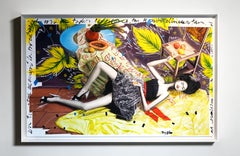
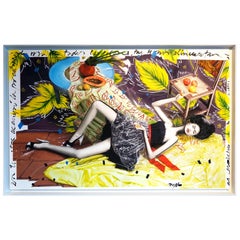
Colored Frida Archival Pigment Print on Aluminum, Framed, 2010

Colored Frida Archival Pigment Print on Aluminum, Framed, 2010

By Efren Isaza

Located in Miami Beach, FL

Colored Frida by Efren Isaza Archival pigment print mounted on aluminum, intervened with hand-applied paint, ink and intentionally scratched by the artist 34 in. H x 53.5 in. W x 1 i...

Category

2010s Modern Figurative Paintings

Materials

Paper, Other Medium

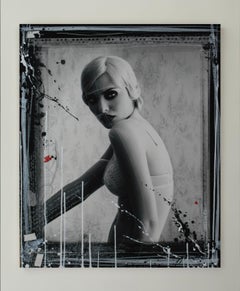
"M with Bra", Black and white photograph intervine by the artist

"M with Bra", Black and white photograph intervine by the artist

By Efren Isaza

Located in Miami Beach, FL

M with Bra by Efren Isaza 37 in. H x 29.5 in. W Archival pigment print mounted on aluminum with ink and paint One of a kind ______________________________ Isaza, one of Colombia’s mo...

Category

2010s Contemporary Figurative Photography

Materials

Metal

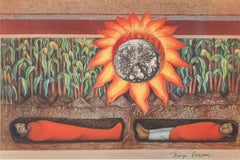
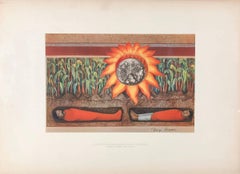
Chapel of the Agriculture School, Chapingo (Forces Under the Earth)

Chapel of the Agriculture School, Chapingo (Forces Under the Earth)

By (after) Diego Rivera

Located in Missouri, MO

(after) Diego Rivera "Chapel, Agriculture School, Chapingo" (Forces Under the Earth) 1933 from the portfolio "Frescoes of Diego Rivera" Published by the Museum of Modern Art, NY Approx. 18.5 x 13.5 with Matting Hand-Signed by the Artist Diego Rivera was born on December 13, 1886 in the mountain town of Guanajuato in Mexico. His mother was an ardent Catholic and his father was a rich and aristocratic revolutionary fighter and an atheist. Little Diego decided in favor of atheism. He swore his family had to leave Guanajuato when he was six because of his diatribes against the Church. When he was eleven he attended the San Carlos Academy of Fine Arts; his real teacher was Jose Posada...

Category

1930s Modern Figurative Prints

Materials

Lithograph

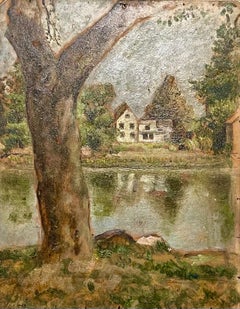
Simka Simkhovitch WPA Artist Oil Painting American Modernist Landscape Pond Tree

Simka Simkhovitch WPA Artist Oil Painting American Modernist Landscape Pond Tree

By Simka Simkhovitch

Located in Surfside, FL

Simka Simkhovitch (Russian/American 1893 - 1949) This came with a small grouping from the artist's family, some were hand signed some were not. These were studies for larger paintin...

Category

1930s American Modern Landscape Paintings

Materials

Oil, Board

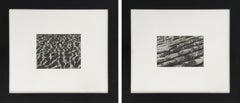
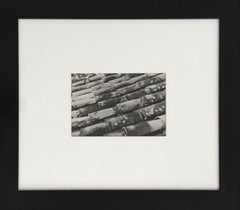
Diptych Arena de la Playa and Techos, Mexico, Vintage Photography. Framed

Diptych Arena de la Playa and Techos, Mexico, Vintage Photography. Framed

By Leo Matiz

Located in Miami Beach, FL

Black and white photographs that reveal the various facets and aesthetic searches of the legendary Colombian photographer, recognized as the creator of memorable realistic, abstract ...

Category

1940s Other Art Style Black and White Photography

Materials

Other Medium, Black and White

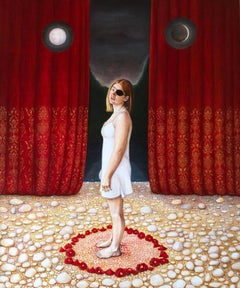
So Long / oil on wood - contemporary portrait woman red and bold

So Long / oil on wood - contemporary portrait woman red and bold

By Chikako Okada

Located in Burlingame, CA

'So Long' a mysterious and fascinating portrayal of a young women standing inside of a ring of red flowers, in front of a heavy velvet gold and red drape, that is falling on either ...

Category

21st Century and Contemporary Realist Figurative Paintings

Materials

Wood, Oil

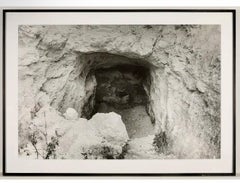
Los Carpinteros Cuban Art Photograph Tuneles Populares Silver Gelatin Photo

Los Carpinteros Cuban Art Photograph Tuneles Populares Silver Gelatin Photo

By Los Carpinteros

Located in Surfside, FL

Los Carpinteros (Cuban, 1992-present). Silver gelatin print photograph, large format. From the series "Tuneles Populares" (The People's Tunnels) 1999 Edition 1/5 Provenance: Bliss Fi...

Category

1990s Conceptual Landscape Photography

Materials

Silver Gelatin

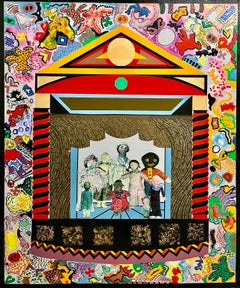
Large Mixed Media Collage Painting Great Jewish Feminist Artist Miriam Schapiro

Large Mixed Media Collage Painting Great Jewish Feminist Artist Miriam Schapiro

By Miriam Schapiro

Located in Surfside, FL

Miriam Schapiro, "Curtain Call" 2002 Hand signed, dated and titled verso and signed and dated recto. acrylic paint, digital images, glitter and textile fabric on canvas, tooling with gold leaf embossing around self edge of painting. size: 60 x 50 in Miriam Schapiro (or Mimi Schapiro) (November 15, 1923 – June 20, 2015) was a Canadian-born artist based in America. She was a painter, sculptor and printmaker. She was a pioneer of feminist art. She was also considered a leader of the Pattern and Decoration art movement. Schapiro's artwork blurs the line between fine art and craft. Her paintings contain craft elements because crafts and decoration is associated with women and femininity. She used icons that are associated with women such as hearts, floral decorations, geometric patterns and the color pink. In the 1970s she made a small woman's object, the fan, heroic by painting it six feet by twelve feet. This bears the influence of the Pattern and Decoration movement artists such as Brad Davis, Mary Grigoriadis, Joyce Kozloff, Robert Kushner, Kim MacConnel, Sonya Rapoport, Miriam Schapiro and Valerie Jaudon. Shapiro was born in Toronto, Ontario, Canada. Her father was an industrial design artist who fostered her desire to be an artist and served as her role model and mentor. Her mother was a stay at home mother who worked part-time during the depression. As a teenager, Schapiro was taught by Victor d’Amico, her first modernist teacher at the Museum of Modern Art. In the evenings she joined WPA classes for adults to study drawing from the nude model. In 1943, Schapiro entered Hunter College in New York City, but eventually transferred to the University of Iowa. At the University of Iowa, Schapiro studied painting with Stuart Edie and James Lechay. She studied printmaking under Mauricio Lasansky and was his personal assistant, which then led her to help form the Iowa Print Group. Lasanky taught his students to use several different printing techniques in their work and to study the masters' work in order to find solutions to technical problems. At the State University of Iowa she met the artist Paul Brach, whom she married in 1946.. By 1951 they moved to New York City and befriended many of the Abstract expressionist artists of the New York School, including Joan Mitchell, Larry Rivers, Knox Martin and Michael Goldberg. Schapiro worked in the style of Abstract expressionism during this time period. Shapiro and Brach lived in New York City during the 1950s and 1960s. During this period Shapiro had a successful career as an abstract expressionist painter in the hard-edge style. In December 1957, André Emmerich selected one of her paintings for the opening of his gallery. Schapiro not only honored the craft tradition in women's art, but also paid homage to women artists of the past. In the early 1970s she made paintings and collages which included photo reproductions of Mary Cassatt's and Georgia O'keefe's paintings. Early in her career, Schapiro started looking for maternal symbols to unify her own roles as a woman. Her series, Shrines (1963), was her first artistically successful attempt at compartmentalizing her life roles. Her painting, Big Ox No. 1, from 1968, references Shrines, however no longer compartmentalized. The center O takes on the symbol of the egg which exists as the window into the maternal structure with outstretched limbs. Her series, Shrines was created in 1961–63. It is one of her earliest group of work that was also an autobiography. Each section of the work show an aspect of being a woman artist. They are also symbolic of her body and soul. In 1964 Schapiro and her husband Paul both worked at the Tamarind Lithography Workshop. One of Schapiro's biggest turning points in her art career was working at the workshop and experimenting with Josef Albers' Color-Aid paper, where she began making several new shrines and created her first collages. In the 1970s, Schapiro and Brach moved to California so that both could teach in the art department at the University of California. Subsequently, she was able to establish the Feminist Art Program at the California Institute of the Arts, in Valencia with Judy Chicago. The program set out to address the problems in the arts from an institutional position. They wanted the creation of art to be less of a private, introspective adventure and more of a public process through consciousness raising sessions, personal confessions and technical training. She participated in the Womanhouse exhibition in 1972. Schapiro's smaller piece within Womanhouse, called "Dollhouse", was constructed using various scrap pieces to create all the furniture and accessories in the house. Each room signified a particular role a woman plays in society and depicted the conflicts between them. Along with Nancy Spero, Joan Snyder, Joyce Kozloff, Audrey Flack and Judy Chicago, she is from that first generation of Jewish American feminist women artists and includes Judaica in her work. Schapiro's work from the 1970s onwards consists primarily of collages assembled from fabrics, which she called "femmages". As Schapiro traveled the United States giving lectures, she would ask the women she met for a souvenir. These souvenirs would be used in her collage like paintings. Her 1977-1978 essay Waste Not Want Not: An Inquiry into What Women Saved and Assembled - FEMMAGE (written with Melissa Meyer) describes femmage as the activities of collage, assemblage, découpage and photomontage practised by women using "traditional women's techniques - sewing, piercing, hooking, cutting, appliquéing, cooking and the like..." She was involved in Abstract expressionism, Minimalism, Computer art, and Feminist art. She worked with collage, printmaking, painting, femmage [fr] – using women's craft in her artwork, and sculpture. Schapiro not only honored the craft tradition in women's art, but also paid homage to women artists of the past. In the early 1970s she made paintings and collages which included photo reproductions of past artists such as Mary Cassatt. In the mid 1980s she painted portraits of Frida Kahlo on top of her old self-portrait paintings. In the 1990s Schapiro began to include women of the Russian Avant Garde in her work. The Russian Avant Garde was an important moment in Modern Art history for Schapiro to reflect on because women were seen as equals. Schapiro also did collaborative art projects, like her series of etchings Anonymous was a Woman from 1977. She was able to produce the series with a group of nine women studio-art graduates from the University of Oregon. Each print is an impression made from an untransformed doily that was placed in soft ground on a zinc plate, then etched and printed. Her image is included in the iconic 1972 poster Some Living American Women Artists by Mary Beth Edelson...

Category

Early 2000s Contemporary Mixed Media

Materials

Glitter, Mixed Media, Fabric, Acrylic, Digital

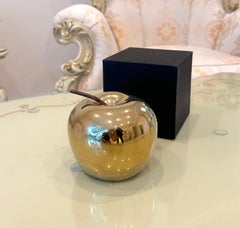
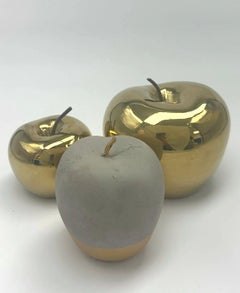
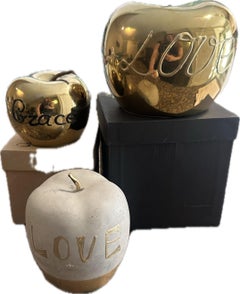
Apple of Eden, Porcelain Art Decor, Installation, Metal Gold, Gift

Apple of Eden, Porcelain Art Decor, Installation, Metal Gold, Gift

Located in Granada Hills, CA

Artist: Kristina Oganezz Work: Art Installation / Art decor Medium: Porcelaine Year: 2024 Color: Metal Gold Title: Apple of Eden Size: H 4,75" x Diameter 3,75" inch, 337 Gram, Eleg...

Category

2010s Impressionist Still-life Sculptures

Materials

Concrete, Gold Leaf

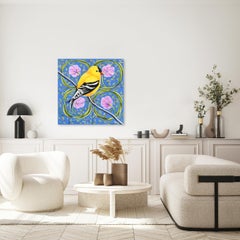
Goldfinch - Original Colorful Floral Figurative Bird Painting on Canvas

Goldfinch - Original Colorful Floral Figurative Bird Painting on Canvas

By Naomi Jones

Located in Los Angeles, CA

Naomi Jones’s evocative figurative painting captures the essence of feminine serenity and nature-inspired symbolism. This soulful portrait features a peaceful woman with flowing aubu...

Category

21st Century and Contemporary Folk Art Animal Paintings

Materials

Canvas, Lacquer, Acrylic

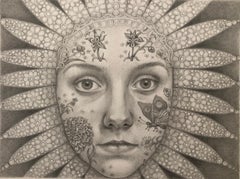
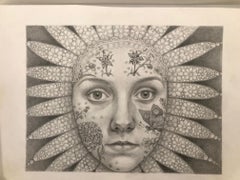
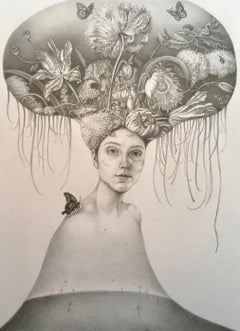
PARADISE SEEKER - pencil drawing - from Okada's 'Neo Flower Children' series

PARADISE SEEKER - pencil drawing - from Okada's 'Neo Flower Children' series

By Chikako Okada

Located in Burlingame, CA

Paradise Seeker,' from Chikako Okada's 'Neo Flower Children' series. features the face of a young woman with flower petals and tattoos in an intricately patterned and complex graphit...

Category

21st Century and Contemporary Realist Portrait Drawings and Watercolors

Materials

Paper, Pencil, Graphite

Infanta Madre Tierra (Mother Earth)

Infanta Madre Tierra (Mother Earth)

By Chikako Okada

Located in Burlingame, CA

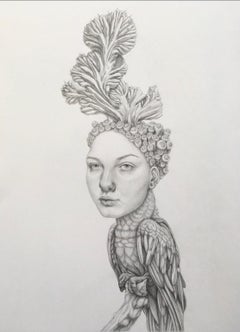
'Infanta Madre Tierra (Mother Earth)' features the face of a young woman with flora motif (top) and series of birds and flora motif (bottom) representing ...

Category

21st Century and Contemporary Realist Portrait Drawings and Watercolors

Materials

Paper, Pencil, Graphite

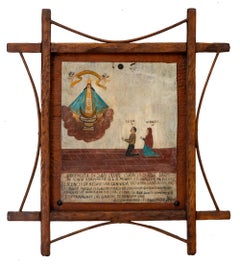
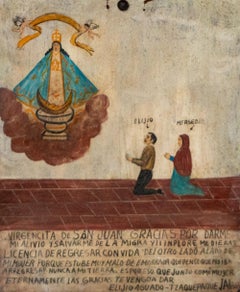
1920s Mexican Ex-Voto Retablo Painting – Safe Return Home Folk Art Oil on Tin

1920s Mexican Ex-Voto Retablo Painting – Safe Return Home Folk Art Oil on Tin

Located in Denver, CO

A moving and authentic 1920s Mexican Ex-Voto retablo painting depicting a heartfelt prayer of gratitude for a safe return home. Hand-painted in oil on tin, this devotional folk art p...

Category

1920s Folk Art Figurative Paintings

Materials

Metal

Infante & Infanta Mellizos

Infante & Infanta Mellizos

By Chikako Okada

Located in Burlingame, CA

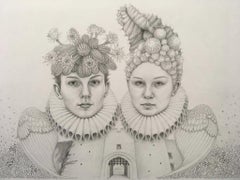
Chikako Okada’s autobiographical works of art bridge traditional realism with magical realism and surrealism. The artist uniquely addresses questions of the human condition through h...

Category

21st Century and Contemporary Realist Portrait Drawings and Watercolors

Materials

Paper, Pencil, Graphite

Freedom
Freedom

Freedom

By Chikako Okada

Located in Burlingame, CA

Chikako Okada’s autobiographical works of art bridge traditional realism with magical realism and surrealism. The artist uniquely addresses questions of the human condition through h...

Category

21st Century and Contemporary Realist Portrait Drawings and Watercolors

Materials

Paper, Pencil, Graphite

Growing Pains

Growing Pains

By Chikako Okada

Located in Burlingame, CA

Chikako Okada’s autobiographical works of art bridge traditional realism with magical realism and surrealism. The artist uniquely addresses questions of the human condition through her meticulously detailed, and patterned imagery. The work is mesmerizing, rich in symbolism, and reference feminine power, vulnerability, sadness, longing, and desire. Often featuring adolescent girls and boys that are mysteriously posed, the artist leaves the circumstances of her subjects to the viewer's interpretation. Chikako Okada is inspired by the paintings of European masters, Mexico's Frida Kahlo, and the American surrealists. The drawing is 23 1/4 X 18 1/4 inches. Professionally matted and framed in a museum quality rose gold wood...

Category

21st Century and Contemporary Realist Portrait Drawings and Watercolors

Materials

Paper, Pencil, Graphite

Shirin Neshat - Limited edition framed figurative photograph

Shirin Neshat - Limited edition framed figurative photograph

By Laurina Paperina

Located in East Quogue, NY

Limited edition framed figurative photograph titled "Shirin Neshat" by Laurina Paperina - Edition 3/3 Laurina Paperina, the artistic alter ego of Laura Scottini, pokes fun at art a...

Category

Early 2000s Contemporary Color Photography

Materials

Photographic Film, Photographic Paper

Composition, Feuilles éparses, Wifredo Lam 林飛龍

Composition, Feuilles éparses, Wifredo Lam 林飛龍

By Wifredo Lam

Located in Southampton, NY

Etching on vélin cuve de Rives paper. Inscription: Unsigned and unnumbered, as issued. Good condition. Notes: From the folio, Feuilles éparses, 1965. Published and printed by Louis B...

Category

1960s Modern Figurative Prints

Materials

Etching

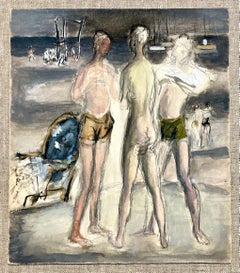
Simka Simkhovitch WPA W/C Painting Gouache American Modernist Beach Scene Nude

Simka Simkhovitch WPA W/C Painting Gouache American Modernist Beach Scene Nude

By Simka Simkhovitch

Located in Surfside, FL

Simka Simkhovitch (Russian/American 1893 - 1949) This came with a small grouping from the artist's family, some were hand signed some were not. These were studies for larger paintin...

Category

1930s American Modern Nude Paintings

Materials

Watercolor, Gouache, Board

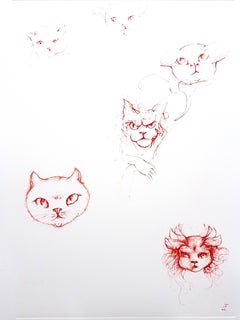
Leonor Fini - Red Cats - Original Etching

Leonor Fini - Red Cats - Original Etching

By Leonor Fini

Located in Collonge Bellerive, Geneve, CH

Leonor Fini - Cats - Original Engraving Mme.Helvetius' Cats Original etching created in 1985, Printed Signature (LF). Conditions: excellent Edition: 100 Support: Arches paper. Dimensions: Paper dimensions: 44 x 28 cm Editions: Moret, Paris. Leonor Fini is considered one of the most important women artists of the mid-twentieth century, along with Leonora Carrington, Frida Kahlo, Meret Oppenheim, Remedios Varo, and Dorothea Tanning – most of whom Fini knew well. Her career, which spanned some six decades, included painting, graphic design, book illustration, product design (the renowned torso-shaped perfume bottle for Schiaparelli’s Shocking), and set and costume design for theatre, ballet, opera, and film. In this compellingly readable, exhaustively researched account, author Peter Webb brings Fini’s provocative art and unconventional personal life, as well as the vibrant avant-garde world in which she revolved, vividly in life. Born in Buenos Aires in 1907 (August 30 – January 18, 1996, Paris) to Italian and Argentine parents, Leonor grew up in Trieste, Italy, raised by her strong-willed, independent mother, Malvina. She was a virtually self-taught artist, learing anatomy directly from studying cadavers in the local morgue and absorbing composition and technique from the Old Masters through books and visits to museums. Fini’s fledging attempts at painting in Trieste let her to Milan, where she participated in her first group exhibition in 1929, and then to Paris in 1931. Her vivacious personality and flamboyant attire instantly garnered her a spotlight in the Parisian art world and she soon developed close relationships with the leading surrealist writers and painters, including Paul Eluard, Salvador Dali, Man Ray, and Max Ernst, who became her lover for a time. The only surrealist she could not abide because of his misogyny was André Breton. Although she repeatedly exhibited with them, she never considered herself a surrealist. The American dealer Julien Levy, very much impressed by Fini’s painting and smitten by her eccentric charms, invited her to New York in 1936, where she took part in a joint gallery exhibition with Max Ernst and met many American surrealists, including Joseph Cornell and Pavel Tchelitchew. Her work was included in MoMA’s pivotal Fantastic Art, Dada and Surrealism exhibition, along with De Chirico, Dali, Ernst, and Yves Tanguy. In 1939 in Paris she curated an exhibition of surrealist furniture...

Category

1980s Modern Animal Prints

Materials

Etching

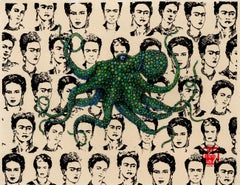
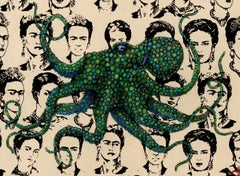
Frida Kahlopus: Green Sheet - Gyotaku Style Sumi Ink Painting of an Octopus

Frida Kahlopus: Green Sheet - Gyotaku Style Sumi Ink Painting of an Octopus

By Jeff Conroy

Located in Chicago, IL

A small octopus is inked in the Japanese style of Gyo-Taku print making over a playful background of black and white images of Frida Kahlo. Using sumi ink to "print" the octopus, th...

Category

21st Century and Contemporary Contemporary Animal Drawings and Watercolors

Materials

Sumi Ink, Watercolor, Mulberry Paper, Color Pencil

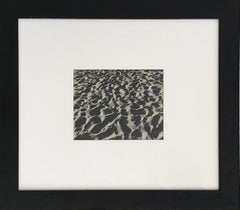
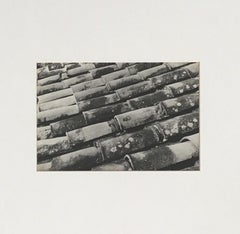
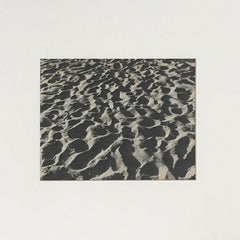
Techos, Mexico, Architectural landscape black and white Vintage Photograph.

Techos, Mexico, Architectural landscape black and white Vintage Photograph.

By Leo Matiz

Located in Miami Beach, FL

Black and white photographs that reveal the various facets and aesthetic searches of the legendary Colombian photographer, recognized as the creator of memorable realistic, abstract ...

Category

1940s Other Art Style Black and White Photography

Materials

Photographic Paper

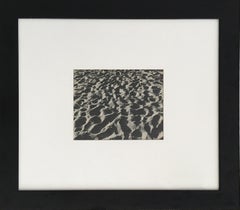
Arena de la Playa,  Landscape Vintage black and white Photograph

Arena de la Playa, Landscape Vintage black and white Photograph

By Leo Matiz

Located in Miami Beach, FL

Black and white photographs that reveal the various facets and aesthetic searches of the legendary Colombian photographer, recognized as the creator of memorable realistic, abstract ...

Category

1970s Other Art Style Black and White Photography

Materials

Photographic Paper

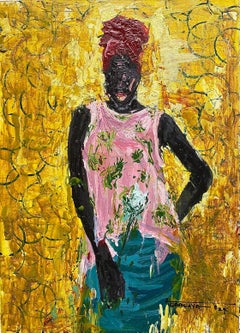
Once Given a White Rose 3 - 21st Century Contemporary, Impasto, Acrylic, Woman

Once Given a White Rose 3 - 21st Century Contemporary, Impasto, Acrylic, Woman

By Agbalaya Abdulahi Opeyemi

Located in Ibadan, Oyo

Shipping Procedure FREE Shipping Worldwide Ships in a well-protected tube from Nigeria This work is unique, not a print or other type of copy. Accompanied by a Certificate of Authenticity. Love is sacred. Love is pure. Love is giving one's totality. Love is not pretense. However, a deceptive love sequel results in a person's broken heart and soul, which later becomes stiff and resistant. There is stiffness and resistance because of the fear of being betrayed again, of being used and dumped, of being called a fool, and of being trampled upon. So, a firm NO is the response to each white rose given again and again. Once bitten, twice shy. Once given a white rose, twice careful of falling prey to the trap of deceptive love. Maybe one day, sincere love will come to stay. Till then, many white roses offered will be rejected with a sigh. This is the story of the lady here. About Artist Agbalaya Abdulahi...

Category

21st Century and Contemporary Contemporary Figurative Paintings

Materials

Acrylic, Cardboard

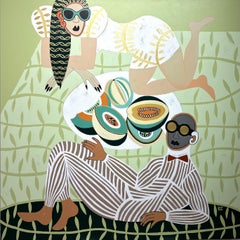
Picnic, Painting, Acrylic on Canvas

Picnic, Painting, Acrylic on Canvas

By Diana Rosa

Located in Yardley, PA

As a visual artist, Diana Rosa takes inspirations from an alternative upbringing where she closely connected with the natural landscape around her. Born and raised in Cuba shaped h...

Category

2010s Contemporary More Art

Materials

Acrylic

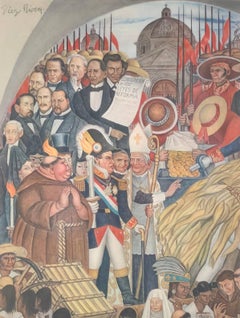
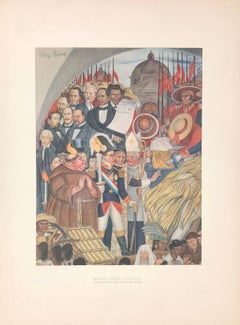
National Palace, Mexico City (Juarez and the Reform Laws)

National Palace, Mexico City (Juarez and the Reform Laws)

By (after) Diego Rivera

Located in Missouri, MO

(after) Diego Rivera "National Palace, Mexico City (Juarez and the Reform Laws) 1933 from the portfolio "Frescoes of Diego Rivera" Published by the Museum of Modern Art, NY Hand-Signed by the Artist Diego Rivera was born on December 13, 1886 in the mountain town of Guanajuato in Mexico. His mother was an ardent Catholic and his father was a rich and aristocratic revolutionary fighter and an atheist. Little Diego decided in favor of atheism. He swore his family had to leave Guanajuato when he was six because of his diatribes against the Church. When he was eleven he attended the San Carlos Academy of Fine Arts; his real teacher was Jose Posada...

Category

1930s Modern Figurative Prints

Materials

Lithograph

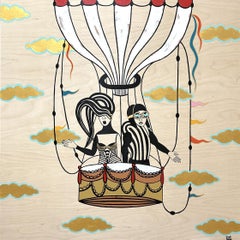
Aerostat, Painting, Acrylic on Wood Panel

Aerostat, Painting, Acrylic on Wood Panel

By Diana Rosa

Located in Yardley, PA

In a stylistic amalgam of Pop and folk, abstract and figurative, Diana Rosa takes inspirations from an alternative upbringing where she closely connected with the natural landscape ...

Category

2010s Surrealist Paintings

Materials

Acrylic

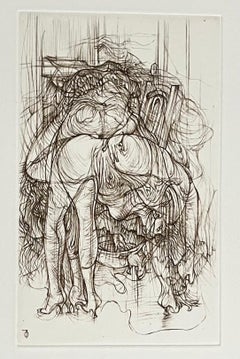
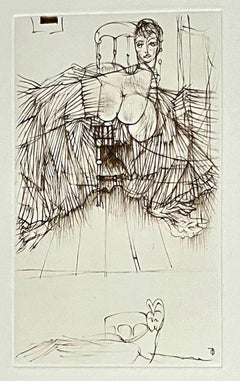
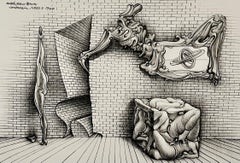
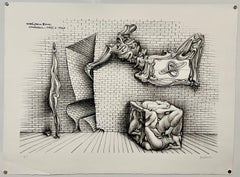
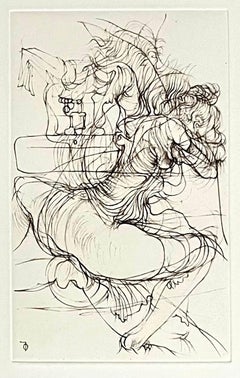
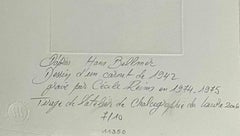
German Surrealist Hans Bellmer Etching Engraving Print Cecile Reims Surrealism

German Surrealist Hans Bellmer Etching Engraving Print Cecile Reims Surrealism

By Hans Bellmer

Located in Surfside, FL

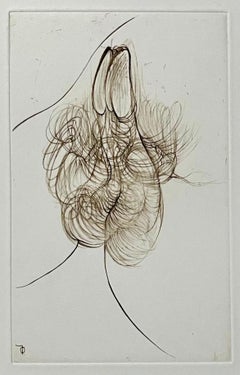
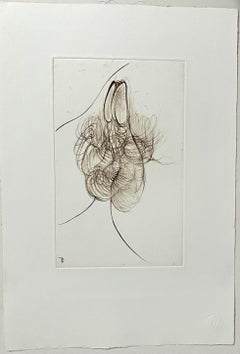
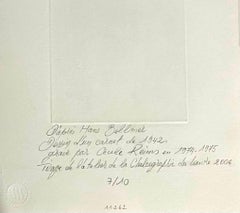
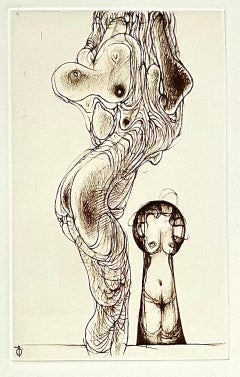
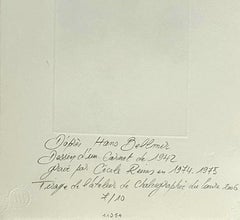
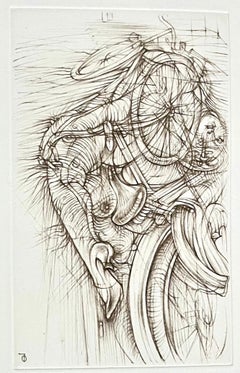
After Hans Bellmer (German, 1902-1975) Surrealist engraving, etching after drawings from a 1942 notebook, engraved in 1974-75 by Cecile Reims Printed by L'Atelier de Chalcographie du Louvre, Paris, Having printed monogram lower left in plate, pencil notations and #7/10 and 'Musee du Louvre' blindstamp verso Dimensions: Sheet 11 X 7.5, Plate size 6.5 X 4 Hans Bellmer ( 1902 – 1975) was a Polish born German artist, best known for his drawings, etchings that illustrates the 1940 edition of Histoire de l’œil, and the life-sized female sculpture mannequin dolls he produced in the mid-1930s. Historians of art and photography also consider him a Surrealist photographer. Bellmer was born in the city of Kattowitz, then part of the German Empire (now Katowice, Poland). Up until 1926, he worked as a draftsman for his own advertising company. Bellmer is most famous for the creation of a series of dolls as well as photographs of them. He was influenced in his choice of art form in part by reading the published letters of Oskar Kokoschka (Der Fetisch, 1925) and Surrealism. Bellmer's puppet doll project is also said to have been catalysed by a series of events in his personal life. Hans Bellmer takes credit for provoking a physical crisis in his father and brings his own artistic creativity into association with childhood insubordination and resentment toward a severe and humorless paternal authority. Perhaps this is one reason for the nearly universal, unquestioning acceptance in the literature of Bellmer's promotion of his art as a struggle against his father, the police, and ultimately, fascism and the state. Events of his personal life also including meeting a beautiful teenage cousin in 1932 (and perhaps other unattainable beauties), attending a performance of Jacques Offenbach's Tales of Hoffmann (in which a man falls tragically in love with an automaton), and receiving a box of his old toys. After these events, he began to actually construct his first dolls. In his works, Bellmer explicitly sexualized the doll as a young girl (his work bears connection to the works of Bathus). Hirschfeld has claimed (without further argumentation) that Bellmer initiated his doll project to oppose the fascism of the Nazi Party by declaring that he would make no work that would support the new German state. Represented by mutated forms and unconventional poses, his dolls (according to this view) were directed specifically at the cult of the perfect body then prominent in Germany. He visited Paris in 1935 and made contacts there, such as Paul Éluard, but returned to Berlin because his wife Margarete was dying of tuberculosis. He was part of the circle of Surrealist luminaries such as Man Ray, Marcel Duchamp, Max Ernst, Joan Miro, André Masson, René Magritte, Alberto Giacometti and Salvador Dali as well as women artists—such as Frida Kahlo, Dorothea Tanning and Leonora Carrington. Bellmer produced the first doll in Berlin in 1933. Long since lost, the assemblage can nevertheless be correctly described thanks to approximately two dozen photographs Bellmer took at the time of its construction. Standing about fifty-six inches tall, the doll consisted of a modeled torso made of flax fiber, glue, and plaster; a mask-like head of the same material with glass eyes and a long, unkempt wig; and a pair of legs made from broomsticks or dowel rods. One of these legs terminated in a wooden, club-like foot; the other was encased in a more naturalistic plaster shell, jointed at the knee and ankle. As the project progressed, Bellmer made a second set of hollow plaster legs, with wooden ball joints for the doll's hips and knees. There were no arms to the first sculpture, but Bellmer did fashion or find a single wooden hand, which appears among the assortment of doll parts the artist documented in an untitled photograph of 1934, as well as in several photographs of later work. Bellmer's 1934 anonymous book, The Doll (Die Puppe), produced and published privately in Germany, contains 10 black-and-white photographs of Bellmer's first doll arranged in a series of "tableaux vivants" (living pictures). The book was not credited to him, as he worked in isolation, and his photographs remained almost unknown in Germany. Yet Bellmer's work was eventually declared "degenerate" (entartete kunst) by the Nazi Party, and he was forced to flee Germany to France in 1938, where Bellmer's work was welcomed by the Surrealists around Andre Breton. He aided the French Resistance during the war by making fake passports. He was imprisoned in the Camp des Milles prison at Aix-en-Provence, a brickworks camp for German nationals, from September 1939 until the end of the Phoney War in May 1940. After the war, Bellmer lived the rest of his life in Paris. Bellmer gave up doll-making and spent the following decades creating erotic drawings, etchings, sexually explicit photographs, paintings, and prints of pubescent girls. In 1954, he met Unica Zürn...

Category

20th Century Abstract Prints

Materials

Etching

War and Peace Acrylic on Canvas, Abstract Expressionist, Signed, 2025

War and Peace Acrylic on Canvas, Abstract Expressionist, Signed, 2025

By Nerea Caos

Located in Sitges, Barcelona

Title: War and Peace Artist: Nerea Caos Technique: Acrylic on canvas Dimensions: 60 x 40 cm (23.6 x 15.7 in) Support: Stretched canvas Date: 2025 Signature: Signed on the back ...

Category

2010s Abstract Expressionist Abstract Paintings

Materials

Canvas, Acrylic

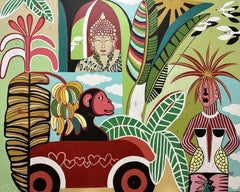
What happens in the jungle stays in the jungle, Painting, Acrylic on Canvas

What happens in the jungle stays in the jungle, Painting, Acrylic on Canvas

By Diana Rosa

Located in Yardley, PA

In a stylistic amalgam of Pop and folk, abstract and figurative, Diana Rosa takes inspirations from an alternative upbringing where she closely connected with the natural landscape a...

Category

21st Century and Contemporary Contemporary Paintings

Materials

Acrylic

German Surrealist Hans Bellmer Etching Engraving Print Cecile Reims Surrealism

German Surrealist Hans Bellmer Etching Engraving Print Cecile Reims Surrealism

By Hans Bellmer

Located in Surfside, FL

After Hans Bellmer (German, 1902-1975) Surrealist engraving, etching after drawings from a 1942 notebook, engraved in 1974-75 by Cecile Reims Printed by L'Atelier de Chalcographie du Louvre, Paris, Having printed monogram lower left in plate, pencil notations and #7/10 and 'Musee du Louvre' blindstamp verso Dimensions: Sheet 11 X 7.5, Plate size 6.5 X 4 Hans Bellmer ( 1902 – 1975) was a Polish born German artist, best known for his drawings, etchings that illustrates the 1940 edition of Histoire de l’œil, and the life-sized female sculpture mannequin dolls he produced in the mid-1930s. Historians of art and photography also consider him a Surrealist photographer. Bellmer was born in the city of Kattowitz, then part of the German Empire (now Katowice, Poland). Up until 1926, he worked as a draftsman for his own advertising company. Bellmer is most famous for the creation of a series of dolls as well as photographs of them. He was influenced in his choice of art form in part by reading the published letters of Oskar Kokoschka (Der Fetisch, 1925) and Surrealism. Bellmer's puppet doll project is also said to have been catalysed by a series of events in his personal life. Hans Bellmer takes credit for provoking a physical crisis in his father and brings his own artistic creativity into association with childhood insubordination and resentment toward a severe and humorless paternal authority. Perhaps this is one reason for the nearly universal, unquestioning acceptance in the literature of Bellmer's promotion of his art as a struggle against his father, the police, and ultimately, fascism and the state. Events of his personal life also including meeting a beautiful teenage cousin in 1932 (and perhaps other unattainable beauties), attending a performance of Jacques Offenbach's Tales of Hoffmann (in which a man falls tragically in love with an automaton), and receiving a box of his old toys. After these events, he began to actually construct his first dolls. In his works, Bellmer explicitly sexualized the doll as a young girl (his work bears connection to the works of Bathus). Hirschfeld has claimed (without further argumentation) that Bellmer initiated his doll project to oppose the fascism of the Nazi Party by declaring that he would make no work that would support the new German state. Represented by mutated forms and unconventional poses, his dolls (according to this view) were directed specifically at the cult of the perfect body then prominent in Germany. He visited Paris in 1935 and made contacts there, such as Paul Éluard, but returned to Berlin because his wife Margarete was dying of tuberculosis. He was part of the circle of Surrealist luminaries such as Man Ray, Marcel Duchamp, Max Ernst, Joan Miro, André Masson, René Magritte, Alberto Giacometti and Salvador Dali as well as women artists—such as Frida Kahlo, Dorothea Tanning and Leonora Carrington. Bellmer produced the first doll in Berlin in 1933. Long since lost, the assemblage can nevertheless be correctly described thanks to approximately two dozen photographs Bellmer took at the time of its construction. Standing about fifty-six inches tall, the doll consisted of a modeled torso made of flax fiber, glue, and plaster; a mask-like head of the same material with glass eyes and a long, unkempt wig; and a pair of legs made from broomsticks or dowel rods. One of these legs terminated in a wooden, club-like foot; the other was encased in a more naturalistic plaster shell, jointed at the knee and ankle. As the project progressed, Bellmer made a second set of hollow plaster legs, with wooden ball joints for the doll's hips and knees. There were no arms to the first sculpture, but Bellmer did fashion or find a single wooden hand, which appears among the assortment of doll parts the artist documented in an untitled photograph of 1934, as well as in several photographs of later work. Bellmer's 1934 anonymous book, The Doll (Die Puppe), produced and published privately in Germany, contains 10 black-and-white photographs of Bellmer's first doll arranged in a series of "tableaux vivants" (living pictures). The book was not credited to him, as he worked in isolation, and his photographs remained almost unknown in Germany. Yet Bellmer's work was eventually declared "degenerate" (entartete kunst) by the Nazi Party, and he was forced to flee Germany to France in 1938, where Bellmer's work was welcomed by the Surrealists around Andre Breton. He aided the French Resistance during the war by making fake passports. He was imprisoned in the Camp des Milles prison at Aix-en-Provence, a brickworks camp for German nationals, from September 1939 until the end of the Phoney War in May 1940. After the war, Bellmer lived the rest of his life in Paris. Bellmer gave up doll-making and spent the following decades creating erotic drawings, etchings, sexually explicit photographs, paintings, and prints of pubescent girls. In 1954, he met Unica Zürn...

Category

20th Century Abstract Prints

Materials

Etching

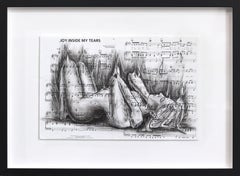
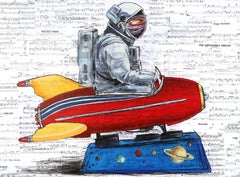
Escaping Your Memory - Original Mixed Media Surrealist Art Framed

Escaping Your Memory - Original Mixed Media Surrealist Art Framed

Located in Los Angeles, CA

Robert Lebsack creates artworks using mixed media with ink, acrylic, and charcoal on archival copies of newspapers, textbooks, and sheet music. As a visionary artist, Lebsack weaves ...

Category

21st Century and Contemporary Pop Art Mixed Media

Materials

Charcoal, Ink, Mixed Media, Acrylic, Archival Paper

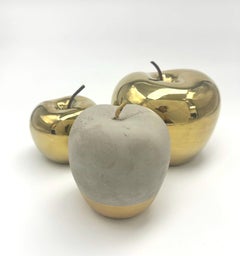
Apples of Eden, Porcelain Art Decor, Installation, Metal, Concrete, Gold, Gift

Apples of Eden, Porcelain Art Decor, Installation, Metal, Concrete, Gold, Gift

By Kristina Oganezz

Located in Granada Hills, CA

Artist: Kristina Oganezz Work: Art Installation / Art decor Medium: Porcelaine, Concrete Year: 2024 Color: Metal Gold Title: Apples of Eden Set Size: H 5.5" x Diameter 6.0" inch, 1...

Category

2010s Impressionist Still-life Sculptures

Materials

Concrete, Gold Leaf

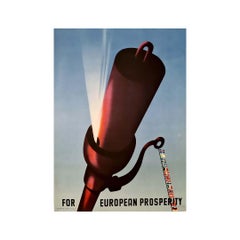
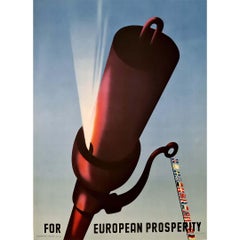
WWII Original poster for European Prosperity - European Recovery Program

WWII Original poster for European Prosperity - European Recovery Program

Located in PARIS, FR

Original poster created by Wladimir Flem. Wladimir Flem was born in 1910 and was primarily inspired creatively by the 1930s. The period of the 1930s was characterized by the conflict between many political ideologies, including Marxist socialism, capitalist democracy and the totalitarianism of communism and fascism. Surrealism continued to dominate in Europe and had an international influence. Artists such as Frida Kahlo and Diego Riviera...

Category

1940s Prints and Multiples

Materials

Paper

He Knows
He Knows

He Knows

By Chikako Okada

Located in Burlingame, CA

'He Knows' features the beautiful face of a boy with down syndrome encircled with lace and shrouded in dignified mystery. The small painting is 7 x 5 1/2 inches, framed 8 3/4 x 7 1/4...

Category

21st Century and Contemporary Realist Figurative Paintings

Materials

Wood, Oil

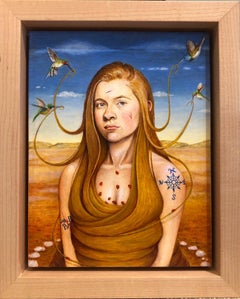
She's Got a Ticket to Ride / oil on wood

She's Got a Ticket to Ride / oil on wood

By Chikako Okada

Located in Burlingame, CA

'She's Got a Ticket to Ride' features a long haired young woman with hummingbirds, who is shrouded in mystery. Tattooed and decorated with ladybugs and sitting within a ring of stone...

Category

21st Century and Contemporary Realist Figurative Paintings

Materials

Wood, Oil

He Knows
He Knows

He Knows

By Chikako Okada

Located in Burlingame, CA

'He Knows' features the beautiful face of a boy with down syndrome encircled with lace and shrouded in dignified mystery. The small painting is 7 x 5 1/2 inches, framed 8 3/4 x 7 1/4...

Category

21st Century and Contemporary Realist Figurative Paintings

Materials

Wood, Oil

Frida - 3D

Frida - 3D

By Reisig and Taylor

Located in New York, NY

An homage to the great Frida Kahlo. About the Artists: Animated through an assemblage of analog, digital, and lenticular photographic technologies, these selections from Reisig and...

Category

2010s Conceptual More Art

Materials

Lenticular

Banana Express, Painting, Acrylic on Canvas

Banana Express, Painting, Acrylic on Canvas

By Diana Rosa

Located in Yardley, PA

In a stylistic amalgam of Pop and folk, abstract and figurative, Diana Rosa takes inspirations from an alternative upbringing where she closely connected with the natural landscape ...

Category

2010s Surrealist Paintings

Materials

Acrylic

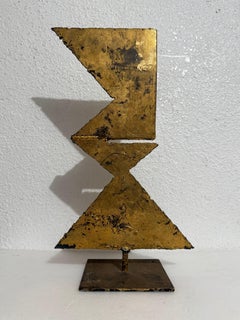
Mexican Art Abstract Brutalist Gilt Steel Geometric Sculpture Mathias Goeritz

Mexican Art Abstract Brutalist Gilt Steel Geometric Sculpture Mathias Goeritz

By Mathias Goeritz

Located in Surfside, FL

Mathias Goeritz (German Mexican, 1915-1990) Geometric Torch-cut Steel or Iron Sculpture with gold leaf gilding. Welded signature, MG. This came from an estate and is signed with his ...

Category

20th Century Modern Abstract Sculptures

Materials

Iron, Gold Leaf, Steel

German Surrealist Hans Bellmer Etching Engraving Print Cecile Reims Surrealism

German Surrealist Hans Bellmer Etching Engraving Print Cecile Reims Surrealism

By Hans Bellmer

Located in Surfside, FL

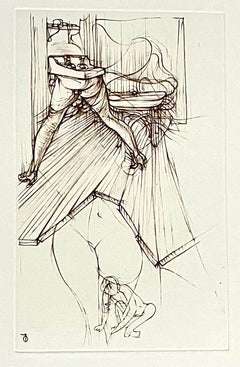
After Hans Bellmer (German, 1902-1975) Surrealist engraving, etching after drawings from a 1942 notebook, engraved in 1974-75 by Cecile Reims Printed by L'Atelier de Chalcographie du Louvre, Paris, Having printed monogram lower left in plate, pencil notations verso Editioned from a very small edition of #7/10 'Musee du Louvre' blindstamp. Dimensions: Sheet 11 X 7.5, Plate size 6.5 X 4 Hans Bellmer ( 1902 – 1975) was a Polish born German artist, best known for his drawings, etchings that illustrates the 1940 edition of Histoire de l’œil, and the life-sized female sculpture mannequin dolls he produced in the mid-1930s. Historians of art and photography also consider him a Surrealist photographer. Bellmer was born in the city of Kattowitz, then part of the German Empire (now Katowice, Poland). Up until 1926, he worked as a draftsman for his own advertising company. Bellmer is most famous for the creation of a series of dolls as well as photographs of them. He was influenced in his choice of art form in part by reading the published letters of Oskar Kokoschka (Der Fetisch, 1925) and Surrealism. Bellmer's puppet doll project is also said to have been catalysed by a series of events in his personal life. Hans Bellmer takes credit for provoking a physical crisis in his father and brings his own artistic creativity into association with childhood insubordination and resentment toward a severe and humorless paternal authority. Perhaps this is one reason for the nearly universal, unquestioning acceptance in the literature of Bellmer's promotion of his art as a struggle against his father, the police, and ultimately, fascism and the state. Events of his personal life also including meeting a beautiful teenage cousin in 1932 (and perhaps other unattainable beauties), attending a performance of Jacques Offenbach's Tales of Hoffmann (in which a man falls tragically in love with an automaton), and receiving a box of his old toys. After these events, he began to actually construct his first dolls. In his works, Bellmer explicitly sexualized the doll as a young girl (his work bears connection to the works of Bathus). Hirschfeld has claimed (without further argumentation) that Bellmer initiated his doll project to oppose the fascism of the Nazi Party by declaring that he would make no work that would support the new German state. Represented by mutated forms and unconventional poses, his dolls (according to this view) were directed specifically at the cult of the perfect body then prominent in Germany. He visited Paris in 1935 and made contacts there, such as Paul Éluard, but returned to Berlin because his wife Margarete was dying of tuberculosis. He was part of the circle of Surrealist luminaries such as Man Ray, Marcel Duchamp, Max Ernst, Joan Miro, André Masson, René Magritte, Alberto Giacometti and Salvador Dali as well as women artists—such as Frida Kahlo, Dorothea Tanning and Leonora Carrington. Bellmer produced the first doll in Berlin in 1933. Long since lost, the assemblage can nevertheless be correctly described thanks to approximately two dozen photographs Bellmer took at the time of its construction. Standing about fifty-six inches tall, the doll consisted of a modeled torso made of flax fiber, glue, and plaster; a mask-like head of the same material with glass eyes and a long, unkempt wig; and a pair of legs made from broomsticks or dowel rods. One of these legs terminated in a wooden, club-like foot; the other was encased in a more naturalistic plaster shell, jointed at the knee and ankle. As the project progressed, Bellmer made a second set of hollow plaster legs, with wooden ball joints for the doll's hips and knees. There were no arms to the first sculpture, but Bellmer did fashion or find a single wooden hand, which appears among the assortment of doll parts the artist documented in an untitled photograph of 1934, as well as in several photographs of later work. Bellmer's 1934 anonymous book, The Doll (Die Puppe), produced and published privately in Germany, contains 10 black-and-white photographs of Bellmer's first doll arranged in a series of "tableaux vivants" (living pictures). The book was not credited to him, as he worked in isolation, and his photographs remained almost unknown in Germany. Yet Bellmer's work was eventually declared "degenerate" (entartete kunst) by the Nazi Party, and he was forced to flee Germany to France in 1938, where Bellmer's work was welcomed by the Surrealists around Andre Breton. He aided the French Resistance during the war by making fake passports. He was imprisoned in the Camp des Milles prison at Aix-en-Provence, a brickworks camp for German nationals, from September 1939 until the end of the Phoney War in May 1940. After the war, Bellmer lived the rest of his life in Paris. Bellmer gave up doll-making and spent the following decades creating erotic drawings, etchings, sexually explicit photographs, paintings, and prints of pubescent girls. In 1954, he met Unica Zürn...

Category

20th Century Abstract Prints

Materials

Etching

German Surrealist Hans Bellmer Etching Engraving Print Cecile Reims Surrealism

German Surrealist Hans Bellmer Etching Engraving Print Cecile Reims Surrealism

By Hans Bellmer

Located in Surfside, FL

After Hans Bellmer (German, 1902-1975) Surrealist engraving, etching after drawings from a 1942 notebook, engraved in 1974-75 by Cecile Reims Printed by L'Atelier de Chalcographie du Louvre, Paris, Having printed monogram lower left in plate, pencil notations verso Editioned from a very small edition of #7/10 'Musee du Louvre' blindstamp. Dimensions: Sheet 11 X 7.5, Plate size 6.5 X 4 Hans Bellmer ( 1902 – 1975) was a Polish born German artist, best known for his drawings, etchings that illustrates the 1940 edition of Histoire de l’œil, and the life-sized female sculpture mannequin dolls he produced in the mid-1930s. Historians of art and photography also consider him a Surrealist photographer. Bellmer was born in the city of Kattowitz, then part of the German Empire (now Katowice, Poland). Up until 1926, he worked as a draftsman for his own advertising company. Bellmer is most famous for the creation of a series of dolls as well as photographs of them. He was influenced in his choice of art form in part by reading the published letters of Oskar Kokoschka (Der Fetisch, 1925) and Surrealism. Bellmer's puppet doll project is also said to have been catalysed by a series of events in his personal life. Hans Bellmer takes credit for provoking a physical crisis in his father and brings his own artistic creativity into association with childhood insubordination and resentment toward a severe and humorless paternal authority. Perhaps this is one reason for the nearly universal, unquestioning acceptance in the literature of Bellmer's promotion of his art as a struggle against his father, the police, and ultimately, fascism and the state. Events of his personal life also including meeting a beautiful teenage cousin in 1932 (and perhaps other unattainable beauties), attending a performance of Jacques Offenbach's Tales of Hoffmann (in which a man falls tragically in love with an automaton), and receiving a box of his old toys. After these events, he began to actually construct his first dolls. In his works, Bellmer explicitly sexualized the doll as a young girl (his work bears connection to the works of Bathus). Hirschfeld has claimed (without further argumentation) that Bellmer initiated his doll project to oppose the fascism of the Nazi Party by declaring that he would make no work that would support the new German state. Represented by mutated forms and unconventional poses, his dolls (according to this view) were directed specifically at the cult of the perfect body then prominent in Germany. He visited Paris in 1935 and made contacts there, such as Paul Éluard, but returned to Berlin because his wife Margarete was dying of tuberculosis. He was part of the circle of Surrealist luminaries such as Man Ray, Marcel Duchamp, Max Ernst, Joan Miro, André Masson, René Magritte, Alberto Giacometti and Salvador Dali as well as women artists—such as Frida Kahlo, Dorothea Tanning and Leonora Carrington. Bellmer produced the first doll in Berlin in 1933. Long since lost, the assemblage can nevertheless be correctly described thanks to approximately two dozen photographs Bellmer took at the time of its construction. Standing about fifty-six inches tall, the doll consisted of a modeled torso made of flax fiber, glue, and plaster; a mask-like head of the same material with glass eyes and a long, unkempt wig; and a pair of legs made from broomsticks or dowel rods. One of these legs terminated in a wooden, club-like foot; the other was encased in a more naturalistic plaster shell, jointed at the knee and ankle. As the project progressed, Bellmer made a second set of hollow plaster legs, with wooden ball joints for the doll's hips and knees. There were no arms to the first sculpture, but Bellmer did fashion or find a single wooden hand, which appears among the assortment of doll parts the artist documented in an untitled photograph of 1934, as well as in several photographs of later work. Bellmer's 1934 anonymous book, The Doll (Die Puppe), produced and published privately in Germany, contains 10 black-and-white photographs of Bellmer's first doll arranged in a series of "tableaux vivants" (living pictures). The book was not credited to him, as he worked in isolation, and his photographs remained almost unknown in Germany. Yet Bellmer's work was eventually declared "degenerate" (entartete kunst) by the Nazi Party, and he was forced to flee Germany to France in 1938, where Bellmer's work was welcomed by the Surrealists around Andre Breton. He aided the French Resistance during the war by making fake passports. He was imprisoned in the Camp des Milles prison at Aix-en-Provence, a brickworks camp for German nationals, from September 1939 until the end of the Phoney War in May 1940. After the war, Bellmer lived the rest of his life in Paris. Bellmer gave up doll-making and spent the following decades creating erotic drawings, etchings, sexually explicit photographs, paintings, and prints of pubescent girls. In 1954, he met Unica Zürn...

Category

20th Century Abstract Prints

Materials

Etching

German Surrealist Hans Bellmer Etching Engraving Print Cecile Reims Surrealism

German Surrealist Hans Bellmer Etching Engraving Print Cecile Reims Surrealism

By Hans Bellmer

Located in Surfside, FL

After Hans Bellmer (German, 1902-1975) Surrealist engraving, etching after drawings from a 1942 notebook, engraved in 1974-75 by Cecile Reims Printed by L'Atelier de Chalcographie du Louvre, Paris, Having printed monogram lower left in plate, pencil notations verso Editioned from a very small edition of #7/10 and 'Musee du Louvre' blindstamp. Dimensions: Sheet 11 X 7.5, Plate size 6.5 X 4 Hans Bellmer ( 1902 – 1975) was a Polish born German artist, best known for his drawings, etchings that illustrates the 1940 edition of Histoire de l’œil, and the life-sized female sculpture mannequin dolls he produced in the mid-1930s. Historians of art and photography also consider him a Surrealist photographer. Bellmer was born in the city of Kattowitz, then part of the German Empire (now Katowice, Poland). Up until 1926, he worked as a draftsman for his own advertising company. Bellmer is most famous for the creation of a series of dolls as well as photographs of them. He was influenced in his choice of art form in part by reading the published letters of Oskar Kokoschka (Der Fetisch, 1925) and Surrealism. Bellmer's puppet doll project is also said to have been catalysed by a series of events in his personal life. Hans Bellmer takes credit for provoking a physical crisis in his father and brings his own artistic creativity into association with childhood insubordination and resentment toward a severe and humorless paternal authority. Perhaps this is one reason for the nearly universal, unquestioning acceptance in the literature of Bellmer's promotion of his art as a struggle against his father, the police, and ultimately, fascism and the state. Events of his personal life also including meeting a beautiful teenage cousin in 1932 (and perhaps other unattainable beauties), attending a performance of Jacques Offenbach's Tales of Hoffmann (in which a man falls tragically in love with an automaton), and receiving a box of his old toys. After these events, he began to actually construct his first dolls. In his works, Bellmer explicitly sexualized the doll as a young girl (his work bears connection to the works of Bathus). Hirschfeld has claimed (without further argumentation) that Bellmer initiated his doll project to oppose the fascism of the Nazi Party by declaring that he would make no work that would support the new German state. Represented by mutated forms and unconventional poses, his dolls (according to this view) were directed specifically at the cult of the perfect body then prominent in Germany. He visited Paris in 1935 and made contacts there, such as Paul Éluard, but returned to Berlin because his wife Margarete was dying of tuberculosis. He was part of the circle of Surrealist luminaries such as Man Ray, Marcel Duchamp, Max Ernst, Joan Miro, André Masson, René Magritte, Alberto Giacometti and Salvador Dali as well as women artists—such as Frida Kahlo, Dorothea Tanning and Leonora Carrington. Bellmer produced the first doll in Berlin in 1933. Long since lost, the assemblage can nevertheless be correctly described thanks to approximately two dozen photographs Bellmer took at the time of its construction. Standing about fifty-six inches tall, the doll consisted of a modeled torso made of flax fiber, glue, and plaster; a mask-like head of the same material with glass eyes and a long, unkempt wig; and a pair of legs made from broomsticks or dowel rods. One of these legs terminated in a wooden, club-like foot; the other was encased in a more naturalistic plaster shell, jointed at the knee and ankle. As the project progressed, Bellmer made a second set of hollow plaster legs, with wooden ball joints for the doll's hips and knees. There were no arms to the first sculpture, but Bellmer did fashion or find a single wooden hand, which appears among the assortment of doll parts the artist documented in an untitled photograph of 1934, as well as in several photographs of later work. Bellmer's 1934 anonymous book, The Doll (Die Puppe), produced and published privately in Germany, contains 10 black-and-white photographs of Bellmer's first doll arranged in a series of "tableaux vivants" (living pictures). The book was not credited to him, as he worked in isolation, and his photographs remained almost unknown in Germany. Yet Bellmer's work was eventually declared "degenerate" (entartete kunst) by the Nazi Party, and he was forced to flee Germany to France in 1938, where Bellmer's work was welcomed by the Surrealists around Andre Breton. He aided the French Resistance during the war by making fake passports. He was imprisoned in the Camp des Milles prison at Aix-en-Provence, a brickworks camp for German nationals, from September 1939 until the end of the Phoney War in May 1940. After the war, Bellmer lived the rest of his life in Paris. Bellmer gave up doll-making and spent the following decades creating erotic drawings, etchings, sexually explicit photographs, paintings, and prints of pubescent girls. In 1954, he met Unica Zürn...

Category

20th Century Abstract Prints

Materials

Etching

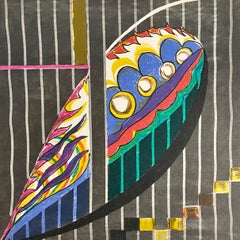
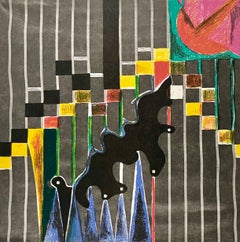
Feminist Surrealist French Abstract Colorful Lithograph Print Myriam Bat Yosef

Feminist Surrealist French Abstract Colorful Lithograph Print Myriam Bat Yosef

By Myriam Bat Yosef

Located in Surfside, FL

Myriam Bat-Yosef Surrealist abstract lithograph print in colorful abstract shapes and shades Hand signed and dated 1971. sheet measures 9.25 X 9.25 inches The envelope and the Peter Buch poster is just for provenance and is not included in this sale. Myriam Bat-Yosef, whose real name is Marion Hellerman, born on January 31, 1931 in Berlin, Germany to a Jewish family from Lithuania, she is an Israeli-Icelandic artist who paints on papers, paintings, fabrics, objects and human beings for performances. Myriam Bat-Yosef currently lives and works in Paris. In 1933, her family fleeing the Nazi Holocaust, Miriam Bat-Yosef emigrates to Palestine and settles in Jaffa. In 1936, she suffers a family tragedy, her father, militant Zionist, is called to fight, still recovering from an operation of appendicitis. The incision will become infected, antibiotics did not exist yet, and her father will die in the hospital after 9 months of suffering. Myriam and her mother leave Palestine to live in Paris for three years. French is Myriam's first school language. In 1939, still fleeing Nazism, she returned to Palestine, leaving France by the last boat from Marseille. She moved to Tel Aviv with her mother, aunt and maternal grandmother. In 1940, she began attending the Academy of Fine Arts in Tel Aviv and took her name as an artist, Bat-Yosef, which means Joseph's daughter in Hebrew, as a tribute to her father. In 1946, Myriam graduated as a kindergarten teacher but wanted to be an artist. Her mother enrolled her in an evening school to prepare a diploma of art teacher. At 19, she performs two years of military service in Israel. In 1952, with a pension of $50 a month that her mother allocated, she went to study at the Beaux-Arts in Paris. To survive, she has several activities while studying. In 1955, she had her first solo exhibition, at the Israeli Club on Wagram Avenue in Paris. Many artists, such as Yaacov Agam, Yehuda Neiman Avigdor Arikha, Raffi Kaiser, Dani Karavan and sculptors Achiam and Shlomo Selinger attended the opening . In 1956, she enrolled at the School of Fine Arts in Florence. This is where she meets the painter Errô. They share an icy studio in winter. Myriam moves to Milan with friends. She organizes a joint exhibition with Erro, one room each, at the Montenapoleone gallery. Her works are admired by the sculptor Marino Marini and the painters Renato Birolli and Enrico Prampolini. Myriam and Erro exhibit in Rome, Milan, Florence and meet many personalities: Alain Jouffroy and his wife, the painter Manina, Roberto Matta and his wife Malitte, textile artist who was one of the founders of the Pompidou Center. Back in Paris, Myriam and Erro get married, which allows Myriam to avoid being called into the Israeli army during the Suez Canal War. In 1957, Myriam and her husband went to Iceland. Myriam works in a chocolate factory. Having enough money, she starts producing art again. She exhibited in Reykjavik's first art gallery. She meets the artist Sigridur Bjornsdottir, married to the Swiss painter Dieter Roth . In 1958, Myriam and her husband leave for Israel. They exhibit in Germany, then in Israel. Back in Paris, the couple became friends with artists of the surrealist movement, such as Victor Brauner, Hans Bellmer, the sculptor Philippe Hiquily, Liliane Lijn, future wife of Takis and photographer Nathalie Waag. Erro and Myriam have a daughter on March 15, 1960, named Tura, after the painter Cosmè Tura, but also close to the Icelandic Thora or the Hebrew Torah. Bat-Yosef’s complex trajectory throughout the 20th century is linked as much to the transnational history of what was for a time called the School of Paris as it is to a certain legacy of Surrealism. Her work features the same idea of resolving antinomies that also defined the spirit of surrealism, and is enhanced with her readings of the Kabbalah and her spiritual grounding in Taoism. However, while there are reasons for her approach to be associated with the process of the ready-made, it is important to consider the immediate intrication of these works with her practice of performance, during which the body itself is also painted – a feminist response to Yves Klein’s Anthropometries (1960) and an echo of the happenings which Jean-Jacques Lebel organised at the time in Paris. In 1963, Erró told Myriam that if she wants to be a painter, she can not be his wife. Myriam chose to be a painter and the couple divorced in 1964. Since that time, Myriam Bat-Yosef has exhibited in many countries: Europe, United States, Japan, etc. Although long in the shadows, the work of Myriam Bat-Yosef has been greeted by many artists and personalities: Anaïs Nin, Nancy Huston, André Pieyre of Mandiargues, José Pierre, René de Solier , Jacques Lacarrière, Alain Bosquet, Pierre Restany, Sarane Alexandrian and Surrealist André Breton who, after a visit to her studio, confided to having been intrigued by its phantasmagorical dimension. She was included in the book Pop Art and Beyond: Gender, Race, and Class in the Global Sixties by Mona Hadler and Kalliopi Minioudaki. Extract "World Citizen, Artist of the Pop Era Sarah Wilson; Why do we know so little of Myriam Bat-Yosef, the most important female Israeli artist of the Pop era? Issues of identity and sexuality feature constantly in her work. She exhibited internationally from Reykjavik to Tokyo; she had two shows at Arturo Schwarz’s famous Dada/surrealist gallery in Milan; she participated in feminist art events in Los Angeles. Above all, in 1971, she conceived Total Art, a Pop Gesamtkunstwerk inside and outside the Israel Museum, Jerusalem. Painter, performer, and installation artist, she was also a lover, wife, and mother. Of Lithuanian-Jewish descent, she was close to the family of philosopher Emmanuel Levinas. An émigré in Paris she would repudiate a national passport, participating in Garry Davis’s short-lived “World Citizens” movement. She continues the lineage of women surrealist artists: Valentine Hugo, Leonor Fini, Dorothea Tanning, Leonora Carrington, Unica Zürn, Jane Graverol...

Category

1970s Surrealist Abstract Prints
Materials

Lithograph

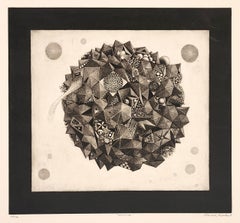
Techtite

Leonard MarchantTechtite, 1980

$722Sale Price|34% Off

Techtite

Located in Kansas City, MO

Leonard Marchant Techtite Messotint Engraving Year: circa 1980 Size: 13.6x14.75 on 31x23in Edition: 70 Signed, inscribed and numbered by hand Drystamp lower left COA provided Ref.: 9...

Category

1970s Modern Figurative Prints

Materials

Engraving

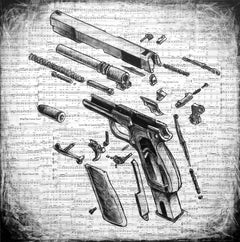
Rhapsody of Love - Original Disassembled Gun Abstract Realistic Painting

Rhapsody of Love - Original Disassembled Gun Abstract Realistic Painting

Located in Los Angeles, CA

Robert Lebsack creates artworks using mixed media with ink, acrylic, and charcoal on archival copies of newspapers, textbooks, and sheet music. As a visionary artist, Lebsack weaves ...

Category

21st Century and Contemporary Street Art Figurative Paintings

Materials

Ink, Mixed Media, Wood Panel, Archival Paper

Feminist Surrealist French Abstract Colorful Lithograph Print Myriam Bat Yosef

Feminist Surrealist French Abstract Colorful Lithograph Print Myriam Bat Yosef

By Myriam Bat Yosef

Located in Surfside, FL

Myriam Bat-Yosef Surrealist abstract lithograph print in colorful abstract shapes and shades Hand signed and dated 1971. sheet measures 9.25 X 9.25 inches The envelope and the Peter Buch poster is just for provenance and is not included in this sale. Myriam Bat-Yosef, whose real name is Marion Hellerman, born on January 31, 1931 in Berlin, Germany to a Jewish family from Lithuania, she is an Israeli-Icelandic artist who paints on papers, paintings, fabrics, objects and human beings for performances. Myriam Bat-Yosef currently lives and works in Paris. In 1933, her family fleeing the Nazi Holocaust, Miriam Bat-Yosef emigrates to Palestine and settles in Jaffa. In 1936, she suffers a family tragedy, her father, militant Zionist, is called to fight, still recovering from an operation of appendicitis. The incision will become infected, antibiotics did not exist yet, and her father will die in the hospital after 9 months of suffering. Myriam and her mother leave Palestine to live in Paris for three years. French is Myriam's first school language. In 1939, still fleeing Nazism, she returned to Palestine, leaving France by the last boat from Marseille. She moved to Tel Aviv with her mother, aunt and maternal grandmother. In 1940, she began attending the Academy of Fine Arts in Tel Aviv and took her name as an artist, Bat-Yosef, which means Joseph's daughter in Hebrew, as a tribute to her father. In 1946, Myriam graduated as a kindergarten teacher but wanted to be an artist. Her mother enrolled her in an evening school to prepare a diploma of art teacher. At 19, she performs two years of military service in Israel. In 1952, with a pension of $50 a month that her mother allocated, she went to study at the Beaux-Arts in Paris. To survive, she has several activities while studying. In 1955, she had her first solo exhibition, at the Israeli Club on Wagram Avenue in Paris. Many artists, such as Yaacov Agam, Yehuda Neiman Avigdor Arikha, Raffi Kaiser, Dani Karavan and sculptors Achiam and Shlomo Selinger attended the opening . In 1956, she enrolled at the School of Fine Arts in Florence. This is where she meets the painter Errô. They share an icy studio in winter. Myriam moves to Milan with friends. She organizes a joint exhibition with Erro, one room each, at the Montenapoleone gallery. Her works are admired by the sculptor Marino Marini and the painters Renato Birolli and Enrico Prampolini. Myriam and Erro exhibit in Rome, Milan, Florence and meet many personalities: Alain Jouffroy and his wife, the painter Manina, Roberto Matta and his wife Malitte, textile artist who was one of the founders of the Pompidou Center. Back in Paris, Myriam and Erro get married, which allows Myriam to avoid being called into the Israeli army during the Suez Canal War. In 1957, Myriam and her husband went to Iceland. Myriam works in a chocolate factory. Having enough money, she starts producing art again. She exhibited in Reykjavik's first art gallery. She meets the artist Sigridur Bjornsdottir, married to the Swiss painter Dieter Roth . In 1958, Myriam and her husband leave for Israel. They exhibit in Germany, then in Israel. Back in Paris, the couple became friends with artists of the surrealist movement, such as Victor Brauner, Hans Bellmer, the sculptor Philippe Hiquily, Liliane Lijn, future wife of Takis and photographer Nathalie Waag. Erro and Myriam have a daughter on March 15, 1960, named Tura, after the painter Cosmè Tura, but also close to the Icelandic Thora or the Hebrew Torah. Bat-Yosef’s complex trajectory throughout the 20th century is linked as much to the transnational history of what was for a time called the School of Paris as it is to a certain legacy of Surrealism. Her work features the same idea of resolving antinomies that also defined the spirit of surrealism, and is enhanced with her readings of the Kabbalah and her spiritual grounding in Taoism. However, while there are reasons for her approach to be associated with the process of the ready-made, it is important to consider the immediate intrication of these works with her practice of performance, during which the body itself is also painted – a feminist response to Yves Klein’s Anthropometries (1960) and an echo of the happenings which Jean-Jacques Lebel organised at the time in Paris. In 1963, Erró told Myriam that if she wants to be a painter, she can not be his wife. Myriam chose to be a painter and the couple divorced in 1964. Since that time, Myriam Bat-Yosef has exhibited in many countries: Europe, United States, Japan, etc. Although long in the shadows, the work of Myriam Bat-Yosef has been greeted by many artists and personalities: Anaïs Nin, Nancy Huston, André Pieyre of Mandiargues, José Pierre, René de Solier , Jacques Lacarrière, Alain Bosquet, Pierre Restany, Sarane Alexandrian and Surrealist André Breton who, after a visit to her studio, confided to having been intrigued by its phantasmagorical dimension. She was included in the book Pop Art and Beyond: Gender, Race, and Class in the Global Sixties by Mona Hadler and Kalliopi Minioudaki. Extract "World Citizen, Artist of the Pop Era Sarah Wilson; Why do we know so little of Myriam Bat-Yosef, the most important female Israeli artist of the Pop era? Issues of identity and sexuality feature constantly in her work. She exhibited internationally from Reykjavik to Tokyo; she had two shows at Arturo Schwarz’s famous Dada/surrealist gallery in Milan; she participated in feminist art events in Los Angeles. Above all, in 1971, she conceived Total Art, a Pop Gesamtkunstwerk inside and outside the Israel Museum, Jerusalem. Painter, performer, and installation artist, she was also a lover, wife, and mother. Of Lithuanian-Jewish descent, she was close to the family of philosopher Emmanuel Levinas. An émigré in Paris she would repudiate a national passport, participating in Garry Davis’s short-lived “World Citizens” movement. She continues the lineage of women surrealist artists: Valentine Hugo, Leonor Fini, Dorothea Tanning, Leonora Carrington, Unica Zürn, Jane Graverol...

Category

1970s Surrealist Abstract Prints
Materials

Lithograph

Feminist Surrealist French Abstract Colorful Lithograph Print Myriam Bat Yosef

Feminist Surrealist French Abstract Colorful Lithograph Print Myriam Bat Yosef

By Myriam Bat Yosef

Located in Surfside, FL

Myriam Bat-Yosef Surrealist abstract lithograph print in colorful abstract shapes and shades Hand signed and dated 1971. sheet measures 9.25 X 9.25 inches The envelope and the Peter Buch poster is just for provenance and is not included in this sale. Myriam Bat-Yosef, whose real name is Marion Hellerman, born on January 31, 1931 in Berlin, Germany to a Jewish family from Lithuania, she is an Israeli-Icelandic artist who paints on papers, paintings, fabrics, objects and human beings for performances. Myriam Bat-Yosef currently lives and works in Paris. In 1933, her family fleeing the Nazi Holocaust, Miriam Bat-Yosef emigrates to Palestine and settles in Jaffa. In 1936, she suffers a family tragedy, her father, militant Zionist, is called to fight, still recovering from an operation of appendicitis. The incision will become infected, antibiotics did not exist yet, and her father will die in the hospital after 9 months of suffering. Myriam and her mother leave Palestine to live in Paris for three years. French is Myriam's first school language. In 1939, still fleeing Nazism, she returned to Palestine, leaving France by the last boat from Marseille. She moved to Tel Aviv with her mother, aunt and maternal grandmother. In 1940, she began attending the Academy of Fine Arts in Tel Aviv and took her name as an artist, Bat-Yosef, which means Joseph's daughter in Hebrew, as a tribute to her father. In 1946, Myriam graduated as a kindergarten teacher but wanted to be an artist. Her mother enrolled her in an evening school to prepare a diploma of art teacher. At 19, she performs two years of military service in Israel. In 1952, with a pension of $50 a month that her mother allocated, she went to study at the Beaux-Arts in Paris. To survive, she has several activities while studying. In 1955, she had her first solo exhibition, at the Israeli Club on Wagram Avenue in Paris. Many artists, such as Yaacov Agam, Yehuda Neiman Avigdor Arikha, Raffi Kaiser, Dani Karavan and sculptors Achiam and Shlomo Selinger attended the opening . In 1956, she enrolled at the School of Fine Arts in Florence. This is where she meets the painter Errô. They share an icy studio in winter. Myriam moves to Milan with friends. She organizes a joint exhibition with Erro, one room each, at the Montenapoleone gallery. Her works are admired by the sculptor Marino Marini and the painters Renato Birolli and Enrico Prampolini. Myriam and Erro exhibit in Rome, Milan, Florence and meet many personalities: Alain Jouffroy and his wife, the painter Manina, Roberto Matta and his wife Malitte, textile artist who was one of the founders of the Pompidou Center. Back in Paris, Myriam and Erro get married, which allows Myriam to avoid being called into the Israeli army during the Suez Canal War. In 1957, Myriam and her husband went to Iceland. Myriam works in a chocolate factory. Having enough money, she starts producing art again. She exhibited in Reykjavik's first art gallery. She meets the artist Sigridur Bjornsdottir, married to the Swiss painter Dieter Roth . In 1958, Myriam and her husband leave for Israel. They exhibit in Germany, then in Israel. Back in Paris, the couple became friends with artists of the surrealist movement, such as Victor Brauner, Hans Bellmer, the sculptor Philippe Hiquily, Liliane Lijn, future wife of Takis and photographer Nathalie Waag. Erro and Myriam have a daughter on March 15, 1960, named Tura, after the painter Cosmè Tura, but also close to the Icelandic Thora or the Hebrew Torah. Bat-Yosef’s complex trajectory throughout the 20th century is linked as much to the transnational history of what was for a time called the School of Paris as it is to a certain legacy of Surrealism. Her work features the same idea of resolving antinomies that also defined the spirit of surrealism, and is enhanced with her readings of the Kabbalah and her spiritual grounding in Taoism. However, while there are reasons for her approach to be associated with the process of the ready-made, it is important to consider the immediate intrication of these works with her practice of performance, during which the body itself is also painted – a feminist response to Yves Klein’s Anthropometries (1960) and an echo of the happenings which Jean-Jacques Lebel organised at the time in Paris. In 1963, Erró told Myriam that if she wants to be a painter, she can not be his wife. Myriam chose to be a painter and the couple divorced in 1964. Since that time, Myriam Bat-Yosef has exhibited in many countries: Europe, United States, Japan, etc. Although long in the shadows, the work of Myriam Bat-Yosef has been greeted by many artists and personalities: Anaïs Nin, Nancy Huston, André Pieyre of Mandiargues, José Pierre, René de Solier , Jacques Lacarrière, Alain Bosquet, Pierre Restany, Sarane Alexandrian and Surrealist André Breton who, after a visit to her studio, confided to having been intrigued by its phantasmagorical dimension. She was included in the book Pop Art and Beyond: Gender, Race, and Class in the Global Sixties by Mona Hadler and Kalliopi Minioudaki. Extract "World Citizen, Artist of the Pop Era Sarah Wilson; Why do we know so little of Myriam Bat-Yosef, the most important female Israeli artist of the Pop era? Issues of identity and sexuality feature constantly in her work. She exhibited internationally from Reykjavik to Tokyo; she had two shows at Arturo Schwarz’s famous Dada/surrealist gallery in Milan; she participated in feminist art events in Los Angeles. Above all, in 1971, she conceived Total Art, a Pop Gesamtkunstwerk inside and outside the Israel Museum, Jerusalem. Painter, performer, and installation artist, she was also a lover, wife, and mother. Of Lithuanian-Jewish descent, she was close to the family of philosopher Emmanuel Levinas. An émigré in Paris she would repudiate a national passport, participating in Garry Davis’s short-lived “World Citizens” movement. She continues the lineage of women surrealist artists: Valentine Hugo, Leonor Fini, Dorothea Tanning, Leonora Carrington, Unica Zürn, Jane Graverol...

Category

1970s Surrealist Abstract Prints
Materials

Lithograph

German Surrealist Hans Bellmer Etching Engraving Print Cecile Reims Surrealism

German Surrealist Hans Bellmer Etching Engraving Print Cecile Reims Surrealism

By Hans Bellmer

Located in Surfside, FL

After Hans Bellmer (German, 1902-1975) Surrealist engraving, etching after drawings from a 1942 notebook, engraved in 1974-75 by Cecile Reims Printed by L'Atelier de Chalcographie du Louvre, Paris, Having printed monogram lower left in plate, pencil notations verso Editioned from a very small edition of #7/10 'Musee du Louvre' blindstamp. Dimensions: Sheet 11 X 7.5, Plate size 6.5 X 4 Hans Bellmer ( 1902 – 1975) was a Polish born German artist, best known for his drawings, etchings that illustrates the 1940 edition of Histoire de l’œil, and the life-sized female sculpture mannequin dolls he produced in the mid-1930s. Historians of art and photography also consider him a Surrealist photographer. Bellmer was born in the city of Kattowitz, then part of the German Empire (now Katowice, Poland). Up until 1926, he worked as a draftsman for his own advertising company. Bellmer is most famous for the creation of a series of dolls as well as photographs of them. He was influenced in his choice of art form in part by reading the published letters of Oskar Kokoschka (Der Fetisch, 1925) and Surrealism. Bellmer's puppet doll project is also said to have been catalysed by a series of events in his personal life. Hans Bellmer takes credit for provoking a physical crisis in his father and brings his own artistic creativity into association with childhood insubordination and resentment toward a severe and humorless paternal authority. Perhaps this is one reason for the nearly universal, unquestioning acceptance in the literature of Bellmer's promotion of his art as a struggle against his father, the police, and ultimately, fascism and the state. Events of his personal life also including meeting a beautiful teenage cousin in 1932 (and perhaps other unattainable beauties), attending a performance of Jacques Offenbach's Tales of Hoffmann (in which a man falls tragically in love with an automaton), and receiving a box of his old toys. After these events, he began to actually construct his first dolls. In his works, Bellmer explicitly sexualized the doll as a young girl (his work bears connection to the works of Bathus). Hirschfeld has claimed (without further argumentation) that Bellmer initiated his doll project to oppose the fascism of the Nazi Party by declaring that he would make no work that would support the new German state. Represented by mutated forms and unconventional poses, his dolls (according to this view) were directed specifically at the cult of the perfect body then prominent in Germany. He visited Paris in 1935 and made contacts there, such as Paul Éluard, but returned to Berlin because his wife Margarete was dying of tuberculosis. He was part of the circle of Surrealist luminaries such as Man Ray, Marcel Duchamp, Max Ernst, Joan Miro, André Masson, René Magritte, Alberto Giacometti and Salvador Dali as well as women artists—such as Frida Kahlo, Dorothea Tanning and Leonora Carrington. Bellmer produced the first doll in Berlin in 1933. Long since lost, the assemblage can nevertheless be correctly described thanks to approximately two dozen photographs Bellmer took at the time of its construction. Standing about fifty-six inches tall, the doll consisted of a modeled torso made of flax fiber, glue, and plaster; a mask-like head of the same material with glass eyes and a long, unkempt wig; and a pair of legs made from broomsticks or dowel rods. One of these legs terminated in a wooden, club-like foot; the other was encased in a more naturalistic plaster shell, jointed at the knee and ankle. As the project progressed, Bellmer made a second set of hollow plaster legs, with wooden ball joints for the doll's hips and knees. There were no arms to the first sculpture, but Bellmer did fashion or find a single wooden hand, which appears among the assortment of doll parts the artist documented in an untitled photograph of 1934, as well as in several photographs of later work. Bellmer's 1934 anonymous book, The Doll (Die Puppe), produced and published privately in Germany, contains 10 black-and-white photographs of Bellmer's first doll arranged in a series of "tableaux vivants" (living pictures). The book was not credited to him, as he worked in isolation, and his photographs remained almost unknown in Germany. Yet Bellmer's work was eventually declared "degenerate" (entartete kunst) by the Nazi Party, and he was forced to flee Germany to France in 1938, where Bellmer's work was welcomed by the Surrealists around Andre Breton. He aided the French Resistance during the war by making fake passports. He was imprisoned in the Camp des Milles prison at Aix-en-Provence, a brickworks camp for German nationals, from September 1939 until the end of the Phoney War in May 1940. After the war, Bellmer lived the rest of his life in Paris. Bellmer gave up doll-making and spent the following decades creating erotic drawings, etchings, sexually explicit photographs, paintings, and prints of pubescent girls. In 1954, he met Unica Zürn...

Category

20th Century Abstract Prints

Materials

Etching

German Surrealism Abstract Surrealist Lithograph Hans Bellmer

German Surrealism Abstract Surrealist Lithograph Hans Bellmer

By Hans Bellmer

Located in Surfside, FL

Hans Bellmer German (1902–1975) Abstract Surrealist Lithograph Souterrain No. 13 8 1944 Musée Jean Brun Date: circa 1965 Hand signed and numbered in pencil Edition of 100 Size: 19.5 x 26.5 in. Hans Bellmer ( 1902 – 1975) was a Polish born German artist, best known for his drawings, etchings that illustrates the 1940 edition of Histoire de l’œil, and the life-sized female sculpture mannequin dolls he produced in the mid-1930s. Historians of art and photography also consider him a Surrealist photographer. Bellmer was born in the city of Kattowitz, then part of the German Empire (now Katowice, Poland). Up until 1926, he worked as a draftsman for his own advertising company. Bellmer is most famous for the creation of a series of dolls as well as photographs of them. He was influenced in his choice of art form in part by reading the published letters of Oskar Kokoschka (Der Fetisch, 1925) and Surrealism. Bellmer's puppet doll project is also said to have been catalysed by a series of events in his personal life. Hans Bellmer takes credit for provoking a physical crisis in his father and brings his own artistic creativity into association with childhood insubordination and resentment toward a severe and humorless paternal authority. Perhaps this is one reason for the nearly universal, unquestioning acceptance in the literature of Bellmer's promotion of his art as a struggle against his father, the police, and ultimately, fascism and the state. Events of his personal life also including meeting a beautiful teenage cousin in 1932 (and perhaps other unattainable beauties), attending a performance of Jacques Offenbach's Tales of Hoffmann (in which a man falls tragically in love with an automaton), and receiving a box of his old toys. After these events, he began to actually construct his first dolls. In his works, Bellmer explicitly sexualized the doll as a young girl (his work bears connection to the works of Bathus). Hirschfeld has claimed (without further argumentation) that Bellmer initiated his doll project to oppose the fascism of the Nazi Party by declaring that he would make no work that would support the new German state. Represented by mutated forms and unconventional poses, his dolls (according to this view) were directed specifically at the cult of the perfect body then prominent in Germany. He visited Paris in 1935 and made contacts there, such as Paul Éluard, but returned to Berlin because his wife Margarete was dying of tuberculosis. He was part of the circle of Surrealist luminaries such as Man Ray, Marcel Duchamp, Max Ernst, Joan Miro, André Masson, René Magritte, Alberto Giacometti and Salvador Dali as well as women artists—such as Frida Kahlo, Dorothea Tanning and Leonora Carrington. Bellmer produced the first doll in Berlin in 1933. Long since lost, the assemblage can nevertheless be correctly described thanks to approximately two dozen photographs Bellmer took at the time of its construction. Standing about fifty-six inches tall, the doll consisted of a modeled torso made of flax fiber, glue, and plaster; a mask-like head of the same material with glass eyes and a long, unkempt wig; and a pair of legs made from broomsticks or dowel rods. One of these legs terminated in a wooden, club-like foot; the other was encased in a more naturalistic plaster shell, jointed at the knee and ankle. As the project progressed, Bellmer made a second set of hollow plaster legs, with wooden ball joints for the doll's hips and knees. There were no arms to the first sculpture, but Bellmer did fashion or find a single wooden hand, which appears among the assortment of doll parts the artist documented in an untitled photograph of 1934, as well as in several photographs of later work. Bellmer's 1934 anonymous book, The Doll (Die Puppe), produced and published privately in Germany, contains 10 black-and-white photographs of Bellmer's first doll arranged in a series of "tableaux vivants" (living pictures). The book was not credited to him, as he worked in isolation, and his photographs remained almost unknown in Germany. Yet Bellmer's work was eventually declared "degenerate" (entartete kunst) by the Nazi Party, and he was forced to flee Germany to France in 1938, where Bellmer's work was welcomed by the Surrealists around Andre Breton. He aided the French Resistance during the war by making fake passports. He was imprisoned in the Camp des Milles prison at Aix-en-Provence, a brickworks camp for German nationals, from September 1939 until the end of the Phoney War in May 1940. After the war, Bellmer lived the rest of his life in Paris. Bellmer gave up doll-making and spent the following decades creating erotic drawings, etchings, sexually explicit photographs, paintings, and prints of pubescent girls. In 1954, he met Unica Zürn, who became his companion until her suicide in 1970. He continued working into the 1960s Cécile Reims (1927) has been drawing the world that surrounds her since her childhood in Lithuania, and subsequently in Paris, Jerusalem, and Barcelona. As a Jew, she had to go into hiding during World War II, and found herself at death’s door when she contracted tubercu- losis. Recovering from the disease, she felt she had to give meaning to her life as a survivor and she experienced a “conversion to art” as one is converted to a religion. Her encounter with the engraver Joseph Hecht in 1945 introduced her to the burin, an unforgiving tool which became her medium of choice. In her early years as an artist, she produced the mysterious Visages d’Espagne, Metamorphoses and Bestiaire de la mort series. But in order to support her work as an artist and to help Fred Deux (1924), whom she married in 1952, she suddenly gave a new twist to her career by turning to the interpretation of others’ work and engraving the drawings made by other artists. Cécile Reims filled this role with good humour and immense talent, as well as secretly collaborating with numerous artists working in the surrealist mode, such as Hans Bellmer, from 1966 to 1975, Salvador Dalí, from 1969 to 1988, Fred Deux, from 1970 to 2008, and Leonor Fini, from 1972 to 1995. In 2004, the Bibiothèque Nationale de France held an important retrospective devoted to Cécile Reims, suddenly putting into the limelight a figure who had long been kept in the shadows. At that point it became essential to produce a catalogue raisonné of her miniature engravings...

Category

20th Century Abstract Abstract Prints
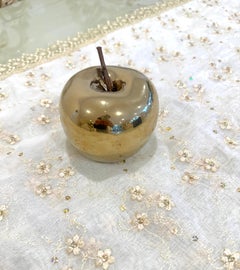
Materials

Lithograph

German Surrealist Hans Bellmer Etching Engraving Print Cecile Reims Surrealism

German Surrealist Hans Bellmer Etching Engraving Print Cecile Reims Surrealism

By Hans Bellmer

Located in Surfside, FL

After Hans Bellmer (German, 1902-1975) Surrealist engraving, etching after drawings from a 1942 notebook, engraved in 1974-75 by Cecile Reims Printed by L'Atelier de Chalcographie du Louvre, Paris, Having printed monogram lower left in plate, pencil notations and #7/10 and 'Musee du Louvre' blindstamp verso Dimensions: Sheet 11 X 7.5, Plate size 6.5 X 4 Hans Bellmer ( 1902 – 1975) was a Polish born German artist, best known for his drawings, etchings that illustrates the 1940 edition of Histoire de l’œil, and the life-sized female sculpture mannequin dolls he produced in the mid-1930s. Historians of art and photography also consider him a Surrealist photographer. Bellmer was born in the city of Kattowitz, then part of the German Empire (now Katowice, Poland). Up until 1926, he worked as a draftsman for his own advertising company. Bellmer is most famous for the creation of a series of dolls as well as photographs of them. He was influenced in his choice of art form in part by reading the published letters of Oskar Kokoschka (Der Fetisch, 1925) and Surrealism. Bellmer's puppet doll project is also said to have been catalysed by a series of events in his personal life. Hans Bellmer takes credit for provoking a physical crisis in his father and brings his own artistic creativity into association with childhood insubordination and resentment toward a severe and humorless paternal authority. Perhaps this is one reason for the nearly universal, unquestioning acceptance in the literature of Bellmer's promotion of his art as a struggle against his father, the police, and ultimately, fascism and the state. Events of his personal life also including meeting a beautiful teenage cousin in 1932 (and perhaps other unattainable beauties), attending a performance of Jacques Offenbach's Tales of Hoffmann (in which a man falls tragically in love with an automaton), and receiving a box of his old toys. After these events, he began to actually construct his first dolls. In his works, Bellmer explicitly sexualized the doll as a young girl (his work bears connection to the works of Bathus). Hirschfeld has claimed (without further argumentation) that Bellmer initiated his doll project to oppose the fascism of the Nazi Party by declaring that he would make no work that would support the new German state. Represented by mutated forms and unconventional poses, his dolls (according to this view) were directed specifically at the cult of the perfect body then prominent in Germany. He visited Paris in 1935 and made contacts there, such as Paul Éluard, but returned to Berlin because his wife Margarete was dying of tuberculosis. He was part of the circle of Surrealist luminaries such as Man Ray, Marcel Duchamp, Max Ernst, Joan Miro, André Masson, René Magritte, Alberto Giacometti and Salvador Dali as well as women artists—such as Frida Kahlo, Dorothea Tanning and Leonora Carrington. Bellmer produced the first doll in Berlin in 1933. Long since lost, the assemblage can nevertheless be correctly described thanks to approximately two dozen photographs Bellmer took at the time of its construction. Standing about fifty-six inches tall, the doll consisted of a modeled torso made of flax fiber, glue, and plaster; a mask-like head of the same material with glass eyes and a long, unkempt wig; and a pair of legs made from broomsticks or dowel rods. One of these legs terminated in a wooden, club-like foot; the other was encased in a more naturalistic plaster shell, jointed at the knee and ankle. As the project progressed, Bellmer made a second set of hollow plaster legs, with wooden ball joints for the doll's hips and knees. There were no arms to the first sculpture, but Bellmer did fashion or find a single wooden hand, which appears among the assortment of doll parts the artist documented in an untitled photograph of 1934, as well as in several photographs of later work. Bellmer's 1934 anonymous book, The Doll (Die Puppe), produced and published privately in Germany, contains 10 black-and-white photographs of Bellmer's first doll arranged in a series of "tableaux vivants" (living pictures). The book was not credited to him, as he worked in isolation, and his photographs remained almost unknown in Germany. Yet Bellmer's work was eventually declared "degenerate" (entartete kunst) by the Nazi Party, and he was forced to flee Germany to France in 1938, where Bellmer's work was welcomed by the Surrealists around Andre Breton. He aided the French Resistance during the war by making fake passports. He was imprisoned in the Camp des Milles prison at Aix-en-Provence, a brickworks camp for German nationals, from September 1939 until the end of the Phoney War in May 1940. After the war, Bellmer lived the rest of his life in Paris. Bellmer gave up doll-making and spent the following decades creating erotic drawings, etchings, sexually explicit photographs, paintings, and prints of pubescent girls. In 1954, he met Unica Zürn...

Category

20th Century Abstract Prints
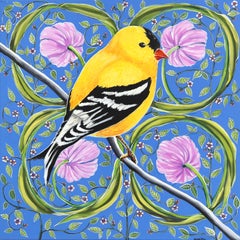
Materials
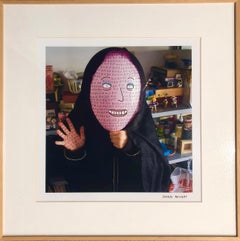
Etching

An Undying Wonderment - Original Figurative Mixed Media Surrealist Inspired Art

An Undying Wonderment - Original Figurative Mixed Media Surrealist Inspired Art

Located in Los Angeles, CA
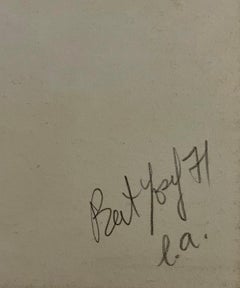
Robert Lebsack creates artworks using mixed media with ink, acrylic, and charcoal on archival copies of newspapers, textbooks, and sheet music. As a visionary artist, Lebsack weaves ...

Category

2010s Surrealist Figurative Paintings

Materials

Paper, Charcoal, Ink, Mixed Media, Acrylic, Wood Panel

Contemporary large figurative painting of women on paper "Bound in grace"

Contemporary large figurative painting of women on paper "Bound in grace"

By Mougenot Natalya

Located in VÉNISSIEUX, FR

“Bound in Grace” is a contemporary figurative–abstract painting by French artist Natalya Mougenot, part of her ongoing series dedicated to women, solidarity, emotional connection, an...

Category

2010s Abstract Expressionist Portrait Paintings

Materials

Paper, Acrylic