Henry Rox
Art Critic Altered by Viewing Post-War Abstract Painting (1948)
from Photo-Sculpture: Reflections on Modern Art
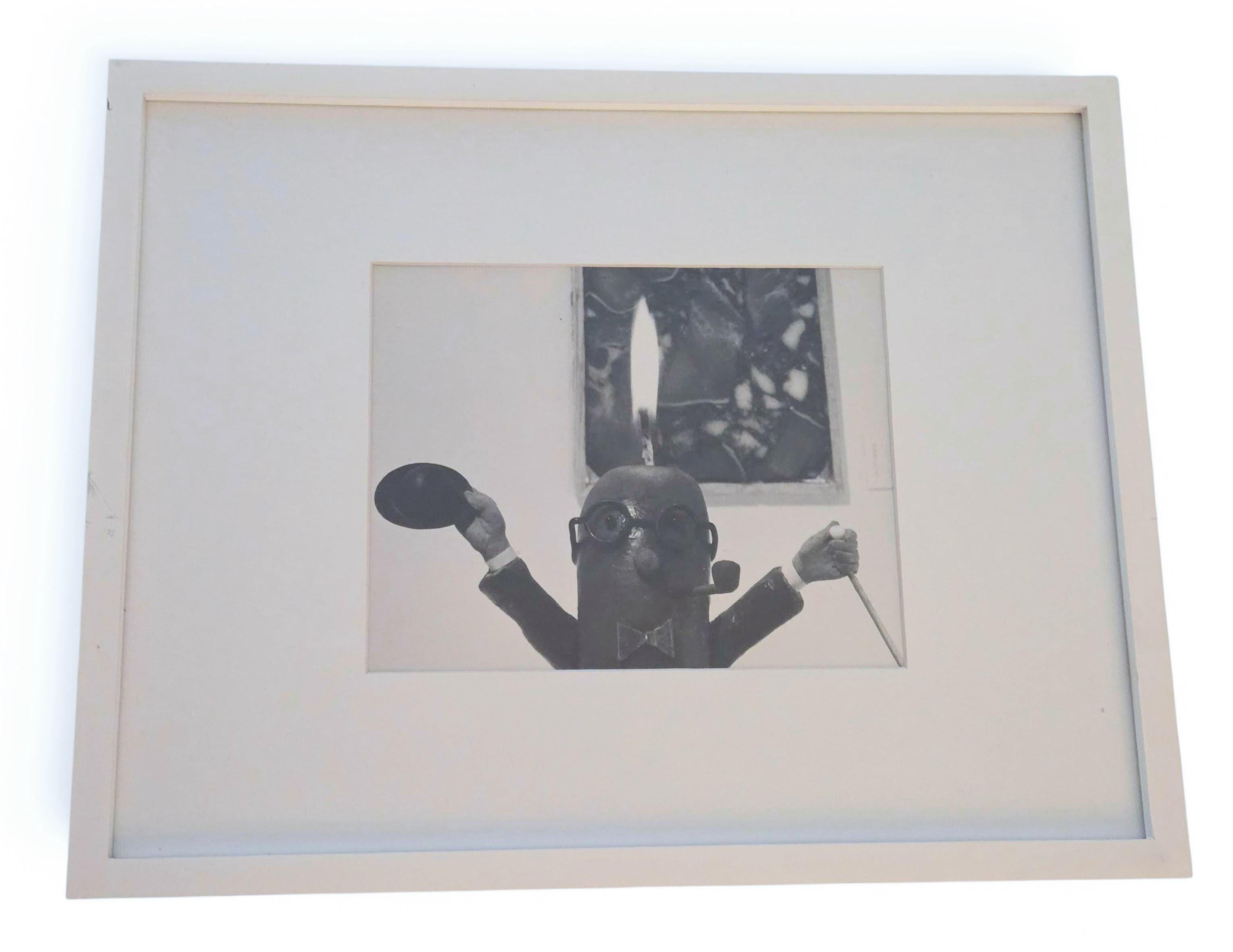
Vintage silver gelatin print
8 x 10 inches
Estate stamp verso
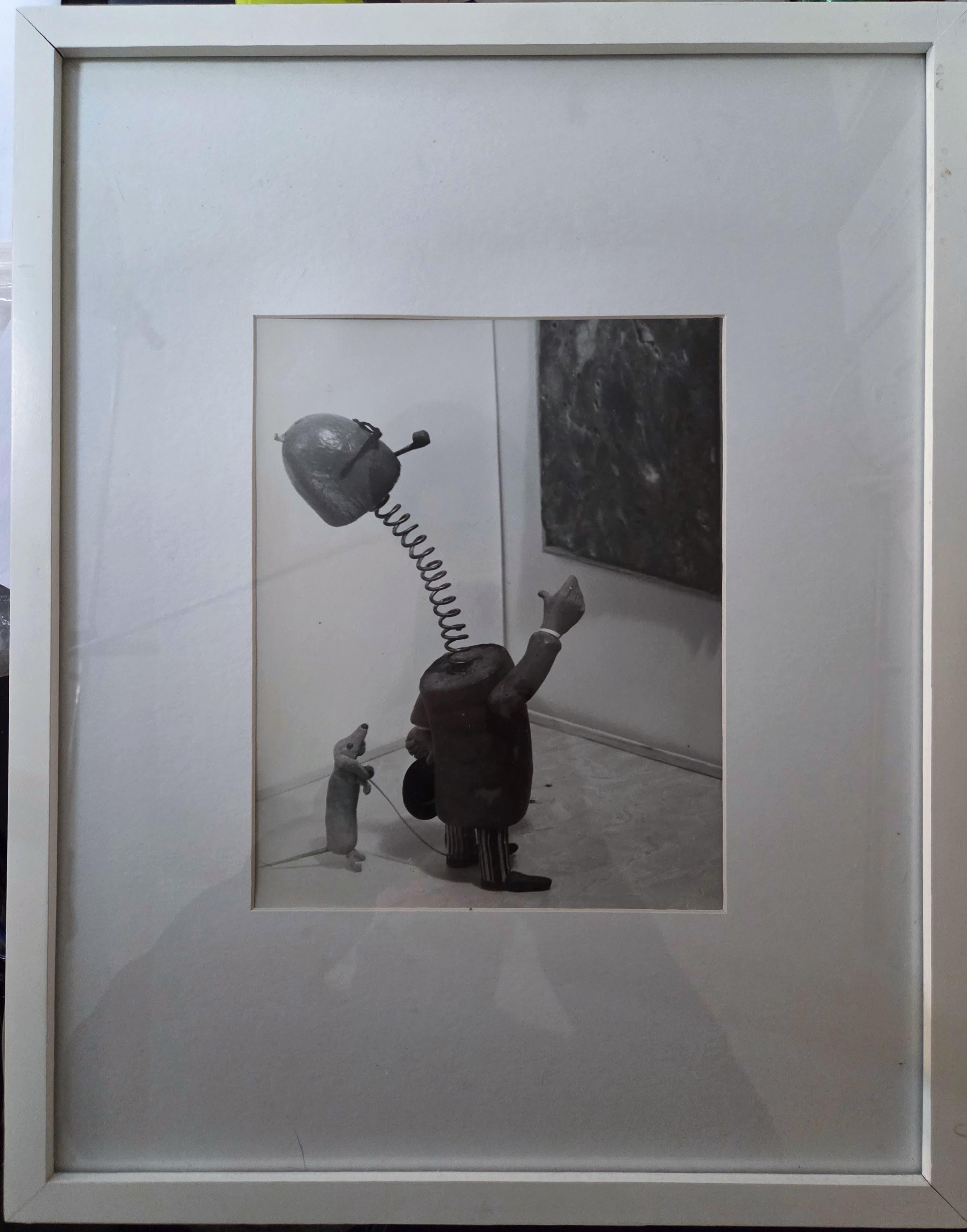
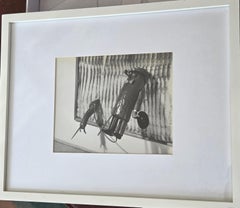
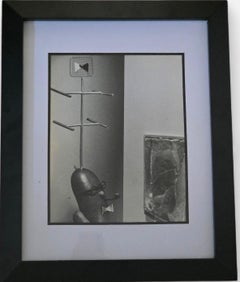
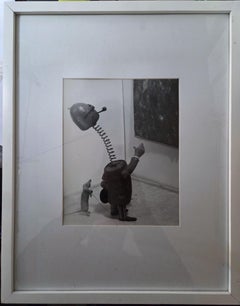
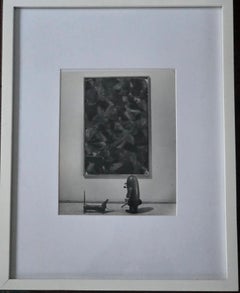
In this photograph from Rox’s "Reflections on Modern Art Series", the constructed art critic appears structurally elevated and subtly turned away from the painting he has just encountered. His hat remains lifted in his hand, his pipe fixed between his lips, yet his body is no longer grounded. He is raised, lightly tethered, as though the force of perception has physically shifted him. The encounter has already occurred; what we witness is its aftermath.
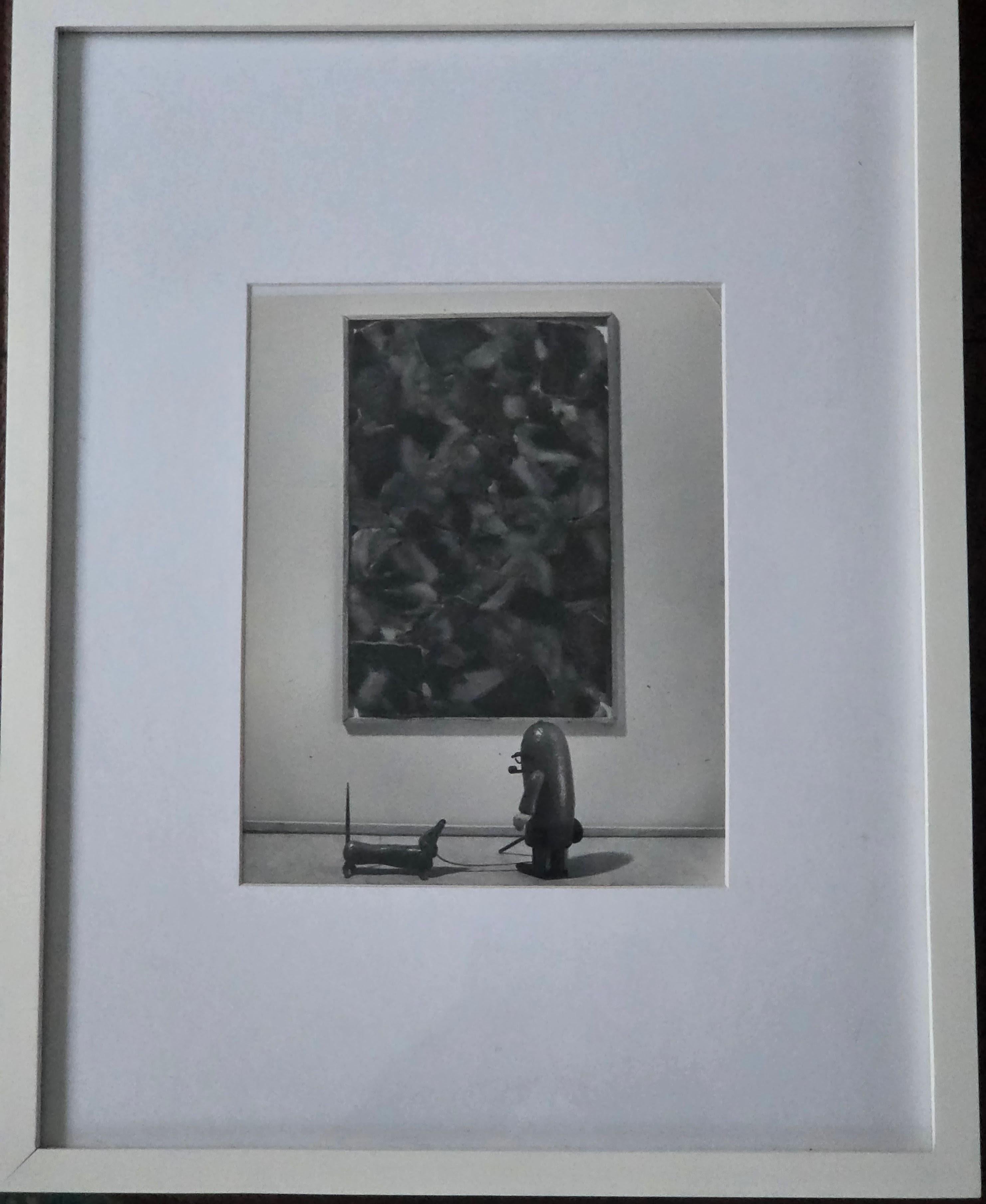
Behind him hangs a vertically organized post-war abstract painting composed of rhythmic, parallel bands. The surface reads convincingly as gestural abstraction: tonal modulation, repetition, and irregular painterly movement. Only upon closer inspection does its material basis reveal itself — an organic construction arranged with sculptural precision. Rox presents the abstraction not as parody but as a convincing participant in the visual language of late-1940s painting.
The critic no longer faces the painting directly, yet he remains connected to it. His elevation suggests that the experience has stayed with him — that abstraction has altered not merely his understanding but his physical bearing. The dachshund at his side remains grounded, reinforcing the tension between instinct and reflective interpretation.
Executed in 1948, at the height of post-war abstraction’s consolidation in New York, this work reflects Rox’s measured engagement with the psychological force of modern painting and the institutional rituals surrounding its reception. As with all of his photo-sculptures, the temporary construction existed only for the camera; the photograph itself is the final artistic object. No known negatives survive. This print bears the estate stamp verso and forms part of the approximately 300–500 lifetime prints preserved following Rox’s death.I
(born Heinz Rosenberg, Berlin, 1899 – South Hadley, Massachusetts, 1967)
Henry Rox was born Heinz Rosenberg in Berlin in 1899 into a prosperous Jewish family whose department store operated in one of the city’s principal upscale commercial districts. This environment afforded him the financial stability necessary to pursue advanced academic and artistic training in Germany and France, placing him early within the intellectual and cultural framework of European modernism.
Education
University of Berlin
Art History
1919–1923
Charlottenburger Kunstgewerbeschule, Berlin
Wood Culture Specialization
1921–1925
Académie Julian, Paris
Sculpture
1925–1927
Académie Colarossi, Paris
Drawing and Sketching
1925–1928
Berliner Fotoschule, Berlin
Advanced Photographic Training
1933
Rox maintained a studio at 14 Rue Bréa in Montparnasse before returning to Berlin, where he established a modern studio above his parents’ shop and later on Nürnberger Strasse. A documented 1930 photograph of his Berlin studio confirms the scale and seriousness of his sculptural practice: a substantial modernist workspace equipped with installed lighting, drafting tables, and works in progress. Rox was not an experimental amateur; he was an established European sculptor operating within the late Weimar avant-garde.
Selected Early Exhibitions
Salon d’Automne, Paris, 1926
Juryfreie Kunstschau, Berlin, 1926
Freie Kunstschau, Berlin, 1929
Preussische Akademie der Künste, Berlin, 1930
Berliner Secession, 1929–1932
Paul Cassirer Gallery, Berlin
Alfred Flechtheim Gallery, Berlin
Royal Academy of Arts, London, 1935, 1937, 1938
Royal Institute, Glasgow, 1938
Working within Berlin’s experimental climate, Rox absorbed Dadaist strategies of constructed juxtaposition and formal irony. His attendance at the Berliner Fotoschule in 1933 strengthened his technical command of photography, though at that time his primary identity remained sculptural.
Exile and Reinvention (1934–1938)
With the rise of National Socialism, Rox and his wife Lotte fled Germany in 1934, abandoning his studio, sculptures, and professional infrastructure. His parents and other family members remained and were later murdered in Nazi concentration camps. When Rox left Berlin, the only professional instrument he carried beyond personal effects was his camera. That instrument became the foundation of his reinvention.
Rebuilding his career in London beginning in 1934, Rox formally developed what he termed “photo-sculpture” — sculptural constructions created specifically for photographic realization rather than pedestal display. In this method, the photograph was conceived as the final artistic object. Financial necessity redirected Rox from independent sculpture toward constructed photographic works for both creative and commercial application, though the intellectual rigor of his sculptural training remained central to the work.
He introduced his constructed photographic language into British publishing culture, leading to commissions from Harrods; De Bijenkorf (Holland); Vitrolite; Guinness; Churchill Tobacco; Shell Oil; Helene of London; and others. Through these commissions, Rox translated avant-garde sculptural intelligence into sophisticated modern advertising imagery.
During this London period, Rox collaborated with James Laver — author, critic, and later Keeper of Prints, Drawings, and Paintings at the Victoria and Albert Museum (1938–1959). Together they produced Tommy Apple and His Adventures in Banana-Land (Jonathan Cape, 1935) and Tommy Apple and Peggy Pear (Jonathan Cape, 1936). These works were structurally rigorous photographic constructions created in dialogue with one of Britain’s leading museum intellectuals. His third book, Banana Circus, published in London in 1940, marked the culmination of this narrative phase.
American Period (1938–1967)
Henry and Lotte Rox departed London for New York in May 1938. In 1939 he joined Mount Holyoke College in South Hadley, Massachusetts as Lecturer in Sculpture, commuting from New York during his first year before relocating permanently in 1940. He later became Mary Lyon Professor of Art.
In 1940 Rox created an animated short incorporated into MGM’s Strike Up the Band, demonstrating continued engagement with narrative construction and material animation. This cinematic collaboration extended his sculptural imagination into film.
Beginning in 1939, Rox’s photo-sculptures gained broader visibility through American publishing networks associated with Henry Luce and Condé Nast. His work appeared in major magazines including Life, Vogue, Mademoiselle, Seventeen, Harper’s Bazaar, Collier’s, and McCall’s. His photographs had already circulated internationally in Germany, England, France, Holland, Denmark, Sweden, Switzerland, Belgium, Austria, Australia, and the United States, establishing a transnational publication record.
Although his financial status never returned to its Berlin-era level, Rox maintained serious sculptural production alongside his photographic work. He participated in six Whitney Museum Annual exhibitions for sculpture and was awarded a Guggenheim Fellowship in 1954 following earlier unsuccessful applications in 1941 and 1949.
Legacy
Following Rox’s death in July 1967 and Lotte Rox’s death in April 1971, approximately 300–500 lifetime prints were preserved. No known negatives are extant. These prints therefore constitute the primary surviving material record of his photo-sculptural practice.
In recent years Rox’s work has undergone renewed European institutional reassessment due in significant part to the research of Wolfgang Vollmer of Cologne. This includes the 2021 exhibition at Fotohof, Salzburg; participation in Berlin’s European Month of Photography; and inclusion in the Bonartes Photo Institute exhibition in Vienna (December 2025 – February 2026).
Rox’s career bridges European avant-garde sculpture, émigré reinvention, British publishing culture, American commercial modernism, and postwar academic practice. His photo-sculptures stand as hybrid works — simultaneously sculptural, performative, and photographic — reflecting a life shaped by rupture, adaptation, and sustained intellectual rigor.
Henry Rox illustrated 3 children's books: Tommy Apple and his Adventures in Banana-Land (1935), Tommy Apple and Peggy Pear (1936), Banana Circus (1940)