Henry Rox (1899–1967)
Art Critic with De Stijl Structure
From Photo-Sculpture: Reflections on Modern Art
c. 1948
Vintage silver gelatin print
8 × 10 inches
Estate stamp verso
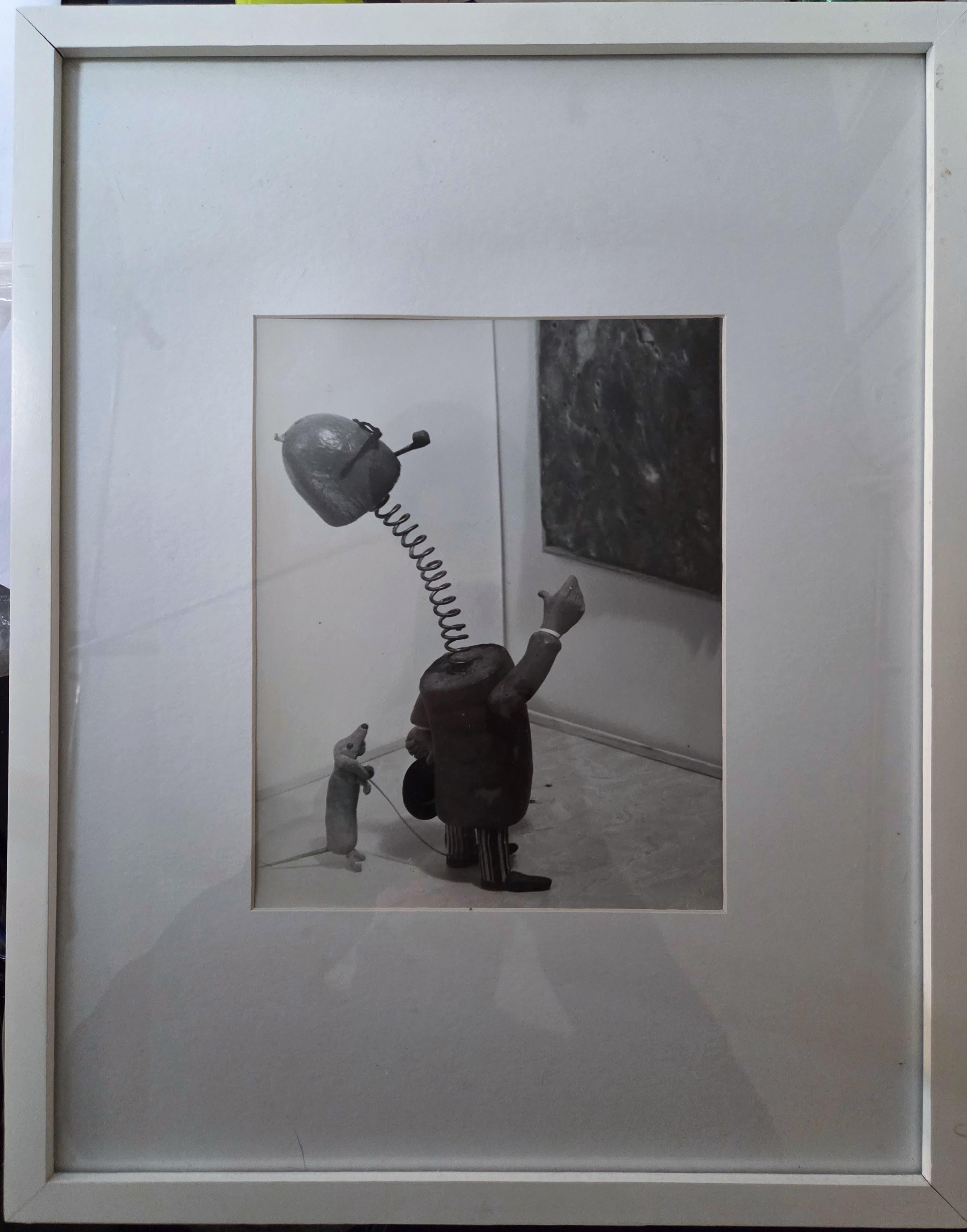
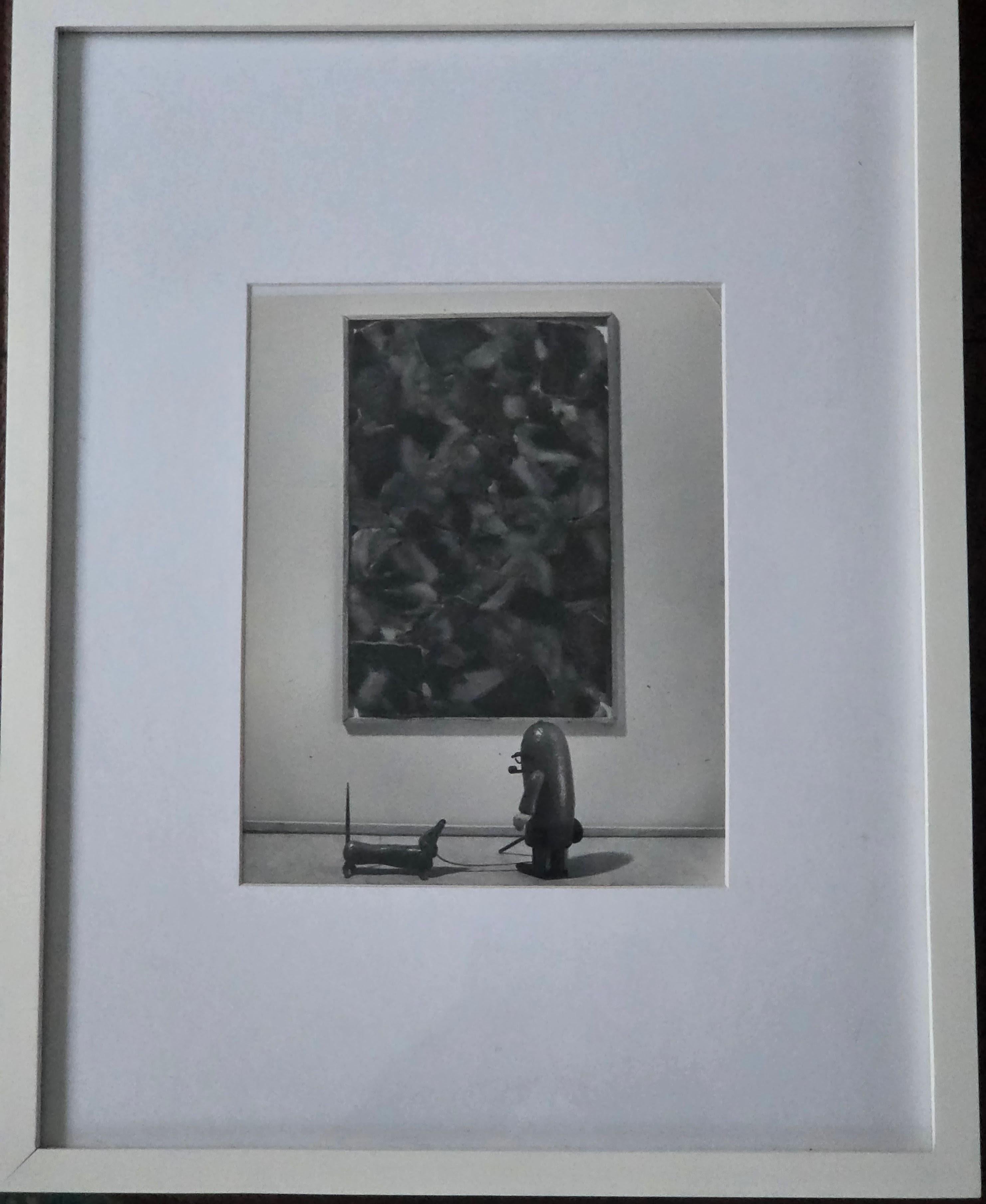
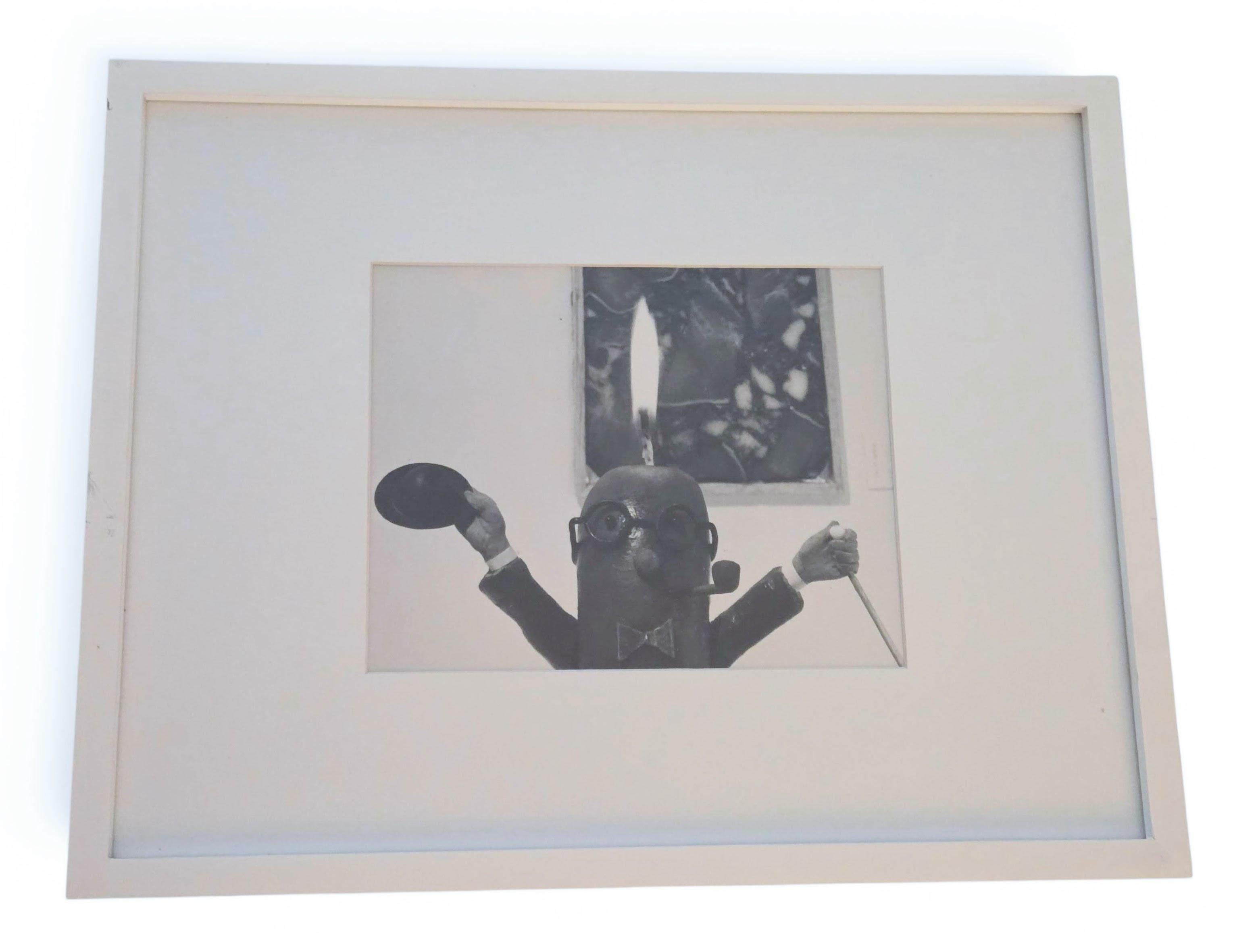
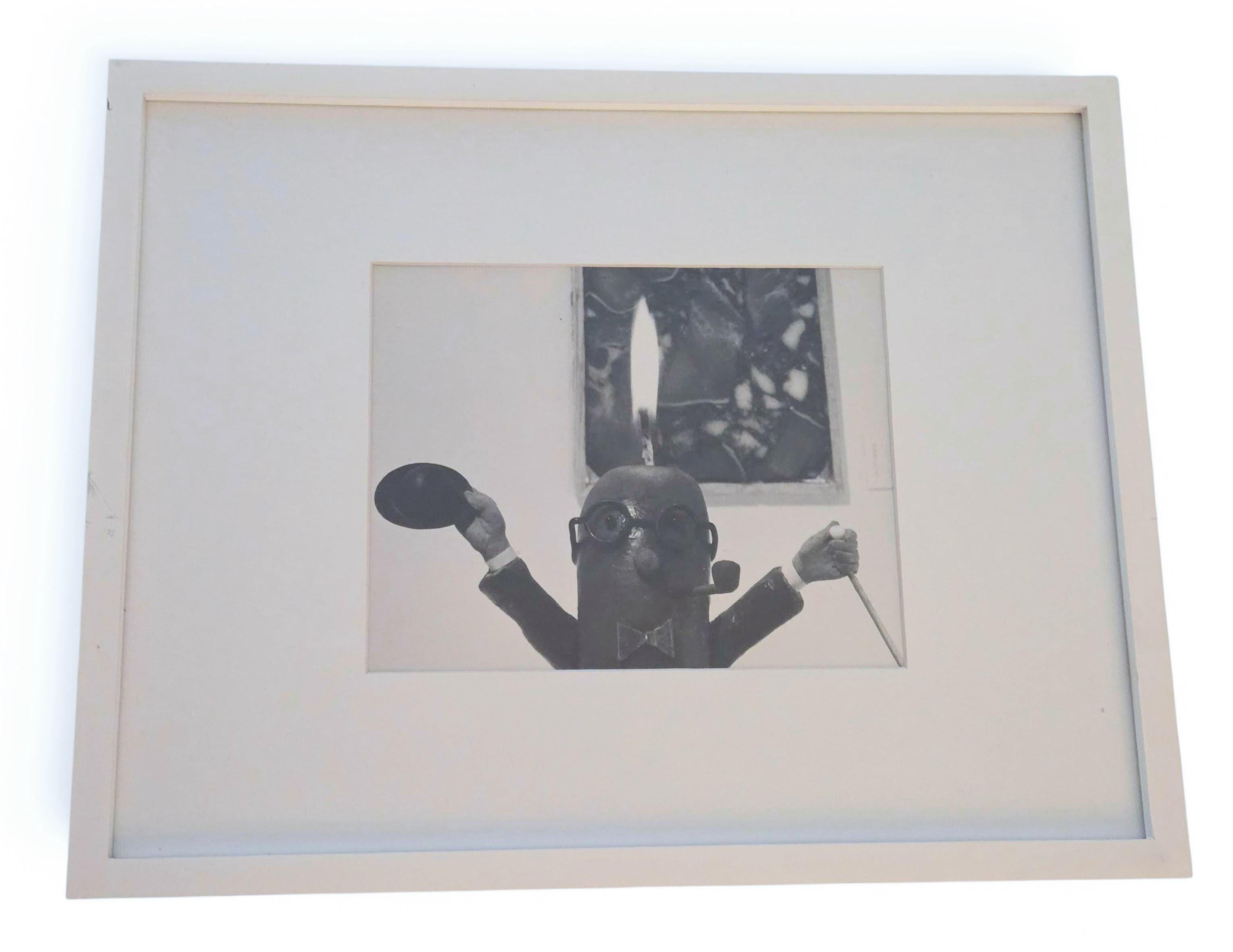
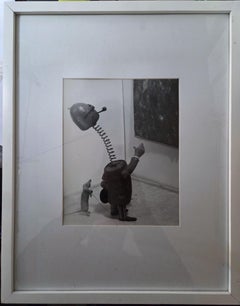
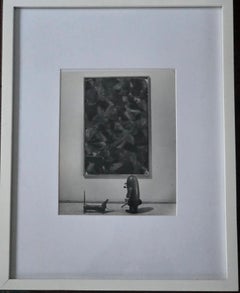
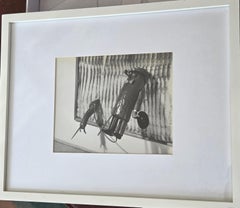
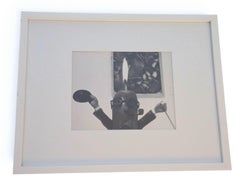
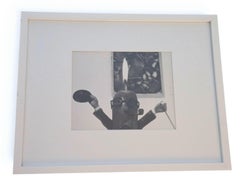
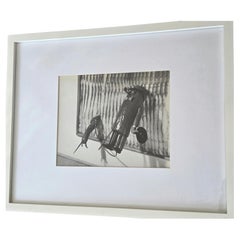
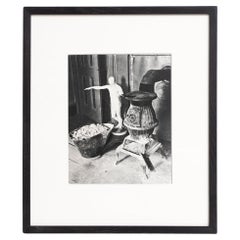
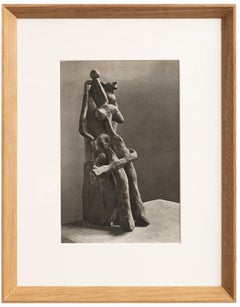
This 8 × 10 inch vintage silver gelatin print presents a sharply defined variation within Henry Rox’s Art Critic series. In this composition, a caricatured “critic” figure—constructed from hot-dog or sausage forms characteristic of Rox’s humorous sculptural vocabulary—stands before a framed abstract composition whose textured surface suggests the material experimentation of post-war painting.
Emerging from the crown of the critic’s head is an elaborate metal framework composed of thin steel tubing and a square mesh screen, terminating in a small geometric form. The structure reads as a mechanical extension of the critic’s mind—an analytic apparatus projecting outward as though translating visual perception into intellectual judgment. The critic peers through round spectacles while holding a pipe, his posture suggesting concentrated contemplation before the abstract canvas.
The rigid orthogonal geometry of this framework recalls the visual language associated with De Stijl, whose artists sought a universal system built from vertical and horizontal relations. Rox does not imitate De Stijl painting directly; instead he constructs a sculptural “thinking device” whose form echoes the structural clarity of modernist abstraction. The critic appears almost physically wired into the system of modern art he is attempting to interpret.
The figure can be understood as a constructed analogue to modern sculptural thinking of the period. Its vertical armature and projecting limbs recall the attenuated figure structures of Alberto Giacometti, while the use of rod-like elements to “draw” the body in space aligns with the linear constructions of Alexander Calder. The grid-based head and simplified, sign-like features further relate to the diagrammatic figure studies associated with Paul Klee and Bauhaus pedagogy. Rather than quoting any single work, Rox synthesizes these tendencies into a practical demonstration of the critic’s mindset: the figure is not observed but constructed, reduced to a system of relationships—balance, proportion, and structure—through which modern art was increasingly understood and evaluated.
Works from Rox’s Reflections on Modern Art series examine, with measured humor, the cultural role of critics confronting increasingly complex forms of modernist painting and sculpture. By transforming the critic into a hybrid of organic form and mechanical instrument, Rox articulates the intellectual apparatus required to decode modern art.
The composition is tightly controlled. The framed work occupies the right side, while the critic anchors the left, compressing the space between them. Rising directly from the critic’s head, the geometric structure establishes a clear opposition: its linear precision contrasts with the irregular, materially dense surface of the painting.
This structure is not external—it is integral to the figure, functioning as an extension of thought. The language of modernism becomes something carried rather than applied, a system already in place before the act of viewing begins. In contrast, the painting resists that order, remaining visually unstable. Rox leaves the relationship unresolved: the critic stands between a system he embodies and an object that does not fully conform to it.
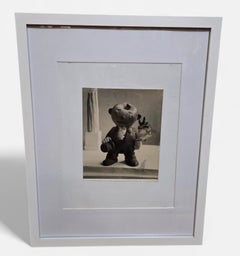
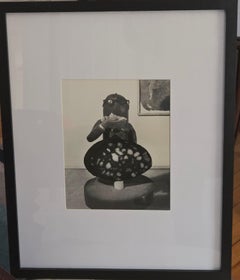
Henry Rox developed what he described as “photo-sculpture,” a process in which miniature sculptural constructions were created specifically for photographic realization. Figures and environments were modeled from wire, clay, fruits, vegetables, and ordinary materials, then carefully staged and illuminated. The resulting photograph was not documentation but the intended final work, combining sculpture, theatrical staging, and photography within a single process.
This approach emerged from Rox’s European training and the experimental photographic culture of the late Weimar period. The influential Film und Foto (FiFo) exhibition of 1930, associated with László Moholy-Nagy, introduced a modern photographic language that emphasized structure, lighting, and the transformation of everyday objects. Rox’s work extends this logic: rather than photographing found subjects, he constructed them, producing images in which ordinary materials assume new formal and narrative roles.
After relocating to London in May 1934, Rox developed these ideas into a sustained practice. There he collaborated with James Laver on illustrated publications including Tommy Apple and His Adventures in Banana-Land (1935) and Tommy Apple and Peggy Pear (1936). His images subsequently appeared in a wide range of European and American magazines, including Life, Vogue, and Harper’s Bazaar, situating his work within the visual culture of mid-century editorial production.
After emigrating to the United States in 1938, Rox continued his photographic and sculptural work while teaching at Mount Holyoke College. His career bridges European avant-garde training, émigré reinvention, and American academic and commercial practice.
Rox’s photographs were reintroduced to American audiences through Modernism exhibitions beginning in 1993, and more recently have undergone renewed European institutional reassessment through the research of Wolfgang Vollmer, including exhibitions at Fotohof, Salzburg (2021), and the Bonartes Photo Institute, Vienna (2025–2026).
No known negatives survive, and the photographs were not produced in formal editions. Individual images exist in limited numbers, and surviving prints constitute the primary record of Rox’s photographic work.
Provenance and Survival
This group of photographs originates from Henry Rox’s final residence in South Hadley, Massachusetts, where a substantial body of material remained following his death. These prints represent a primary material record of the artist’s photographic practice.Henry Rox (1899–1967)
Art Critic with De Stijl Structure
From Photo-Sculpture: Reflections on Modern Art
c. 1948
Vintage silver gelatin print
8 × 10 inches
Estate stamp verso
This 8 × 10 inch vintage silver gelatin print presents a sharply defined variation within Henry Rox’s Art Critic series. In this composition, a caricatured “critic” figure—constructed from hot-dog or sausage forms characteristic of Rox’s humorous sculptural vocabulary—stands before a framed abstract composition whose textured surface suggests the material experimentation of post-war painting.
Emerging from the crown of the critic’s head is an elaborate metal framework composed of thin steel tubing and a square mesh screen, terminating in a small geometric form. The structure reads as a mechanical extension of the critic’s mind—an analytic apparatus projecting outward as though translating visual perception into intellectual judgment. The critic peers through round spectacles while holding a pipe, his posture suggesting concentrated contemplation before the abstract canvas.
The rigid orthogonal geometry of this framework recalls the visual language associated with De Stijl, whose artists sought a universal system built from vertical and horizontal relations. Rox does not imitate De Stijl painting directly; instead he constructs a sculptural “thinking device” whose form echoes the structural clarity of modernist abstraction. The critic appears almost physically wired into the system of modern art he is attempting to interpret.
The figure can be understood as a constructed analogue to modern sculptural thinking of the period. Its vertical armature and projecting limbs recall the attenuated figure structures of Alberto Giacometti, while the use of rod-like elements to “draw” the body in space aligns with the linear constructions of Alexander Calder. The grid-based head and simplified, sign-like features further relate to the diagrammatic figure studies associated with Paul Klee and Bauhaus pedagogy. Rather than quoting any single work, Rox synthesizes these tendencies into a practical demonstration of the critic’s mindset: the figure is not observed but constructed, reduced to a system of relationships—balance, proportion, and structure—through which modern art was increasingly understood and evaluated.
Works from Rox’s Reflections on Modern Art series examine, with measured humor, the cultural role of critics confronting increasingly complex forms of modernist painting and sculpture. By transforming the critic into a hybrid of organic form and mechanical instrument, Rox articulates the intellectual apparatus required to decode modern art.
The composition is tightly controlled. The framed work occupies the right side, while the critic anchors the left, compressing the space between them. Rising directly from the critic’s head, the geometric structure establishes a clear opposition: its linear precision contrasts with the irregular, materially dense surface of the painting.
This structure is not external—it is integral to the figure, functioning as an extension of thought. The language of modernism becomes something carried rather than applied, a system already in place before the act of viewing begins. In contrast, the painting resists that order, remaining visually unstable. Rox leaves the relationship unresolved: the critic stands between a system he embodies and an object that does not fully conform to it.
Henry Rox developed what he described as “photo-sculpture,” a process in which miniature sculptural constructions were created specifically for photographic realization. Figures and environments were modeled from wire, clay, fruits, vegetables, and ordinary materials, then carefully staged and illuminated. The resulting photograph was not documentation but the intended final work, combining sculpture, theatrical staging, and photography within a single process.
This approach emerged from Rox’s European training and the experimental photographic culture of the late Weimar period. The influential Film und Foto (FiFo) exhibition of 1930, associated with László Moholy-Nagy, introduced a modern photographic language that emphasized structure, lighting, and the transformation of everyday objects. Rox’s work extends this logic: rather than photographing found subjects, he constructed them, producing images in which ordinary materials assume new formal and narrative roles.
After relocating to London in May 1934, Rox developed these ideas into a sustained practice. There he collaborated with James Laver on illustrated publications including Tommy Apple and His Adventures in Banana-Land (1935) and Tommy Apple and Peggy Pear (1936). His images subsequently appeared in a wide range of European and American magazines, including Life, Vogue, and Harper’s Bazaar, situating his work within the visual culture of mid-century editorial production.
After emigrating to the United States in 1938, Rox continued his photographic and sculptural work while teaching at Mount Holyoke College. His career bridges European avant-garde training, émigré reinvention, and American academic and commercial practice.
Rox’s photographs were reintroduced to American audiences through Modernism exhibitions beginning in 1993, and more recently have undergone renewed European institutional reassessment through the research of Wolfgang Vollmer, including exhibitions at Fotohof, Salzburg (2021), and the Bonartes Photo Institute, Vienna (2025–2026).
No known negatives survive, and the photographs were not produced in formal editions. Individual images exist in limited numbers, and surviving prints constitute the primary record of Rox’s photographic work.
Provenance and Survival
This group of photographs originates from Henry Rox’s final residence in South Hadley, Massachusetts, where a substantial body of material remained following his death. These prints represent a primary material record of the artist’s photographic practice.
Condition
Very good vintage condition. Minor handling marks consistent with age. Verso with later collection stamp.